Tag Archives: the presence of God

The Supply of the Spirit (and the great grey shrike)

“Now to him who is able to do exceedingly abundantly above all that we can ask or think, according to the Power that works in Us, to him be glory in the church to or generations, forever and ever, amen.” (Ephesians 3: 20–21)

I just love it when God completely blows my mind with something that reminds me of this verse, the “exceedingly abundantly above all that we can ask or think“ aspect of who He is. I went on a birding trip last week and had an experience that gave me a memorable picture of the difference that can exist between our expectations and God‘s supply.

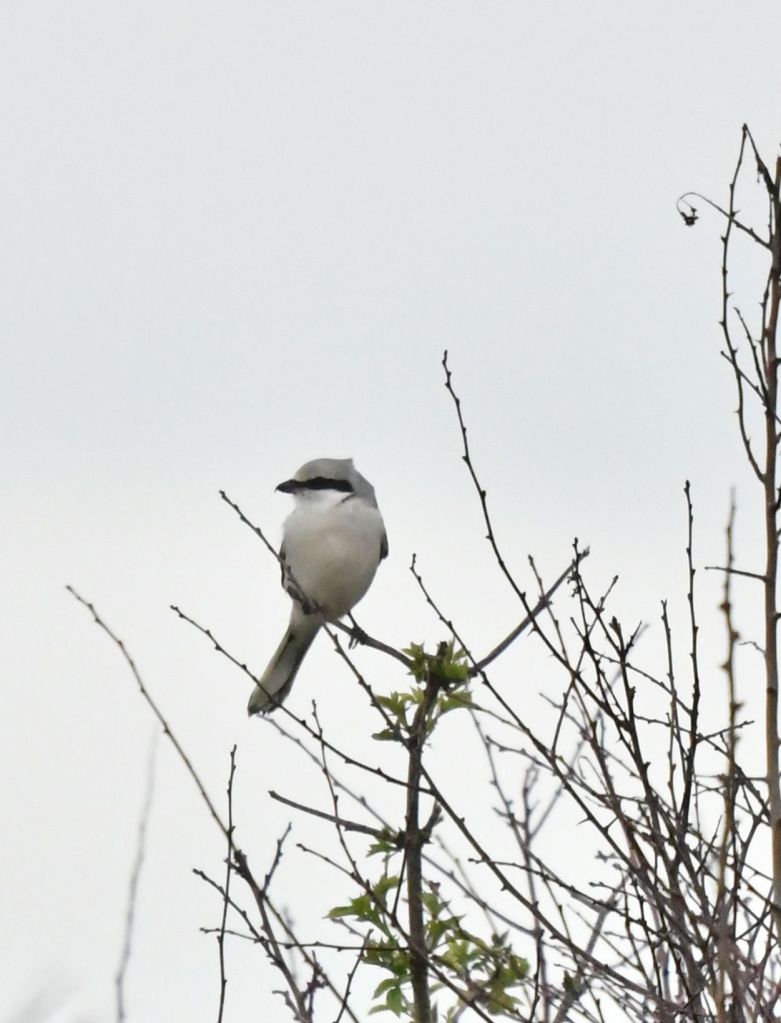
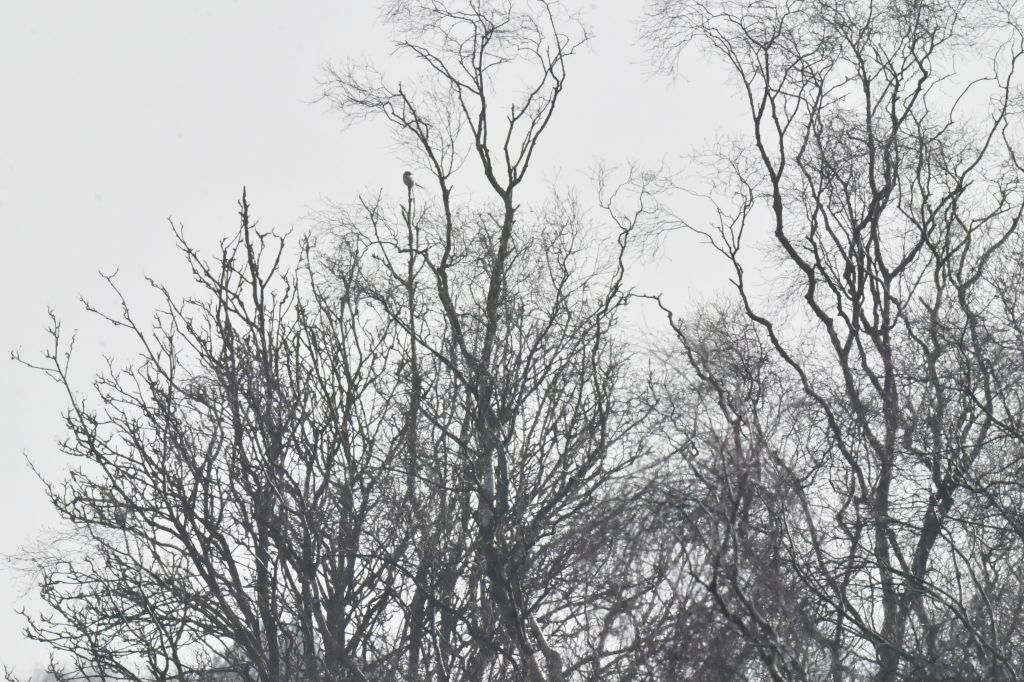
The bird in the picture is a great grey shrike. They are rare winter visitors to the UK: there have only been about 60 individuals in the whole country over this Winter, mainly in the south and the east. Twitchers will travel halfway across the country to see one if it is reported on a birding blog. So last year I got very excited when one decided to stay for a few weeks on the edge of the woods about 4 miles from my house. I did get to see it, perching in a distant tree, and treasured the photograph below that I got – as you can see, it was hardly one you would put in a frame and hang on the wall. (The bird is about a quarter of the way down, slightly left of centre.)

When these birds find an area that they like they tend to stay there until they leave for their breeding grounds, so when one was reported in Lincolnshire (a county in England on the east coast, if you aren’t in the UK) last week, I made sure that the site was my first stop on a trip to that area that I was planning. My expectation was framed by my previous experience, so when we reached the spot where this bird had made its temporary home, I was expecting to scan the distant trees with my binoculars to get a sight of it.

There was another birder there when my friend and I arrived. “There it is! Just there, on top of the hedge!” he said. I started scanning the distant hedge with my binoculars. “No,” he said, “THERE!” And there, no more than 20 metres away (as opposed to the 200 or so that I was expecting), set a beautiful great grey shrike, posing for my camera. But that is not all: these birds have a habit of hovering like kestrels when they are hunting for prey. This little bird did not disappoint: it repeatedly flew down from its perch and hovered a few feet from the ground, looking for insects and worms in the mud. It was one of the most precious birding moments that I have ever experienced.


So why am I writing about it? I’ll put the answer as a question. What are your expectations of an encounter with God? Is it like the first time I saw a shrike, a distant grey spot on a treetop a couple of hundred yards away or more? What is your idea of “the presence of God?” Is it the cosy feeling of gathering with other believers and a good band, singing a few worship songs together; or could it be that God has more for you, a lot more, an intensity of love and peace that causes you to fall to your knees because standing has become impossible, where the shrike is hovering in front of your face and not perching in the dim distance?

Of course it is good to gather and worship, and it is true that the spirit of God is present among us when we do, because if we are believers He is within us all. But let us not be sold short into believing that this is all we can expect, because “God is able to do exceedingly abundantly above all that we can ask or think, according to the Power that works in us.”

Paul wrote this to the Philippians:

What then? Only that in every way, whether in pretense or in truth, Christ is preached; and in this I rejoice, yes, and will rejoice. For I know that this will turn out for my deliverance through your prayer and the supply of the Spirit of Jesus Christ, according to my earnest expectation and hope that in nothing I shall be ashamed, but with all boldness, as always, so now also Christ will be magnified in my body, whether by life or by death. (Philippians 1: 18-20)

Paul’s “Ernest expectation and Hope“ was for an abundant “supply of the spirit,” a deluge, not a trickle. What about us? Surely God, who “gives the Spirit without measure,” wants the supply of the spirit in our lives to lead us to a place of submission that is real because we know that we have met with Jesus and have experienced something of His love and power? Yes, our experience must be rooted in the truth of God‘s word, but I don’t think God has given us the supply of His Spirit for us to only experience Him through the printed page. And yes, when two or three are gathered in His name He is there in the midst of us, but that is the beginning of the journey and a statement of faith; it’s not our destination. We don’t rise on eagle’s wings just by believing that we are eagles, but we need to wait for the wind to lift us, because that is how eagles soar. It’s “those who wait on the Lord” who renew their strength. The wind might not come for hours or even days, but we strengthen our faith through exercising it in the wait. The words of Christ are words are words of life, and He wants us to feel that life “according to the Power that works within us” as well as knowing the words that release it.


God honoured Paul’s expectation with such abundance that he personally started at least 14 churches probably 20, possibly more (see www.churchplanting.com) as well as fostering the growth of many of them, including the “hub“ church at Ephesus, through his letters and direct apostolic influence. You and I may not be Paul, but we have the same spirit who dwells within us, and it’s the spirit who raised Jesus from the dead. If we want to see Him really work among us, we need to raise our expectations, lift our wings and face into the wind – remembering that “the wind blows where it wills,” and not according to our plans.

The Wings of the Morning

The Clouds
The Lord said: “Look at the clouds. They are full of water, and they are being blown along by my wind, sometimes gently, sometimes fast. But they are moving, they are always moving, just like I am always working, and they change shape as they go. The wind blows where it wishes, and you do not know where it comes from or where it is going. I want you to be like these clouds, lifted high into heavenly places, blown along by my spirit, ready to go where I am blowing, ready to change as you feel my breath, carrying nothing except the water of my spirit which I will cause you to release onto the dry earth where and when I say. Do you see clouds rolling along the ground? No. And so you must let go all that will hold you down, every weight, and let me lift you into the place where you will be blown in the direction that I choose to be moulded by my spirit, releasing what I give you upon the Earth.”

The Air Balloon.
“Lord,“ I said, “My hand reaches down and grips the roots in the soil. Will I be able to let go of the worldly and carnal things that sometimes it seems that I hold so tight? Can I be lifted as you say, or will I stay here below, gripping onto the things of the world?

“Yes,“ He said. “You won’t be able to help it. You are attached, because I have attached you, to my air balloon. And as I rise up into high places, I will take you with me, and you simply won’t be able to hold on because the pull of my presence will be so much stronger than the pull of the ground.”

The Beauty of the Lord
“Consider the beauty of the natural world. From the light reflected in the small liquid Diamond of a teardrop to the grandeur of the mountains, the freshness of a leaf in spring, the rumble of a distant waterfall, the leap of a gazelle, the wings of a seagull. Were not all these things made through me? All that you can see, hear, and feel was made through me. So in me is all the splendour and variety of the natural world, for it has all come out of me. Can I not draw you unto me?”

Such knowledge is too wonderful for me,
It is high, I cannot obtain it.

Where can I go from your Spirit,
or where can I flee from your presence?

If I ascend to heaven, you are there,
If I make my bed in hell, behold, you are there.

If I take the wings of the morning,
Or dwell in the uttermost parts of the sea,

Even there your hand will lead me,
And your right hand shall hold me.

(Psalm 139: 6-10)

The Pool of Bethesda (2): the paralysis of religion

After this there was a feast of the Jews, and Jesus went up to Jerusalem. Now there is in Jerusalem by the Sheep Gate a pool, which is called in Hebrew, Bethesda,  having five porches. In these lay a great multitude of sick people, blind, lame, paralyzed, waiting for the moving of the water. For an angel went down at a certain time into the pool and stirred up the water; then whoever stepped in first, after the stirring of the water, was made well of whatever disease he had. Now a certain man was there who had an infirmity thirty-eight years. When Jesus saw him lying there, and knew that he already had been in that condition a long time, He said to him, “Do you want to be made well?” he sick man answered Him, “Sir, I have no man to put me into the pool when the water is stirred up; but while I am coming, another steps down before me.” Jesus said to him, “Rise, take up your bed and walk.” And immediately the man was made well, took up his bed, and walked. And that day was the Sabbath. (John 5: 2-9)

God’s house of mercy
The healing at the pool took place on the Sabbath. In the sequence of signs as John recorded them, this was the first time that Jesus challenged the religious order by “working” on the designated day of rest, and John records it as the opening skirmish of His battle with the pharisees that ended at Calvary. “For this reason the Jews persecuted Jesus, and sought to kill Him, because He had done these things on the Sabbath.” (John 5:16) “Bethesda” means “house of mercy,” or “flowing water,” and it was by the Sheep Gate. This is not just a place in Jerusalem: it is a picture of the church. The healing at Bethesda was certainly a sign pointing to our need for an encounter with the living Christ, but it also tells us that there are many sheep in God’s house of mercy and flowing water who are immobile on their beds by the pool, and that one of the main types of paralysis is the paralysis of religion.

Paralysed by religion
The dictionary definition of religion refers to worship of a God or gods and the activities surrounding that worship, and in a broader sense to “enthusiastic and repeated engagement” in a particular pursuit. Avid sports fans are often referred to as making a religion of their sport, for example. However, I worship the Christian God, enthusiastically and repeatedly, yet if someone asks me the question “are you religious?“ I say, “No I’m not religious; I have a living faith.“ So in the church many of us now see the term religion as not so much describing our worship of the living God, but the practice of those who, in the words of Paul to Timothy, have “a form of godliness but deny its power.” (2 Timothy 3: 5–7). The question for those of us who say we have a living faith is this: is it possible for us also to be paralysed by religion?

We tend to Pillory the Pharisees today as archetypal examples of everything we want to avoid in our worship of Christ. And so we should: they lived by the law and missed Jesus. There is no need to quote here any of the many things that Jesus said against them: the important point is that we don’t follow their example and find ourselves as paralysed and lifeless as they were. They too were lying by the pool on their bed, the bed of the law, waiting for the waters to be stirred by the Messiah – who was standing right in front of them.

Flowing in the spirit?
The Bible tells us, “Whatever was written in the past was written for our instruction so that we could have hope through endurance and through the encouragement of the scriptures.”  (Romans 15:4) The Holy Spirit hasn’t just made it clear how tragically fruitless the religion of the Pharisees was so that we could feel superior in our relationship with Him: those scriptures are also there for our instruction so that we can take care not to follow any of their practices. How much of this instruction are we actually taking on board? For example – and I know I’m far from being the first person to say this – I was born again In 1984, when the charismatic movement was surging through the established church. We used to think of ourselves as “flowing in the spirit,“ and (I’m ashamed to say) how superior we were to the church down the road whom we saw as ossified in their “hymn– prayer sandwich“ format. I now belong to one of the larger modern evangelical Charismatic/Pentecostal networks. We consider ourselves to be free in the spirit, and to be hosts of the presence of God during our meetings. But before I go to church on a Sunday, I know that we will start with a couple of fairly lively praise songs, the host for the day will do the notices, the children and teenagers will go out to their respective groups, we will continue with worship for about another half an hour, then there will be a preach (we used to call them sermons, but that was  too religious) for about 30 minutes, and then a closing song and an appeal for ministry at the end. We will start at 10:30 and finish around 12:15; gather for refreshments after the meeting, and will be out of the building by about 12:45. We do make room for the gifts of the Spirit during the worship time, so three or four people might bring a word of encouragement, a prophecy or a word of knowledge; maybe a tongue and an interpretation – but how different is this really from the “hymn-prayer sandwich?“ The fillings might be a bit different, but it is no less predictable, and I suspect that we are not very different from many modern evangelical churches.

The Spirit of God does graciously meet with us in the little box that we give him, and we rejoice in the fact that we have been in his presence, even though it may have just been the hint of a reflection of a glimmer. We say, and pray, that we want more of him; we long to see healings and deliverance; yet how much more of ourselves will we give? Would we know more of His presence and His power if we gave him more of our time? Or even if we took the compartments out of the box and, for example, allowed the allocated time for worship to eat into the allocated time for the sermon? Or even – shock horror – not have a sermon (sorry, a preach) at all?


The mountain and the chocolate box
I think we can be very easily satisfied with the experience that we describe as “entering the presence of God.“ When the presence of God came into Solomon’s temple at the time of its dedication, the priests were unable to stand. When the Roman soldiers came to Gethsemane to arrest Jesus, they fell to the ground when He identified himself with the words “I am He.” (John 18:6) In our own church we had a half night of prayer a couple of months ago (we should have them more often…), from 8 pm to 2 am. People came and went as they pleased; not many stayed for the whole six hours. But it wasn’t until about 1:30 that the presence of God really came, so powerfully that most of the few of us who were there had to fall to our knees; and then someone gave a prophetic word that brought a long awaited breakthrough in the life of one of those present. When the presence of God came to Toronto, He changed lives and impacted people like Heidi Baker, (Iris Global) Che Ann (Harvest International Ministries) Bill Johnson (Bethel Church) and Nicky Gumbel (the Alpha Course) whose ministries have brought the Kingdom of God into millions of lives. A hallmark of Toronto Airport Vineyard meetings in the 1990s, as well as of other revivals, was daily meetings that went by the clock in heaven and not the clock in the kitchen. I think we can package the presence of God in a chocolate box when He wants to take us up a mountain. God has a much bigger space to move in than we often allow Him. If the dimensions of our box are so far away from His, it’s because our religion keeps it small and keeps us too easily satisfied.

The dynamic of Life
Jesus said , “For as the Father has life in himself, so he has granted the Son also to have life in himself,” (John 2:26) and that He had come to “give life, and that in abundance.” (John 10:10) I love to go out and take photographs of birds. One of the great difficulties in bird photography is the fact that the subjects rarely keep still. Life is always on the move. When the cells in a body become motionless, that body is dead. When Jesus told the paralytic to pick up his bed and walk on the Sabbath day, He was giving him life: He was asserting the dynamic of Life over the inertia of religion.

So how much are we really free from the constraints of religion that we see in the Pharisees of Jesus‘s day? Anne and I lead one of the small groups in our church (we call them “life groups.“ What do you call yours?) This Summer each life group is  leading an evening midweek meeting for the whole church. Everyone in our life group comes to the school of prophecy that we host at our house, and our vision is to encourage the other groups to pursue the presence of God more actively in their gatherings. I had planned how I felt our meeting should flow, and who should contribute what. Anne was most dismissive. “And where exactly is the Holy Spirit in control of all of this??“ she asked. And she was right. How easy it is to operate in the flesh when we think we are being spiritual. When man controls he brings religion. When the Holy Spirit controls, he brings liberty.

A living, breathing bride
Jesus comes to give life. His words are words of life. Walking is not doing the same things the same way, but doing what He says, when He says it. Life is movement. When He speaks, the life He speaks brings into us movement. We can be walking in the Spirit while we have a meal out with friends because we can be responding to His promptings between mouthfuls in the conversation, and we can be walking in the flesh every Sunday at our Church meetings because we are following our prepared format and not His dynamic instructions. When He returns, He will coming back for a living,  breathing bride that He has perfected and made beautiful in His presence, and He is longing for us to run to meet Him, however our theological lens views that moment. We may not fully understand how we will be caught up in the air (1 Thessalonians 4:17), but one thing we do understand is this: He will not be pleased with a bride who sits in her pew and recites the litany of the wedding service without even looking into His face.