Category Archives: Christian Life

Seeking God’s presence and walking in His ways as a Spirit-filled believer.

The normal christian Life

“As He is, so are we in the world.” (1 John 4:17)

Even charismatic/pentecostal theologians (such as the writer of a note on this verse in my “Spirit-filled Life Bible”) say that this statement by the apostle John relates only to our position in Christ – justified, seated with Him in Heavenly places, co-heirs with Him etc. – but doesn’t refer to being like Him in other ways. However I feel challenged by the Scriptures I find that say we are, at least potentially, like Him in other ways too. I believe that He is calling us to a place where we are like Him in character and in power as well. I have written about much of this is, with Bible references, in the post “It is Finished”, so I won’t repeat it here. In that post I cover the fact that we are like Him, by faith, in the following:

Death – we are “crucified with Christ; it is not I who live, but Christ who lives in me.” (Gal 2:20)

Resurrection – We are raised up with Christ (Eph 2:6)

The Baptism of the Holy Spirit (Mark 10:39)

Being born of the Spirit (John 3:5, 2 Cor 5:15)

Heavenly authority (Matt 18:18)

Being sons of God (Gal 4: 6-7, Rom 8:29)

In addition,
we have His life flowing through us, not our own (John 10:10; John 20:21)

We have the Spirit who raised Him from the dead giving that life to our mortal bodies (Rom 8:11)

And his character is being formed in us, (Gal 4:19) so that we manifest the fruit (SINGULAR!) of the Spirit: the indwelling Christ Himself.

All of the above bear out Luke 6:40, in which Jesus declares: “A disciple is not above his teacher, but everyone who is perfectly trained will be like his teacher.”

Throughout their time with Jesus, pre and post-resurrection, the disciples did not have a clue about the Kingdom of God. Even moments before He ascended to Heaven, “they gathered around him and asked him, “Lord, are you at this time going to restore the kingdom to Israel?” (Acts 1:6). All the seeds of His teaching were dormant until they were baptized in the Holy Spirit, but once he was filled with the Spirit Peter was able to say to the lame man at the Gate Beautiful “Silver and gold have I none, but what I have I give you. In the name of Jesus Christ of Nazareth, rise up and walk!”

The Day the Church Started Walking

This was the first of the “works that I am doing …and greater” that Jesus prophesied (John 12:14), brought glory to God through out the city, was recognised by the Jewish elders as a “notable miracle”, and led to a further 5,000 men (plus, one assumes, may women and children) being saved. While Pentecost itself was the birth of the church, this was the day that the Church started walking. It came about because a fully trained disciple was filled with the Holy Spirit, believed the words of Jesus and acted on them.

We say we are filled with the Holy Spirit. But are we? This is what Paul calls being filled with the Spirit, when he prays for the Ephesians “…that He would grant you, according to the riches of His glory, to be strengthened with might through His Spirit in the inner man, that Christ may dwell in your hearts through faith; that you, being rooted and grounded in love, may be able to comprehend (the Greek word used here means to understand through experience, not just in our heads) with all the saints what is the width and length and depth and height— to know the love of Christ which passes knowledge; that you may be filled with all the fullness of God. Now to Him who is able to do exceedingly abundantly above all that we ask or think, according to the power that works in us to Him be glory in the church by Christ Jesus to all generations, forever and ever. Amen.”    (Eph 3 16-21) When were we last “filled with all the fullness of God”? When we are exhorted to be filled with the Spirit (eg Eph 5:18) it’s not a one-off occasion; it’s an ongoing process. In the template that we have, the New Testament, being filled “with all the fullness of God” is the normal Christian Life. Why are we so far from it, we who have had years of teaching from the Word and who are baptized in the same Spirit as Peter and Jesus?

Two possible barriers:

1)      That we are still clanking around in the armour of Saul instead of putting on the armour of God; walking in and relying on the flesh instead of the Spirit. God spoke to us  about this in SOP a few weeks ago. Have we removed any of it since then?

2)      We do believe the Word of God. But do we believe with our hearts, or with our heads? Just as salvation, which is the beginning of our life in Christ, comes when we “confess with your mouth that Jesus is Lord and believe in your heart that God raised him from the dead”, surely we also have to believe with our hearts that God’s promises for the rest of our life in Christ are true as well. There is a big difference between believing that they are true on paper, and walking in them as Peter did at the Gate Beautiful. Yet it’s not a big step between believing with our hearts that God raised Jesus from the dead, to believing with our hearts that the same Spirit who raised Jesus dwells in and gives life to our mortal bodies also.

Praying in the Spirit

We looked at the first corporate prayer of the church recorded in the NT, which is in Acts 4: 24-30. The disciples “raised their voice to God with one accord and said: “Lord, You are God, who made heaven and earth and the sea, and all that is in them… grant to Your servants that with all boldness they may speak Your word, by stretching out Your hand to heal, and that signs and wonders may be done through the name of Your holy Servant Jesus. And when they had prayed, the place where they were assembled together was shaken; and they were all filled with the Holy Spirit, and they spoke the word of God with boldness.”

How often are our prayers formulaic, relying on how we always pray instead of relying on the Holy Spirit to show us how to pray (Rom 8 26-27)? We need to be praying in the Spirit, not in the flesh. If the Gate Beautiful was where the church started walking, Acts 4: 24-30 is where it started talking. I’m sure that if we prayed as we were led on each occasion, instead of just praying as we always do, we would see God’s hand moving a lot more frequently.

Holiness and Power

That was me done, but lots more came through various people. Marion is reading Andrew Murray’s commentary on Hebrews, and we considered how the Holiness movement preceded Pentecostalism, and both holiness and the power of God  are essential aspects of the Kingdom message. Holiness and Power go together, just as Word and Spirit go together. Rob reminded us that everything has its foundation in love: the whole of 1 John 4: 16-17 is “And we have known and believed the love that God has for us. God is love, and he who abides in love abides in God, and God in him. Love has been perfected among us in this: that we may have boldness in the day of judgment; because as He is, so are we in this world.” Whatever we face, we need to trust that love and “lean into God”, rather than away from Him. When we read the Word, we must ask the Holy Spirit to speak to us through it. When we pray He wants us to give Him a platform to speak into our lives, not just spend our time talking to Him.

Wild Love

Rob had a lovely word about the love of God: he said it was “wild.” I have a (secular) book called “Wilding,” (which I strongly recommend to all nature lovers) about a “rewilding” project is Sussex where a large farm estate (Knepp Farm) has, over the years, been carefully and scientifically released back to its original balance of nature from decades of intense agriculture, and is now teeming with flora and fauna that have not been seen there for a hundred years or more. God’s love is “wild” like the life in Knepp Farm: rampant, untrammelled, uncontained, triumphant, and above all fruitful

The Contagion of Sin

Sin is sinful!! We need to be obsessive about contagion with sin, just as we are learning to be with coronavirus. It’s the result of the Fall; it gives dominion to the devil. We need to deal with it by keeping short accounts, repenting and asking the Lord for a right spirit every time we fall. Elaine said that God had shown her that he is serious about all this, because serious times are ahead, and we need to take Him seriously and look at ourselves seriously. One of the Eagles prophets has also had a word from the Lord about being serious. We have all that we need to do whatever He says with authority, but we need to push through in prayer and not be lazy. Jake gave us Romans 12:3: “For I say, through the grace given to me, to everyone who is among you, not to think of himself more highly than he ought to think, but to think soberly, as God has dealt to each one a measure of faith.”

I’ve just seen how many times in this I have said “we need to…” But I think it’s true. If we want to walk and talk as normal new testament Christians there are a lot of things that I think we do need to take on board. God is shaking Heaven and Earth, He is pruning His vine, and He is poking us out of our comfort and complacency. Another of the Eagles prophets said that Jesus is “walking round and inspecting the foundations of His church.” It’s challenging, but it’s very exciting!

He loved them to the end

“Now before the Feast of the Passover, when Jesus knew that His hour had come that He should depart from this world to the Father, having loved His own who were in the world, He loved them to the end.” (John 13:1)

We have looked at two conditions of fruitfulness so far: die to self, and remain in the Vine. As I pointed out in “abiding in the Vine,” Jesus tells us In John 15 v 8 that “producing much fruit” brings glory to the Father and is evidence of our discipleship. A third test, not specifically of fruitfulness but of the reality of our discipleship, is in the extent to which we fulfil the “new commandment:”

“A new commandment I give to you, that you love one another; as I have loved you, that you also love one another. By this all will know that you are My disciples, if you have love for one another.” (John 13: 34-35)

Jesus didn’t pray for the world. He carried the love of God for it, He died for it, but He didn’t pray for it, so we mustn’t waste our time praying for it either: “I do not pray for the world but for those whom You have given Me, for they are Yours.” (John 17:9) This means that we do pray for specific individuals that we believe God has put on our hearts, but we don’t “pray for the world” in general terms. But what Jesus does ask is that “the world may know that You have sent Me, and have loved them as You have loved Me.” (John 17:23) He wants the world to know that we are His disciples, and he tells us that this will happen if we love one another.

We tend to think of the Lord’s precedent of Love for us as His death on the Cross for our sins. There is indeed no greater love than this, but according to John 13:1 He gave the disciples a lesson in Love before He went to the Cross. He washed their feet. And He told them/us specifically: “”For I have given you an example, that you should do as I have done to you.” (John 13:15). He wants us to wash one another’s feet to demonstrate our love for one another, and if we do that the world will know that we are His disciples. It’s right there, and it’s been there for 2000 years: we know it’s true. But what does it mean?

The aspect of this story that is – I think – most frequently taught is that we need one another to clean off the “dirt” of our walk. We share, we confess, we pray for one another, we encourage one another, and so we keep our feet clean. But what strikes me is that Jesus “took off His outer garment.” What’s your outer garment? It’s what identifies us; what makes us stand out from the crowd – or possibly shows which crowd we belong to. But if we are going to show our love for one another in a way that the world will notice it’s no use to us at all: it needs to come off. To love one another we need to stop thinking about who we are. All I need is whatever will get the dirt off your feet.

Just today I have heard of two examples of people in ministry criticising other ministers. I think this is an example of what NOT to do. If I think your feet are dirty I need to take off my robe and come to you with water and a towel. We may well find out that mine are far worse than yours and need washing more urgently. What I don’t do is stand up with my robe on, so that everyone knows who I am, and tell the world about your smelly feet. This does not show the world how much I love you, but just confirms their suspicions about Christian hypocrisy.

Jesus is coming for a bride without spot or blemish. I think He wants us to show our love by helping each other to get ready of when He comes, and if we do that we will also be pointing others towards Him because they will see that we are His disciples.

light and dark don’t mix

Jake was talking about chocolate with Adele , and had the picture of cadbury dark milk chocolate which was intended to have best of both milk and dark chocolate in one bar. He felt the Lord say “I didn’t intend my church to best of both; I want my church to be a light and to shine for me without being mixed with the darkness of this world. I want my church to be sold out for light and me, and not have the best of both.”

The following is an extract from ”Wheat in the Winepress,” where I am writing about the fleece, and what I felt there is for us to learn from this particular portion. The message is the same. I believe God wants us to get serious about Light.

Wet ground, dry fleece

“An old friend from Gloucestershire, whom I see occasionally at prophetic gatherings, had a vision recently. In the vision she heard the sound of an old-fashioned typewriter, very loud, filling the room with the clack-clack-clack sound of the keys on the paper. Then she saw the typewriter, an old black upright machine. According to the way she told the story, there was no hand actually on the typewriter, but words were being formed. Instead of coming out of the top, the paper was coming out of the side, so the message was creating a banner. It said – this was in normal sized type –

“Some of my people are living dangerously”

Then in very large letters, the single word: MIXTURE

Some of us are mixing the flesh and the spirit; the Kingdom of God and the kingdoms of the world. Perhaps a public ministry – and a little bit of private sin. Declaring God’s faithfulness – and being faithless in marriage. God in our Sunday conversations and in our quiet times – and a critical spirit and judgemental tongue for those close to us at other times. There are many ways of living this mixture, but there is only one truth: “the flesh lusts against the Spirit, and the Spirit against the flesh; and these are contrary to one another” (Gal. 5:17).

Isaiah exhorts God’s people (Isa. 48:20) to “Go forth from Babylon”, and many scholars read this as being an exhortation to be separate from the world’s systems. Looking to the book of Revelation, when the cry goes out from the third angel that “Babylon has fallen”, we read that anyone who receives the mark of the beast “shall also drink of the wine of the wrath of God” (Rev. 14:10). There is no certain interpretation of these scriptures, but one thing is clear: as God’s chosen people we have been called out of the world, its systems and its ways; out of darkness and into the “marvellous light” of the Lord Jesus. Anything that is not separation is mixture, and God tells us that mixture is dangerous. And so we come back to the fleece, which on the second night was not touched by the water all around it.”

(From Wheat in the Winepress Chapter 6: “Know your God: the fleece.”)

perfect unity

“I in them, and You in Me; that they may be made perfect in one, and that the world may know that You have sent Me, and have loved them as You have loved Me.” (John 17:23)

The unity between the Father, the Son, and the church is complete: this is the pinnacle of all that Jesus came to achieve.

If Jesus prayed for it we can achieve it. If we learn to recognise his voice and ignore others we can keep in step with Him, because Unity with God is our goal, not cultivating fruits to try and be godly – this leads to religion, failure and shame, and takes us away from the purpose He has created us for, which is to walk with Him. If we call on Him He will reach out and bring His peace and presence:  He doesn’t care how far away we feel.

If we seek God with all our hearts we will deliver His gifts in His love and under His direction. if we seek gifts without seeking Him we operate in our own strength and risk delivering pride and clanging cymbals.

The new testament is full of examples of how to be like Jesus, in Unity with the Father; and full of ways to develop and train our minds and bodies to walk in that unity.

We need to be in his peace to hear his voice, so we must diligently seek that peace. That is the place of unity with God, and from there we can operate in his power, by His Spirit. If we lose it, we must go back and find it – don’t keep going in agitation. The longer we spend out of it, the messier our lives can get. Every negative word can weaken it: God want us to get every word right – it’s not enough just to be “good”. The biggest victories in our lives – and the salvation of those around us – will come as we diligently seek to walk in unity with one another and, most of all, with Jesus and the Father. It’s by that, and not by our evangelistic efforts or our attempts at goodness, that the world will know that the Father sent His Son because He loved it so much.

Anne Hext. Written in Sept 2016

Transporting the Tabernacle

Not a tame Lion

In Numbers 3-4 we read of the specific tasks allotted to the Levites. Unless our Bible study resources take us to the books of the Law, we (or is it just me??) tend to pass over these sections of Scripture in favour of the sweeping narratives of Samuel and Kings, the beauty and the raw emotion of the Psalms, the wonders of the prophets and of course the Grace-filled New Testament. But if we want to encounter the holiness of our God we will find Him above the place of atonement in the tabernacle of Moses. We too easily humanise our Heavenly Father. Yes, He is Abba. Yes, He welcomes us into His arms. Yes, He sings a song of love over us. But His accessibility by the blood of Jesus and His presence among us does not dilute the awesomness of His majesty. As C.S. Lewis famously said in the Chronicles of Narnia, He is not a tame lion. While we inhabit our tents of flesh we cannot see Him as he is (1 John 3:2), but this does not diminish who He is among us. Because Grace had not been given (one could say that Moses was the exception) the Levites only had a detailed set of regulations to keep them safe from destruction as they carried out their duties. The power that emanates from His being and permeated through all the sacred objects is like the electricity coursing through overhead power cables: touch it and you die. Such was – such is – the power that if any of the Kohathites, whose job was to transport the ark on their shoulders, even looked at a part of the load that was not their designated area, they would be destroyed. When God was allocating the tasks He gave specific instruction to Moses regarding the Kohathites “that they may live and not die when they approach the most holy things.”

The pure perfection of creative love that made and powers the Universe is not cuddly daddy. This is the power that raised Jesus from the dead. This is the cable that is coiled inside our spirits. Because we have the insulation of the blood of Jesus we can grasp the power line, but because we can grasp it without being destroyed does not diminish it at all: it just gives us an understanding of the power the blood of Christ.

Gifted for Service

We are called into the Kingdom, and gifted for our service to the King, for the same purpose that our Old Testament counterparts were appointed to, which is to is to take the land. Romans 11:29 tells us that “the gifts and the calling of God are irrevocable.” This was written about the salvation of the nation of Israel, but it applies to each one of us in the church today.

The Kohathites, and the other two Levite families, the sons of Gershon and Merari, were given their tasks for a specific purpose: the Tabernacle where God dwelt among His people had to be transported into the promised land, where He planned for His holy presence to drive out the occupying  idolatrous Canaanites.  In the Old Testament, as in the New, the servants of God were appointed tasks so that the works of the evil one could be destroyed and the Kingdom of God established in the Land. As we move forward in the giftings and ministries that we feel God has called us into let us be aware of the holiness of the tabernacle that we are carrying.

A Caleb Spirit

“But there are giants!” whimpered all the leaders except Joshua and Caleb. And indeed there were. But it seemed like those giants knew more about the power and presence of God than the Israelites He was dwelling among: “They have heard that You, LORD, are among these people; that You, LORD, are seen face to face and Your cloud stands above them, and You go before them in a pillar of cloud by day and in a pillar of fire by night.” (Num 14:14) We know the story. Caleb and Joshua knew their God: “Only do not rebel against the LORD, nor fear the people of the land, for they are our bread; their protection has departed from them, and the LORD is with us. Do not fear them.” (Num 14:9). Sadly, their compatriots didn’t. Caleb, we are told, “had a different spirit”. Joshua had an insatiable hunger for the presence of God, which we read about in Exodus 33v11: “So the LORD spoke to Moses face to face, as a man speaks to his friend. And he would return to the camp, but his servant Joshua the son of Nun, a young man, did not depart from the tabernacle.” When God speaks of Caleb and Joshua the phrase He uses is that they “wholly followed the Lord.” They were yoked to Him.

For us to take the Land that God has led us to, wherever and whatever it is, two things are needed. We need that Caleb spirit, that knows that whatever the difference in strength and power may be between ourselves and the giants we face, that pales into insignificance when compared to the difference between those giants and the God who is with us. And we need to realise that it is not us who take the land, but God, by the supernatural power of His Holy Spirit. There will be giants, and giants can only be defeated supernaturally. If we, the church, will transport the holy presence of God into enemy-occupied territory, the gates of hell shall not prevail against us. God will clear the ground before us and we will sow seeds that bear fruit. What a high calling! And what satisfaction, what rest for the soul, to know that I am carrying my bit of the Ark on my shoulders.

“The best, or nothing”

Jake has felt that the Lord has given him the following words over the last week or so. There is a definite theme to them, which fits in well with what I believe God is saying to us at Wildwood and to the wider Church.

The best, or nothing

The Mercedes slogan is “the best, or nothing.” God wants us to think in these terms for ourselves: let’s be the best, which of course we can only do as we yield to His Spirit. Jeremiah 29 11 says “For I know the thoughts that I think toward you, says the LORD, thoughts of peace and not of evil, to give you a future and a hope.” (This is the New King James version. NIV says “the plans I have for you…”)

A note from Bob: God’s thoughts towards us for our future in Christ are nothing less than perfection. We all love to quote Jeremiah 29 vs 11, but we would do well to keep verse 11 in the context of what the Lord goes on to say in vs, 12-13 “Then you will call upon Me and go and pray to Me, and I will listen to you. And you will seek Me and find Me, when you search for Me with all your heart.” If we want to walk in the fulfilment of God’s perfect plans for us, we need to seek Him with all our hearts.

White Hot Metal

In Rev 3: 15-16 Jesus says to the church at Laodicea “”I know your works, that you are neither cold nor hot. I could wish you were cold or hot. So then, because you are lukewarm, and neither cold nor hot,  I will vomit you out of My mouth.” Jesus wants a church He can work with, writes Jake. He is spurring us on to be “white hot for Him”. White hot metal is pliable and can be purged of impurities. When we are white hot the Holy Spirit can shape us and mould us to reflect His image, the way He originally intended.

The Old Wireless Set

Jake writes: “I have a picture of an old fashioned wireless set, that you have to tune into each station. I feel God saying, ‘How clearly do you want to hear my voice?  Are you satisfied with background noise, or even huge amounts of interference so that you have to strain to hear what I am saying? Or are you focused on hearing me? Do you want clarity enough to be prepared to spend time fine tuning into me?  I have given every one of you interests: I will use your interests to link with what I am saying to you. Are you prepared to fine  tune in to what I am saying?'”

face time

“Seek the LORD and His strength;
Seek His face evermore!” (Psalm 105:4)

We can have zoom meetings with each other; but God wants face time.

When Jesus was on His way to the house of Jairus to heal his daughter, someone in the crowd reached out and touched Him. We know the story. Jesus was on the way to an Important Meeting, but He stopped. “Who touched me?” He said (read the story in Luke 8 43-48). When Peter pointed out that they were surrounded by a crowd of people pushing and shoving, Jesus explained that He knew someone had reached out and touched him intentionally: “Somebody touched Me, for I perceived power going out from Me.”

How often have you had your head full of a big project (or maybe not such a big one…); someone has wanted your attention, and you haven’t had time to stop for them because of what you were on your way to do? Jesus had a crowd following Him and was on His way to perform a miracle for one of the leaders of the synagogue.  If Jesus had been like you and me and listened to His flesh He might have thought something like this: “This could be a strategic moment in My ministry! This Jairus guy is one of the leaders of the Jews! This could be a big chance to win them over!” But instead He stopped, and was drawn by Love to the person who had reached for Him and received some of the Life that He carried.

God want us to seek Him and His strength. There was no conversation between Jesus and the woman until after she had received her healing: she just sought Him in faith, connected, and received. If we spend time seeking His face and connecting with Him, power will go out from Him into us. If we seek His face we will receive His strength, we will be filled with His Spirit and His fire will come and purify our hearts. I believe that God is preparing the Church for a new outpouring of His Spirit, when we are fully loving the Lord with all our hearts, all our souls and all our minds (Matt 22 37); when there is no room in our thinking or our emotions (soul) for anything that is not Him. Just as the woman’s faith had made her “whole” – Greek sozo, which is also the word used for salvation – I believe that it is God’s desire for our faith to make us whole – wholly in love with Him – as well.

If we commit ourselves to seeking His face “while He may be found” – for some of us, this is an opportunity that lockdown has uniquely provided – I believe He will do this in us, and our often carnal thinking will be replaced by His heavenly perspectives:

“Seek the LORD while He may be found,
Call upon Him while He is near.
Let the wicked forsake his way,
And the unrighteous man his thoughts;
Let him return to the LORD,
And He will have mercy on him;
And to our God,
For He will abundantly pardon.
“For My thoughts are not your thoughts,
Nor are your ways My ways,” says the LORD.
“For as the heavens are higher than the earth,
So are My ways higher than your ways,
And My thoughts than your thoughts.” (Isaiah 55: 6-9)

We may read this as an unattainable impossibility, and so it is – for the flesh. But when Jesus comes for His bride, He will want her to be on the same wavelength as He is: wouldn’t you? So for our Groom, this means us, the bride, thinking heavenly thoughts, not earthly ones. All Spirit; no flesh. New thinking and new ways. As perfect as He is. We may not be there yet, or anywhere near, but now is the time to make that the desire of our hearts, to believe that it is possible, and to keep face-timing the Lord until it is fulfilled (Matt 7: 7-8). And then the power that has gone into us will flow out of us as well, bringing healing and salvation to whoever stops us on the way to our meeting.

Shoes of the Gospel of Peace

I enjoyed Markus’s teaching from Ephesians 6 on Sunday about having our feet “fitted with the readiness that comes from the gospel of peace”. If you’re anything like my vintage you will remember the chorus “Our God Reigns”, that begins with an adaptation of the words from Isaiah 52:7

How beautiful upon the mountains
Are the feet of him who brings good news,
Who proclaims peace,
Who brings glad tidings of good things,
Who proclaims salvation,
Who says to Zion,
“Your God reigns!”

This person with lovely feet is obviously wearing those shoes of the gospel of peace. Paul may even have had it in mind when he wrote about them to the Ephesians (and to us). I have  a prayer-zoom every week with Bernard (who used to lead our church if you have joined us since he moved on), and last week The Shoes of The Gospel of Peace came up, the shoes worn by messengers of the gospel. I felt the Lord gave me a picture of the shoes worn by Mercury, the “messenger of the Gods” in Greek mythology. They looked like this:

In my picture though, the wings were wings of fire. God has been speaking about fire: there is the fire of Pentecost that we are eagerly waiting for, and there is the fire of purification that destroys the virus, as Andrew Baker has written about (“Fire kills viruses“). If we want to be effective messengers of the gospel, we need them both: the fire of the Holy Spirit to empower us, and the fire of purification to ensure that we carry that fire without it going out.

Bernard said last Tuesday, “If we want the fire on our feet, we need to go through the fire ourselves.” He’s been through it, as he contracted COVID himself and is still recovering. But we can be comforted in this, too, for the Holy Spirit says in Isaiah 43:2:

“When you walk through the fire, you shall not be burned,
Nor shall the flame scorch you.”

So if you feel you are going through the fire, I hope this will encourage you: not only does the Word say that you won’t be burnt because the Lord is with you, but it’s also possible that as you walk through the flames some of them will stick to your feet, and become for you the “Shoes of readiness that comes from the gospel of peace”.

They’re better than a Roman soldier’s sandals, and even better than Markus’s running shoes…

Holiness: you shall be perfect

You shall go to the ball…

If you are married, it is very likely that you and your spouse became man and wife because you loved one another. If your marriage is successful, one of the reasons is probably the fact that you were attracted to the qualities you saw in your spouse. You loved – and hopefully still love! – your spouse because of who they are, and because you love the qualities and the attributes that characterise them. We worship God, and tell Him we love Him. It’s reasonable to say that God’s standout attribute is His holiness. So do we love holiness?

If we put a poster on the wall saying Be holy, for I am holy,” our response to it at any given time would be a good litmus test of whether we are walking in the flesh or in the Spirit. The flesh is corrupt so it will always want to avoid even the thought of holiness, so in the flesh we would most likely just want to take it off the wall and put a photo frame there instead. If we want to run from the poster there is no point praying about anything, because we won’t be praying in the Spirit and our prayers will have no Life – unless of course we are praying about not wanting to run from the poster. However in the Spirit we will see those words and be drawn to Jesus, and coming from our heart will be a cry that He will continue to work in our lives to remove anything that stops the light of His holiness shining in our lives. That would be a good time to pray.

In the Sermon on the Mount Jesus sets us a goal which is more or less interchangeable with Holiness, when he says “Therefore you shall be perfect, just as your Father in heaven is perfect.” (Matt 5:48) Seated in heavenly places, as we are, it is true that our spirits are “the righteousness of God in Christ,” and when the Father sees us in His Son all He sees is perfection, and the Beauty of Holiness. But earlier in the same chapter (verse 16), Jesus exhorts us to “Let your light so shine before men, that they may see your good works and glorify your Father in heaven.” Our mission on Earth is to live our lives in such a way that the world also sees what God sees. Paul uses the same Greek word for perfect – telios – when he writes to the Ephesians that the purpose of ministry is “the edifying of the body of Christ till we all come to the unity of the faith and of the knowledge of the Son of God, to a perfect man, to the measure of the stature of the fullness of Christ.” (Ep 4: 12-13)

As we have already explored, the words of Life that Jesus is sowing, the seeds of the Kingdom of God, would not be activated until the Holy Spirit came and watered them in. So we too need to hear them in the Spirit: perfection, just like holiness, comes by faith and by intimacy with Jesus – “the knowledge of the Son of God.” The pursuit of perfection is for the Church on earth: now, so that the light of Christ in us is not clouded by the flesh but shines strongly into the darkness that covers the nations; and ultimately so that when the groom returns He finds His bride pure, spotless, and “without blemish.” In these last seconds, (see “three seconds to midnight”) the Holy Spirit is reminding the Church that Jesus meant what He said in the sermon on the mount. And if we listen with the hearing of faith, we hear the promise as well as the instruction: “You shall be perfect, just as your Father in Heaven in perfect.”

Cinderella church, you shall go to the ball. But in our story, the ball starts at midnight…

Commit to the lord whatever you do…

Here’s an encouragement for all of us all to be bold in our witness to Jesus and to our faith, and a testimony to God’s faithfulness to His word.

Proverbs 16:3 says “Commit to the LORD whatever you do, and he will establish your plans.” He WILL establish them. That’s not a “might”; that’s a promise.

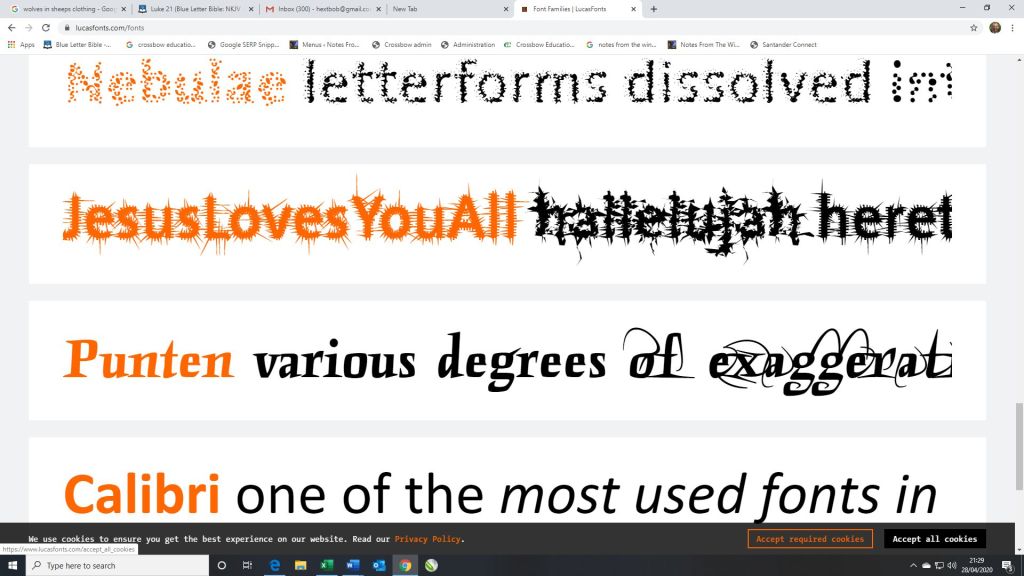
If you use a computer, you will probably use the font “calibri”. It’s the default font for Microsoft Word, and is one of the most used fonts in the world. It’s created by a Dutch font designer called Lucas de Groot. If you click on the“fonts” page, showing all the different font families created by his company Lucas Fonts, you’ll see this, right in the middle:

Lucas teaches typed design at Potsdam University in Germany, and lectures all over the world. It would seem that he doesn’t do it alone…

So commit to the LORD whatever you do, and he will establish your plans.