Tag Archives: i will build my church

Bread from Heaven: 2

Make the people sit down
In his letter to the Galatians, Paul says that what matters most of all is “faith working through love.” So here we are on the mountainside. We have kept in step with the Spirit; we have lifted our eyes with love, we are aware of how God has led us to and provided for this moment, and so we believe that Jesus wants to meet the need that is now before us. Even though He knows what He is going to do, we don’t. What next?

Jesus says, “Make the people sit down.” Some miracles require preparation, and that preparation has to be in obedience to what the Lord has asked us to do. The disciples could not see with their natural eyes what might happen next, but they got their instructions and complied with them. Like the unprofitable servant (Luke 17:10), they simply did what they were told to do. And more than that, they had to do so with authority. 12 men had to exercise crowd control on 5000, many of whom had their families with them, and all of whom were ravenous and will have wanted to be first in the queue for whatever goodies Jesus was going do dish out. We have probably read and heard the story many times, but if you imagine the scene and do the maths it’s not hard to see that the first miracle was actually getting that crowd ready to receive the food in the first place. When I was a teacher I found it hard enough to control a group of thirty, so I needed to exercise authority – and that was when I knew what it was I was going to deliver.

The disciples could organise the crowd because the Lord had clearly given them the mandate to do so, and they put their trust in His authority without question. I wonder what they thought He was going to do? Elijah and Elisha both worked miracles of multiplication, but the nearest thing to supernatural provision of food at this level that they would all have known of was the manna in the wilderness. It was a story that they would have heard many times, and it was deeply embedded in their culture. Maybe when they heard it they wondered what it was like, and now they were thinking, “Wow, we’re going to see manna! Awesome!” How often we have one expectation, and God does something completely different, often meeting our need at a deeper level. But one thing we do know, is that God is “able to do exceedingly abundantly above all that we ask or think, according to the power that works in us.” (Eph. 3:20) We can be expecting manna when God has multiplication in mind.

Authority follows the Anointing
So when God gives us an instruction, we don’t know what we are being prepared for: all we know is what we have heard and the One who is doing the preparing. But because we have had the instruction, we have the authority to carry it out. I have a friend, Andrew, who tells the story of a meeting when he stepped up to preach at a conference towards the end of the worship time, and the Holy Spirit said to him “The anointing isn’t on you; it’s on the lady who is ministering with the flags.” He knew the Lord’s voice well enough and had the humility to obey, laying down his message and releasing the flag ministry to become the focus of that part of the conference. Authority followed the anointing.

In how many churches, every Sunday, is manna on the programme when God has multiplication planned? Our meeting this week will be basically the same format as last week. And the week before, and next week. We know what to expect, and we know what we will do: it’s time to gather the manna.  We prepare our sermon or our worship set and it’s what we do. If we are Pentecostals or charismatics we probably ask God to anoint it, but what we are much less likely to do is to ask Him to replace or change it if He wants to. If it’s a smaller group we might be more likely to be flexible, but a hungry crowd at a conference, waiting to be fed? Will we put down the important message we have spent a week preparing and praying over, and move aside for the flags? Andrew did just that, the power of God fell, His manifest presence came into the room, and lives were changed. Andrew didn’t know what was going to happen: he just “made the people sit down.” If we will hear God’s word in faith and act in authority, He will provide more than we can ever ask or imagine. All we have to do is lay down our lives.

Manna, or Mission?
We have sometimes hosted gap year students from Germany who have come to spend the year as interns working with the children and young people in our church. We have kept in touch with most of them, and recently one of them, David, invited us over to his wedding. We accepted the invitation, and decided to visit two of the others while we were in Germany. We weren’t driving and it meant quite complicated travel arrangements, but we knew they would like to see us, and we wanted to see them. (We were actually hoping to arrange a visit to a fourth family, but the travel arrangements just didn’t work in the time we had available. There was no grass in that place…) One of our friends referred to our trip as a “mission.” That’s a bit high-sounding, I thought – we are just going to a wedding and visiting a couple of other young friends and their families. But God had plans that we knew nothing of, because we walk in works prepared beforehand. (Eph 2:10)

What God had prepared for the young man we visited first of all was to organise an outreach in his town three days after we arrived, which gave us time to prepare and pray with him and spend time with his family. We went into the town with the outreach team, met some of his friends in his church, identified a spiritual stronghold over the town and pulled it down in prayer.  Next we moved on for David’s wedding. We had two days there, but couldn’t stay at the venue on the night of the reception because it was fully booked, and we were going to have to stay in another hotel a few miles away. But God! The owner/manager of the venue gave a free room, already paid for by guests who had not shown up, and even arranged to collect our luggage from the other hotel, where we had already taken it that afternoon. This enabled us to have a precious time of prayer with David and his new wife the following morning as well as some good conversations with his unsaved aunt and uncle, which wouldn’t have happened if we hadn’t been able to stay there on the second night.

After the wedding we went to see our third and most recent gap-year student, to find that her father, an elder in their village Lutheran church, was considering leaving it because, as he put it, ‘the pastor just gave history lessons and didn’t preach Jesus.’ We prayed with the family and were able to encourage them, and we had a lovely day together on a Rhine cruise, which further cemented our friendship. The mission didn’t end there, because we called in to see our daughter on the way home back in the UK, and our visit coincided with a visit from one of her friends who had been planning to go to her house for months, who had been wanting to meet us, and who, again, was in need of prayer.

No-one got dramatically healed, no-one got saved – although someone did on the outreach – but love took us to Germany, we did what we were told, there was “much grass in that place” (including a free hotel room), and Jesus did some building in His church from plans that we knew nothing of. A bit like the disciples, who were probably just expecting some time out with Jesus in the hills and found themselves managing a large-scale outreach, we just thought we were going on a trip to celebrate David’s wedding and visit two other families; but it turned out that God had planned the three sets of circumstances to coincide in different parts of Southern Germany for us to walk in a mission that He had prepared beforehand. Potentially, every day can be a mission where loaves and fishes are ready to be multiplied. So are we in the promised land yet? Because when we arrive, the manna stops.
I Will Build My Church

The Kingdom Of God is not a matter of eating and drinking, but of righteousness peace and joy in the Holy Spirit (Romans 14:17)

I woke up this morning singing a song we had in church on Sunday:
“Father let Your kingdom come,
Father let Your will be done,
On earth as in heaven,
Right here in my heart.“

It is, of course, one of several settings to music of the Lord’s prayer, and it’s one of my favourites. But it’s got me thinking about the Kingdom Of God (never a bad thing) and how we perceive it. In particular, I’m thinking about our experience of the Kingdom In our church situations, and the relationship between the two. If you are feeling at all disappointed in, critical of, or hurt by what’s going on in your church at the moment, then this is for you. That probably means all of us at some time or another.

We can all get lost in our own imaginings of what the Kingdom Of God is like in heaven, but what do we know about the Kingdom Of God on earth? We know it is within us, we know that it’s eternal, we know it’s wherever we see the rule and reign of the Lord Jesus manifested, and we know it’s “righteousness peace and joy in the Holy Spirit.” if we think about the rule and reign of Jesus in the light of John 10:10, we know that the kingdom is manifested when we see the works of the enemy destroyed and life in abundance established. And if we think of the heart’s desire of the King himself, we have to land on John 17:21 and His prayer in Gethsemane that “That they all shall be one, just as you, my Father, are in me, and I am in you, so that they also shall be one in us.”

Paul is clear about the ultimate purpose of the church and how to attain it in Ephesians 4: 15-16, which is that “speaking the truth in love, (we) may grow up in all things into Him who is the head—Christ— from whom the whole body, joined and knit together by what every joint supplies, according to the effective working by which every part does its share, causes growth of the body for the edifying of itself in love.” When the body of Christ has attained this goal we will have become the answer to the Lord’s prayer in Gethsemane and to the Lord’s prayer that He gave us on the Mount of Olives: His kingdom will have come on earth.

Unfortunately, it can seem at times that some people in our churches are either writing chapter 7 of Ephesians, or have never read the epistle at all. The Holy Spirit reminds us in Isaiah 26:3 that “You will keep him in perfect peace whose mind is stayed on you, because he trusts in You.” To live in the good of this verse, we need to remember Matthew 6:33: “seek first the kingdom of God and His righteousness,” whether we are finding it in church or not. Ephesians 4:3 tells us that we find the unity of the spirit in the bond of peace, so if we have peace in our hearts about our bonds with other members of the church, we know that we have done our part to maintain the unity of the spirit with them, and our hearts are prepared for the rule of the Kingdom of God.

The Ecclesia
Jesus is building His church in truth and love, because truth and love are who He is, and the church is His body on earth. My Church isn’t, but His church is. Where there is truth and love in the assembly of the saints we find His body, and when we are in truth and love we are part of it, whether we are in my church, your church, their church, or someone’s church on the other side of the world. Jesus said I will build My church, not My churches. Paul says we are one body, not many bodies (1 Cor 10:17), and that we are being “built together as a dwelling place of God in the Spirit.” (Ephesians 2:22) Peter says: “You also, as living stones, are being built up a spiritual house, a holy priesthood, to offer up spiritual sacrifices to God through Jesus Christ…(who) has become the chief cornerstone.” (1 Peter 2:5-7)

The word that is used for this building, the church, is ecclesia. In the Christian context, ecclesia refers to a gathering of believers called out from the daily concourse of society to worship God, but the prime meaning of the word refers to an assembly of people called out of their houses to convene at a meeting place for the purpose of deliberation. So there is an implication of government here: when we meet to worship God, we also assemble to administer the government of His Kingdom. In fact Psalm 149 reminds us that our praise is integral to establishing His rule on earth. When Jesus says that the gates of hell won’t prevail against His church, He is saying that the councils of the powers of darkness won’t prevail against the government that is on His shoulders.

The government of the cross
And here’s the thing: Isaiah ‘s prophecy (Isaiah 9:6) wasn’t just a metaphor: Jesus did, literally, carry the government of His kingdom on His shoulders, when He carried the cross to Calvary. When we carry our cross as Jesus instructed and genuinely die to self, we are also carrying His authority to rule. We are part of the governing ecclesia of His kingdom on earth. Neither the many churches in your city nor the 45,000 denominations on Earth today are meant to be little microcosms of the Church of Christ: they are simply parts of it. More than that, they are only parts of it where they reflect the life of Christ and the government of the cross.  And since, according to 1 Corinthians 13:13,  it’s faith, hope, and especially love, that are the only things that last forever (“remain” or “endure,” depending on your translation), they have to be the three elements that make up the DNA of the everlasting life of Christ. Alongside those three it’s the word of God that endures forever. The cross, the DNA of the life of Christ, and the word of God: if we want to find the ecclesia of Jesus where His kingdom is governed, this is what we look for.

What if we don’t find it, or if or own church seems to be missing the mark? This doesn’t mean we spend our lives in the ranks of the spiritually homeless. On the contrary, God puts us into imperfect fellowship to teach us how to love one another, and to prepare our hearts to be carriers of His Kingdom. Our churches are training grounds for the government of His ecclesia, whether we govern in our local church or not. We can’t cause growth of the body by speaking the truth in love if we have no-one to speak it to, no relationships in which to exercise Kingdom values, and no arteries where the life of Christ can flow.

I was in a meeting the other day when I sensed the Holy Spirit showing me that His church was like an orchestra, with different instruments scattered far and wide, but where all the instruments were in tune with each other, all eyes were on the conductor and everyone was playing the same piece of music. The prophetic word He was giving me was that He was changing the (musical) key to a higher pitch. In my spirit I found myself looking at a violin that was far away. Just at that moment I received a phone call from a friend who pastors a church in East Germany. Not a coincidence, I felt, but a confirmation of what the Lord was showing me about His church.  

Pillars and sandcastles
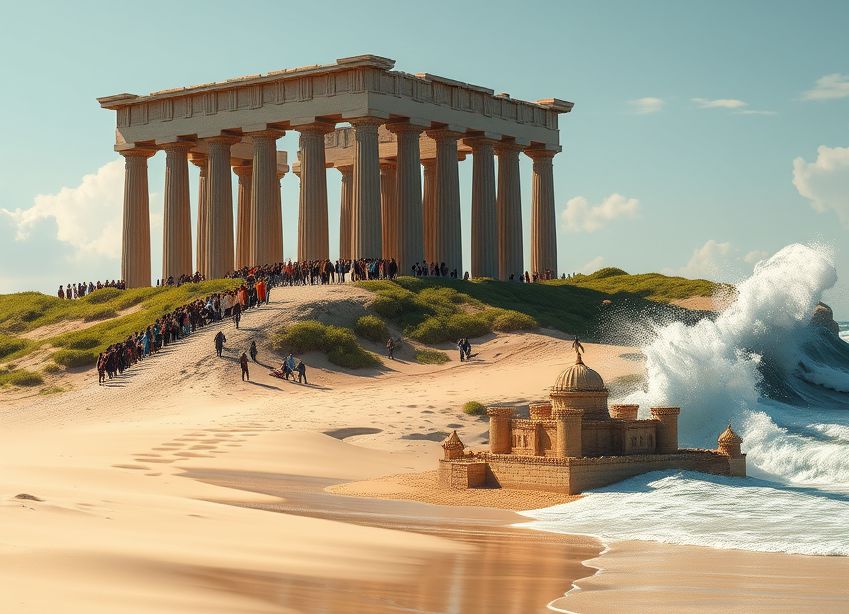
People are hurt and Churches fail or divide when they become houses of the government of man and not of the government of Jesus, building castles of sand instead of being built as living stones. The church at Philadelphia was clearly of the latter type, and Jesus makes this promise to those that would “hold fast to what they have:”

 He who overcomes, I will make him a pillar in the temple of My God, and he shall go out no more. I will write on him the name of My God and the name of the city of My God, the New Jerusalem, which comes down out of heaven from My God. And I will write on him My new name.” (Revelation 3:12.)

This is the reward for those who belong to the ecclesia of Christ. By contrast, a sandcastle is recognisable by its turrets and not by its pillars, and in the turrets flags are sometimes planted, where men like to write their own names. When someone seems to be waving their flag in our faces, we don’t want to snatch it out of their hands, but we need to pray that they, and we, will be pillars in the temple of our God where He can write His own name on our lives. If someone tells us how to “eat and drink,” we respond with righteousness, peace and joy in the Holy Spirit. Because a wave is coming when the sandcastles will be washed away, and only the pillars of the ecclesia will stand.

I Will Build My Church


Jesus said “I will build my church, and the gates of hell so not prevail against it.“ We are in the world, but we are not of it.  Jesus was from above; we too are born from above. All good and perfect gifts come down from the Father of lights.  All that Jesus builds of his Church is from above. When the kingdom of God comes on Earth as it is in Heaven, it comes from above, and what is built is from above. What is built is not of the world, even though it is in it. What is of the world is passing away; what Christ brings into the world is eternal. As the apostle John wrote:  “The world is passing away, and the lust of it; but he who does the will of God abides forever.” (1 John 2:17) Even in the rubble and devastation of war, the eternal Kingdom of God is being built in the hearts of men and women who love him. (Other references from this paragraph: Matt: 16:18, John 17:16, John 8:23, James 1:17.)

That is all solid scriptural truth, and it’s easy for me to sit in my armchair and dictate it into my iPhone, in the comfort and convenience of the Western world and its technology. But if a bomb landed on my house now as they are landing in Ukraine, and took away in seconds all that I have built over 40 years, where would my heart be?

David wrote “I will walk within my house with a perfect heart.” (Psa 101:2) If my house collapsed around me, I wonder if  my heart still be perfect? I think not. I don’t have to look back very far over the last 24 hours without seeing glaring imperfections in my heart. In fact there is only Jesus, whom David prophesied in that psalm, who can say in truth that He walks within His house with a perfect heart. And we are all His house; (Heb 3:6) By His Spirit He does walk among us, building His Kingdom as we give Him the building materials of our lives. As Christina Rosetti wrote in the words of the Christmas Carol, all that we can give Him is our hearts, and when we give Him our hearts, He builds with them. His house is the place where righteousness dwells, and where love, truth, peace, and joy are found.


Paul wrote: “He died for all, that those who live should live no longer for themselves, but for Him who died for them and rose again.“ (2 Cor 5:15) If I’m living for myself I’m not building His house, but I’m building my own. If my heart is attached to the house that I build, to my own satisfaction, my own peace and joy, and it falls down around me, I will be devastated. But If my heart is truly devoted to building His house, and I live  for Him through loving others, I will not care if mine collapses,  but I will pick my way through the rubble looking for people who have been hurt by falling stones. And as I do that His kingdom will be built in that place on Earth, even though not a stone of my house remains standing.

I am a long way from this, as I expect most of us are. But we can choose on a daily basis to build His house rather than stay huddled in our own, simply by preferring one another…