Tag Archives: the unity of the body

I Will Build My Church

The Kingdom Of God is not a matter of eating and drinking, but of righteousness peace and joy in the Holy Spirit (Romans 14:17)

I woke up this morning singing a song we had in church on Sunday:
“Father let Your kingdom come,
Father let Your will be done,
On earth as in heaven,
Right here in my heart.“

It is, of course, one of several settings to music of the Lord’s prayer, and it’s one of my favourites. But it’s got me thinking about the Kingdom Of God (never a bad thing) and how we perceive it. In particular, I’m thinking about our experience of the Kingdom In our church situations, and the relationship between the two. If you are feeling at all disappointed in, critical of, or hurt by what’s going on in your church at the moment, then this is for you. That probably means all of us at some time or another.

We can all get lost in our own imaginings of what the Kingdom Of God is like in heaven, but what do we know about the Kingdom Of God on earth? We know it is within us, we know that it’s eternal, we know it’s wherever we see the rule and reign of the Lord Jesus manifested, and we know it’s “righteousness peace and joy in the Holy Spirit.” if we think about the rule and reign of Jesus in the light of John 10:10, we know that the kingdom is manifested when we see the works of the enemy destroyed and life in abundance established. And if we think of the heart’s desire of the King himself, we have to land on John 17:21 and His prayer in Gethsemane that “That they all shall be one, just as you, my Father, are in me, and I am in you, so that they also shall be one in us.”

Paul is clear about the ultimate purpose of the church and how to attain it in Ephesians 4: 15-16, which is that “speaking the truth in love, (we) may grow up in all things into Him who is the head—Christ— from whom the whole body, joined and knit together by what every joint supplies, according to the effective working by which every part does its share, causes growth of the body for the edifying of itself in love.” When the body of Christ has attained this goal we will have become the answer to the Lord’s prayer in Gethsemane and to the Lord’s prayer that He gave us on the Mount of Olives: His kingdom will have come on earth.

Unfortunately, it can seem at times that some people in our churches are either writing chapter 7 of Ephesians, or have never read the epistle at all. The Holy Spirit reminds us in Isaiah 26:3 that “You will keep him in perfect peace whose mind is stayed on you, because he trusts in You.” To live in the good of this verse, we need to remember Matthew 6:33: “seek first the kingdom of God and His righteousness,” whether we are finding it in church or not. Ephesians 4:3 tells us that we find the unity of the spirit in the bond of peace, so if we have peace in our hearts about our bonds with other members of the church, we know that we have done our part to maintain the unity of the spirit with them, and our hearts are prepared for the rule of the Kingdom of God.

The Ecclesia
Jesus is building His church in truth and love, because truth and love are who He is, and the church is His body on earth. My Church isn’t, but His church is. Where there is truth and love in the assembly of the saints we find His body, and when we are in truth and love we are part of it, whether we are in my church, your church, their church, or someone’s church on the other side of the world. Jesus said I will build My church, not My churches. Paul says we are one body, not many bodies (1 Cor 10:17), and that we are being “built together as a dwelling place of God in the Spirit.” (Ephesians 2:22) Peter says: “You also, as living stones, are being built up a spiritual house, a holy priesthood, to offer up spiritual sacrifices to God through Jesus Christ…(who) has become the chief cornerstone.” (1 Peter 2:5-7)

The word that is used for this building, the church, is ecclesia. In the Christian context, ecclesia refers to a gathering of believers called out from the daily concourse of society to worship God, but the prime meaning of the word refers to an assembly of people called out of their houses to convene at a meeting place for the purpose of deliberation. So there is an implication of government here: when we meet to worship God, we also assemble to administer the government of His Kingdom. In fact Psalm 149 reminds us that our praise is integral to establishing His rule on earth. When Jesus says that the gates of hell won’t prevail against His church, He is saying that the councils of the powers of darkness won’t prevail against the government that is on His shoulders.

The government of the cross
And here’s the thing: Isaiah ‘s prophecy (Isaiah 9:6) wasn’t just a metaphor: Jesus did, literally, carry the government of His kingdom on His shoulders, when He carried the cross to Calvary. When we carry our cross as Jesus instructed and genuinely die to self, we are also carrying His authority to rule. We are part of the governing ecclesia of His kingdom on earth. Neither the many churches in your city nor the 45,000 denominations on Earth today are meant to be little microcosms of the Church of Christ: they are simply parts of it. More than that, they are only parts of it where they reflect the life of Christ and the government of the cross.  And since, according to 1 Corinthians 13:13,  it’s faith, hope, and especially love, that are the only things that last forever (“remain” or “endure,” depending on your translation), they have to be the three elements that make up the DNA of the everlasting life of Christ. Alongside those three it’s the word of God that endures forever. The cross, the DNA of the life of Christ, and the word of God: if we want to find the ecclesia of Jesus where His kingdom is governed, this is what we look for.

What if we don’t find it, or if or own church seems to be missing the mark? This doesn’t mean we spend our lives in the ranks of the spiritually homeless. On the contrary, God puts us into imperfect fellowship to teach us how to love one another, and to prepare our hearts to be carriers of His Kingdom. Our churches are training grounds for the government of His ecclesia, whether we govern in our local church or not. We can’t cause growth of the body by speaking the truth in love if we have no-one to speak it to, no relationships in which to exercise Kingdom values, and no arteries where the life of Christ can flow.

I was in a meeting the other day when I sensed the Holy Spirit showing me that His church was like an orchestra, with different instruments scattered far and wide, but where all the instruments were in tune with each other, all eyes were on the conductor and everyone was playing the same piece of music. The prophetic word He was giving me was that He was changing the (musical) key to a higher pitch. In my spirit I found myself looking at a violin that was far away. Just at that moment I received a phone call from a friend who pastors a church in East Germany. Not a coincidence, I felt, but a confirmation of what the Lord was showing me about His church.  

Pillars and sandcastles
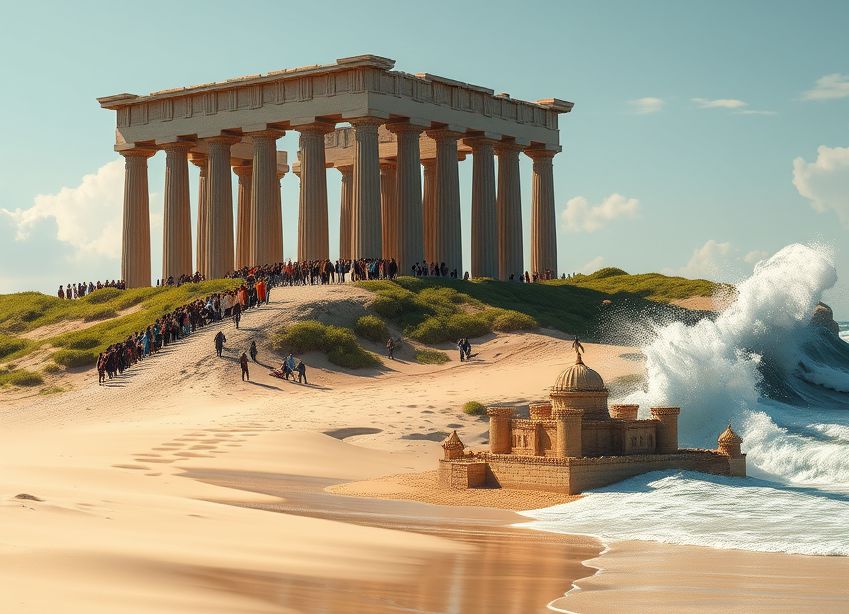
People are hurt and Churches fail or divide when they become houses of the government of man and not of the government of Jesus, building castles of sand instead of being built as living stones. The church at Philadelphia was clearly of the latter type, and Jesus makes this promise to those that would “hold fast to what they have:”

 He who overcomes, I will make him a pillar in the temple of My God, and he shall go out no more. I will write on him the name of My God and the name of the city of My God, the New Jerusalem, which comes down out of heaven from My God. And I will write on him My new name.” (Revelation 3:12.)

This is the reward for those who belong to the ecclesia of Christ. By contrast, a sandcastle is recognisable by its turrets and not by its pillars, and in the turrets flags are sometimes planted, where men like to write their own names. When someone seems to be waving their flag in our faces, we don’t want to snatch it out of their hands, but we need to pray that they, and we, will be pillars in the temple of our God where He can write His own name on our lives. If someone tells us how to “eat and drink,” we respond with righteousness, peace and joy in the Holy Spirit. Because a wave is coming when the sandcastles will be washed away, and only the pillars of the ecclesia will stand.
The prayer of agreement

I think that one of the most overused verses in the Bible is Matthew 18:20 “For if two or three are gathered in my name, there am I in the midst of them,” and one of the most disappointing is the verse immediately preceding it, which promises “If two of you agree on anything you ask, it shall be done for them by my Father in heaven.“

Verse 19 – if two of you agree – is often quoted to encourage people to pray together in pairs or small groups. “God promises to answer!” is the exhortation. Unfortunately, experience often proves otherwise, so the encouragement to meet is without substance. How many times do two or more pray together, yet what we’ve asked for isn’t done for us by our Father in heaven? Yet God’s word is true and His promises are trustworthy, so if our experience does not line up with the Word we must look more deeply into Scripture to see what our experience is missing, not hold up our experience as the truth and dismiss the Word.

The problem here is that the words do what they say on the tin: agree means agree, shall be done means shall be done. There is nothing in the Greek that suggests that they do not mean exactly what they say: there is not even a let out in the tense as there is in Matthew 7:7, where the tense of “ask and it shall be given” actually means ask persistently and it shall be given. The tense of “ask” means just once is enough.

So we gather, we agree, we ask, and yet nothing seems to happen. Why is that? One reason could be that we simply don’t wait long enough for the answer: we give up, and faith (if it ever really existed) evaporates. The promise doesn’t say when it will come, and the Bible has much to say about waiting. In fact “Wait” can seem like one of God’s favourite words. But although I think that can be true at times, I don’t think it is the main point here. I think the reason that a lot of “prayers of agreement” seem to go unanswered is in the first word of verse 20: “for.” Jesus says that the promise of answered prayer is a consequence of two or three being gathered in His name. Only when that is the case does He say He is present in the gathering, “there in the midst of them.“

First of all, what is it to be “gathered together?“ The Greek word means anything from being drawn together like fishes in a net, or assembled as a crowd, to the idea of those who were previously separated becoming one. Given that the heart of Jesus as He prayed in Gethsemane for us “all to be one,” and that the thrust of much of Paul’s teaching is that we are one body in Christ, I think the meaning of “gathering” tends towards the last definition. And “In His name“ does not just mean wearing our church name badges: the Greek word onoma means everything He is; His whole identity. To be in His name means to be the fullness of who we are in Christ. I think that to be gathered in His name means to be one in the spirit, not just in theory, “in faith,” or according to our theology; but experientially, in the lived reality of that moment. If this is the case, and since verse 19 (“when two of you agree…“) is conditional upon verse 20 (“For if two or three of you are gathered…”) the concept of agreement is elevated from being one of verbal and intellectual consensus to a shared understanding in the spirit of a prayer request that we know by revelation is in the Father’s will.

In those conditions we are together in unity according to Jesus’s prayer of John 17:21: that they all may be one, as You, Father, are in Me, and I in You; that they also may be one in Us, that the world may believe that You sent Me.”  When our hearts are in agreement like this and there is no doubt or discord, we are already in the Father’s will, so the answer to our prayer is standing right there with us.

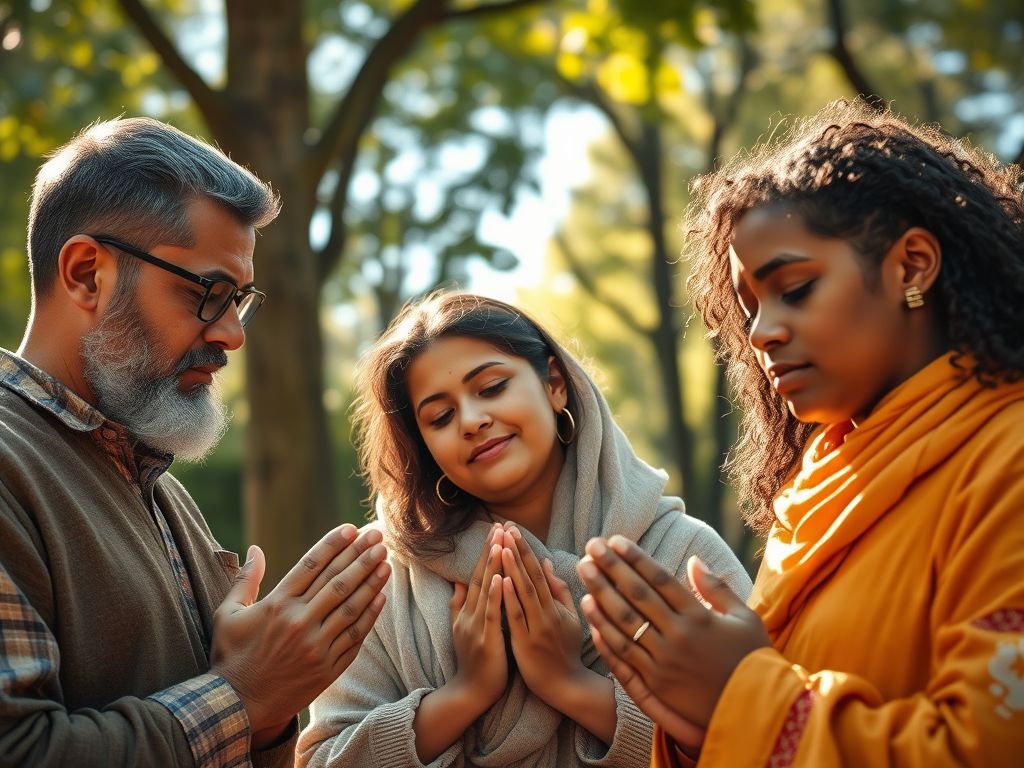
I was in a prayer meeting this morning, when a brother mentioned that there was a photo in a ministry prayer letter from a meeting we had both attended that included me a girl that I had been praying with in. I had my hands raised in a posture of worship, and she was on her knees. I guess it made a good photo. We prodded at various things throughout the morning, then just as the meeting was ending (how often has that happened?) The Holy Spirit fell powerfully. At that moment, my friend showed me the prayer letter with the photograph. In hushed voices, we agreed in prayer that the Lord would grant that girl her petition, and we knew immediately that the prayer was answered. Jesus was there “in the midst” according to Matthew 18:20: we could feel His presence.

When Jesus promised that He would send the Holy Spirit He said “I will not leave you as orphans; I will come to you.” (John 14:18) But I think we pray like orphans far too often in our corporate prayer times. Instead of meeting the conditions of “gathering in His name,” we talk to a Father who isn’t there, and then we wonder why He doesn’t appear to be listening.

The Body and the Vine

‘”The eye cannot say to the hand, “I have no need of you.”‘

We had an African morning in church today, to celebrate and to feed back on our recent trip to Liberia. As part of the worship, we sang some songs in Zulu with the translations on the screen. One brother comes from South Africa, which isn’t exactly Liberia, but it made the point: we may have different languages and different cultures, but our songs worship the same Lord and have the same meaning. Our churches may be thousands of miles apart, but we are members of the same body and branches of the same Vine. The life of Jesus flows through us all, wherever we are in the world. The verses are familiar:

“The body is not one member but many. If the foot should say, “Because I am not a hand, I am not of the body,” is it therefore not of the body? And if the ear should say, “Because I am not an eye, I am not of the body,” is it therefore not of the body? If the whole body were an eye, where would be the hearing? If the whole were hearing, where would be the smelling? But now God has set the members, each one of them, in the body just as He pleased. And if they were all one member, where would the body be? But now indeed there are many members, yet one body. And the eye cannot say to the hand, “I have no need of you”; nor again the head to the feet, “I have no need of you.” (1 Cor 12: 14-21)

Jesus gave the analogy of the vine to the apostles to express something of the same idea that His Spirit gave to Paul some years later: just as the body has many members, the vine has many branches. Although the description that we have in John’s gospel doesn’t extend to further viticultural details, it is true to say that every branch of the vine is unique, just like every member of the body. But as Jesus said: “If anyone does not abide in Me, he is cast out as a branch and is withered… If you keep My commandments, you will abide in My love, just as I have kept My Father’s commandments and abide in His love.” (John 15: 6,10)

Without love – His Love – the branches wither. As Paul famously wrote to the Corinthians: “Without love, I am nothing.” (1 Cor 13:2)  It all comes down to love. I can pour out my love to Jesus in gratitude for what He has done for me, but unless I can love another branch that is a different shape to me, and maybe has more (or less) fruit, my worship is meaningless. The apostle John makes this clear in his first letter: “For if anyone who does not love his brother, whom he has seen, how can he love God, whom he has not seen?” (1 John 4:20).

Unless we see one another as members of the one body and allow the love of the vine to flow between us, we are nothing. Without love, the eye expects the whole body to be an eye; without love the hand  tells  the foot “I have no need of you.” Criticism and judgementalism come when the eye doesn’t understand what the hand is doing, and so just sees it as a useless eye. But if the eye sees the hand as a member of the Body that is of equal value to itself, although its purpose is entirely different, the love of the Vine can unite the two. Instead of discarding the foot and all that it stands for (excuse the pun!) the hand will seek to understand the connection the foot has to the body, and through that will understand the foot. And to come back to the relevance of this morning’s service, when the hand speaks to the foot it will seek to use the language of the foot. To speak to the hand, the eye needs to understand how the hand sees the world and to speak the language of the hand. Because this too is love.

“But now God has set the members, each one of them, in the body just as He pleased” (verse 18). If you are a hand, and God has set you next to an eye, it was for a reason. Not that you have to learn to see, or even more importantly that you have to teach the eye how to hold a hammer; but that you have to learn to love. Because “If you abide in Me, and My words abide in you, you will  ask what you desire, and it shall be done for you. By this My Father is glorified, that you bear much fruit; so you will be My disciples.” (John 15: 7-8)

If the body were an eye, where would the hearing be? (1 Cor 12)

Paul’s teaching on the gifts of the Spirit in the church and the diversity that He has placed within the body of Christ is a well-known passage. In the first part Paul shows how the Holy Spirit distributes supernatural gifts among His people when they meet together to reveal Jesus, the second part shows how each born again believer is a unique gift to the body of Christ that helps enable the kingdom of his Love to  be established on the Earth.

The world and worldly culture celebrate diversity. However the politically correct emphasis on diversity that we see in today’s society is not an expression of the rich variety that God has put into His creation, but is a worship of diversity for its own sake. Diversity in the world has become an idol: worshippers gather round it In abandonment to their lusts just as the children of Israel gathered round the golden calf and “rose up to play.” (1 Cor 10:7)

The devils’ idols are always a substitute for God’s truth. If the Lord is doing something in Heaven, the enemy will try to set up his copy on Earth, so where the Kingdom of God is advancing there is often an idol to be pulled down in order for God’s will to be done. If we look at the counter culture that the enemy is seeking to establish on Earth, we can often see the emphasis of the heavenly culture that the Holy Spirit is bringing to the church. Diversity is an example of this. The devil is seeking to establish his doctrine of diversity in the flesh, according to which every divergence from God’s created order is to be not only accepted, but celebrated. There are many bodies, but no membership.  In fact membership of any one group is often regarded as sectarian.

In God’s kingdom there is one body, and we are all members of it. Like the snowflakes, each one of us is different and each one of us is beautiful, and each one of us is a unique expression of God’s perfect order. But we are all made of water. “For by one Spirit we were all baptized into one body—whether Jews or Greeks, whether slaves or free—and have all been made to drink into one Spirit.” (1 Cor 12:13)  The devil, on the other hand, would have us celebrate snowflakes made of plastic, rubber, bronze…

How does this translate into Gods kingdom purposes today? I believe that the enemy is parading his version of diversity in front of our eyes because he wants to blind the world to the beauty of God’s Kingdom truth. Jesus is calling His body to unity, but in that unity is the essential principle that we recognise the diversity and beauty that He has put into each individual. A prophetic theme currently being expressed is that God will be removing many leaders from the platforms and podiums where they have become exalted, and raising up the unknown and lowly to minister in the power of his Spirit when he sends the next great wave of Revival. We will no longer gather around denominational flags and banners; we will just gather around Jesus under his Banner of Love, honouring and serving Him as we honour and serve one another. The Unity won’t command the blessing because we all sing the same songs, have all read the same books, or all agree with the same teachers; and not even because we all pray in tongues and prophesy (or not!): the unity will command the blessing when we love, serve, and prefer one another.

We will all be one when we have recognised that we are all different. If you are an ear and I am an eye, we may look like we have nothing in common, but the same blood flows through us, we both serve the same body, and we both have the mind of Christ. I’m not inadequate because I can’t hear like you, and – even more important – I’m not superior because you can’t see like me. When we really celebrate each other’s uniqueness I believe those beautiful snowflakes will fall more and more thickly, until the glory of God covers the Earth as the waters cover the sea.