Category Archives: Discipleship and witness

The world will know that we are Jesus’s disciples by our love; but Jesus didn’t tell us that this is how we make disciples. The New Testament model for making disciples is to glorify the Father by doing His works in the name of the Son, by the power of the Holy Spirit. We are called to show the world the Triune God in action.

The Chain: Linked to the Body

“”I in them, and You in Me; that they may be made perfect in one, and that the world may know that You have sent Me, and have loved them as You have loved Me.” (John 17:23)

The focus of Jesus’s ministry was always to glorify the Father, and to demonstrate that He was the Son whom the Father had sent, because He loved it so much, to bring eternal life to all who accepted Him. His master plan – His only plan – was to build His church to destroy the works of the enemy and reveal the love of the Father that He poured out into the hearts of His children by the power of the Holy Spirit. The church is the chain that makes the wheels of the bike go round: unless we are linked in with other believers our discipleship is not going to progress.

Paul prays: “that Christ may dwell in your hearts through faith; that you, being rooted and grounded in love, may be able to comprehend with all the saints what is the width and length and depth and height— to know the love of Christ which passes knowledge; that you may be filled with all the fullness of God.” (Eph 3: 15-17) The pre-requisite to knowing the love of Christ and being filed with all the fullness of God is being “rooted and grounded in love.” The arena in which we fulfll the command to love one another and keep pedalling forward (as I wrote earlier in this series) is the local church, where Jesus is Lord, the Father is glorified, and the life of the Holy Spirit flows; where believers pray for one another, serve one another, minister to one and other and are accountable to one another.

If there were a  prize for the most-quoted verse of scripture, Matthew 18:20 would probably be in contention for runner -up: (the winner, of course, being John 3:16.) “Where two or three are gathered in my name, there am I in the midst of them.” Jesus “in the midst” is the essence of church. I think if we all took discipleship a lot more seriously Jesus would probably be a lot more evident in the midst than He often is, but that’s not for this chapter. I think what is important here is for us always for us to remember where we are headed as we cycle up the mountain:

“In Him we have redemption through His blood, the forgiveness of sins, according to the riches of His grace which He made to abound toward us in all wisdom and prudence, having made known to us the mystery of His will, according to His good pleasure which He purposed in Himself, that in the dispensation of the fullness of the times He might gather together in one all things in Christ, both which are in heaven and which are on earth—in Him.” (Eph 1: 7-10)

God is gathering us together in Christ, and His vehicle is the church. “He put all things under His feet, and gave Him to be head over all things to the church, which is His body, the fullness of Him who fills all in all.” (Eph 1:22-23) This is the goal of our discipleship, and it’s why we cannot follow Jesus on our own. It’s why Jesus prayed “May they all be one as you and I are one” (John 17:21). And it’s why we cannot  be walking in the Spirit if we “bite and devour one another” (Galatians 5:15)

Because the heart of God breaks at division in His church. Revival will sweep the nations when brothers and sisters in Christ set aside petty doctrinal and stylistic differences and gather round the standard of our Saviour to destroy the works of the devil in His name. But when one ministry denounces or criticises another, they are allowing those very works of the devil into their own ranks. For what is more important: what we think we know about what God thinks, or whether we obey His commandment to love one another? Whether we criticise and condemn one another, or whether we  are “kind to one another, tenderhearted, forgiving one another, even as God in Christ forgave you?” (Ephesians 4:32)

The Lord needs His chain to be well-oiled. Jesus is always there, ready to pour the oil of the Holy Spirit onto each one of His links.  We need to be connected to one another with links that are supple and yielding. Without the oil of His anointing we become rusty and rigid, set in our ways, insensitive to one another and out of touch with the three cogs on the crankshaft – the  Father, the Son and the Holy Spirit. It is for each one of us to keep seeking the Lord so that we remain well-oiled individually in order for the corporate chain of the life of the Body to function smoothly. Again, as I wrote above, it is not for one link to assess whether another is functioning as it should, or even whether or not it should be there. We are nothing on our own: it is only through our connections to those three cogs and to one another that we have purpose. Paul writes this to the Galatians:

“If anyone thinks himself to be something, when he is nothing, he deceives himself. But let each one examine his own work, and then he will have rejoicing in himself alone, and not in another. For each one shall bear his own load.” (Gal 6: 3-5)

Jesus says to the church at Sardis: “I know your works, that you have a name that you are alive, but you are dead. “Be watchful, and strengthen the things which remain, that are ready to die, for I have not found your works perfect before God.” (Rev 3: 1-2). The “things that remain” are Faith, Hope, and Love, and the greatest of these is Love. (1 Cor 13:13). These three are the gold, silver, and precious stones that remain from our works after the wood, hay and stubble have been consumed in the fire. (1 Cor 3:12) We are alive in Christ to the degree that we are linked to one another in Love, and the body of these connections is the Church of Christ. To be disciples we must be in the chain, and we must be vigilant to overcome any thoughts and attitudes that would tempt us to break our connections.

Hold on at all times: the handlebars

“Giving all diligence, add to your faith virtue, to virtue knowledge, to knowledge self-control, to self-control perseverance, to perseverance godliness, to godliness brotherly kindness, and to brotherly kindness love.” (2 Peter 1: 5-7)

We have all seen cyclists – usually young men or boys – cycle along without holding the handlebars. I remember when I was a boy and first learnt the skill. I also remember that, as a rule, it was only a skill I employed when I knew other people were watching…  But there are two circumstances that every cyclist riding “no hands” has in common: this particular skill can only be accomplished on as smooth terrain, generally a road or another paved surface; and it is not something that can realistically be attempted when cycling uphill. As Christians, we have left the paved surface of the road, and are heading up the mountain on a dirt track. If there is one thing we need to do, it is to keep hold of the handlebars.

There are many exhortations in the New Testament, whether from Jesus, Paul or any of the other writers, to persevere in our faith. Perhaps the most frequently quoted is from Pauls’ letter to the Philippians:

“Brethren, I do not count myself to have apprehended; but one thing I do, forgetting those things which are behind and reaching forward to those things which are ahead, I press toward the goal for the prize of the upward call of God in Christ Jesus.” (Phil 3: 13-14)

The word translated as “diligence” in the introductory passage is spoude, which means earnestness, eagerness, being full-on, not just in the desire to accomplish something but in the energy and persistence applied to carrying it out. Elsewhere Peter writes be diligent to be found by Him in peace, without spot and blameless.” (2 Pe 3:14) Paul exhorts Timothy to be diligent in pursuing godliness “so that (his) progress may be seen by all,” (1 Tim 4:15), and to the Galatians he writes “And let us not grow weary of doing good, for in due season we will reap, if we do not give up.” (Gal 6:9). References to being committed and wholehearted are set like precious stones throughout Proverbs. The rewards held out by the Lord to the seven churches in the Book of Revelation are all for those who “endure.” And these references only scratch the surface of what is a very deep-veined theme running through the whole of Scripture. Diligence is the name written on our handlebars: if we don’t hold on, we will fall off.

At this point there might appear to be a tension between the fundamental truth that we are saved by Grace (the Cross of Christ) and not by works (staying on the bike) However there isn’t one. The bike itself is a gift from God. The desire to ride it and to stay on is a gift from God, just as faith itself is a gift from God (Eph. 2:8; 2 Peter 1:1). And Psalm 37:24 tells us: “Though he fall, he shall not be utterly cast down: for the Lord upholds him with His hand,” so even our ability to stay on the bike is by the Grace of God. The very words that are given to us by the Holy Spirit encouraging us to be diligent and to endure also give us the desire and the ability to carry them out. I think it can reasonably be said that those who to fall away are the ones who never really got on the bike in the first place – who confessed with their mouths that Jesus Christ is Lord, but never really believed it in their hearts. (Romans 10: 9) So if you, like me, are picking your bike off the ground and getting on again for the fiftieth time this week, don’t beat yourself up over it and call yourself a failure. The good news is, you never were a success in the first place! All of that glory belongs to the Lord. The fact that you are getting on your bike again is proof that you are, by the grace of God, being diligent.

So, holding onto the handlebars, we press on towards the goal of the upward call of God in Christ Jesus. We carry on pedalling along the mountain track. Sometimes there are downhill stretches and easier sections, but the call is upward and the overall direction of the track is always to take us ultimately “further up and further in,” as Aslan says in the final book of the Chronicles of Narnia. And this leads us to the other essential function of the handelbars: they are what gives the bike direction. We don’t just hold on “with all diligence” in order to stay on the bike; we hold on to stay on the path. And we always look forward: looking back brings disaster. With our eyes fixed on Jesus, the Author and Finisher of our faith, we steer along His track to  the top of the mountain.

Being born again isn’t about boarding a train in this life and stepping onto Heaven’s platform in the next one: it’s about the slow process of growing to maturity in Christ as we consistently reveal to the watching world that He is the one who is keeping us on track. The higher up and further in we go, the closer to Him we get and the more like Him we become, so that “Many peoples will come and say, “Come, let us go up to the mountain of the LORD, to the temple of the God of Jacob. He will teach us his ways, so that we may walk in his paths.” (Isaiah 2:3)

The Mountain of God is the Mountain of His presence, where Love rules and His Glory dwells. It’s where He met with Moses and gave the Old Covenant to His people, and it’s where He meets with us to lead us forward by His Spirit today. There is one simple test that will tell us if we are on our bikes or completely off track, and it’s the question I referred to in the chapter on the pedals: are we learning to love? Jesus has individualised lessons for each one of us, and they will all be somewhere along the route that Peter maps out in the scripture that opens this section. But learn them we must if we are to progress up the mountain, because

They shall not hurt nor destroy in all my holy mountain: for the earth shall be full of the knowledge of the LORD, as the waters cover the sea. (Isaiah 11:9)

This is where our direction must be set. We can keep moving, with both wheels on the ground, our feet on the pedals and our hands close to the brakes, gripping the handlebars tightly. But whenever we hurt or destroy we’ve lost our way.

Free Downloads

Apart from my books “Wheat in the Winepress,” and “Two Seconds to Midnight,” everything on this site is free. There are no “donate” buttons anywhere. Thirty-odd years ago I asked the Lord to give me a business that would support my ministry calling, and He has done just that. I would of course love you to buy my books, not because I want your money, but because I think they will bless and encourage you and I believe they are words for these times.

So if you do download anything from here, there will be no follow-up, no pestering, nothing. Just, hopefully, a bit of blessing for you. I’ll be adding to the titles every so often. Just click on the title below and it will take you to another page: click again on the link you find there and it will take you to the pdf for you to download. (There’s probably a better way of doing this, but I don’t know what it is!)

Serving to Soaring (12 pages)

A Beginner’s Guide to Prophesy (3 Pages)

The Prophetic Ministry

Blowing the Trumpet

The Bike Ride: Pictures of Discipleship

Spirit Without Limit

Seated in Heavenly Places

Is everything just chance, or is there a plan?

The Pillars of Evangelism

Sunday 13th Sept: discipleship

It’s great to have a “live stream” of the prophetic in our Sunday meetings again, even though we aren’t physically together. As I write this, I am reminded of Paul’s words to the Corinthians ; “For my part, even though I am not physically present, I am with you in spirit.” (1 Cor 5:3). We use the phrase “with you in spirit” a lot, so much so that it has basically lost its meaning. I think it’s time that we rediscovered the spiritual power of these words. Our born again spirits really are in the same place, seated in Heavenly places in Christ.

There were two prophetic words this morning.

Jake had the following scripture
“Therefore take up the whole armour of God, that you may be able to withstand in the evil day, and having done all, to stand.” (Ephesians 6:13)

He felt the Lord saying “There is a battle coming, but I want you to know that I have given you everything you need to be more than conquerors, so that you will be standing strong at the end.”

The Lord spoke to me during the worship.
Anne and I were sitting on the sofa watching the meeting on my laptop. I was quite happy; the laptop was adequate for the job. But as we were watching, Anne was sorting out the connection between the wi-fi and the TV, so that we could enjoy the meeting on a bigger screen and with better volume. As she was putting in the password, I felt the Lord say to me: “Are you content with just the laptop, or do you want more?”

God want us to press in for the big screen. He wants us to move onto a new level in our relationship with Him, and not to be content with what we have at the moment.  His desire is for us to have Him on that big fixed screen and stay connected all the time, not to fold up our laptops and switch them off when we feel like it.

Discipleship is not a part-time activity. As Rob’s message that followed emphasised, it is an all-in, full time call.

Soaring like Eagles

But those who trust in the LORD will find new strength. They will soar high on wings like eagles. They will run and not grow weary. They will walk and not faint.” Isaiah 40 v 31

We need to understand the eagle to get a more complete picture of what the Lord is saying through this passage.

The eagle is the fastest animal created, soaring at speeds of 140 miles per hour and in excess of 200 miles per hour when it spots prey. It also flies at a height of between 23000 feet to 36000 feet, sometimes for days without a single flap of its wings, and even can fly through a hurricane. Eagles actually love the challenge of a storm . When other birds will try to flee, the eagle will fly into it, using the wind of the storm to rise higher in a matter of seconds, just  soaring  unaltered from its path but at a greater height. The eagle’s wings are so aerodynamic that air flows over them causing very little turbulence. I believe that as we wait upon the lord He prunes and trims our wings to be more aerodynamic, so that we may soar on the thermals and fly into the storms when they come.

“I am the true vine, and my Father is the gardener. He cuts off every branch in me that bears no fruit, while every branch that does bear fruit he prunes so that it will be even more fruitful. You are already clean because of the word I have spoken to you. Remain in me, as I also remain in you. No branch can bear fruit by itself; it must remain in the vine. Neither can you bear fruit unless you remain in me. I am the vine; you are the branches. If you remain in me and I in you, you will bear much fruit; apart from me you can do nothing. If you do not remain in me, you are like a branch that is thrown away and withers; such branches are picked up, thrown into the fire and burned. If you remain in me and my words remain in you, ask whatever you wish, and it will be done for you. This is to my Father’s glory, that you bear much fruit, showing yourselves to be my disciples.” (John 15 v1-8)

Eagles are very efficient birds, which is how God wants us to be:  soaring on his thermals in the Spirit. So just like He prunes us to make us fruitful, the Lord will also prune and trim our wings to be ever more aerodynamic, soaring and remaining steady through the storms of life. Another amazing fact about the eagle that if it loses a feather either on one side – on land or soaring – it instantly loses the same feather on the other side to keep it in balance. I believe when the Holy Spirit prunes us He does the same thing, keeping us balanced so we can continue soaring with Him.

Eagles are famous for their vision: we talk about having “eagle eyes.” The eagle flies well above the ground so it can one see what is going on. What we are called to do as a church and as members of His body is to wait on the Lord so we can soar above the troubles of life, even flying into the storms, appearing almost motionless as we keep an eye out for anyone caught in the enemy’s snare on the ground.  When we see someone in trouble we can dive down to rescue them as quickly as possible, carrying them with us up to the safety of the skies to be restored by the Lord .

Thanks and credits

Here I wish to give credit to Adele and Phoebe for letting me take picture of Phoebe having her feet being washed for the cover and chapter 1 pictures.

Thank you to Graham Russell for taking the photograph of Pete their dog.

A big thank you to Bob  Hext for mentoring me and  for reviewing materials that I have written and am writing.

All thanks and Praise goes to the Our Lord for gifting me and  guiding me.

Identity Crisis

Bartimaeus (Mark 10 v 46-52)

Bartimaeus knew about Jesus and knew what he would do for him, yet he also was aware that he did not deserve to be healed as he called out “Son of David, have mercy on me!”

Herein lies another key, which is knowing our frail spiritual state. As Bartimaeus showed, we really don’t deserve anything: all that we receive is by the Lord’s mercy. But because of what Jesus has done on the cross for us  we can boldly enter the throne room of our Father and ask for what we want. “Let us therefore come boldly to the throne of grace, that we may obtain mercy and find grace to help in time of need.” (Heb 4:16)

Bartimaeus recognised Jesus and not stop calling out to Him.  Even when he was told to be silent he was persistent and called out even more, and when Jesus called him he  threw off anything that was hindering him, jumped up  and went to Him.  Then jesus asked him what he wanted.  Bartimaeus simply said: “I want to see,” not “if it’s your will,” or “It would re really nice if I could see…”

So we can see how much he wanted to see and be healed: he threw his cover off and jumped up;  he didn’t just get up on his feet and tentatively wander over in the hope that he might be noticed.  Bartimaeus had one thing on his mind, and his actions expressed it. Although this story is used for healing, I believe we can do the same with whatever we want from the Lord. The writer to the Hebrews says:

Therefore, since we are surrounded by such a huge crowd of witnesses to the life of faith, let us strip off every weight that slows us down, especially the sin that so easily trips us up. And let us run with endurance the race God has set before us. (Hebrews 12 v1))

These weights could be things that we have held onto from the past that we have allowed to  become part of our identity. This could include illness, disability, even sin:  essentially anything that we hold onto that means that we are not fully accepting our identity In Christ. Are we willing throw off everything, even things that have become our identity, like Bartimaeus’s begging bowl?  We don’t need them: we are new creations, as 2 Corinthians 5: 17 makes absolutely clear.

Therefore, if anyone is in Christ, he is a new creation: The old has gone, the new is here!

Our identity is in Christ and not things of the past; whether it’s our wealth, our position in our job, what we have given away, our house, our reputation, even our healing.  It has all gone, and the new has come. We are hidden in Christ.

For you died to this life, and your real life is hidden with Christ in God .(Colossians 3: 3)

So our identity should be focused who Jesus says we are; and since this is hidden in Him, nothing can take it from us.  It will always be true.  How we process this truth is our choice: we can either throw everything off to fully take hold of it in faith; or we can put some of our eggs in different baskets, maybe because we don’t want to let go of something else that has become our identity due to fear, or maybe we are just hedging our bets because our experience hasn’t matched up to the  truth. However, the truth remains, whether we choose to believe it and act on it or not, much like the sun is always shining even if it cloudy. If our experience is not matching the truth we need to take hold of the Word fully, letting go of everything that hinders us. 

Now go back to the sub-title of this article. I left a word out. What was it?

So anything that stops us remembering and living out these truths could be classed as part of the identity of our old self; the one that has gone.   Are we willing to throw them all off and jump up, making ourselves look  foolish, shouting louder than the noise of the distractions around us? Are we prepared to stumble blindly towards Jesus, through the mocking and the catcalls, despite all the adversity, until we hear Him say to us: “What can I do for you?”  Will we speak the truth that is in our hearts and say directly and plainly, “I WANT TO SEE!”

Our Father in Heaven doesn’t mince His words. Jesus tells us to let our “yes be yes, and our no be no.” I believe we need to follow His ways in this, and tell Him what is on our hearts without wrapping it up in formulae.

John Wesley and Billy Graham.
Two more recent examples of calling out earnestly and in desperation are John Wesley and Billy Graham.  In John Wesley’s house there are two knee sized marks in the carpet next to his bed where he cried out to God for revival. When Billy Graham was a student at Wheaton College he was one of a group of students that visited the building. When the lecturer returned to the coach he counted the students and found one missing, so he went back into the building to find Billy Graham kneeling in the same knee marks as Wesley, his face flat the bed, calling out: “Do it again lord!” Do we have this passion? How much do we want to know Jesus and do what He asks of us? Will we long for and cry out for healing and revival? Do we cry out for God to touch us again? And the big question: what are we willing to sacrifice to gain these things?

If we want to learn from Bartimaeus and Billy Graham we must be willing to shut ourselves away and lock into the Lord, to become more like Jesus and to let his holy fire refine us. In so doing we in turn will be set on fire for him.  If it only takes one man to stand in the gap for the Lord to do what He did through John Wesley and Billy Graham, just imagine what one church can do. Jesus said when two or three are gathered in my name I will be there in the midst.

Bartimaeus’s old identity.
Bartimaeus’s old identity was “blind.” This was the word I missed out earlier.  He knew who Jesus was, and not caring what he sounded or looked like he approached Him boldly and in complete faith that Jesus would meet his need. His identity was Bartimaeus, not Blind Bartimaeus. And yes, Jesus healing him was an awesome miracle, but there is more written about Bartimaeus than the miracle here. I think that the fact that he was blind is secondary to the fact that he was persistent and didn’t hold onto his disability. I think Mark is making the point that it was persistence and desperation for Him which caused  our Lord to stop. He wants to see how much we really want what He has for us.  He wants us to be utterly reliant on him and desperate for Him. In His presence all of us are beggars.

Serving to Soaring

A series of five articles by Jacob Dominy.

CONTENTS

Service

Flowing or stagnant?

The Crumbs under the Table

Identity Crisis

Soaring like Eagles

Service

Jesus called them together and said, “You know that those who are regarded as rulers of the Gentiles lord it over them, and their high officials exercise authority over them. Not so with you. Instead, whoever wants to become great among you must be your servant, and whoever wants to be first must be slave of all.  For even the Son of Man did not come to be served, but to serve, and to give his life as a ransom for many.” (Mark 10: 42- 45)

We must be prepared to serve; even to clean the toilets. We may have to serve for a long time in the most menial tasks; unseen and not seeking praise. Serving with a heart of love and enthusiasm are key: we must never serve in order to gain position.

Wildwood Church meets in a school, so every Sunday involves a lot of setup work. I have been on the set-up team at various times since 1988. Quite often this has meant making my own way to church, leaving early on a Sunday morning and having to walk or cycle there before I had a car.  It became more of a sacrifice when I was married, when I would cycle and find a lift for my wife. We are given clear instructions on how to serve in Matt 6: 3-4: “when you do a charitable deed, do not let your left hand know what your right hand is doing, that your charitable deed may be in secret; and your Father who sees in secret will Himself reward you openly.” If we take the lowest place at the table (Luke 14:10) our host will eventually say ; “’Friend, we have a better place for you!’”

Jesus, the King of Kings,  gave us the ultimate example of royal behaviour to follow:
“Jesus, knowing that the Father had given all things into His hands, and that He had come from God and was going to God, rose from supper and laid aside His garments, took a towel and girded Himself. After that, He poured water into a basin and began to wash the disciples’ feet, and to wipe them with the towel with which He was girded.” (John 13: 3-5)

Finally, 1 peter 4 10-11 tells us:
Each of you should use whatever gift you have received to serve others, as faithful stewards of God’s grace in its various forms. If anyone speaks, they should do so as one who speaks the very words of God. If anyone serves, they should do so with the strength God provides, so that in all things God may be praised through Jesus Christ. To him be the glory and the power for ever and ever. Amen.

However we are called to serve, we carry on in that capacity until God makes a change.

The Rose

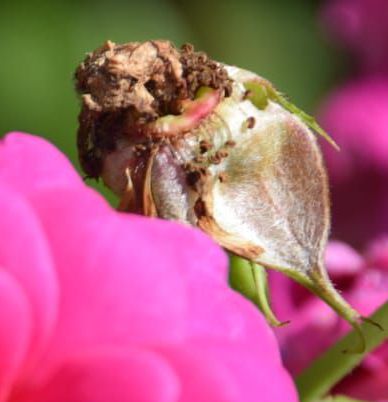
I was looking at this image of a rose this morning.

It struck me that we all love the beauty and (when they’re scented) fragrance of the rose, and the many images of the rose in art and literature – the poem by Robbie Burns, “My love is like a red, red, rose” comes to mind immediately – express well the fact that roses symbolise much of what our flesh longs for. But I was drawn to the “dead head” behind the bloom, where the petals have fallen and the seed head, the fruit, is beginning to form. When I looked at it I thought that in its own way it is as beautiful as the flower, full of all sorts of little details of life in transition that the Creator has put in place.

And I felt the Lord say something like this, not just to me but to many of us:

“You seek the beauty of the bloom, but like the grass it is transient and soon fades and falls. Consider what I am doing in the seedhead that is being formed, for this is the part of your life that I am looking at. You may feel at times like the flower that is over. You may feel that everything is in transition. But it is in the seedhead that is forming, and that the eyes of the world pass by, where my life is hidden. You don’t need the appreciation that the world gives to the beauty of the flower: you need to remember that it is the seeds of my life and of my word that I have put into you that are of lasting value.”

Jake also had a word about roses, which he sent me this afternoon. This does emphasise  the fragrance and beauty of the bloom rather than its transience. He had been looking at a climbing rose in his garden. It may even be this one, as it’s his picture. He writes:

“What I felt the Lord say was that not only do we need to be grafted into the vine of the rose, but we also need to be shaped and tied back in order that we can bear the fruit that we are called to bear, without breaking or being burdened with it. The tying down or tying back I feel is being linked into the Body of Christ, and having close fellowship with other believers, and in this way becoming one beautiful rose bearing much fruit and becoming a showpiece of His glory.  The Lord says: ‘The wind that will carry your aroma is my Holy Spirit, and the bees that pollinate my body are those who share my word: both believers and non believers who visit the church and talk about my body in a positive light.’ ”

I (Bob) think it is important that we catch what God is saying about being “tied into” fellowship with others. When winds blow and storms rise, blooms that are leaning out on their own are in danger of being broken off.

The Snowball

I felt that God gave me this yesterday:

God has made a snowball, and has set it rolling down a mountain. It is the true Church; the righteousness of God in Christ, the people of God loving one another, held together by the Word of God and moving in the power of the Spirit of God. As yet it is small, but as it rolls it gathers momentum and it increases in size as it keeps gathering more snow to itself. The enemies of God and of righteousness say “this is only a snowball!” and seek to stand in its path to break it up, and they set fires to melt the snow. But the snowball crushes those who stand it its way, and puts out the fires that would melt it. Our strength is in Him as we hold fast to one another and to the Word that binds us together, and as we keep to the trajectory that He has ordained.

As I was meditating on it this morning I thought the following, but this is my further reflection on what I had felt the Lord had showed me, rather than the original rhema word:

As we do this we will find the snow sticking to us as we go, because we will be His witnesses. We do not have to make this happen, and we cannot gather another person’s snow: our responsibility is to pray for those that we are connected to in the Body of Christ, that they will be “sticky” enough to gather the snow that is in their path and remain united to the rest of the snowball as it rolls. For each one of us, the snow that we gather is our part of Ephesians 2v 10: “For we are his workmanship, created in Christ Jesus for good works, which God prepared beforehand, that we should walk in them.”

Or, in this case, roll in them.

Jesus Talking

According to a personal evangelism course called “Talking Jesus,” a high number of people come to faith as a result of “conversations with a Christian.” I think it was about 35%; the only higher number (over 40%) being those who grew up in a Christian family. This is good to know, as we all need as much encouragement as possible to share the gospel! The lowest figure of the five mentioned (the others were, and I think I am quoting correctly, “attending  a standard church service”, and “experiencing the love of Jesus) was 17%, which is the number of Christians who have come to faith (as I did, in fact) through an “unexplained spiritual experience.” But I can’t help thinking that this 17% is a sad reflection of the state of the church today, and how far removed it is from the pattern set by Paul, for example, who came to the Corinthians “not with persuasive words of human  wisdom, but in demonstration of the Spirit and of power, that your faith should not be in the wisdom of men but in the power of God.” (1 Cor 2: 4-5)

Actually, Jesus never told us to “share our faith.” He told us to “make disciples,” and He said “”you shall receive power when the Holy Spirit has come upon you; and you shall be witnesses to Me  in Jerusalem, and in all Judea and Samaria, and to the end of the earth”  (Acts 1:8). The Greek word for witness is “martyr.” We all know one meaning of that, which is something that I don’t think any of us want to be; but the other meaning is “spectator.” This passage seems to be telling us that when the power of the Holy Spirit comes upon us we will watch Jesus (be spectators) doing His work – the works of the Father, in fact. This is what happened throughout the Book of Acts, and this is what happened with Paul at Corinth. We have consigned the meaning of the word to being witnesses of what Jesus did, rather what He is doing now; and from that we have created an activity called ”witnessing,” which, as far as I can see, is actually divorced from the model that we are given in the New Testament.

“The word of God is living and powerful, and sharper than any two-edged sword, piercing even to the division of soul and spirit, and of joints and marrow, and is a discerner of the thoughts and intents of the heart.” (Heb 4:12) When Jesus (today, through the Holy Spirit) speaks, one of two things happen: people run, or they turn (I’m quoting my wife, Anne, here). They don’t just stand there and say, “Yes, that’s interesting.  Of course you are entitled to your opinion.” In politics and business especially, the power of influence is sometimes called “leverage.” Judging by the figures we are given in the Book of Acts, the leverage of Holy Spirit empowered signs and wonders confirming the preaching of the Word is very high. By contrast, the leverage of other forms of evangelism has to be much lower. What would the figures look like if we were to carry on in the biblical pattern, hungering and thirsting in prayer for the Holy Spirit to come and do the works of Jesus for us to witness, instead of just trying to “witness” ourselves?

It is God’s heart and our calling that we reach out to as many as we can with the good news of salvation. The world needs to see how much we love one another, because that is how it will know that we are disciples of Christ. But Jesus didn’t say that this is enough to make new disciples; He only said that it confirms the truth of who we are in Him. Although there may be some people who are drawn to the light that they see in us, I think the New Testament pattern for making new disciples is to be witnesses of His work among those who don’t know Him. We need to ask Jesus who He is calling and we need to pray for them and ask for opportunities for them to meet Him. But when we are with them, we mustn’t be like tradesmen without a toolkit: we need the gifts of the Holy Spirit if we are to witness Jesus in operation. Without them, our leverage is poor or non-existent, but with them, how many more people exponentially would be coming to faith as that 17% became 37%, 47%, 57% or more? Because this is what happens when revival comes.

A friend at Wildwood Church was saying recently how she was with someone and the Holy Spirit said “talk about THAT” (Whatever THAT was, or who it was, of course she didn’t say.) Her first thought was “No, I can’t mention THAT!” But she obeyed. Tears, repentance, and blessing followed. She simply used a gift from the toolbox – in this case, a word of knowledge. Her talking  was leveraged by the power of the Holy Spirit. As Paul exhorted Timothy, we need to be ready to preach the word “in season and out of season.” (2 Tim 4:2), so we certainly do need  to be talking Jesus; but most of all we need to see Jesus do the talking.