Category Archives: The word of God

Understanding the Sabbath: Peace in Christ

“He Himself is our peace.” (Eph 2:14)

“For this reason the Jews persecuted Jesus, and sought to kill Him, because He had done these things on the Sabbath.” (John 5:16)

There is a lot more to the Sabbath law than observance of the fourth commandment, which instructed the Jews to “Remember the Sabbath Day, and keep it holy.” Just as Jesus’s “work” on the Sabbath was emblematic to the Jews of His disrespect for the whole of the Old Covenant law, the sabbath itself looks forward to the New Covenant in His blood that sets us free from condemnation under the Law and into the peace of His Sabbath rest.

The Bible tells us: “And on the seventh day God ended His work which He had done, and He rested on the seventh day from all His work which He had done. Then God blessed the seventh day and sanctified it, because in it He rested from all His work which God had created and made.” (Genesis 2:2-3) The new testament adds another layer to the Creation account: the specific involvement of Jesus in the work of creation.

“For by Him all things were created that are in heaven and that are on earth, visible and invisible, whether thrones or dominions or principalities or powers. All things were created through Him and for Him.” (Col 1:16) “All things were made through Him, and without Him nothing was made that was made.” (John 1:3) God rested from his work on the Sabbath, or the seventh day, so the Sabbath was instituted. But it wasn’t only the Father who rested: the Son rested too.

A way of life, not just an observance
God rested when the work of creation was finished. And He rested again when the work of the new creation was finished on the cross. When God blessed the sabbath day and sanctified it under the old covenant, He was looking forward to the time when, in Jesus, His rest would be a way of life, not just an observance. But in the era of the Old Covenant also, God’s rest extended beyond the seventh day. The writer to the Hebrews says:  “To whom did He swear that they would not enter His rest, but to those who did not obey?” (Heb 3:18) For the rebellious Hebrews, who “did not enter because of unbelief,” (Heb. 3:19) entering God’s rest equated to entering the Promised Land, where they would find rest from the toil of slavery.

Just as Canaan represented God’s rest for the Israelites, we enter our rest in Christ when we believe in His promises to us, or as Hebrews 3:14 puts it, “if we hold the beginning of our confidence steadfast to the end.” The Greek word used for God’s rest is “katapausis,” which means “a calming of the winds.” Katapausis Is the spiritual atmosphere of Heaven. Jesus tells us “My peace I give to you; not as the world gives do I give to you” (John 14:7), and when we walk in His peace we walk in the atmosphere of Heaven and find “rest for our souls.” (Matt. 11:29). All the winds are calm, because – as Jesus physically demonstrated – it is He who calms the storm.  As every Christian knows, He famously said, “The Sabbath was made for man, not man for the Sabbath.” (Mark 2:27). God gave us the Sabbath to enshrine in His Law that we need to enter His rest, not that we need to stop working every seven days.

Finished – but still working
Two notions that seem to be at odds with each other are that “God finished His work” on the seventh day, and the words of Jesus to the Pharisees when they confronted Him over healing the man at the pool: “My Father has been working until now, and I have been working.” (John 4:17) What is the difference between the work that the Father and the Son finished on the seventh day, and the work that they were – and still are – continuing to do?

I think the answer lies in the fact that creation was perfected on the seventh day, so all of God’s dealings with Man – Father, Son, and Holy Spirit – from then on were from His place of rest. Whether it was Christ’s miracles of healing and deliverance, God’s victories in the reign of David and many other heroes, or His repeated call to His errant people through His prophets to return to Him, the focus of God’s work has always been to restore His people to their Sabbath state of wholeness and relationship with Him. The lame man was healed on the Sabbath so the he could walk in the wholeness that the Sabbath represents. Just as the first creation was finished on the Sabbath day, so the new creation was perfected when Jesus cried out from the cross “It is finished!” And so the writer to the Hebrews says: “We who have believed into that rest.” (Hebrews 4:3) Through faith in the redeeming blood of Jesus that was shed on the Cross, we become “the righteousness of God in Him,” (2 Cor 5:21) and enter into the perfection of God’s rest.

“True righteousness and holiness.”
This perfect state is the condition of the new man, “which was created according to God, in true righteousness and holiness.”  (Eph 4:24) Peter exhorts us to  “be diligent to be found by Him in peace, without spot and blameless,” (2 Pe 3: 13) while Hebrews 4:9-11 says “There remains therefore a rest for the people of God. For he who has entered His rest has himself also ceased from his works as God did from His. Let us therefore be diligent to enter that rest, lest anyone fall according to the same example of disobedience.” The peace of His sabbath rest is the gift of God’s grace through Jesus, yet two new testament writers exhort us to be diligent to “enter” that gift. So while we cannot earn God’s peace by our religious works, we need to “work” at keeping a short account of sin in our lives (“without spot and blameless”) and “work” at remembering who we are in Christ, what He has purchased for us, and that “The Spirit of God, who raised Jesus from the dead, lives in you.” So rest does not come without some effort (Romans 8:11), but if we are diligent to keep these truths foremost in our thinking we will walk away from the paralysis of religion and into God’s rest.

Only in that place we can really access everything that is our promised inheritance in Christ.

(The topic of “entering into God’s rest” is also explored in “Walking in Newness of Life.”)

Walking in Newness of Life

The God  who is Love created man in His image, so we were made in the image of Love. Satan marred that image with sin, so the foundation of God’s design for society was ruined, and love was replaced by the Law. God’s perfection and beauty could be found in His Law (See all of Psalm 119), but for men, even the priesthood and the Levites, the dedicated servants of God, it was impossible for that Godliness to be reflected in their behaviour. As we learn from Romans 7, “The Law is holy, and the commandment holy and just and good … but sin, that it might appear sin, was producing death in me through what is good.” (Romans 7:12) Instead of living in the freedom and safety of Love – the fulfilment of the Law – human beings outside of Christ are now only free and safe to the extent that sinful behaviour is held in check by law. The law is like the sign that says “don’t step on the grass:” Since by its nature sin always looks for ways to bypass the law and step on the grass, law is always multiplying to keep pace with sin.

Recently I saw a village primary school with a tree in the grounds. It was the beginning of the school day. Children were climbing the tree and swinging on the branches. There was no visible supervision, although various parents were around, dropping their children off. It was a happy, joyful scene. I thought: “Goodness, this is wonderful. Children climbing the tree, doing what God designed them to do, with no health and safety police wagging their fingers? I must take a photo!” Then a second thought came hard on its heels. “No, you can’t take a picture. The safeguarding police say No.”

In the world, the law of sin and death proliferates, both in fact driven by fear: fear of death (in this case, health and safety) and fear of sin (safeguarding.) But in the Kingdom of God there is a different order, because peace has come to Earth:

“For He himself is our Peace, who has made both one, having broken down the middle wall of separation, having abolished in his flesh the enmity, that is the law of Commandments contained in ordinances, so as to create in himself one new man from the two, thus making peace, and that he might reconcile them both to himself in one body through the cross, thereby putting to death the enmity.”  (Ephesians 2:14–16).

On one level, Paul is writing in this scripture about the enmity between “those who are near and those who are afar off,“ (Eph 2:17) that is the Jews and the Gentiles. The Jews are “near“ because they were chosen by God to manifest Him to the world through their obedience to his law; the Gentiles are “far off“ because they are lost in carnality and enslaved to the world’s thinking. But there is a deeper level, another war, a level of reality in the spirit that is represented by the two people groups. The enmity between Jew and Gentile represents the war between flesh and spirit that Paul refers to in the epistles to the Galatians and the Romans:

“The flesh lusts against the spirit and the spirit against the flesh, and these are contrary to one another, so that you do not do the things that you wish.“ (Galatians 5:17) 

When Paul writes to the Romans he says: “I delight in the law of God according to the inward man.” (Romans 7:22), and in verse 23 he calls it “the law of my mind:” “But,” he says, “I see another law in my members, warring against the law of my mind, and bringing me into captivity to the law of sin which is in my members.” (Romans 7:23) The “war” between the law of God and the law of sin that Paul describes here is the same as the battle between flesh and Spirit that he writes about to the Galatians. His terminology has evolved (His epistle to the Galatians was the first one written) but the conflict is the same – whether it’s called flesh against Spirit; the law of sin against the law of God, Gentile against Jew.

We (or at least I) tend to polarise our thinking, with the result that our drive is to be “more spiritual” at the expense of the flesh which, as we know, has to die. But the key is not to strive to crucify the flesh, but to recognise that Jesus Himself is our peace because, as Ephesians 2:14 makes clear, “He has broken down the middle wall of separation.” He has put to death the enmity by creating in himself “one new man from the two.” When we step back into Jesus, the Word made flesh, we step into the peace that He has created, where the flesh is no longer captive to sin but merges with the spirit in one new creation, and we are no longer striving against the law of God, but seeking to fulfil it in faith and love.

I was in the Spirit one day; it was sunny outside, and the thought came to me: “I fancy going birdwatching this morning, instead of sitting here having a quiet time.” I said: “Lord, I fancy going birding now. What should I do” He said, “Do what you like.” So I thought about that, and decided that what I liked doing just then, rather than going out looking for birds to photograph, was sitting with Jesus and studying is word with Him. So that’s what I did, and in the few minutes that followed received a revelation that I will share in another post. And I learnt an important truth: whatever we do when we walk in newness of live is going to be in His will.

Paul first explores the idea of the wall of separation in the letter to the Galatians, when he says “In Christ Jesus neither circumcision nor uncircumcision avail anything, but a new creation.” (Gal 6:15). We often say/hear/read statements like this; “I keep putting my flesh on the altar, but it keeps climbing off again!” I wonder if this is because we haven’t grasped the reality of who we are as new creations in Christ, where flesh and Spirit have become one in Him? In His Kingdom, religion and carnality are both equally irrelevant, as they play no part in the new creation. If we overlay Galatians 6: 15 with Galatians 5:6, which is “in Christ Jesus neither circumcision nor uncircumcision avail anything, but faith working through love,” we find an equation that states “a new creation is faith working through love.”

If this is true, and scripture confirms it is – because “without faith it is impossible to please God,” and “unless one is born again, he cannot see the kingdom of God,” – our actions must always be not only carried out in a spirit of love, but in a place of faith, if we are to be walking “in newness of life”, living as new creations. Does this mean our actions “avail nothing” in the Kingdom of God unless we are in some way walking on the water and trusting God for the miraculous? I don’t think so. Since “faith comes from hearing,” I think we are walking in faith whenever we hear God directing our steps and do – or don’t do – whatever it is He says. We are in faith whenever we allow Him to guide us with His eye (Psalm 32:8). Our faith is in the person of Jesus: not just because the righteousness of God that is ours by faith is going to clothe us in white and give us a place at the wedding banquet, but because in Him, clothed in Him, we live our lives as new creations in a world that is passing away, “in the midst of a crooked and perverse generation.” (Phil 2:15) And when, by faith, we are in Christ, then our deeds will be directed by love, because God is Love.

One of the leaders at a recent Alpha that we ran at our church bought a little toy bus for a child who loved busses, and left it on the table at the Alpha meeting. A young man on the course noticed the bus, and asked about it. “There’s a kid I often see at work who has got a thing about busses. I saw this and bought it for him.” The young man was so touched that someone would go out of their way to buy a toy bus for a child that he had no real relationship with, just because “the kid loves busses,” that he realised in that moment that the love of Jesus was actually a reality that directed people’s lives, and gave his life to Christ. Buying the bus didn’t require miraculous provision; it just required responding to a prompting from the Lord and doing a small act of kindness. Faith working through love, at the heart of the new creation, availing much for the Kingdom of God.

The scriptures give us many analogies for living out our lives as new creations, as children of the Kingdom and not of the world. Paul likes the image of putting on clothes: “clothe yourselves with the Lord Jesus Christ, and do not think about how to gratify the desires of the flesh.” (Romans 13:14), or “put on the new man which was created according to God, in true righteousness and holiness.” (Eph 4:24) We “put on the armour of God,” and we “put on” Christ’s own character (Col 3:12-17). But to put on clothes we need to go to the wardrobe, and this wardrobe only exists in one place, and that is heaven. We may call it spiritual realms, or heavenly places, or, as both Jesus and Paul do, just “above;” but it’s the place where Christ is seated. “Seek the things that are above, where Christ is, seated at the right hand of God. Set your minds on things above, not on earthly things.” (Col 3:1-2) And just like the atmosphere of places on earth are unmistakeable and tell us clearly where we are – be it beach, forest, desert, mountain or city – heaven too has its own atmosphere. It’s the atmosphere of rest.

Rest (katapausis) is a state of the environment. When the Father finished the work of creation He rested. “Rest“ refers to the state of Tranquility, literally a “calming of the winds.” It is the atmosphere of heaven, the atmosphere of the Spirit. God instituted the Sabbath day for men to keep holy, so that His creation could share something of the atmosphere of rest in which He dwells. Peace (eirēnē), however, is a state of the soul. It’s an experience. Jesus gives us His peace. He’s the prince of peace, He made peace when He broke the wall of division between Jew and Gentile, and all they represent, at the cross. Peace is what we experience when we are at rest, when the winds have stopped.

The Prince of Peace is also Lord of the Sabbath. Jesus is lord of our circumstances and Lord of our souls. The writer to the Hebrews exhorts us to “diligently enter into that rest,” (Hebrews 4:11), and affirms that “we who have believed“ have done so (Hebrews 4:3); while Peter, quoting the psalmist, exhorts us to “seek peace and pursue it.” The peace that Jesus gives us, “not as the world gives,“ is our experience of the spiritual atmosphere of heaven.

And here’s the thing: we cannot put on Christ unless we go to the wardrobe, the place of God’s rest, and if we’re not experiencing peace we haven’t entered it, and so we’re in the wrong place. We will either be operating out of our carnality or out of the religion that tries to control it (and religion has many spiritual disguises), but we won’t be where the wall of division has been broken down. To “seek peace and pursue it” is more than just trying to calm down, and more even than trying to seek the face of Jesus: it is to ensure that we are walking in newness of life, because nothing else avails anything for the Kingdom of God.

Ears to Hear

Paul wrote to the Galatians: “Foolish Galatians, who has bewitched you? He who supplies the Spirit and works miracles among you, does He do so by the works of the law, or by the hearing of faith?”  (Gal 3:1)

When we read this our initial, instinctive, impression of the Galatian church is probably something like “Bad Galatians! Paul is telling you off!” But actually if we look at our own church and compare the active presence of God at work among us, “supplying the Spirit and working miracles,” how do we compare with Galatia, where the text suggests that the miraculous is the norm? And alongside that expectation of seeing the miraculous power of God at work through the “supply” of the Spirit is also the assumption that the believers there are exercising the “hearing of faith” as a norm. Again, is this true of us today?

Paul is addressing a serious issue in the letter to the Galatians, specifically the heresy creeping into the church at Galatia that believers needed to be circumcised and to put themselves under Jewish law to attain salvation, but the context – the “lump” where the enemy is trying to insert his false “leaven” (Gal 5:9)- is that of a church of Spirit-filled believers who had “begun in the Spirit” (Gal 3:3), who hear God and walk by faith, and who experience the presence of God among them in power. The Galatians were a new church, and this level of life in Christ was where Paul feared they would fall away from. Many of us are in churches that have been in existence for decades, or even centuries, and we still haven’t attained to it. Maybe the same leaven is at work today.

Jesus talks about having “ears to hear.” Isaiah says: “Behold, a king will reign in righteousness,… The eyes of those who see will not be dim, And the ears of those who hear will listen.” (Isaiah 32: 1,3) We  can hear the Word with our eardrums and process it with our natural brains, but it doesn’t mean that we are hearing with our spiritual ears, and if we don’t have those “ears to hear,” we won’t be listening. It’s when the King reigns in righteousness in our lives that our hearing ears start to listen. We don’t just listen to Him when we want a miracle; we listen to him all the time and let his word direct our steps. We listen because He is the King.

Maybe this is why we so often don’t often see the miraculous: Maybe we don’t walk in it when we don’t need it. But when we walk in obedience and seek His direction in our lives at every step, we walk in the dimension of the miraculous, so we can expect the miraculous to be part of the landscape. Just as in the natural world we can turn a corner and see a flower by the path or a bird on the branch, so we can expect to see a gift of the Holy Spirit in front of us whenever He has chosen to put it there. As the prophet wrote, “The eyes of those who see will not be dim.”

Paul said he was “exceedingly zealous for the traditions of my fathers.“ (Gal 1:14) As God is preparing the Church for the upheavals of the last days and ultimately the return of the Bridegroom for His bride, we need to be vigilant that we too aren’t in thrall to the traditions of our own “fathers,” slavishly ‘doing church’ the way we always have done or the way it’s done in our particular denomination of network, rather than doing today what He wants today, which may be different from what He wanted yesterday, or last week, or last year. If this is the case we may not be walking in obedience to the King, and it could be that we are being even more foolish than the Galatians.

The desert and the camel

A couple of months ago the Lord gave me the following word, but I think now is the time to release it:

“I am the God of the universe. I put the stars in the sky. I put every vein on every leaf on every tree. Not a sparrow falls to the ground without my knowing. When those kairos moments, those “god- incidences,” happen in your life where you see my hand at work, arranging and organising your situations, it is because I have knitted the universe together to meet you in that moment and to open up my path for you.

You look ahead and you see an expense of barren desert. A rocky plane, stretching into the distance, with no path turning to the right or to the left. You say “I do not know which way to go. In every direction it looks the same, and the distance seems so great wherever I look.”

But I say I am calling you to walk by faith and not by sight. You cannot see a path because if I were to reveal it, you would be walking by sight and not by Faith. But I will guide you with my eye, even though your eye cannot see where to go. And you will hear a voice behind you, saying: “this is the way, walk in it,“ and you will step forward, one step at a time on my word. Because my word in you is living and active, and as you step on my word I will create that path for your feet and I will build structures that you can’t see through the active power of my word, even the structures of my kingdom. Will you trust me to knit the universe together anew at every step of obedience that you take? Will you trust my word, by which the worlds were made? Will you walk with me? Will you trust the power of my Spirit in your life?”

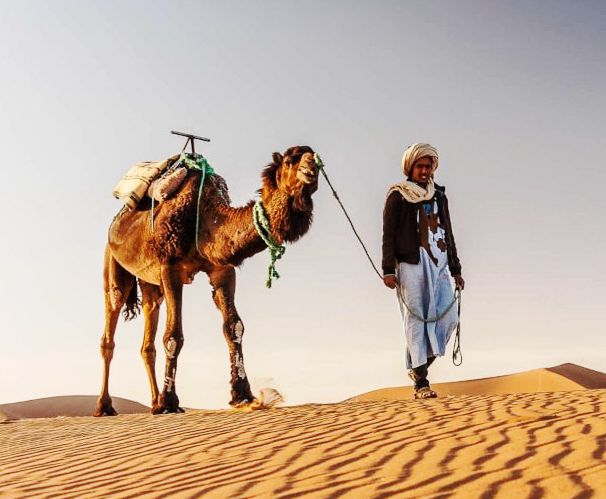
At around the same time the Lord also showed me a camel. It was, again, in the desert. Someone was trying to lead it with a rope, but it was resisting. I think the Lord was – is – saying that the camel knows that it’s got everything it needs to cross the desert: water stored in its hump; big flat feet to help it to walk across the soft sand without its feet sinking in, but we can be like camels who don’t know what they are carrying in their humps, and are resisting the person who is trying to lead them out across the desert. He says: “You have everything you need. You have my Spirit, and you have my word. I am holding the rope and I know the way you should go. You won’t wander off and get lost, so trust me and come with me across the desert. You may think it’s forbidding and barren, but it is also beautiful, and I will show you things, hidden things, that you have never seen before, because you have never been this way until now. Come, because now is the time.”

The God of David’s deliverance.

One of David’s great psalms of faith is Psalm 18, which he wrote, according to 2 Sam 22: 1, “on the day that the Lord delivered him from his enemies and Saul.” Many of the truths expressed both in Psalm 18 and in the book of Psalms as a whole – not to mention the rest of the Bible – are encapsulated in the section from verses 28-34. I wrote last week about the walk of faith. If we can allow the Holy Spirit to write the following promises on our hearts, as He did for David, I believe our walk will be strengthened. Here is the whole passage, followed by a few thoughts on each verse.

For You will light my lamp;
The LORD my God will enlighten my darkness.

For by You I can run against a troop,
By my God I can leap over a wall.

As for God, His way is perfect;
The word of the LORD is proven;
He is a shield to all who trust in Him.

For who is God, except the LORD?
And who is a rock, except our God?

It is God who arms me with strength,
And makes my way perfect.

He makes my feet like the feet of deer,
And sets me on my high places. (Psalm 18: 28-34)

He teaches my hands to make war,
So that my arms can bend a bow of bronze.

(Psalm 18: 28-34)

For You will light my lamp;
The LORD my God will enlighten my darkness
.

This is a promise. Sometimes we find darkness has descended on us like a cloud. It seems like the Lord is enthroned in another universe – if He even exists at all – and all we have is the experience of our flesh and our immediate circumstances. But the Lord promises that He will light our lamp. The light shines in the darkness, and the darkness has not overcome it. If we can keep this word in our hearts, believe it, speak it out, and ask the Lord to manifest its reality, it will strike the match that lights the lamp.

In addition, He promises to give us direction when we are lost or confused. His word is a lamp unto our feet and a light unto our path: he will show us not only where to put our feet next, but – although sometimes we have to wait for this – He will shine a light on the direction of our path ahead.

And finally, this is a promise of revelation. We can, and do, read the word diligently; we can quote promises of healing and provision, or whatever else we need, but our lamp can remain unlit. If the Word of God is the  sword of the Spirit, we need the Spirit to wield it; it’s not enough to quote it mechanically. And if it is a lamp unto our feet we need the Spirit to light it: a memory verse that is not breathed into us by the One who wrote it is not likely to guide our feet anywhere. We need the Word, and we need the Spirit. This applies as much to our personal devotions as it does to our church services.

For by You I can run against a troop,
By my God I can leap over a wall

Jeremiah 12:5 says “If you have run with the footmen, and they have wearied you, Then how can you contend with horses?”  As deep darkness spreads across the nations (Isaiah 60:2) we will need to be moving in the opposite direction to the troop of the world. Temptation, persecution, hardship, financial pressure are all “horses” that we could face. But God promises that He will be with us in our trials, and if we do not allow ourselves to be swept along by “the troop” but trust in His faithfulness and the power of His Spirit, we will see the glory of the Lord appear over us as He promises in Isaiah 60:2.

We can apply the second part of this verse to many metaphorical “walls,” but one wall that the enemy is always trying to fortify is that of division within the body of Christ. Jesus wants us united so that the blessing can be commanded (Psalm 133); Satan will do all he can to prevent this from happening. The flesh will always seek to protect its own interests, so it is only by the Spirit, in the love of Christ, that we can be one with our brothers and sisters in Christ and attain to “the unity of the Spirit in the bond of peace.” (Eph 4:3)

As for God, His way is perfect;
The word of the LORD is proven;
He is a shield to all who trust in Him.

God says: “I will instruct you and teach you in the way you should go; I will guide you with my eye.“ (Psalm 32:8) As I have written elsewhere, if someone is going to guide us with their eye we need to be looking at them in order to see what they are looking at. In general terms His way will always be the way of Love, and because love fulfils the whole of the law it will always be perfect, but in the specific context of our own daily need for direction, His way will always be our perfect option when we follow his guidance. Man’s wisdom at best is relative and incomplete, whereas God’s word contains no impurities: the Hebrew word translated as “proven” has the connotation of smolten metal that has had all the dross removed. So His proven word can always be relied upon to give us perfect direction: our part is to trust Him. It is not the words themselves that are our shield, like some sort of spell or mantra; it is the God who speaks them. When we look to Him and trust Him to be our shield, it is not so difficult to follow in the direction that He gives us.

For who is God, except the LORD?
And who is a rock, except our God?

There is one God, Father, Son and Holy Spirit, world without end. Salvation, deliverance, Life itself, an only be found in Him. Is God the rock on which we build our lives, or is it our career, our family, our wealth, our status, our marriage, our ministry? This verse needs very little comment, except the concluding words of the first epistle of John: “Little children, keep yourselves from idols.” (1 John 5:21) An idol is anything that takes the place of God in our hearts. Only He can have the place of lordship.

It is God who arms me with strength,
And makes my way perfect.

The word translated here as “arms” actually means “clothes,” or “girds,” as in being girded with armour. The verse actually speaks of the strength provided by the armour of God. Another meaning of the word translated here as “perfect” is “complete.” When we have put on the Ephesians 6 armour of God we are complete in Christ. Putting on the armour is the same as putting on Christ.  Psalm 93:1 says, “The Lord is clothed, He has girded Himself with strength.”  The armour that He is wearing is the strength that He arms us with. “Putting on the armour” isn’t a ritual to go through in our morning devotions: what we need to do regularly is to check that we have never taken any of it off. When we are “armed with” faith, salvation, righteousness, truth, and peace, wielding the Word of God, our way is perfect and we stand clothed in Christ. If any of them are missing we are less than complete.

He makes my feet like the feet of deer,
And sets me on my high places.

Have you ever seen a deer slip on a mountain path? Exactly: they don’t.  Ephesians 2: 6 tells us that we are seated with Christ in heavenly places; and Zechariah 3:9 tells us that, in Christ, we will  have “places to walk among those who stand here” (in the courts of Heaven). We are called to walk after the Spirit and not after the flesh (Romans 8:4), and to walk after the Spirit is to walk in the high places where God has set us. He wants us to be sure-footed, not taking a couple of spiritual steps then falling into carnality. He gives us those deer’s feet, and He lifts us to our high places: the truth of these words only manifest in our lives when we are yielded to His Spirit. And it is “my high places” where He sets me; not someone else’s. Each of us has a place of authority, the place of our call, where His anointing will flow. If you don’t know yet what your “high places” are, ask the Lord to show you.

He teaches my hands to make war,
So that my arms can bend a bow of bronze.

Finally, we are called to battle, whether we want to recognise it or not. A bow of bronze would have been a formidable weapon in David’s time, but you couldn’t use one effectively without training. And this isn’t all theory and interesting ideas: after we had studied this passage in School of Prophesy recently, Anne and I went for a walk on Cannock Chase (an area of wooded heathland near our home). While we were there we saw a small group of people – four or five – join hands round a tree and appear to pray, but they looked, and felt in our spirits, shifty and dark. If they were praying, they were not praying to Jesus. When they had gone, we went to the tree to investigate, and found a couple of memorials there to people who, presumably, had died. We prayed, for light to come into the darkness there, and for curses to be broken. God was teaching our hands to make war.

He will lead us into victory, and His glory will rise over His church as the times get darker; but we will need to fight for it.

In Him we live and move and have our being

Psalm 119: 116 says “uphold me according to your word, that I may live, And do not let me be ashamed of my hope.“ God’s word is not just ink printed on a page. It’s not just a collection of true stories, a set of ideas and principals to live by, descriptions of past events and prophecies of future ones, although it is all of those.

Hebrews 4: 12 says God’s word is “living and powerful and sharper than any two edged sword … and is a discerner of the thoughts and intents of the heart,”  and in Hebrews 1:3 we read that Jesus is “upholding all things by the word of His power.” These are profound statements, but they are also very familiar to most Christians who have any knowledge of the Bible: how can we take hold of them and position ourselves so that we don’t lose their depth in their very familiarity, but experience the reality of our lives being upheld by the word that upholds the Universe?

God said in Isaiah 55:8 that His thoughts are not our thoughts, and his ways are not our ways; that they are as far from us as the heavens are from the Earth.  Indeed, if we could comprehend those thoughts with our little human brains then He wouldn’t be much of a God, and the mystery of faith that underpins our relationship with Him would be non-existent. So in as much as I can stretch my thinking in the direction of His truth, I see it like this:

Just like the force of gravity in the natural world, God’s word is an ever present force in the spiritual realm. Speaking of the Temple, Hebrews 9:5 tells us that things on earth are but a shadow of the reality in Heaven (Hebrews 8:5). In the same way, I think that the power and the immanence of the word of God must be more tangible, its light more visible and its truth more discernible in heavenly places than they are on earth. Only in Christ, in the incarnation that we celebrate at Christmas, did the fullness of God’s word enter earthly dimensions; and since Pentecost the power of His word has arced in and through the body of Christ like an electric current as the Holy Spirit has taken what is Christ’s (John 16:5) and brought heaven to earth to build His kingdom. The Incarnation is more than Christmas; it is now: the Spirit of God is always wanting to make His word incarnate in our lives as we, His body, grow “to the measure of the stature of the fullness of Christ.” (Eph 4:13)

Kairos moments
To illustrate this, here are a couple of examples of how His word has supernaturally reached from heaven to earth in my experience. These are “kairos moments,” moments when, according to Webster’s dictionary, “conditions are right for the accomplishment of a crucial action; the opportune and decisive moment.”

I know a young Christian man who is a military pilot. When he was first deployed onto an aircraft carrier, I wanted an encouragement for him from the Bible that God would always be with him. I didn’t look the following verses up because I knew them and thought they were appropriate; they were the next section in my reading on the morning when I prayed for him:

“If I take the wings of the morning,
And dwell in the uttermost parts of the sea,
Even there your hand shall guide me,
And your right hand shall hold me.”
(Psalm 139 9-10)

Is there another verse in all the Bible that would have been more fitting for him then? I don’t think so. I cannot begin to fathom how God so arranged the universe for my reading of that scripture and my prayer for his deployment to coincide, but coincide they did: His living, active word reached across from heaven to enter a young man’s situation, answering his prayers and mine in one kairos moment.

More recently– in October 2024 – I was due to fly to Dallas from the UK for a business conference. I had invested time and money into the event, and I was expecting it to be profitable for our business. But a situation came about in the UK that suggested I should be here and not in Dallas. When I prayed about it, I felt the Lord strongly confirming that this was with was the case, so I didn’t go.

On the night when I should have been flying, I couldn’t sleep: did I hear from the Lord? Should I be on that plane? I really needed to know that I had heard from God and had made the right decision. It would have been too late to change my mind, but I needed to know for my own well-being.

In the morning, again, not by any prior knowledge of the scripture or seeking comfort by looking through an index of relevant verses, I read the following words:

“I will bless the lord who has given me counsel, My heart also instructs me in the night seasons.“ (Psalm 16:7)

I had wanted to know that I had heard from the Holy Spirit, but He wanted me to know as well. He had given me counsel and had instructed my heart in the night season.

Just as the word of Christ upholds universe by his mighty power, so He wants to bring His word into our lives by His Spirit, to uphold us “that we may live.“ Our God loves to communicate with us. His sheep hear his voice. Moreover, Acts 17:28 tells us “In him we live and move and have our being.” But any signal needs a receiver, so to step into these Kairos moments we need our spirits to be in tune with His. We can look at the River of Life, or we can step into it.  If you have not ever experienced the reality of moving in the dimension of the word of His power, take a step forward in your Christian life and make 2025 the year that you get your feet wet. And if, like me, you feel you may have sometimes dipped your toes into this wonderful heavenly stream, let’s at least try and get in up to our knees by the time we next celebrate the Word made flesh and dwelling among us.

Have a blessed new year!

“Lord, teach us to pray!”

When they disciples asked Jesus to teach them to pray, what did He do? The standard answer is “He gave us the Lord’s prayer.”

Indeed He did, but the Lord’s prayer wasn’t all the teaching. The Lord’s prayer in Luke 11 finishes at verse 4 with “Deliver us from the evil one,” but the teaching continues in verse 5:

“And He said to them, “Which of you shall have a friend, and go to him at midnight and say to him, ‘Friend, lend me three loaves; for a friend of mine has come to me on his journey, and I have nothing to set before him.”

The parable of the Importunate friend follows, concluding with the exhortation from Jesus, transcribed  in the Greek present continuous tense, to “Ask (and keep on asking), and it will be given to you; seek (and keep on seeking) and you will find; knock (and keep on knocking) and the door will be opened to you.” We are not told why we need to persist, but we are told it is important: Jesus repeats the point in the parable of the unjust judge (Luke 18:1-8). We can hazard some guesses as to why: maybe our persistence demonstrates our love, maybe it builds our faith, and God certainly needs to see both our love and our faith when we come to Him in prayer. And sometimes we need to persist because we have an enemy who is interfering with the process, as Daniel discovered (Daniel 10:13-21) when the answer to his prayer was delayed. But persist we must.

There is still more to this than an encouragement to persist in prayer. The friend isn’t asking for bread for himself; he is asking for bread for “a friend who has come to me on his journey.” Jesus is teaching us to persist in our prayers for others who are on their own journey, and whose need has come to our attention. So as well as being persistent, prayer here is about the needs of others. A distinction between the old and new testament models of prayer is that old testament prayer – primarily the Psalms – is about seeking God to meet personal needs; whereas the new testament model is about “us,” whether we are looking at the Lord’s prayer (forgive us, lead us, deliver us, give us) or Paul’s prayers for the churches. Love flows through new testament prayer life. We pray for our friends; our friends pray for us.

Living Bread
Now we come to the prayer itself. The friend asks for bread. As we know from Matthew 4:4 the “bread” that we are to live by is “every word that proceeds from the mouth of God.” The importunate friend asking for bread represents us going to our Friend, Jesus, and asking Him for a word from the mouth of God that will meet the need of our companion. God “watches over His word to perform it.” (Jer 1:12) God’s word is “living and active” – it is imbued with God’s life and energy (the Greek translated as active is energes). We find the same “energy” word when James is writing about the prayer of a righteous man: “Confess your trespasses to one another, and pray for one another, that you may be healed. The effective, fervent prayer of a righteous man avails much.” (James 5: 15) Again, prayer here is not asking for bread for self, but for others.

 God says of His word

“It shall not return to Me void,
But it shall accomplish what I please,
And it shall prosper in the thing for which I sent it.”
(Isaiah 55:11)

It is the word itself that carries the power to heal, provide, deliver. Jesus cast out demons with a word. The nobleman who came to Jesus for “bread” for his sick son “believed the word that Jesus spoke to him,” (John 4: 50) as did the centurion with the sick servant. (Luke 7: 1-10) Jesus tells us that the words He speaks to us “are spirit, and they are life.” (John 6:63) And not only do the words – the “bread” – that we receive carry the life and power of God, they also carry the weight of His authority. His word is forever “settled in heaven.” (Ps 119:89) The Strong’s entry for the Hebrew word translated as ”settled” is “to stand, take one’s stand, stand upright, be set (over), establish.” The rule of God’s word over creation, and over the prayer need that we have sought it for, is established forever. Jesus told the nobleman “Go your way, your son shall live.” When we receive a word from the mouth of God that our needy friend can live by, that word has the authority of heaven to bring God’s rule into their situation, and the life and energy to transform it. We have to persist until we receive it.

Stones and Bread.
Jesus finishes His teaching on prayer with a final set of illustrations:

“If a son asks for bread  from any father among you, will he give him a stone? Or if he asks for a fish, will he give him a serpent instead of a fish? Or if he asks for an egg, will he offer him a scorpion? If you then, being evil, know how to give good gifts to your children, how much more will your heavenly Father give the Holy Spirit to those who ask Him!” (Luke 11: 11-13)

The “bread” is always delivered by the Holy Spirit. Jesus said of the Holy Spirit “He will glorify Me, for He will take of what is Mine and declare it to you.” (John 16:14) We cannot receive a word from God by looking in a Bible index to find an appropriate scripture, unless the Lord sovereignly leads us there. We cannot quote a healing verse that we know and apply it to someone’s sickness unless the Holy Spirit has quickened it to us.  We cannot recite learned verses of God’s provision and expect our bank accounts to suddenly go into credit. We cannot wield the sword of the Spirit, the word of God, other than by the Spirit. It is always “by my Spirit,” never “by might nor by power.” (Zech 4:6)

Our Father in Heaven is longing to give us bread: He doesn’t give stones. And He wants us to ask for bread until we get it: the Greek word aiteō, translated as “ask,” suggests the confident requisitioning of items that the giver expects to release; or “insistent asking without qualms,” as one commentary puts it. James makes it clear that prayers with selfish motives are not answered when he writes: You ask and do not receive, because you ask amiss, that you may spend it on your pleasures. (James 4:3) But I think there may be many cases of unanswered prayer that come about because we are not waiting for the Spirit to deliver the bread, and we are not persisting in our asking. Instead we pick up the nearest stone, and wonder why it doesn’t bring life.

Eating the Word of God

“My food is to do the will of Him who sent Me and to finish His work.” (John 4:34)

When we eat bread, or any other food, the body converts it into energy, and the energy turns to action. So it is with the word of God: we “eat” by believing, then we turn that belief into action by our obedience. This is the dynamic of living faith. We know from scripture that “the word of God s living and powerful” (Heb 4:12). The Greek word translated as powerful, or “active” in other translations, is energes. The Word, like physical bread, delivers the energy to act. James is very clear when he writes to the church about action:

“But do you want to know, O foolish man, that faith without works is dead? Was not Abraham our father justified by works when he offered Isaac his son on the altar? Do you see that faith was working together with his works, and by works faith was made perfect? And the Scripture was fulfilled which says, “Abraham believed God, and it was accounted to him for righteousness.”  And he was called the friend of God. You see then that a man is justified by works, and not by faith only.”  (James 2: 20-24)

The flabby church
When we eat our fill but are inactive, the food we consume turns to fat and not to energy. We can become flabby and inert. If we fill ourselves with scripture and teaching and do not act on what we have read and heard, even though we believe it to be true, we risk turning into a flabby church, rich in theology but poor in active faith. When Jesus addresses the seven churches in the book of revelation He begins each message with the statement: “I know your works.” He didn’t say, “I know your theology or I know your worship meetings; He said “I know what you do.” The church at Laodicea thought that they were “rich” and that they needed nothing – they had got everything right – but Jesus called them “wretched, miserable, poor, blind, and naked” (Rev 3: 17). Because their works were lukewarm Jesus said He would ‘vomit them out of his mouth’ if they did not repent of their ways.

Laodicea was a flabby church. Great worship, great teaching, but not much action. It contrasts with the church at Philadelphia, of whom Jesus says: “I know your works. See, I have set before you an open door, and no one can shut it; for you have a little strength, have kept My word, and have not denied My name.” (Rev 3: 8-9). The word translated here as strength is the power-word “dunamis,” used almost exclusively in the NT for supernatural, miracle working power; the power of the Spirit. Clearly they saw some signs and wonders. Not a lot, but they did see a little. Moreover, they “kept His word”. They didn’t just hear His word, but they obeyed it. They “kept (His) command to persevere” (Rev 3:10). Their faith was active. They were a church of Word and Spirit, those whom the Father is seeking, who “worship in Spirit and in Truth.”

“Go your way, your son lives.”
The account of the nobleman’s son that I was also looking at in the last post (From Faith to Faith) (John 4: 47-54) Illustrates this kind of active faith. The man had begged Jesus to come and heal his son. “Come down before my child dies.” He wanted Jesus to come to his house and physically heal him. In his mind Jesus had to come with him to his house for his son to stay alive, but instead Jesus simply tells him  “Go your way, your son lives.” His faith was not just to believe in His power to heal, but to act on that faith by walking away and not trying to persuade Jesus to come with him. Verses 52-53 is significant: “Then he inquired of them the hour when he got better. And they said to him, “Yesterday at the seventh hour the fever left him.” So the father knew that it was at the same hour in which Jesus said to him, “Your son lives.” And he himself believed, and his whole household.”

There were no mobile phones in those days. This was a two day journey. Every step was a step of faith: he had to believe the word that was spoken to him if he was going to see his son alive again. What if…? What if…? And here in this short account is a model for the prayer of faith. We pray: (Lord, come down and heal my son!”); God answers (Go your way, your son lives); we believe the word He has spoken, but we have to wait to see that answer fulfilled (two days’ walk); yet as we wait we believe that the healing has already taken place. For new covenant Christians it was at the Cross (By His stripes we were healed), and for the nobleman’s son it was when Jesus released His word of life (Your son lives) and with it the command to believe (Go your way).

Believe, receive, and obey.
Very often our prayers don’t follow this pattern. We usually start well, in that we go to Jesus with our prayer; but we often miss the next step in this story, which was to hear the words that Jesus (by His Holy Spirit) speaks in response to our prayer. So our faith remains at the level of generalities: we hope Jesus will heal (or provide or whatever) because we know He can, rather than knowing what He has said to us about our situation and believing the word He has spoken into it. So for the first scenario we are “hoping and praying” for an eventual outcome: we endeavour to put our trust in who God is, but we don’t have an answer that He has spoken into our relationship with Him now, so there is no dynamic element to our faith.  In the second scenario we have met with Jesus in that moment, we have heard what He has said, we are believing that the word that has been spoken has already changed the situation in the Spirit, and we are walking towards seeing it in the flesh just as the man walked towards his restored son. We are in the reality of Mark 11:24: “Therefore I say to you, whatever things you ask when you pray, believe that you receive them, and you will have them.” We receive the answer to the prayer in the spiritual present, but we walk towards it in the material future.

The man received the healing of his son the moment he believed the word that Jesus had spoken, but he also had to obey the command to go his way in order to see it manifest. There is a very famous painting by Holman Hunt, picturing the words of Christ “Behold, I stand at the door and knock…” These words are generally applied to the state of the unbeliever’s soul, waiting for Jesus to come in with salvation. However He actually spoke them to believers, specifically to the Laodiceans, whom He had just chastised for their lukewarmness: “As many as I love, I rebuke and chasten. Therefore be zealous and repent. “Behold, I stand at the door and knock. If anyone hears My voice and opens the door, I will come in to him and dine with him, and he with Me.” (Rev. 3: 19-20)

Jesus had set before the Philadelphians “an open door, and no-one can shut it.” By contrast, the Laodiceans had a closed door, which He was waiting for them to open. I think many of us may be more keen to have the experience of hearing God’s voice than we are to opening the door to actions of faith and love; but if we want to dine with Jesus we need to do what He says, and not just listen to His words.

From Faith to Faith

“So Jesus came again to Cana of Galilee where He had made the water wine. And there was a certain nobleman whose son was sick at Capernaum. When he heard that Jesus had come out of Judea into Galilee, he went to Him and implored Him to come down and heal his son, for he was at the point of death. Then Jesus said to him, “Unless you people see signs and wonders, you will by no means believe.” The nobleman said to Him, “Sir, come down before my child dies!” Jesus said to him, “Go your way; your son lives.” So the man believed the word that Jesus spoke to him, and he went his way. And as he was now going down, his servants met him and told him, saying, “Your son lives!” Then he inquired of them the hour when he got better. And they said to him, “Yesterday at the seventh hour the fever left him.” So the father knew that it was at the same hour in which Jesus said to him, “Your son lives.” And he himself believed, and his whole household. This again is the second sign Jesus did when He had come out of Judea into Galilee.”

Signs and wonders: we all want to see them. Why was Jesus so disparaging about the miraculous here, particularly since he says later that “the works which the Father has given Me to finish—the very works that I do—bear witness of Me, that the Father has sent Me.” (John 5:36)? The importance of this second sign is that Jesus is looking for faith – “the evidence of things hoped for” (Heb 11:1) – that will draw people to the Father who sent Him, not just followers seeking the supernatural for their own benefits. To believe on the basis of a miracle that is seen is evidence-based, not faith-based, and does not generate the Hebrews 11:1 faith that reaches into the unseen. But faith that “believed the word that Jesus spoke” will continue to believe the words that Jesus speaks, and opens the door to eternal life: “He who hears My word and believes in Him who sent Me has everlasting life, and shall not come into judgment, but has passed from death into life.” (John 5:24)

When Jesus withstood the first temptation, he said, quoting Deuteronomy 8:3, “It is written, Man shall not live by bread alone, but by every word that comes from the mouth of God.” (Matt. 4:4) A few verses on in the discourse to the Pharisees quoted above, Jesus states: “I can of Myself do nothing. As I hear, I judge; and My judgment is righteous, because I do not seek My own will but the will of the Father who sent Me.” Although the word translated here as “judge” – krino –  is most commonly used in English with reference to judicial processes, the meaning of the Greek is much broader and relates primarily to mental judgement: having an opinion or making choices and decisions in any context, not just that of human behaviour. Jesus is basically saying, ”Whatever the situation, I do what the Father tells me; I don’t just do what I like. What the Father says is what I do. I live by every word that comes from His mouth.”

Paul writes: “For in it (“it” refers to the gospel) the righteousness of God is revealed from faith to faith; as it is written, “The just shall live by faith.” (Romans 1:17) Jesus says explicitly here that the righteousness of His decisions comes from the fact that He always does what the Father says, and by implication His human flesh has no say in anything. When we believe in Jesus and are born again His righteousness becomes ours, but to reveal His righteousness on a daily basis we have to live by His words, “from faith to faith.”  If we want to witness to Christ, His righteousness must be revealed in us. There is only one way to achieve this: just as Jesus said to his disciples after the meeting with the Samaritan woman, (John 4) our food must be to do the will of the one who sent Him.

Ask, Seek, and Knock: Living the Sermon on the Mount.

Jesus introduces the sermon on the mount with the statement: “”Blessed are the poor in spirit, for theirs is the kingdom of heaven.” It’s easy to miss the full meaning of “poor” in this context. The Greek word used here is ptochos – which Strong’s defines as “ reduced to beggary; asking for alms, destitute of wealth, influence, position , honour.” The Kingdom of Heaven belongs to those who know, deep in their spirits, that they have absolutely nothing of their own that could deserve it. As evangelicals we know that of course – or at least, we certainly should – which is why we have to come to the Cross for forgiveness and be born again. But what struck me is the connection between this opening statement of the Lord’s ministry and these verses in the middle and towards the end of the sermon:

 “Seek first the kingdom of God and His righteousness, and all these things shall be added to you.” (Matt 6:33)

“Ask, and it will be given to you; seek, and you will find; knock, and it will be opened to you. For everyone who asks receives, and he who seeks finds, and to him who knocks it will be opened. Or what man is there among you who, if his son asks for bread, will give him a stone? Or if he asks for a fish, will he give him a serpent? If you then, being evil, know how to give good gifts to your children, how much more will your Father who is in heaven give good things to those who ask Him!” (Matt 7: 7-11)

Maybe it’s my own carnality at work here, but when I’ve thought about the “good things” that my Heavenly Father has in store for me I have tended to think more in terms of earthly “things” than heavenly ones. I think that this is mainly because it comes after verse 33 of the previous chapter, quoted above, where Jesus makes it very clear that we should trust our heavenly Father for our material needs, and keep our focus on the Kingdom of God and His righteousness. But in the context of this verse, what we surely “ask, seek and knock” for is the Kingdom and the righteousness of God, not our material provision. In fact Jesus tells us specifically not to worry about the other stuff that the Gentiles – the people who don’t know God – seek. He doesn’t say don’t ask for it at all, because He teaches us practically in the same breath to ask for our daily bread, but what He wants us to do is to trust our Father, Jehovah Jireh, as the faithful source of our provision and not to worry about it and “seek” it because we don’t know where it is coming from. We do know.

Manna from Heaven
The tense of “Ask, seek and knock” is the present continuous: “ask and keep on asking…”  If God gives us good things from the storehouses of Heaven when we ask for them, Jesus is telling us not only to seek, and keep seeking, the Kingdom of God; but also that He will give us what we ask for: “Ask, and it will be given to you, seek and you will find…” as indeed Luke adds in his rendering of this passage: “Do not fear, little flock, for it is your Father’s good pleasure to give you the kingdom.” (Luke 12:32)

This is where we return to our opening verse: “Blessed are the poor in spirit, for theirs is the kingdom of heaven.” Those who receive the blessing are the spiritual beggars, continually crying out to God for His Kingdom and His righteousness, but also knowing that it is His good pleasure to keep answering their prayers. God wants relationship: He want us to keep coming and receiving from His hand, not helping ourselves, like hopper-fed chickens, to the provision that he has downloaded and left for us. Manna from Heaven only lasts one day.

Therefore…
Bible Teacher Andrew Wommack famously says, “Whenever you see a therefore, you must ask what it is there for.”

Verses 11-14 of Matthew 7 go like this:

“If you then, being evil, know how to give good gifts to your children, how much more will your Father who is in heaven give good things to those who ask Him! Therefore, whatever you want men to do to you, do also to them, for this is the Law and the Prophets. Enter by the narrow gate; for wide is the gate and broad is the way that leads to destruction, and there are many who go in by it. Because narrow is the gate and difficult is the way which leads to life, and there are few who find it.”

So what is this therefore there for? Jesus seems to jump completely from one topic to another. But if we work backwards through this statement  I think we can see where He is going. To obey the Law – to do God’s will – we have to enter the narrow gate, and not travel the broad way. We can only enter by the narrow gate if we are poor in spirit and ask Father to give us what we need to live a Kingdom life. Only when we ask for His Kingdom provision can we truly achieve the love for others that the Royal Law demands. It is difficult; we have to keep asking for the Kingdom of God to be a reality in our lives (“Your Kingdom come..) to stay on this path. Like the hero of Pilgrim’s Progress, it is easy to wander off track. A comparison with Luke’s rendering is again useful here: instead of saying our Father will give “good things” when we ask, Luke says: “If you then, being evil, know how to give good gifts to your children, how much more will your heavenly Father give the Holy Spirit to those who ask Him!” (Luke 11:13)

Good Things
The “good things” we need from the hand of God to love others as we love ourselves only come by the Holy Spirit, and we have to keep asking for them. Another well-know present continuous tense in the New Testament is Eph 5:18: “Be filled (keep being filled” with the Holy Spirit.”  To keep being filled with the Holy Spirit isn’t just so that we can walk in supernatural gifting: we need to keep being filled because if we don’t we are spiritually destitute and lacking in the righteousness of the Kingdom of God. “Blessed are they who hunger and thirst after righteousness, for they shall be filled.”

As Jesus comes to the end of His message He makes it clear that it is not the gifting that we receive by the Spirit but our love –the love of God –  “that has been poured out into our hearts through the Holy Spirit, who has been given to us” (Romans 5:5) – that qualifies us for Kingdom entry. When He tells us that it is “by their fruits” that we can tell the difference between true sheep and “ravenous wolves”, He says: “Many will say to Me in that day, ‘Lord, Lord, have we not prophesied in Your name, cast out demons in Your name, and done many wonders in Your name? And then I will declare to them, ‘I never knew you; depart from Me, you who practice lawlessness!” (Matt 7:23)

Building on the rock
Those who ‘do many wonders’ but whom Jesus says He never knew are the ones who don’t obey “ the Law and the prophets,” which is to love others by our actions, doing to them as we would have done to ourselves.  This is how we enter by the narrow gate. It is not our gifting that brings us into the kingdom of heaven, but our obedience to the Royal law, which produces our fruitfulness. (Matt 7:17) The great themes of this introduction to the Kingdom of God cascade right through the New Testament – abiding in the vine (John 15), bearing the fruit of the Spirit (Galatians 5), the deception of spiritual pride (The Church in Sardis, Rev 3) and much, much more.

The Sermon on the Mount ends with the picture of the house built on the rock. We build on the rock when we are obedient to God’s word, seeking Him continually for the “good things” of the Kingdom that are the foundations our house, being filled with the Holy Spirit to satisfy our hunger and thirst for righteousness. “Let your waist be girded and your lamps burning; and you yourselves be like men who wait for their master, when he will return from the wedding, that when he comes and knocks they may open to him immediately,” He says. (Luke 12: 35-36) By living in obedience to His Kingdom message today, we prepare ourselves for when He comes back tomorrow.  It is possible to build a house with gifting alone, but it will be built on sand; and when trials and temptations come it will fall. We don’t have to look far across the landscape of the church to see the houses of gifted leaders in ruins on the sandy ground of their unsubmitted lives.

More houses will fall as God continues to shake heaven and earth and purifies His bride to prepare her for His return. How do we make sure we are building on the rock? Recognise that without Him we are destitute of the good things of the Kingdom that will enable us to love others as we are commanded, and have the faith to keep asking God to fill  us with those things by His Spirit, trusting Him for our daily provision, which we keep second in line to our great spiritual need.