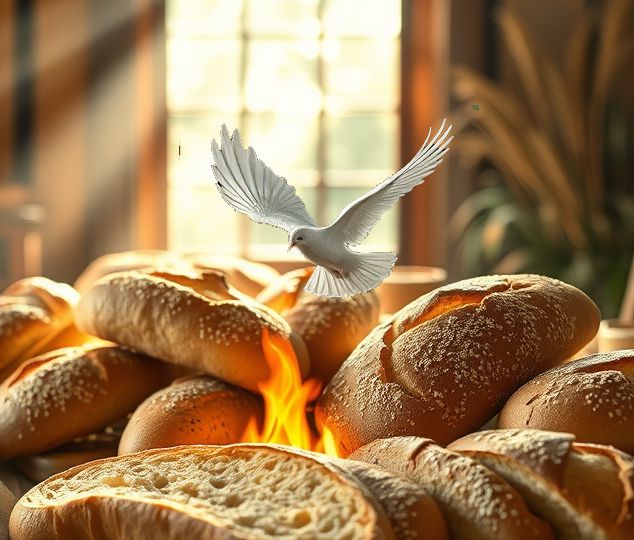
“Do not labour for the food which perishes, but for the food which endures to everlasting life, which the Son of Man will give you, because God the Father has set His seal on Him.” (John 6:27)
We have seen how Jesus used the sign of the loaves and fishes to model a fundamental principle of His economy, which is, as the couriers sang way back in 1978 (thanks, for the link, CA!) that “God cannot put His riches into hands already full.” In addition, this sign demonstrates the management structure of the Kingdom of God: through Jesus, the bread of Heaven is passed on to the disciples for distribution. “Freely you have received, freely give,” He said when He commissioned the disciples to “Heal the sick, cleanse the lepers, raise the dead, cast out demons.” (Matt 10:8). We receive in order to give.
Sent to multiply
I think we can sometimes come to Jesus in gratitude and love for making a way at the cross for us to approach the Father, but then run there to soak up Father’s love and forgiveness without looking back to Jesus to ask Him what He wants us to do with it. But Jesus stands between us and the Father not just to represent us to Him, but to represent Him to us. “As the Father has sent me, so I am sending you,” He says in John 20:21, and when He is referring to Himself as the Bread of Life, He says: “As the living Father sent Me, and I live because of the Father, so he who feeds on Me will live because of Me.” (John 6:57) As His life on earth was the Father’s life, so our life on earth is His life in us. And life, in the natural order of God’s creation, has one purpose and one only, which is to bear fruit and multiply. Everything that grows exists to reproduce itself. Just as the first natural man and woman were told to “go forth and multiply,” (Genesis 1:28) the same mandate rests on spiritual man:
“I am the true vine, and My Father is the vinedresser. “Every branch in Me that does not bear fruit He takes away; and every branch that bears fruit He prunes, that it may bear more fruit. You are already clean because of the word which I have spoken to you. Abide in Me, and I in you. As the branch cannot bear fruit of itself, unless it abides in the vine, neither can you, unless you abide in Me. I am the vine, you are the branches. He who abides in Me, and I in him, bears much fruit; for without Me you can do nothing. If anyone does not abide in Me, he is cast out as a branch and is withered; and they gather them and throw them into the fire, and they are burned.” (John 15: 1-6)
We have one purpose in Christ, and that is to bear fruit. We have the life of Christ in us so that we can impart it to others. It may be through salvation, through healing, prophesy or other spiritual gifts, it may be through material or financial blessing, it may be through all of these and more (1 Corinthians 12:11), but however the Spirit of God wants to use us, we live to give. Just as Jesus gave the loaves and fishes to His disciples to give to others, so we come to Him for “the food which endures to everlasting life, which the Son of Man will give you” in order to share it with others. And in doing so, we find life for ourselves.
Feeding on Jesus
Central to this passage is the idea of “feeding on Jesus.” What it means to eat His flesh and drink His blood is so crucial to the Christian faith that the Church split over its meaning in the 16th century, with the Council of Trent in 1551 solidifying the dogma of transubstantiation and declaring that the elements of the Eucharist became the actual body and blood of Jesus. As a Protestant, I don’t hold to this doctrine, so this leaves me free to ask the question: what did Jesus really mean?
I think we can find strong clues in this passage, and if we examine them in the light of a few other sayings in John’s gospel I believe we can move towards an understanding of what Jesus may be saying to His Church. The starting place is the relationship between Jesus the Son and God the Father. Looking at verse 57 again, He says; “As the living Father sent Me, and I live because of the Father, so he who feeds on Me will live because of Me.” What does it mean to “live because of the Father?” One answer is of course that this is true in a very real way: the Son of Man was actually begotten of the Father. God sent Him from Heaven by creating a natural body for Him on earth. As Hebrews 10:5 says, “when He came into the world, He said: “Sacrifice and offering You did not desire, But a body You have prepared for Me.” However, although this is true, I don’t think it’s what Jesus meant by living because of the Father. If He says that we will live if we feed on Him, just as He lives because of the Father, I think we have to look and see if He too lives by “feeding on the Father.” If He does, it will complete the equation which He uses more than once, that says “as it is between my Father and Me, so it is between me and you.” (e.g. John 20:21 above, also John 5:21, and John 15: 9-12.)
Living in the Vine
And He does. The loaves and the fishes are not the first time Jesus refers to food as being more than a meal for the stomach. After the meeting with the Samaritan woman, He says to His disciples: “I have food to eat of which you do not know… My food is to do the will of Him who sent Me, and to finish His work.” (John 4: 32-34) He says again in John 6:38 “I came down from Heaven, not to do my own will, but the will of the one who sent me.” Jesus feeds on the Father by doing His will. In fact He did nothing else: “Most assuredly, I say to you, the Son can do nothing of Himself, but what He sees the Father do; for whatever He does, the Son also does in like manner.” (John 5:19) Because this was completely true, He could say to Philip: “If you have seen me, you have seen the Father.” (John 14:9) Jesus feeds on the Father by doing His will all the time, so He only lives because of the Father. Nothing in His life is directed by anything other than the Father’s will. And so it is true for us: if we feed on Him by doing His will, we will live because of Him. In doing so we abide in Him ((John 15: 1-6 above) We live because of what the eucharist remembers (Luke 22:19) but we don’t live because we eat it. Only He has the words of life (John 6:68) but we don’t live because we devour them: we live because we do what He says. As Jesus did nothing without the Father, we can do nothing without Him (that equation again). And when we do what He says we remain in the vine, the life of the vine within us multiplies, our prayers are answered (John 15:10 “You will ask what you desire and it shall be done for you”) and we “bear much fruit.”
Servants of Christ
Jesus pointed to this with the parable of the unprofitable servant (Luke 17: 7-10) when the disciples asked Him to increase their faith: “So likewise you, when you have done all those things which you are commanded, say, ‘We are unprofitable servants. We have done what was our duty to do.” There are many references to our status as servants of Christ, such as Ephesians 6:5, 1 Cor 7:22, and 1 Peter 2:16. I think Col 3:23-24 is particularly rich in meaning, (I have written about it recently in “Heart and Soul, Doing Everything for the Lord”): “Whatever you do, do it heartily, as to the Lord and not to men, knowing that from the Lord you will receive the reward of the inheritance; for you serve the Lord Christ.” Ephesians 2:10, which I’m sure I quote more than any other verse in the Bible, tells us that “We are God’s handiwork, created in Christ Jesus to do good works, which God prepared in advance for us to do.” (NIV) As it was with Jesus, our food is to do the will of the One who sent us, and to complete His work.
So we come back to our opening reference, “Do not labour for the food which perishes, but for the food which endures to everlasting life, which the Son of Man will give you, because God the Father has set His seal on Him.” (John 6:27) A transaction took place at the cross: we exchanged our lives for the life of Christ, which we received by the grace of God alone. But this is only His part of the transaction: our side is the manner of our response. We respond in love and worship, of course; but Jesus makes it clear that love is more than a feeling, and worship is more than singing: “He who has My commandments and keeps them, it is he who loves Me. And he who loves Me will be loved by My Father, and I will love him and manifest Myself to him.“ (John 14:21)
God’s Seal
Jesus puts the food that endures to eternal life into our hands when we respond to His grace with our faithful obedience. He tells us that He can give us this bread because the Father has set His seal on Him. As we have seen, He gives it to us so that we in turn can give it to the world. Again we see here the “as with me, so with you” equation, because God’s seal on Jesus came in the form of a dove when the Holy Spirit descended on Him in the Jordan, and we too have received the same seal through Him: “In Him you also trusted, after you heard the word of truth, the gospel of your salvation; in whom also, having believed, you were sealed with the Holy Spirit of promise, who is the guarantee of our inheritance until the redemption of the purchased possession, to the praise of His glory”. (Eph 1: 13-14) It is by the Spirit that we receive the life of Christ, and it is by the Spirit that we impart it. Peter wrote: “As each one has received a gift, minister it to one another, as good stewards of the manifold grace of God. If anyone speaks, let him speak as the oracles of God. If anyone ministers, let him do it as with the ability which God supplies, that in all things God may be glorified through Jesus Christ, to whom belong the glory and the dominion forever and ever. Amen.” (1 Peter 4:10-11) God’s seal on us isn’t just a promise of our future inheritance: it is the mark of our authority and empowering to do the works that Jesus did, and greater. (John 14:12)
So we give out our bread with the ability that God supplies, handfuls feeding thousands. Those who operate in prophetic or healing ministry know what this looks like. A line of people, maybe two or three deep, maybe even more, depending on the size of the meeting, have all responded to an altar call and have come forward for ministry. Like the disciples standing there with a handful of crumbs you see the hopeful faces, all looking to the Lord to receive something from Him through you. Maybe you have a few crumbs of a word; maybe nothing at all. But you know Jesus is there, like that day on the hillside, so you look to Him, empty-handed, because that is all you can do. Then as each person comes forward for prayer, He puts fresh bread into your hand, and you see God’s abundance flow in the power of the Holy Spirit.
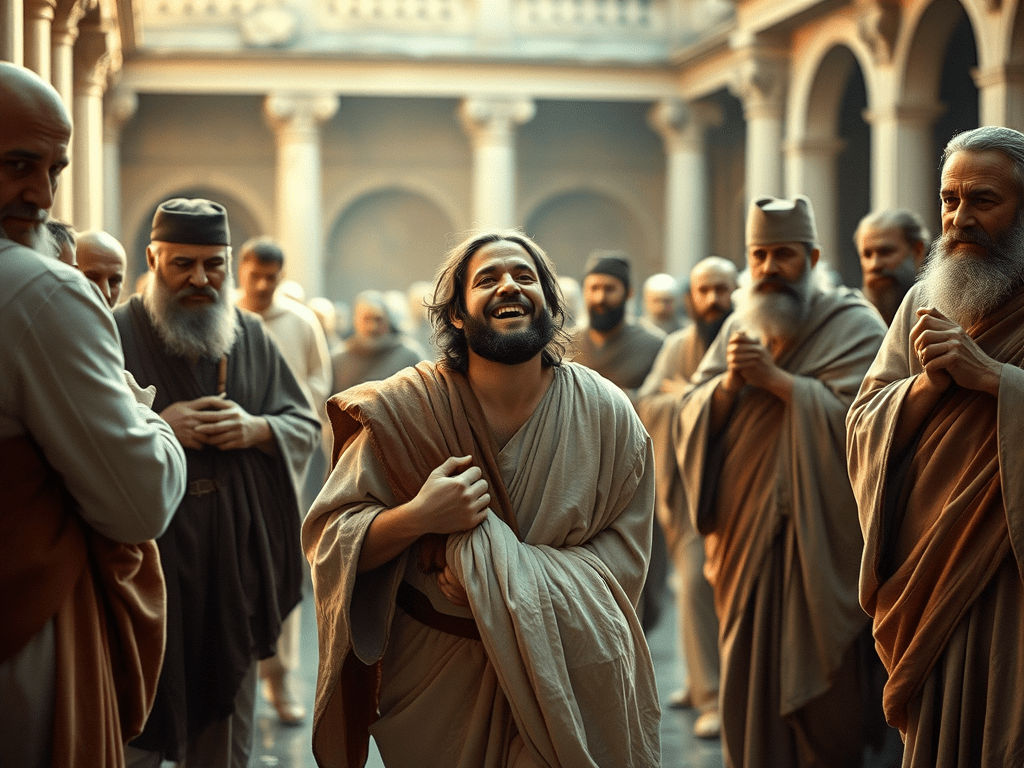
I’ll finish with a story of how this worked out in a taxi recently, and it is particularly relevant here because it features the dove. A good way of keeping the mindset of serving Christ is to quite simply ask Him this: “Lord, have you got any jobs for me today?” Anne (my wife) prayed this while she was in a taxi not long ago, and felt that she was being asked to share her faith with the asian taxi driver. Wondering how to start the conversation, they drove past a church and she commented on the architecture. That proved to be the opening that the Lord had provided, and soon the conversation turned to spiritual matters. The driver said that he had given his life to Jesus as a young man many years ago, had been prayed for to be filled with the Holy Spirit, and had a real experience of the presence of God. He went home and told his parents, and they said: “Did you see the Dove?” to which he answered “No.” They said “It’s all rubbish then. You were just imagining it. If you didn’t see the Dove, it wasn’t the Holy Spirit.” Disheartened, He believed them, and went back to his old life without giving Jesus any further thought. But God had a work prepared beforehand for Anne, and He wasn’t letting the taxi driver go. She explained that the Dove had been specifically for Jesus, and that his experience of the Holy Spirit was real. She prayed for him in the taxi, and the Holy Spirit came on him again. When she got out of the taxi, the driver jumped out as well, ran round to her, and gave her what she says was the biggest bear hug she had ever received in her life.
“Lord, I’m your servant. Have you got any bread for me today?”







 Notes From The Winepress