Category Archives: Christian Life

Seeking God’s presence and walking in His ways as a Spirit-filled believer.

The Purpose of the Commandment

“And they overcame him by the blood of the Lamb and by the word of their testimony, and they did not love their lives to the death.” (Rev. 12:11)

The task of the Ephesians 4 ministries, of which the ministry of the prophet is one, is to “equip the saints for the work of ministry, for the edifying of the body of Christ, till we all come to the unity of the faith and of the knowledge of the Son of God, to a perfect man, to the measure of the stature of the fullness of Christ.” (Eph 4: 12-13) That is actually quite a big ask. It’s one thing to run around on the walls of the city waving flags that say “Thus saith the Lord,” but it is something else entirely to enable people to respond to what the Lord saith.

In his first epistle to Timothy, Paul wrote “Now the purpose of the commandment is love from a pure heart, from a good conscience, and from sincere faith.” (1 Tim 1: 5) This commandment was the “charge” that Paul had instructed Timothy to lay upon the elders of the church at Ephesus that they should not stray from the “sound doctrine” (1Tim 1:10; Titus 1:9) outlined in verse five above. The purpose of the commandment is love. If I have been out in my car and am driving home, the purpose of everything I do is to get me home. Turn here, brake there, indicate now, stop at these lights – many different actions, but all one purpose: to get me home. I can wave lots of flags – and there are plenty of them on this website – but the ultimate purpose of them all has to be to help and encourage the body of Christ to grow in love “to the measure of the stature of the fullness of Christ.”

So according to 1 Tim 1:5, love comes from three sources: a pure heart, a good conscience, and a sincere faith. Each of these sources is in itself God-given. To start with the first one, I know for a fact that my heart, outside of Christ, is far from pure. It is addled with sin and self-interest. But also “I know Him in whom I have believed” (2 Tim 1: 12), and His heart is not only pure, but it overflows with love for me; so much so that when I am walking in the knowledge (the experience, not just the theory) of that love I can love others with it. It’s only the Cross, and the blood that He shed for me there, that can bring me into the place of relationship with Him where His love is “poured into my heart by the Holy Spirit that is given to us.” To lead others into a love that make sense of all the flags I am waving, I need to lead them into an experience of the Holy Spirit that makes His love an empirical reality. Jesus said: “Freely you have received; freely give.” (Matt. 10:8) We cannot give what we haven’t received.

Love comes from a good conscience. Again in the first letter to Timothy (1 Tim 4:2) Paul writes of those who “speak lies with hypocrisy” whose “consciences are seared with a hot iron.” These are people whose consciences have become totally insensitive to conviction of sin, for whom truth and integrity have no meaning or value. A good conscience is the opposite: open to conviction by the Holy Spirit, a good conscience is the reflection of the heart of someone who runs to Jesus whenever sinful thoughts or actions creep into their lives, whose speech is always in sincerity and truth. 1 John 1:7 says “if we are living in the light, as God is in the light, then we have fellowship with each other, and the blood of Jesus, his Son, cleanses us from all sin.” It is the blood of Jesus that keeps us in the light, so we can love (“have fellowship with”) one another.

When Jesus first saw Nathaniel approaching, he said:  “Behold, an Israelite indeed, in whom is no deceit!” (John 1: 47) In the Spirit Jesus had already seen Nathaniel “under the fig tree” and knew his heart. The Father’s vision for His people was – and still is – that they would represent His ways on Earth, and although we can only guess at what Jesus meant, it would seem logical to assume that the transparency inherent in being without deceit, also translated as “guile,” is a prerequisite to effectively representing and demonstrating the love of God on Earth. The name Nathaniel means “Gift of God.” The transparency of a clear conscience can only be ours through the Cross, as a gift of God’s grace.

Finally, love comes from a sincere faith. Sincere means without hypocrisy; without pretence. Sincere faith is faith that is lived, not just faith that is theorised about.  I have written in The Mind of Christ about Peter stepping out of the boat, but another good example of faith at work can be found in Jeremiah 32 vs 1-23. Jeremiah has been imprisoned by King Zedekiah for prophesying God’s judgement on his sins and the sins of Judah. Jerusalem itself is already under siege: destruction and exile to Babylon are imminent. In this context Jeremiah receives a word from the Lord to buy his cousin’s field at Anathoth, which was a priests’ city about three miles from Jerusalem. He obeys the Lord, signs the deeds for the field in the presence of witnesses, weighs out good silver for it, then buries the deeds in a pottery jar to preserve it as a testimony to God’s faithfulness, in anticipation of the day when his prophesy of Jerusalem’s ultimate and glorious restoration would be fulfilled. Jeremiah didn’t just stand up in the storm of imprisonment and destruction and say “God is going to restore Jerusalem:” he demonstrated his faith that God would do as He said.

Those of us who teach and/or prophesy the word of God have a responsibility to demonstrate in our lives that we believe it. We have to be prepared to buy the field; to start walking impossible steps on the waves. We have to have a testimony: without one, our faith is just a theory.  Paul said to the Corinthians “Imitate me, as I imitate Christ.” (1 Cor 11:1). It’s not enough to say “Step out of the boat!” We have to step out of the boat ourselves and say “Follow me!” In doing so we are also demonstrating that we do not love our lives unto death, because if any sinking is going to happen, we will be the first under the water. However if we stay afloat, we are able to reach out a hand to others in the name of the One that we are standing next to and lift them out of the waves.

In “the Mind of Christ” I also wrote how the “effective working” in Ephesians 4: 16 – “the effective working by which every part does its share, (that) causes growth of the body for the edifying of itself in love” – exclusively means the use of supernatural power. The power that God makes available to us is analysed in detail for us in 1 Corinthians 12 and 14, and is commonly referred to as the Gifts of the Holy Spirit. The growth of the Body which fulfils the vision and purpose of Jesus, the head, happens when all of us are open to, and operate, in the gifts of the Holy Spirit.

If we want to know where to aim for, it’s helpful to remember what Jesus calls effective working. It is what He tells the disciples to do with what they have freely received: “Heal the sick, cleanse the lepers, raise the dead, cast out demons.” (Matthew 10:8) The gifts of the Spirit that He is telling them to use are italicized below: “But the manifestation of the Spirit is given to each one for the profit of all: for to one is given the word of wisdom through the Spirit, to another the word of knowledge through the same Spirit to another faith by the same Spirit, to another gifts of healings by the same Spirit to another the working of miracles, to another prophecy, to another discerning of spirits, to another different kinds of tongues, to another the interpretation of tongues But one and the same Spirit works all these things, distributing to each one individually as He wills.” (1 Cor 12: 7-11) As Paul writes to the Philippians, we may not have already attained, but we press on towards the goal. John Wimber, an icon in the ministry of healing, said that he must have prayed for a thousand people before the first one was actually healed…

Confidence to operate in the supernatural is best achieved in small groups, down to twos and threes. One of our School of Prophesy members suggests that those who are not confident in using the gifts connect with those who are, and who can help that gift to grow. She says “Growth in the use of gifts helps us to hear from the Lord – we connect in like interconnecting wires attached to the main body.” This seems entirely scriptural to me, as it is a practical application of the principle of discipleship and will contribute to “the effective working by which every part does its share.”

Revelation 12:11 says that the saints overcame the enemy “by the blood of the Lamb, and by the word of their testimony; and they loved not their lives unto the death.” We find in this verse the three foundations of sound doctrine that are expressed in I Tim 5: our conscience is cleansed by the blood of the Lamb so that we are transparent to the Truth; the word of our testimony tells of those acts of faith in the name of Jesus where we have walked in the supernatural ourselves, and we love from a pure heart that is void of self-interest. If we want to help others to overcome, we need to be doing it ourselves.
Fault Lines

For we, though many, are one bread and one body; for we all partake of that one bread.” (1 Cor 10:17)

I think that in these days we all have to be particularly vigilant about division. Because the Lord is taking the church in a new direction there will be many new projects and new initiatives, so just as the enemy tried to use Sanballat when Nehemiah was rebuilding the wall of Jerusalem, he will do all that he can  today to frustrate and destroy the work.

If we put some very familiar scriptures together, we know unless God build the house, the labourers labour in vain; that where two of you agree … it shall be done for them; and the unity commands the blessing. If we, the builders, are in unity as we set out on a new work for the Kingdom, God is with us, the work is blessed, and He is building the house – or to couch it in NT language, Jesus is building His church. But this of course is the last thing that the devil wants, so he will do all that he can to stop it from happening.

One of his key weapons is to bring division. I felt the Lord gave me the word “Fault lines.” The word was this: “Beware of fault lines in your relationships. A fault lines become a fissure, a fissure become an earthquake, and the earthquake brings destruction.”

The Lord went on to show me that as soon as we start talking and thinking about “fault,” whether we are denying fault or imputing it, we start to draw a “fault line” on the ground. Each person then stands on their own side of the line and the division widens: the line becomes a fissure and the fissure becomes an earthquake, and the building work is stopped.

So as we open ourselves to His leading in initiating new works for the Kingdom of God we need to be diligent in ensuring that any potential areas of division are brought into the light and resolved. I believe this is a word for now, because it is always on the enemy’s agenda to sow division, and particularly, it would seem, in this season. But “we are not unaware of his plans.” Next time the enemy tries to tell you to draw a fault line on the ground – and that may even be right now – remember that God says this:

If you take away the yoke from your midst,
The pointing of the finger, and speaking wickedness,
If you extend your soul to the hungry
And satisfy the afflicted soul,
Then your light shall dawn in the darkness,
And your darkness shall be as the noonday. (Isaiah 58: 9-10, my italics.)

Faith: The Mind of Christ

“For who has known the mind of the Lord that he may instruct Him? But we have the mind of Christ.” (1 Cor 2:16)

Jesus wants His church to be built through works of “faith expressed through love.” (Gal 5:6) James tells us that “faith by itself, if it does not have works, is dead.” And since Hebrews 11:16 tells us that “without faith it is impossible to please God,” we are left with the inescapable conclusion that there is a call on the life of every Christian to demonstrate the love of God through acts of faith. But when storms rock our boat, faith and love can be the last things on our minds: all we want to do is cling, shivering, to the gunwales, like the disciples in the tempest on the Sea of Galilee when they saw Jesus walking towards them on the water. So while the storm is crashing all around we have a choice, as they did: we can either grip the side of the boat in desperation and wonder if Jesus is going to get to us before it sinks, or we can step out of it at His word and walk the impossible in His direction.

Paul writesthe whole body, joined and knit together by what every joint supplies, according to the effective working by which every part does its share, causes growth of the body for the edifying of itself in love.” (Eph 4:16). To put this a bit more simply, the whole of the body of Christ  grows when we all build each other up in love by playing our different parts effectively. The problem, as I have already said, is that we don’t usually feel very effective when it seems like our ship is about to sink. But we can easily miss an important detail of this verse. The word  translated as “effective” is energeia. Energia is a “power word”: it is only used in the New Testament for supernatural power. In other words, the effective working by which every part does its share”- the acts of faith expressed through love by which we build each other up and cause the Body of Christ to grow – have to be supernatural.

Faith is only a theory unless we stand on it. And standing on our faith is like walking on the water: it involves trusting in the supernatural.  We don’t actually live out our Christian lives on the boat; we are only “effective” on the water; either walking on it towards Jesus, or, like Peter, being pulled out of the waves and into His presence. And as Peter found out, even if we do momentarily sink it’s better to be on the water than in the boat.

Great Expectations

Faith isn’t just about trusting in the supernatural; it’s about expecting it. I did a lot of hitch-hiking in the 1970’s, both in the UK where I live, and further afield including parts of Africa where the roads were very different to what they are today. I would set out with a destination in mind, and I knew I would get there eventually. I expected nothing else. Faith is a bit like that: we know where we are going, it’s too far for us to walk, we don’t have any other means to make the trip, so we wait until God shows up and takes us there by a power that is not our own. We expect nothing else.

What expectations do we bring to our journey? The 1949 revival in the Hebrides came about when God answered the persistent prayers of two elderly sisters who drew a circle on the floor and said to the Lord that they were going to kneel there until He poured out His Spirit on their thirsty land. They waited by the road until they got their lift. We have a church intern living with us at the moment. If I say we are going to have some time together at 9.00 pm, there is a knock on my study door at 9.00 pm and a voice saying “Bob, are you ready? It’s nine o’clock!” And if I’m not quite ready I stop what I am doing because I said I would be. Jesus said “knock, and the door will be opened to you.” What has God said He would do, for us and through us? Do we knock on His door and wait until He comes out because He said He would? Because as Smith Wigglesworth famously said: “God is more eager to answer than we are to ask.”

The Heart of the Matter

We talk sometimes about doing something because it is “in our heart,” or conversely not carrying something out because it “isn’t in our heart to do it.” There are many obstacles on the path of faith, but one of them is surely that we have certain promises from God in our heads, but we don’t have them in our hearts. Romans 10: 9 says “if you confess with your mouth the Lord Jesus and believe in your heart that God has raised Him from the dead, you will be saved.” Faith, whether for salvation or for seeing the miracle working power of God, is a matter of the heart, not the head. Mark 11:23 and Matthew 21:21 make this clear: Jesus tells us that we will see the mountains moved if we believe “and do not doubt in our hearts” that God will do what only He can do.

For those of us who sometimes find it difficult to make that shift from head theory to heart faith, help is at hand. Paul wrote: “For who has known the mind of the Lord that he may instruct Him? But we have the mind of Christ.” (1 Cor 2:16). The Greek word nous, translated as mind, means all the faculties of perceiving and understanding as well as those of feeling, judging and determining. When we were born again, God didn’t just give us a new heart, but He also gave us His nous. Jesus didn’t doubt in His heart that He had authority over the waves: for a start, they belonged to Him. Our human minds will never grasp the dominion that we have in the Spirit, in Christ; but we don’t need them to because our Father has given His children the mind of His son. It is a gift to all of us, if we will receive it. It is only by the mind of Christ that we can receive the mustard seed “faith of God” (Mark 11:23) that moves the mountain. If we can take hold of this gift we will really get it into our hearts that nothing is impossible with God. Even walking on water.

How do we do that? We go and knock on His door, ask Him for it, and wait. But I’ve got to stop writing now: it’s nearly nine o’clock.

Walking on the Water

This is the full text of what I felt the Lord gave me for this morning’s meeting (Sunday 18th Oct):

We have just sung “My Lighthouse.” Jesus was the disciples’ peace when they were in a boat on the troubled sea of Galilee. But to find His peace, Peter stepped out of the boat and began to walk towards Him. He put his foot on the waves. God wants to teach us all to put our foot on the waves, because in this troubled sea it will actually be safer than trying to stay in the boat. The Holy Spirit is teaching us all to walk on water because the ship of the world system is sinking. We have his power and his authority to do so, and he gives us the faith by His Spirit to trust that who He is in us is greater than he who is in the world” (1 John 4:4). He says to us this morning: “Learn to listen to my voice so you can hear me calling you to come, step out of the boat and onto the waves; because that is your place of peace, not inside the boat. Do not be afraid, because I am with you, and I will not ask you to step further than I know you are able. Seek My presence in all that you do and be attentive to My voice, because I am going to start giving you opportunities to do by My power what you cannot do in your own strength. The storm is rising and the ship of the world’s system is going to sink, and that is why I am training you now to walk on the water.”

Bob.

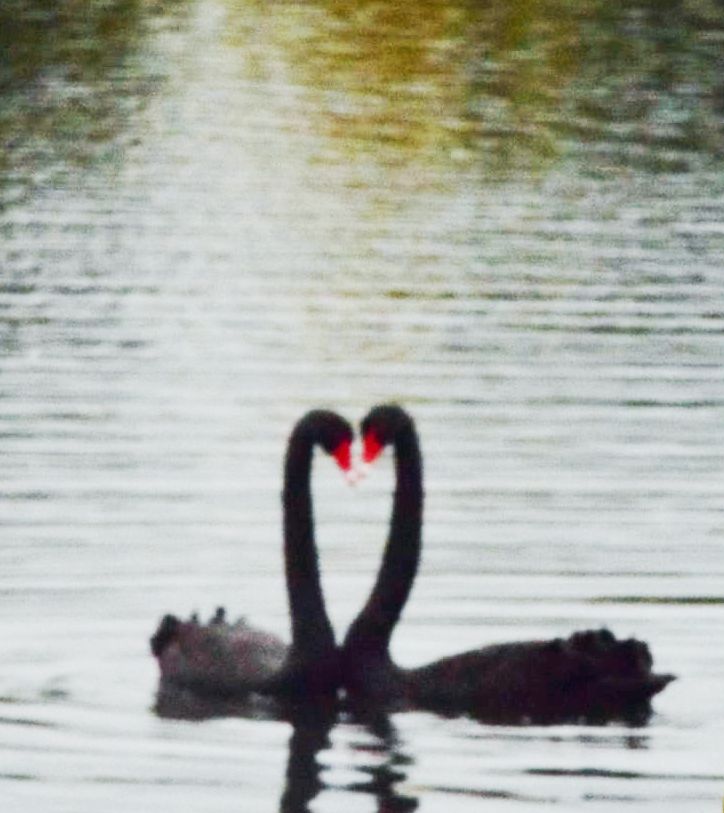
Jake also had a word this morning about being on the water. Although the picture is far from stormy, it echoes the theme of God “calling us out onto the water” (as we sing in the song “oceans”) to do by His spirit what we cannot do on our own. While there is a strong sense in what I felt God gave me that He is calling us deeper into the supernatural for our own survival, the burden of Jake’s word is that we need the supernatural power of the Holy Spirit to effectively minister God’s love to others. The two go together: we cannot minister to those who are caught in the storm if we are stuck in our own boats ourselves. We are the body of Christ: we need to be on the water, calling “Come!” in His name to the lost and the frightened. Here is Jake’s word, and the picture that goes with it that he took at Trentham Gardens.

“Just like these swans, the Lord is saying that He wants us to be in sync with Him. Only through being in sync with the Spirit can we reveal God’s heart, which is Love, to those around us.”

“You call me out upon the waters,
The great unknown, where feet may fail…” (From “Oceans, by Darlen Zscheck)

Whatever the storm may look like, the place of peace is on the water.

Following the Light

Adele brought this encouragement for the church on Sunday:

“We have to stand up and say that God is working in our lives; that we can trust our loving God and that He will get us through all the difficult times we have had to go through. He is our light through the darkness.”

While we were singing “Cornerstone,” just before Graham shared this, I had the following from the Lord, which confirms what Adele shared:

“You see clouds in the sky, but I am the light you see them by. You say the clouds block out the sun, but they will bring the rain that this dry land needs.”

Again and again, God is encouraging the church not to look down, but to look up. 1 Thessalonians 5 vs 4-5 says this:

“You are all sons of light and sons of the day. We are not of the night nor of darkness. Therefore let us not sleep, as others do, but let us watch and be sober.”

As the darkness around us thickens, the light will get stronger. The message the Holy Spirit gave to two people through “The Tall Building” encourages us to look out of the window and be aware of what is doing; in other words to “watch and be sober.” If you haven’t read this, I encourage you to do so, particularly as Wildwood Church itself has been spoken of prophetically as a tall building that is a light on a hill.

Like the Pillar of Fire that led the Israelites through the desert, the Light is leading us to new places. As children of Light we need to be alert to what He is doing. I have heard it said that the journey from Egypt was only a twelve day trek: it was the Israelites’ refusal to accept God’s leading that cost them forty years and a lost generation. Let us take this opportunity to trust and respond to the Holy Spirit, who is the Pillar of Fire that is leading us now just as He was back then, and let’s take hold of the Promised Land ourselves: we don’t want the Lord to have to wait another forty years for a church that will follow Him.

Because He will do: He has all the time in the world. And I don’t know about you, but I really don’t want to spend much longer in this wilderness. The way out of the darkness is to follow the Light as closely as possible.

Our most Powerful Weapon

If we know the New Testament at all, we will know – even if we can’t quote it verbatim –  that “ the weapons of our warfare are not carnal but mighty in God for pulling down strongholds, casting down arguments and every high thing that exalts”, (2 Cor 10: 4-5) What we might not be quite so sure about is what the weapons of our warfare are. Some things are clear: Psalm 149 tells us that the high praises of God in our mouths and the two-edged sword in our hands will bind the enemy kings and nobles “in fetters of iron,” (vs. 6-9) so that gives us some guidance on dealing with the “principalities and powers in heavenly places” that Ephesians 6 vs 12 tells us we are struggling with. The gospels tell us specifically that we will be able to cast out demons by the power of the Holy Spirit. Jesus did this “with a word,” so we should expect, as His disciples with His power and the authority of His name, to be able to do the same. But more often than not, the most intense battles we face are not in situations where we can launch into high praise or begin calling out the demonic: they are in our marriages and families, and those with whom we have the closest relationships.

Jesus tells us explicitly how to deal with conflict in Matthew 5: 39. He famously says “If anyone slaps you on the right cheek, turn to them the other cheek also.” This command has become embedded in Christian doctrine as one that promotes non-violence and non-resistance and a decision to forsake vengeance for the sake of pursuing love for one’s enemy. “The other cheek” is not commonly seen as a “weapon of our warfare…mighty in God for pulling down strongholds.” Yet that is precisely what it is. Jesus didn’t just come to Earth in order to build an alternative Kingdom of love and peace, where we all turn away from violence in the hope that others will see our example and come over to us from the dark side: He came to “destroy the works of the evil one,” so that the strongholds he has built in our lives will crumble, the knit together threads of anger and fear will unravel, and the roots of bitterness exposed and completely pulled out. The other cheek is a weapon “mighty in God” that we turn against the enemy.

Romans 12: 20-21 picks up the theme from the sermon on the Mount, but this time the act of loving one’s enemy is actually defined as an act of warfare: “If your enemy is hungry, feed him; if he is thirsty, give him a drink. For in so doing, you will heap burning coals on his head. Do not be overcome by evil, but overcome evil with good.” We are not called to just ignore evil, but to meet it head-on and overcome it. The burning coals certainly imply shame and remorse, and may also be taken to suggest purification and judgement. But more than these, heaping burning coals on someone’s head strikes me as a powerful and effective act of warfare: that enemy is not going to show his face again.

To bring this back to that “other cheek:” what actually happens when we turn it? Here’s an illustration. Terry and Jean have been married 25 years and are about to celebrate their silver wedding. They both are Christians with leadership roles in church. Terry loves his wife and loves the Lord, but he has a very defensive side to his nature, particularly when accused of something that he either didn’t do, didn’t mean to do, or had a very good reason for doing. So Terry also loves his own reputation, and for 25 years he has run to shore up his reputation when Jean has been hurt by something he has done, rather than simply address the specific problem and ensure that he isn’t going to hurt Jean again. While Terry’s focus is on strengthening his own defensive shell, he is not really thinking about how deeply the wounds run that his bickering comments inflict on his wife. She feels increasingly alone and unloved; he feels increasingly frustrated and misunderstood. A problem arises concerning their silver wedding celebration plans. Jean is hurt and angry; Terry feels unjustly blamed. The enemy is rubbing his hands: can he give Terry another cast-iron reason for justifying himself and pulling down his wife? Can he make Jean feel so despondent about their relationship that she finally gives up, not just on their wedding anniversary but on their marriage itself?

The enemy nudges the argument nicely along the well-worn “You always…!” and “Well, you did…!” tracks. But what’s happening? Terry has walked away and gone into his den to sit down. He has his eyes shut. Danger! Is he praying? And now he is opening his Bible… the demon assigned to prowl around their marriage turns his attention to Jean, but she has put on some worship music, so he won’t be able to sow any negatives into her mind for a while…

Terry is pouring his heart out to the Lord. The Holy Spirit speaks to us in many different ways, but just imagine this as a dialogue between Terry and Jesus:

“Lord, why do I always end up here? Why will she never admit that she is wrong to accuse me of being thoughtless like that, and that I could never have known that they have changed the menu? Nothing I say is ever any good, and it’s always my fault! And it isn’t – in fact it hardly ever is!”

“You’re right, Terry.”

“Sorry, Lord?”

“You’re right. Nothing you say is ever any good. Actually you’ve only got one option.”

“What’s that, Lord?”

“Love your wife.”

“Yes, I do! But…”

“No buts. It’s not about you and what she thinks of you: it’s about the fact that she’s hurting.”

“But it’s like she’s just slapped me in the face!”

“Exactly. So turn the other cheek. This is just one slap. But if you face this slap and are prepared to let her slap you again I’ll tell you what will happen: the barrier of self-defence that you have put up all your life will crumble away, and you will see Jean for who she is and respond to what she is feeling. She will see that you care about her more than you care about yourself, and your marriage will have new life.”

At that moment Terry sees a single shining tear on Jesus’s cheek. Reflected in it are streaks of red; faint reflections of His shed blood, then Jesus disappears. The tear remains, suspended. He sees that tear and that blood shed for him; he sees the dirty footprint trail of self-justification and cries of “it’s not fair!” winding through his life from as far back as he can remember, then the tear falls on the footprints and they all burn up like a fuse and are no more. When Terry goes in to apologise to Jean it isn’t just for tonight’s argument, but for every excuse he has ever made since they first met.

Jesus turned the other cheek at the cross and brought salvation to mankind. The spiritual overcame the carnal forever. When Jesus asks us to do the same it is not in a passive attempt at emulating godly behaviour, but in an active expression of His victorious Spirit that demolished the very stronghold of death itself. When we use this most powerful weapon we can demolish strongholds that bitter arguments have built up over decades. Christian marriages are always in the devil’s sights for some of his most virulent attacks, but Jesus has given us one act that will undo many years of his most careful work.

The Baptism in the Holy Spirit

On Sunday the teaching in the “discipleship” series at Wildwood Church was on the need for the baptism in the Holy Spirit. The Holy Spirit gave me “The Time of Unlocking“ the previous Wednesday evening. It specifically mentions gifts and ministries, which of course can only come from the Holy Spirit. The whole sense of the message was that God was “unlocking” a new outpouring of His Holy Spirit, which would be evident in many ways.

Jake (Jacob) sent me the message about the escalator a few days beforehand, the day after I read a devotional about Jacob’s ladder. The escalator takes us up, in the power of God. What we receive in heavenly places we then bring down to earth. Jake’s escalator is Jacob’s ladder for the 21st century; Jacob’s ladder on steroids. It’s the Holy Spirit within us who takes us up the escalator and gives us what Jesus is asking us to bring to down to Earth. God’s words to me, to Jake, and through the message to Wildwood Church (and no doubt many other churches)  on Sunday are all connected: we cannot be effective disciples without the power of the Holy Spirit, and we have to consciously ask Jesus for this baptism, or drenching, in the Holy Spirit, rather than just assume that we have received it. We need to press the button for the stairs to become an escalator. (See the escalator post.)

Three voices independently bringing messages that are connected is not a coincidence, it’s actually one voice: it’s the voice of the Lord. As we keep hearing through many prophetic voices, we are in a new season; and God wants His people equipped. We need to become familiar with the supernatural in our own lives. This isn’t just because revival cannot happen without it; it’s because the world is going to fail us increasingly, so unless we can tap into the supernatural resources of God’s Kingdom we will be struggling. Our Heavenly Father doesn’t want that for us.

If you don’t know whether or not you’ve been baptised in the Holy Spirit, then you probably haven’t been. You know if you’ve been baptised in water; you will know if you’ve been baptised in the Spirit. For many people it is evidenced by speaking in tongues, but for everyone the main thing is that it is experiential. The spiritual dimension becomes a personal reality. And as Paul wrote (Ephesians 5:18) – as if we haven’t heard it enough times already – having received it once we need to keep on being filled if we are to keep walking in a fresh experience of God.

So there are three distinct stages to becoming an effective disciple of Jesus Christ. One is repentance and turning to Christ – what used to be called “repentance unto faith.” The second is baptism in water. Again, this is not a “bolt-on” to our faith: it is foundational. Colossians 2:12 says we are “buried with Him in baptism, in which you also were raised with Him through faith in the working of God, who raised Him from the dead:” it’s hard to know the fulness of resurrection life without first passing through burial with Christ. And the third is baptism in the Holy Spirit. Sometimes they all happen together, but you know that they have all happened. All three are essential. All three are foundational to us being “filled up to all the fullness of God” (Eph 3:19) for which Jesus went to the cross. He did not die in anguish for us to receive anything less.

A couple of nights ago Jake had a dream which he has shared with me, which I am including here because I think it is also part of this message. Jake called the dream “Picky Eaters.” In the dream, God had served a generous meal to His people, but some of them were leaving food on the side of their plates. The Lord said “I have served this meal up to my people to make them strong in Me, but some of them are being picky eaters. They pick and choose what they want to eat, but the meal is the full gospel. They cannot discard part of it and still expect to grow strong.”

I want to emphasise again that this is the meal that was paid for on the cross. How can we be picky when such a great price was paid? But if you are uncertain about biblical foundations for the baptism in the Holy Spirit – whether or not it is actually on the plate – you can find more in the article The Name of the Father.

Only You have the words of life.

We have a young man from Germany staying with us at the moment. Over breakfast this morning we were discussing the different German words for bread. I speak reasonable German, and I thought there was just one generic word: Brot. But apparently not. The bread that comes out of my breadmaker isn’t actually “Brot”, it’s called (in German) Toast. It’s Toast before it’s been toasted, and it’s Toast afterwards. I learnt that “Brot” is actually the drier German bread with a hard crust, often made of rye flour. If you toast Brot, it’s still called Brot after it’s been toasted. So a slice of bread can be a slice of toast, and a slice of toast can be a slice of bread. Words can be very confusing.

So Joni and I had an amusing conversation, but what was interesting for me was that the Lord had also been speaking to me about words before breakfast. I have read two scriptures on the subject in the last few days: one is Ephesians 5 vs 6: “Let no one deceive you with empty words, for because of these things the wrath of God comes upon the sons of disobedience,” and the other is from one of my favourite passages of the bible, Isaiah 11:

There shall come forth a Rod from the stem of Jesse,
And a Branch shall grow out of his roots.

The Spirit of the LORD shall rest upon Him,
The Spirit of wisdom and understanding,
The Spirit of counsel and might,
The Spirit of knowledge and of the fear of the LORD.

His delight is in the fear of the LORD,
And He shall not judge by the sight of His eyes,
Nor decide by the hearing of His ears

But with righteousness He shall judge the poor,
And decide with equity for the meek of the earth;
He shall strike the earth with the rod of His mouth,
And with the breath of His lips He shall slay the wicked.
” (Isaiah 11:1-4)

In case you didn’t see it, the connection is between being “deceived by empty words” and the Branch (Jesus) not deciding by “the hearing of His ears.” The words we hear can be very deceiving. Sometimes this is deliberate; sometimes the person speaking is just using them badly; and sometimes we deceive ourselves into hearing something that was never actually spoken. Sometimes more than one of these may be in play at the same time, but whichever it is, the result can often be words that are empty of truth and appearances that are not what they seem.

As we move into the new season that has already begun with COVID, the deceptions around us are going to multiply. There will be deceptive explanations of government policies that are promoted as being for the good of society but that have actually been inspired by demonic principalities whose aim it is to weaken and persecute the Church. As the enemy sends in more forces we will find ourselves face to face with demons more regularly as they operate through people who are opposing us or who are binding up the captives we are sent to liberate, and every word that will come from their mouths will be a lie. There will be – and already are – political and social movements that claim to have an agenda of social justice, but which actually are driven by a much darker agenda of closing down all expressions of the true justice that comes from the King of Kings. We need to discern the spiritual realities behind appearances, and we can only do this by faith.

It isn’t just in obvious “battle situations” that this need is apparent, but within our own relationships. We need to grow in unity, in our churches, our marriages and our families. We need to look past inadequate words and try to see each other’s hearts, and we need the help of the Holy Spirit to do that. And then we need to know the heart of God for the other person, so we can continually build one another up in love. When compared to the riches of God’s grace we are all infinitely poor, so it is with righteousness that we must judge one another. We cannot rely on the sight of the eyes or the hearing if the ears if we want to grow our relationships in Christ.

The discernment we need to ask for has six components, and they are listed above. They are: wisdom, understanding, counsel, might, knowledge, and fear of the Lord. I will try and unpack these another time, but that needn’t stop us asking the Holy Spirit for them now, because now is when we need them. And I want to leave this with a final thought. The “rod of His mouth” has to be the Word of God, and the “breath of His lips” the Holy Spirit; so we come back to the over-arching importance of the Word and the Spirit in the ministry of the Church. Jesus warned his disciples about the “yeast of the Pharisees”, which was the predominant “bread” of the religious culture of the time. We too need to look beyond the bread of appearances and seek out the Bread of life, which is every word that proceeds from the Mouth of God and is fed to us by the Holy Spirit.

The battle is hotting up, so if we don’t, we are toast.

Faith: the Frame.

By faith we understand that the worlds were framed by the word of God, so that the things which are seen were not made of things which are visible. (Heb 11:3)

This morning I saw a hearse coming towards me on the road with a long queue of cars behind it. I was glad I was driving in the opposite direction. Then, very briefly, I saw the number-pate: on it were my initials. My first thought – because the flesh tends to butt in before the spirit – was: “That’s you, Bob! Could that be an omen?” But then the Spirit spoke to me with the truth: “You are already dead, Bob. You were crucified with Christ. It is not you who live, but Christ who lives in you!” So by the time the line of cars had passed, I was thinking: “Halleluia! I’m dead to my flesh, and alive in Christ!” This is what the Word of God says; it’s what my experience of the Holy Spirit confirms every day; and it’s what my heart believes even if my head is assailed by doubts. It is the confession of my faith. Faith is the frame that holds the entire bicycle together.

By faith we understand… that the things which are seen were not made of things which are visible. Hebrews 11:1 tell us “Now faith is the substance of things hoped for, the evidence of things not seen.” Faith is a substance. Whether we believe this or not is our choice. But if we can allow the substance of faith to become a reality in our hearts we can look into it and see that which our brains cannot fathom. “The Just shall live by faith” was the revelation given to Martin Luther and is the central plank of the Protestant reformation. The scripture occurs three times in the New Testament (Romans 1:17,Galatians 3:11,Hebrews 10:38), and these in turn refer back to Habakkuk 2: 4: “Behold the proud, His soul is not upright in him; But the just shall live by his faith.” So what do we see when we look into the substance of faith?

Faith is so much an idea that our minds can grasp, as the very substance of a dimension that our spirits walk in. If I go out into my garden I walk on grass. If my spirit enters the Heavenlies I walk in faith.  It is where Truth is defined by the Word of God and not by the word of science, and where Life is defined not by the ageing and wearing out of the body, but by its resurrection. In this dimension, we see the rule of Heaven established on Earth:

“Behold, a king will reign in righteousness,
And princes will rule with justice.
A man will be as a hiding place from the wind,
And a cover from the tempest,
As rivers of water in a dry place,
As the shadow of a great rock in a weary land.
The eyes of those who see will not be dim,
And the ears of those who hear will listen.
Also the heart of the rash will understand knowledge,
And the tongue of the stammerers will be ready to speak plainly.

(Isaiah 32: 1-4)

We see the King of righteousness Himself

The Spirit of the LORD shall rest upon Him,
The Spirit of wisdom and understanding,
The Spirit of counsel and might,
The Spirit of knowledge and of the fear of the LORD.
His delight is in the fear of the LORD,
And He shall not judge by the sight of His eyes,
Nor decide by the hearing of His ears;
But with righteousness He shall judge the poor,
And decide with equity for the meek of the earth;
He shall strike the earth with the rod of His mouth,
And with the breath of His lips He shall slay the wicked.
Righteousness shall be the belt of His loins,
And faithfulness the belt of His waist.
(Isaiah 11: 2-5)

And in this dimension of faith, as “the earnest expectation of the creation eagerly waits for the revealing of the sons of God.” (Romans 8:19), we see the redeemed, sin-free world that creation is earnestly expecting:

The wolf also shall dwell with the lamb,
The leopard shall lie down with the young goat,
The calf and the young lion and the fatling together;
And a little child shall lead them.

The cow and the bear shall graze;
Their young ones shall lie down together;
And the lion shall eat straw like the ox.

The nursing child shall play by the cobra’s hole,
And the weaned child shall put his hand in the viper’s den.

They shall not hurt nor destroy in all My holy mountain,
For the earth shall be full of the knowledge of the LORD
As the waters cover the sea.
  (Isaiah 11: 6-9)

I make no apology for quoting these scriptures at length, as I believe they are among the most beautiful verses in the entire Bible. They describe the society and the landscape of the Mountain of God where our bike ride is taking us. And this place is real: its substance is faith. If we can allow our spirits to walk there we will find that our own judgements won’t be “by the sight of our eyes or by the hearing of our ears” either, but they will come to us by the spirit of the King of the Mountain who dwells within us.

Free of the curse of sin, beyond the reach of the devil, and untrammelled by the limitations of the world and the flesh, the substance of faith determines the abundance of God’s supply, whether this is of provision, healing, spiritual gifts or any other blessing. Ephesians 1:3 says “Blessed be the God and Father of our Lord Jesus Christ, who has blessed us with every spiritual blessing in the heavenly places in Christ.” Every spiritual blessing has already been given to us in heavenly places. They are a reality. Their substance is faith. When we read about them in the Word of God we are reading the Maker’s handbook on all the resources that we have in our personal cupboards of His provision in Heavenly Places.

Jesus tells us “ whatever things you ask when you pray, believe that you receive them, and you will have them.(Mark 11:24) Our English word “receive” has a fairly passive connotation: there is a sense of holding out one’s hands for something to be placed into them. The Greek word, lambanō, that is used here, is far more active. Here are the primary definitions. They are all involve actively taking hold of rather than passively receiving:

  1. to take with the hand, lay hold of, any person or thing in order to use it
    1. to take up a thing to be carried
    1. to take upon one’s self
  2. to take in order to carry away
    1. without the notion of violence, i,e to remove, take away
  3. to take what is one’s own, to take to one’s self, to make one’s own
    1. to claim, procure, for one’s self

Jesus is telling us to take hold of those things that we ask for, believing that they already exist – which they do, made of the substance of faith. He is telling us to reach into our heavenly “provisions cupboard” and take hold of that spiritual blessing which the Father has provided. I remember a healing meeting with Ian Andrews in the late 1980s. If I remember correctly, he said that God had showed him a warehouse full of all the body parts that exist, and when he prayed for healing he just reached into the warehouse and took hold of a new part to replace the one that was malfunctioning. He believed he received, and he had what he prayed for. On Earth as it is in Heaven: what was made of the substance of faith in the heavenly realms became flesh and blood on Earth.

Of course, that is easier to write than to do. If you’re anything like me, most of us blunder around and get hold of something occasionally; but as John Wimber discovered the more we blunder the more chance we have of actually taking hold of what God has provided. I’m sure Ian Andrews did  a lot of blundering, and probably still does some! And of course we are always in a battle: God may have provided; we might be reaching out into the right place, but the devil is standing in front of the cupboard. Sometimes we have to fight for what we’re reaching for, and keep praying until we know in the Spirit that the battle is won.  Proverbs 23: 12 says “Apply your heart to instruction, And your ears to words of knowledge.”  The word of knowledge is really helpful in enabling us to take hold of the substance of faith, so if you are praying for people ask the Holy Spirit for that gift – and take hold of it! I have seen a small number of miraculous healings when I have prayed for people, including a broken toe being instantly mended and a deaf ear being opened; and they have always followed a word of knowledge.

This is one of my pet topics, and I could keep writing – but you might not keep reading. The frame of faith touches every part of the bike – the wheels, the handlebars, the brakes, the saddle, the pedals. If we can understand that faith is a substance and that we do not have to ask God for what He has already given but learn to take hold of it instead of just holding out our hands; and if we can really believe in our hearts that the Word of God is all true and is describing a dimension that our spirits have access to, then I believe we will progress further and faster in our discipleship as we walk – or cycle – after the spirit and not after the flesh.

Bob Hext Sept 2020

The Saddle: Seated with Christ in Heavenly Places

And God raised us up with Christ and seated us with him in the heavenly realms in Christ Jesus. (Eph 2: 6-7)

Are you born again? Because if you are, (and if you aren’t you need to be) this is what happened when Jesus entered your heart: you were raised up, united with Christ, and seated with Him in heavenly places. God picked you up and put you on the saddle. When you were raised out of the waters of baptism it was a symbol not only of your new life in Christ as you live out your discipleship on the earth, but also of God’s own hand lifting you from the “miry clay” of sin to be seated with His Son in the Spirit. And to be absolutely clear, Scripture gives us more detail of exactly where in the heavenly realms Jesus is seated. When God raised Him from the dead by “the exceeding greatness of His power toward us who believe, according to the working of His mighty power which He worked in Christ when He raised Him from the dead,” He “seated Him at His right hand in the heavenly places, far above all principality and power and might and dominion, and every name that is named, not only in this age but also in that which is to come.” (Eph 1: 19-21).

Since we are seated with Him, our saddle is there as well. So what does it mean to be seated?

It means the job is done. The death and resurrection of Jesus completed the work of salvation for all time, and we sit with Him, sharing in that completed work. He won the victory at Calvary and we share in the spoils. Nothing we did put us in that seat – even the faith that we had to believe in Jesus was a gift of God. God lifted us, and God seated us. And the power with which He lifted us with now dwells within us, and is available to us when we “walk not after the flesh, but after the Spirit.” (Romans 8:4) However we must also remember that Jesus is not just sitting with His feet up at the right hand of the Father now that His work is completed: He is busy interceding for us (Heb 7:25). So as we sit there with Him we can be engaged in the same activity, and we can be talking with Him about what He wants us to pray for.

Being seated means we are in the place of authority. Jesus is seated “far above all principality and power and might and dominion.” Not just a bit above, but far above. I have never been given revelation on the topography of the heavenly realms, but those who have tell us that the second heaven is the area of the demonic principalities and powers, whereas the third heaven – where Paul was taken and “heard inexpressible words, which it is not lawful for a man to utter” (2 Cor 12: 4) – is where Jesus is seated, and where we, in the Spirit, are seated with Him. We are not just above the forces of the enemy and their destructive works on Earth, we are literally on another level. If we think about demonic activity from an earthly or carnal perspective, we can easily feel intimidated or uncertain; and this makes sense because the second Heaven is obviously on a “higher” level than our earthly abode. This of course is exactly what the devil wants. But if we look at the enemy from where we are seated we have a very different picture, and it is no longer us who are intimidated, but him.

Finally, being seated means being in the place of rest. I am sure you have seen someone on a mountain bike, pedalling up an impossible-looking slope, with their legs moving faster than their wheels, but nonetheless moving forward in their lowest gear, remaining seated, and not even appearing to exert themselves. Hebrews 4 talks about the rest of God, and verse 3 tells us that “we who have believed do enter that rest.” Later in the same chapter the writer exhorts us (v. 11): “Let us therefore be diligent to enter that rest, lest anyone fall according to the same example of disobedience.” (ie the disobedience of the Israelites.) Peter too exhorts us to “be diligent to be found of him in peace, without spot, and blameless.” (2 Pe 3:14) If we keep short accounts with God and with one another “the blood of Jesus cleanses us from all sin” (1 John 1:7) and our peace remains with us. Even though we may be pedalling hard, the saddle remains a restful place. And when we are in it, whatever the path looks like, our God “will supply all (our) need according to His riches in glory by Christ Jesus” (Phil 4: 19). The right gear will be there on the bike when we need it. We do not need to get out of the saddle to exert more pressure on the pedals, and we certainly do not need to get off the bike to help God by pushing it up the hill.