Category Archives: Living by Faith

Living by Faith is not just the calling of a few “full time” Christians who depend on God for their income: it is the substance of things hoped for, and without it one cannot please God. Only by faith do we have access into the grace in which we stand. And “just in case any should boast,” faith is itself a gift from God.

Bread from Heaven: 3

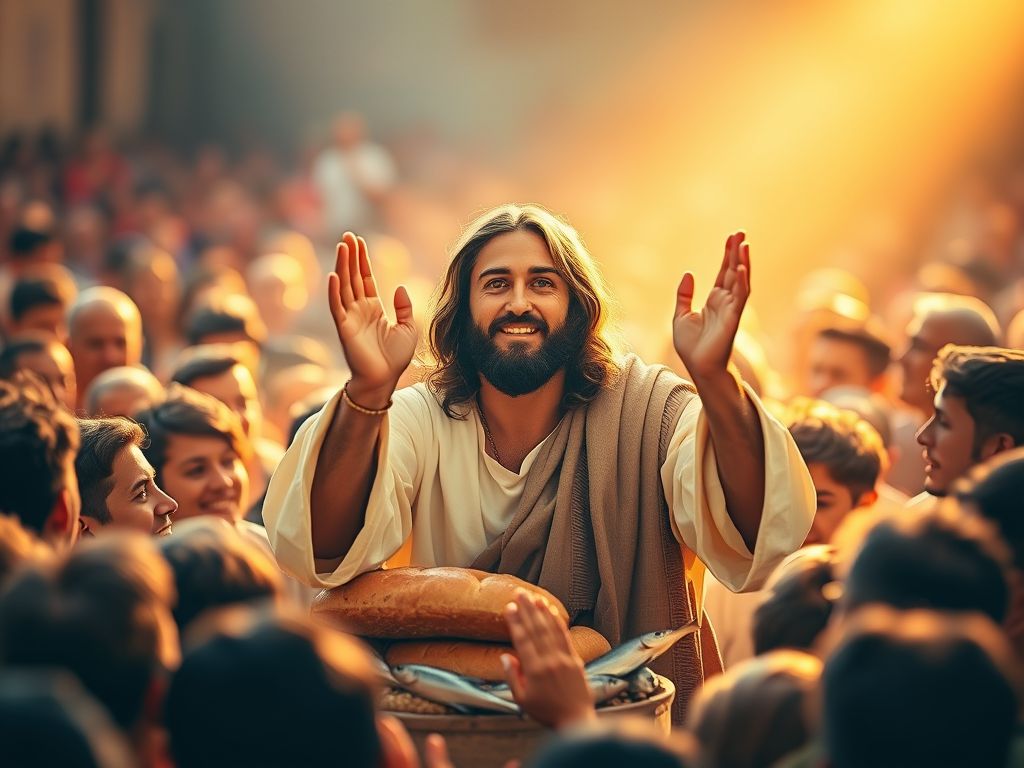
And Jesus took the loaves, and when He had given thanks He distributed them to the disciples, and the disciples to those sitting down; and likewise of the fish, as much as they wanted. (John 6:11)

He knew what He would do
In our attempts to bring up our children to say “please,” the parents among us might well have said at times: “And what’s the magic word?” However in the Kingdom it’s not please, it’s thank you. Jesus didn’t ask the Father to multiply the loaves and fishes; he thanked Him for them. This miracle, along with its “twin“ where the 4000 are fed in the accounts of Matthew and Mark, is one of only three occasions in the New Testament where Jesus gives thanks to the Father. The Greek word used for giving thanks is eucharisteo, and Jesus uses it when He feeds the multitude, when He thanks His Father for always hearing His prayers at the raising of Lazarus, and at the last supper, when He gave thanks for the bread and wine.

Eucharisteo: We use the same Greek word ourselves when we remember the cross at the Eucharist, and for me, this is the key to understanding much of the significance of this miracle. Andrew looked at the loaves and fishes with eyes of flesh and asked: “What is this among so many?”, but Jesus looked with the eyes of the spirit and saw the riches in glory that would meet the need of the multitude above all that the disciples could ask or imagine. He could see the limitless creative powers of heaven, and He knew that “all that the father has is mine,” (John 16:15) so it is no surprise that John’s account of the miracle tells us that “He himself knew what He would do.” (John 6:6)

In everything give thanks
In his letter to the Philippians, Paul exhorts us to “be anxious for nothing, but in everything, by prayer and supplication, with thanksgiving, make your requests known to God.“ (Philippians 4:6) We know that Jesus had direct access to the Father’s provision because of who He was, and there are no barriers to our faith in that regard. But it is much harder to believe that we have the same access to that provision, because we know who we are as well. We can, and do, believe that Christ dwells in our hearts through faith, that in Him we are seated in heavenly places, and that all things are possible through Him; but we also know that we have only experienced the boy’s family picnic when faced with a multitude, and not the feast.

When Jesus gave thanks at the feeding of the 5000, I don’t think He was thanking His Father for the loaves and fishes in His hand, but for the provision that was in heaven. Demonstrating what He told His disciples in Mark 11:24, He believed He had received it, gave thanks for it, and it was done for Him. His Father passed the food to Jesus, and He passed it to the disciples to give out.

God wants us to give thanks in everything. Whether we are faced with abundance or lack, and whether or not we are petitioning heaven for something, we are to be thankful at all times. Paul expresses this sentiment in his letter to the Romans:

“… He who eats, eats to the Lord, for he gives God thanks; and He who does not eat, to the Lord he does not eat, and gives God thanks. For none of us lives to himself, and none of us die himself. So if we live, we live to the Lord; and if we die, we die to the Lord. Therefore, whether we live or die, we are the Lord’s.” (Romans 14:6–8).

Our Inheritance
As I have mentioned, the only occasion outside of feeding the multitudes and giving thanks for the bread and the wine at the last supper, was when Jesus thanked the Father for hearing Him at the raising of Lazarus. His Eucharist there was more about His relationship with the Father than what He was about to do. Our constant thanksgiving to God is not for what we do or don’t eat – or do, or receive -, but it’s for a relationship with Him which we can indeed be thankful for in all things. We can be thankful to Jesus every moment of the day for the fact that we are His, and what we have is His. But more than that, amazingly, what He has is also ours:

“And if you are Christ’s, then you are Abraham‘s seed, and heirs according to the promise.”(Galatians 3:19)

“And because you are sons God has sent forth the spirit of His son into your hearts, crying out, “Abba, Father!“ Therefore you are no longer a slave but a son, and if a son than an heir of God through Christ.” (Galatians 4:6–7)

We are heirs of God through Christ. We have an inheritance to be forever thankful for. Just as everything that the Father has belongs to Jesus, everything that Jesus has is ours in Him. Of course this does not mean that my neighbour’s house, or wife, or goods belong to me because they are His: the key phrase is “in Him.” “In Jesus name” is not just a phrase that turns a request into a prayer, but it’s the declaration that what we are asking for in prayer is something that we are requesting on His behalf because He has told us that He wants us to have it, whether it’s to accomplish His Kingdom purposes through us or for us. Whatever we are doing, we have an inheritance to be thankful for, and which is at our disposal all the time we are walking alongside Him. What is His is ours. If I am sitting at the dinner table with my wife and I ask her to pass the salt, she is not going to question my action: the salt on the table is a shared possession. Of course she is going to let me have it.

Paul makes this clear in his first letter to the Corinthians:

“Therefore let no one boast in men. For all things are yours. Whether Paul or Apollos or Cephas, or the world, or life, or death, or things present, or things to come – all are yours. And you are Christ’s, and Christ is God’s.” (1 Corinthians 3:21-23)

Just as Jesus is the transition from earth to heaven for our spirits, He is also the transition for us from heaven to earth for our inheritance. So whatever the loaves and fishes or the starving crowd may represent, what do we have available to meet the need? Jesus can make our lack into His abundance if we remember to thank Him for our inheritance. Pass the salt, please, Lord. Thank You.

Bread from Heaven: 2

Make the people sit down
In his letter to the Galatians, Paul says that what matters most of all is “faith working through love.” So here we are on the mountainside. We have kept in step with the Spirit; we have lifted our eyes with love, we are aware of how God has led us to and provided for this moment, and so we believe that Jesus wants to meet the need that is now before us. Even though He knows what He is going to do, we don’t. What next?

Jesus says, “Make the people sit down.” Some miracles require preparation, and that preparation has to be in obedience to what the Lord has asked us to do. The disciples could not see with their natural eyes what might happen next, but they got their instructions and complied with them. Like the unprofitable servant (Luke 17:10), they simply did what they were told to do. And more than that, they had to do so with authority. 12 men had to exercise crowd control on 5000, many of whom had their families with them, and all of whom were ravenous and will have wanted to be first in the queue for whatever goodies Jesus was going do dish out. We have probably read and heard the story many times, but if you imagine the scene and do the maths it’s not hard to see that the first miracle was actually getting that crowd ready to receive the food in the first place. When I was a teacher I found it hard enough to control a group of thirty, so I needed to exercise authority – and that was when I knew what it was I was going to deliver.

The disciples could organise the crowd because the Lord had clearly given them the mandate to do so, and they put their trust in His authority without question. I wonder what they thought He was going to do? Elijah and Elisha both worked miracles of multiplication, but the nearest thing to supernatural provision of food at this level that they would all have known of was the manna in the wilderness. It was a story that they would have heard many times, and it was deeply embedded in their culture. Maybe when they heard it they wondered what it was like, and now they were thinking, “Wow, we’re going to see manna! Awesome!” How often we have one expectation, and God does something completely different, often meeting our need at a deeper level. But one thing we do know, is that God is “able to do exceedingly abundantly above all that we ask or think, according to the power that works in us.” (Eph. 3:20) We can be expecting manna when God has multiplication in mind.

Authority follows the Anointing
So when God gives us an instruction, we don’t know what we are being prepared for: all we know is what we have heard and the One who is doing the preparing. But because we have had the instruction, we have the authority to carry it out. I have a friend, Andrew, who tells the story of a meeting when he stepped up to preach at a conference towards the end of the worship time, and the Holy Spirit said to him “The anointing isn’t on you; it’s on the lady who is ministering with the flags.” He knew the Lord’s voice well enough and had the humility to obey, laying down his message and releasing the flag ministry to become the focus of that part of the conference. Authority followed the anointing.

In how many churches, every Sunday, is manna on the programme when God has multiplication planned? Our meeting this week will be basically the same format as last week. And the week before, and next week. We know what to expect, and we know what we will do: it’s time to gather the manna.  We prepare our sermon or our worship set and it’s what we do. If we are Pentecostals or charismatics we probably ask God to anoint it, but what we are much less likely to do is to ask Him to replace or change it if He wants to. If it’s a smaller group we might be more likely to be flexible, but a hungry crowd at a conference, waiting to be fed? Will we put down the important message we have spent a week preparing and praying over, and move aside for the flags? Andrew did just that, the power of God fell, His manifest presence came into the room, and lives were changed. Andrew didn’t know what was going to happen: he just “made the people sit down.” If we will hear God’s word in faith and act in authority, He will provide more than we can ever ask or imagine. All we have to do is lay down our lives.

Manna, or Mission?
We have sometimes hosted gap year students from Germany who have come to spend the year as interns working with the children and young people in our church. We have kept in touch with most of them, and recently one of them, David, invited us over to his wedding. We accepted the invitation, and decided to visit two of the others while we were in Germany. We weren’t driving and it meant quite complicated travel arrangements, but we knew they would like to see us, and we wanted to see them. (We were actually hoping to arrange a visit to a fourth family, but the travel arrangements just didn’t work in the time we had available. There was no grass in that place…) One of our friends referred to our trip as a “mission.” That’s a bit high-sounding, I thought – we are just going to a wedding and visiting a couple of other young friends and their families. But God had plans that we knew nothing of, because we walk in works prepared beforehand. (Eph 2:10)

What God had prepared for the young man we visited first of all was to organise an outreach in his town three days after we arrived, which gave us time to prepare and pray with him and spend time with his family. We went into the town with the outreach team, met some of his friends in his church, identified a spiritual stronghold over the town and pulled it down in prayer.  Next we moved on for David’s wedding. We had two days there, but couldn’t stay at the venue on the night of the reception because it was fully booked, and we were going to have to stay in another hotel a few miles away. But God! The owner/manager of the venue gave a free room, already paid for by guests who had not shown up, and even arranged to collect our luggage from the other hotel, where we had already taken it that afternoon. This enabled us to have a precious time of prayer with David and his new wife the following morning as well as some good conversations with his unsaved aunt and uncle, which wouldn’t have happened if we hadn’t been able to stay there on the second night.

After the wedding we went to see our third and most recent gap-year student, to find that her father, an elder in their village Lutheran church, was considering leaving it because, as he put it, ‘the pastor just gave history lessons and didn’t preach Jesus.’ We prayed with the family and were able to encourage them, and we had a lovely day together on a Rhine cruise, which further cemented our friendship. The mission didn’t end there, because we called in to see our daughter on the way home back in the UK, and our visit coincided with a visit from one of her friends who had been planning to go to her house for months, who had been wanting to meet us, and who, again, was in need of prayer.

No-one got dramatically healed, no-one got saved – although someone did on the outreach – but love took us to Germany, we did what we were told, there was “much grass in that place” (including a free hotel room), and Jesus did some building in His church from plans that we knew nothing of. A bit like the disciples, who were probably just expecting some time out with Jesus in the hills and found themselves managing a large-scale outreach, we just thought we were going on a trip to celebrate David’s wedding and visit two other families; but it turned out that God had planned the three sets of circumstances to coincide in different parts of Southern Germany for us to walk in a mission that He had prepared beforehand. Potentially, every day can be a mission where loaves and fishes are ready to be multiplied. So are we in the promised land yet? Because when we arrive, the manna stops.

The name of the Lord is a strong tower.

The name of the Lord is a strong tower; the righteous run into it and are safe.” (Proverbs 18:10)

I am not someone who likes to do “actions“ with songs in church, and this proverb is the chorus of a song (“Blessed be the name of the Lord“ by Clinton Utterbach) that is often used (in the UK at least) to get a congregation – particularly children – engaged in praise. Personally, I like to think about the words as I’m singing them, and I can’t do that if I’m running on the spot and waving my arms about, but I guess that’s just me. And there’s actually some great stuff to think about here.

The lyrics of the chorus are slightly different from the proverb. The lyrics are “the righteous run into it and they are saved,“ but the proverb tells us that the righteous run into it and are safe. It’s the word “safe” that struck me when I looked it up. It doesn’t just mean in a place of safety, nor is it specifically just “rescued.” The Hebrew word śāḡaḇ means “too high for capture.” The place of safety isn’t created by the walls, but by the elevation. The person who runs into this strong tower is lifted to a place that is inaccessible to the enemy. And if we know Ephesians 2:6 we know that the place where we have been raised up to is together with Christ in heavenly places. When we are raised up in the spirit, we are inaccessible to the enemy.

I have also just been reading the prayer of Jabez, which is in 1 Chronicles 4:10. He prayed “Oh that you would bless me indeed, and enlarge my territory, that your hand would be with me, and that you would keep me from evil, that I may not cause pain!“ When we pray the Lord‘s prayer, we also ask Him to deliver us from evil. I don’t know about you, but I’ve always thought of this in terms of keeping me safe so that evil things don’t happen to me. Jabez isn’t praying selfishly here: he turns it round to say “keep me safe from evil so that I don’t bring it upon anybody else.” If we bring this reflection to our safety in the name of the Lord, we get an added dimension to the proverb: when we run to the place of safety, the people around us are also protected from any pain that the enemy would seek to cause through us.

So how do we run into the name of the Lord? As I have said elsewhere, (and not just me of course!) to be “in the name” of Jesus isn’t just about a position of faith, but it’s about where we are putting our feet in actuality. The name of the Lord isn’t just what we call him, but it’s who He is, and to be in His name we have to be true to Him. If we have spent the day following our own selfish desires we can hardly expect to pray “in the name of Jesus” at the end of it, because we haven’t been in His strong tower; we have walked after the flesh and not after the spirit, by sight and not by faith. It’s the righteous who run into the strong tower: righteousness is only ours by faith, and “all that is not of faith is sin.” (Romans 14:23).

So when we are walking by faith we are lifted into the heavenly tower of the name of Jesus, out of reach of the enemy who has no access to our spirits, and a blessing, not a danger, to those around us.  Where are you today? Are you up in His strong tower? If not, start running, before anybody gets hurt.

Bread from Heaven

After these things Jesus went over the Sea of Galilee, which is the Sea of Tiberias. Then a great multitude followed Him, because they saw His signs which He performed on those who were diseased. And Jesus went up on the mountain, and there He sat with His disciples. Now the Passover, a feast of the Jews, was near. Then Jesus lifted up His eyes, and seeing a great multitude coming toward Him, He said to Philip, “Where shall we buy bread, that these may eat?” But this He said to test him, for He Himself knew what He would do. (John 6: 1-6)

Jesus lifted up His eyes
When Jesus saw the crowds coming towards them and asked Philip “Where shall we buy bread, these might eat?” (John 6:5), He knew not only the eternal words that the Holy Spirit had spoken through Isaiah hundreds of years previously, but He also know what He was going to say to the Jews the following day, and, more significantly, what He wanted His church to learn from it from that time until His return.

John introduces the narrative by presenting Jesus on a mountain with His disciples. This must be every believer’s favourite place: a mountaintop experience with the Lord, in the company of a few close friends. When we are in that place, we want it to go on for ever. Eventually it will, but John also tells us that “a great multitude followed Him, because they saw His signs which He performed on those who were diseased.” (John 6:2) If we are spending time with Jesus on Earth, the crowds are never going to be far behind.

It’s all about the harvest
When He met the Samaritan woman, Jesus said to His disciples: “Behold, I say to you, lift up your eyes and look at the fields, for they are already white for harvest!” (John 4:36). Now John echoes this exhortation in his account of the fourth sign, reminding us that it is not just about the significance of the Lord’s supernatural power to multiply bread, or even about His compassion for the hungry: it’s all about the harvest. Jesus lifted up his eyes. So one challenge to us as we consider this sign is this: how much time do we spend with our eyes on the ground instead of lifting them up to the harvest?

If you are the same as me, you probably equate ‘lifting your eyes’ with Psalm 121 – lifting our eyes to the hills, and seeing that our help comes the Lord “who made heaven and earth.” Although Jesus clearly does get help from heaven here- a lot of help – He is not looking away from His circumstances and comforting Himself, as we do, with eyes of faith: He is looking at the circumstances with eyes of love so that He can comfort the people He can see. If I was on a mountain and saw a hungry crowd below me, I would either want to go further up the mountain, or round to the other side, and down. Quickly. But He is not thinking about how the circumstances affect Him; He is only thinking of how He can affect the circumstances. This is a standout Kairos moment of His ministry, and He knew what He would do.

Facing the hungry crowd
As for us, there are times when we are on that mountain and there is a “hungry crowd” coming towards us. It might only be one person, but we know what it will mean: they will make demands. Certainly our time and energy, quite probably our money and/or resources, possibly our emotions, but one thing we know is true: they are hungry, and we’ve only got a few loaves and fishes. But the other thing that is true is that we are there with Jesus. We know that He only did what the Father told Him to do and didn’t always minister to everyone He met, and it might be that the He tells us not to get involved and to get down off the mountain. But assuming He doesn’t, how do we face the “hungry crowd” with the crumbs that we have to offer?

“He said to Philip, “Where shall we buy bread, that these may eat?” But this He said to test him, for He Himself knew what He would do.”

I don’t think that He was testing Philip on his knowledge of Isaiah 55. Jesus wanted to know if Philip was starting to see with the eyes of the Spirit, or if he was still limited to the material world. At this stage, it looks like his score was zero (which is encouraging for us, as the same Philip completely by-passed all the confines of the material world in the power of the Holy Spirit when he preached the gospel to the Ethiopian Eunuch!). I think Jesus is regularly testing our faith. Since He said “Will the Son of Man find faith on earth when He comes?” (Luke 18:8), it makes sense that He will be putting us in situations where He can see where we are on the faith-o-meter. He wants all our readings to increase.

There was much grass in that place.
God knows what our faith is ready for, and He also knows whether or not this is a Kairos moment for us, where He has got everything lined up for us to operate in the power of the Spirit. Wisdom says “ponder the path of your feet.” (Prov 4:26) The hungry crowd is approaching. Where has the “path of our feet” led us? Are we on a rocky slope, or is there “much grass?” People will be filled if they are in a place where they can be sufficiently at peace to receive from the Lord. If they are struggling just to keep on their feet and stay upright, it is less likely that we are going to reach into their situation, and that God hasn’t planned for us to try: if that moment hasn’t yet arrived we are just going to be emptied ourselves, and no-one is going to get any bread.

Verse 10 tells us that “There was much grass in that place.” For the miracle to take place the crowd needed somewhere to sit down and rest so that they could receive and partake of what Jesus was going to give them. Jesus hadn’t yet drawn on His heavenly resources, but the natural setting was in place – indeed it had been developing ever since that grassy plateau on the mountain had been created through Him and for Him (Colossians 1:16) at the beginning of time. Part of the convergence of that moment was that the hungry crowd should be there with Jesus just where there was provision for them to stop and sit down: not on a rocky slope or a narrow path, but on a flat area where “there was much grass.” If God can provide that visible abundance in the earthly realm just at the right time, how much more are heavenly resources available?

The Kingdom of Abundance
Paul writes to the Ephesians: “Now to Him who is able to do exceedingly abundantly above all that we ask or think, according to the power that works in us, to Him be glory in the church by Christ Jesus to all generations, forever and ever. Amen. (Eph 3:20) Jesus is Lord over a kingdom of abundance. “God does not give the Spirit by measure,” (John 3:34) because there is no limitation in the Kingdom of God. The writer to the Hebrews tells us that the earthly tabernacle and its rituals were a “copy and a shadow of heavenly things.” (Heb 8:5). There are clues in Scripture that this applies to the rest of the earthly creation as well, and that the temporal is a shadow of the eternal. The earthly Jesus is the Son of Man who goes to the cross, and we get a glimpse of the heavenly Jesus when He appears on the Mount of Transfiguraton. We have the Jerusalem of Israel, and the “New Jerusalem coming down out of heaven;” (Revelation 21:2) and we have John’s revelation that “it does not yet appear what we shall be.” (1 John 3:2).

The disciples could only see five loaves and two fishes, but Jesus could see the bread of heaven. When we pray for the Kingdom of God to come “on earth as it is in heaven,” we are praying for limitless heaven to come to limited earth. So when we lift our eyes and sense that Jesus is showing us a need that He wants to meet, and we know that there is “much grass in that place,” we can look with the eyes of faith and see that the single packed lunch which is the most our brains can grasp will convert to 5,000 by the power that works within us. At least.

Four rules for walking in the works God has prepared for us.

Ephesians 2:10 says that we are “God’s workmanship, created in Christ Jesus for Works prepared beforehand, we might walk in them.“ God’s word doesn’t say that we should do the works or complete them or carry them out, or any such similar term: he says that we should walk in them. So what does that mean? How do we walk in what God is prepared?

God has given us parameters for walking. We are to walk by faith and not by sight, we are to walk in Love, and we are to walk in the Spirit. There are other specifics too, like walking in newness of life,  walking circumspectly, and more; but these three enough to go on with. If we are to be walking in God‘s works – His works and not our own – we need to pay attention to them.

Rule One: “Walk by faith and not by sight.” ( 2 Cor:7)
To walk in God‘s works, we need to walk by faith. Among all the other things that can be said about what it is to walk by faith, one top level definitive is that it is contrary to walking by sight. We know this because scripture says so. A first requirement for any of God‘s works is that we cannot see everything that we need in order to carry it out, but that we trust God to provide it. If He has prepared the works beforehand, He has also prepared the resources. We cannot see them because we’re walking by faith, but we trust him to provide. We don’t wait to see his provision before we take a step: we start walking beforehand, knowing that He is El Shaddai, and will provide. Rule one stands alongside rule two:

Rule Two: “So likewise you, when you have done all those things which you are commanded, say, ‘We are unprofitable servants. We have done what was our duty to do.’  (Luke 17:10)

When the disciples asked Jesus to increase their faith, he gave them the model of the unprofitable Servant. The walk of faith has to be a walk of obedience: we do what we are told to do, no more, no less. So what has He told us to do? I think  there are two levels of command. There are scriptural commands which are for everyone, and there are specific directives which are unique to each of us. Jesus told us to love God with all our being, and to love our neighbour as ourselves. His “new commandment” was that we love one another. Without love, we are nothing (1 Cor 13:2), and as the whole of 1 Corinthians 13 makes clear, our works are worthless.

I think we find another “level 1” directive in Micah 6:8, where we find these famous words:  “And what does the Lord require of you But to do justly, To love mercy, And to walk humbly with your God?” If we are walking humbly before our God we are more likely to hear the specific directives at level two – whether we are Heidi Baker being told to go to Mozambique, or A N Other being told to give $100 into a specific ministry, or to pray for someone’s healing in the street. If we are looking for power encounters and adventures of faith without paying attention to level one, the chances are that we will be operating out of personal ambition and spiritual pride and not humility and love, and it’s unlikely that the Lord is going to give us any of the John 14:12 “greater things“  to do. But when our hearts are set on obeying the Lord at level one, “you will hear a voice behind you saying this is the way; walk in it” (Isaiah 30:21), and that word will be confirmed in such a way that we will not doubt the instruction. This leads us to rule three:

Rule Three: “A new commandment I give to you, that you love one another; as I have loved you, that you also love one another. By this all will know that you are My disciples, if you have love for one another.  (John 13:34-35)

Rule three is to walk in love. Not only is nothing we do of any value if we don’t walk in love, but Jesus tells us that we will glorify Him if we do – because all will know that we are His disciples. The love Jesus is talking about is His sacrificial “agape” love. Somebody I know well in our church has been given a vision for a project in Liberia, where there is 85% unemployment. This project, when completed, will provide income and employment and bring a little bit of God‘s kingdom to earth. Her dream is to do something that will lift a community out of poverty, and she thinks about it night and day. She said once that she wasn’t sure if it was from the Lord. I said I’m sure it is. Why? Because, apart from other confirmations she has received, she gets absolutely nothing out of it for herself, yet is prepared to invest a significant amount of time and money into the work. It is an expression of agape love with no self interest. Where does God’s Love point us? Because that is where His works will be prepared.

Rule four: “Pray always with all prayer and supplication in the Spirit (Eph 6:18)
Faith and agape  Love are only ours by the Spirit: “The flesh profits nothing.” (John 6:63)  Faith is “the gift of God, not of works, lest anyone should boast,” (Eph 2:9) and God’s love is “poured into our hearts by the Holy Spirit who was given to us.“ (Romans 5:5) Faith and Love are two of the only three things that “remain“ when all else has passed away (1 Corinthians 13:13) Spiritual projects are carried forward by spiritual prayer. Paul asks the Ephesians to be “praying always with all prayer and supplication in the Spirit, being watchful to this end with all perseverance and supplication for all the saintsPaul’s work as a messenger of Christ was sustained by the prayers of the body of Christ. If Paul needed prayer support to walk in the walks prepared for him, then so do we, and we need to be upholding others with our own prayers.

So to fulfil the purposes that we were created for in Christ Jesus, we receive our instructions from the Lord, and we trust Him to provide us with what we need to carry them out. We are 100% motivated by the blessing that we are expecting others to receive from the work, and we ensure that every step is covered and guided by Spirit-led prayer. If we take our steps according to these principles, I think we will see the works that God has prepared starting to take shape in front of us as we walk.

Ears to Hear

Paul wrote to the Galatians: “Foolish Galatians, who has bewitched you? He who supplies the Spirit and works miracles among you, does He do so by the works of the law, or by the hearing of faith?”  (Gal 3:1)

When we read this our initial, instinctive, impression of the Galatian church is probably something like “Bad Galatians! Paul is telling you off!” But actually if we look at our own church and compare the active presence of God at work among us, “supplying the Spirit and working miracles,” how do we compare with Galatia, where the text suggests that the miraculous is the norm? And alongside that expectation of seeing the miraculous power of God at work through the “supply” of the Spirit is also the assumption that the believers there are exercising the “hearing of faith” as a norm. Again, is this true of us today?

Paul is addressing a serious issue in the letter to the Galatians, specifically the heresy creeping into the church at Galatia that believers needed to be circumcised and to put themselves under Jewish law to attain salvation, but the context – the “lump” where the enemy is trying to insert his false “leaven” (Gal 5:9)- is that of a church of Spirit-filled believers who had “begun in the Spirit” (Gal 3:3), who hear God and walk by faith, and who experience the presence of God among them in power. The Galatians were a new church, and this level of life in Christ was where Paul feared they would fall away from. Many of us are in churches that have been in existence for decades, or even centuries, and we still haven’t attained to it. Maybe the same leaven is at work today.

Jesus talks about having “ears to hear.” Isaiah says: “Behold, a king will reign in righteousness,… The eyes of those who see will not be dim, And the ears of those who hear will listen.” (Isaiah 32: 1,3) We  can hear the Word with our eardrums and process it with our natural brains, but it doesn’t mean that we are hearing with our spiritual ears, and if we don’t have those “ears to hear,” we won’t be listening. It’s when the King reigns in righteousness in our lives that our hearing ears start to listen. We don’t just listen to Him when we want a miracle; we listen to him all the time and let his word direct our steps. We listen because He is the King.

Maybe this is why we so often don’t often see the miraculous: Maybe we don’t walk in it when we don’t need it. But when we walk in obedience and seek His direction in our lives at every step, we walk in the dimension of the miraculous, so we can expect the miraculous to be part of the landscape. Just as in the natural world we can turn a corner and see a flower by the path or a bird on the branch, so we can expect to see a gift of the Holy Spirit in front of us whenever He has chosen to put it there. As the prophet wrote, “The eyes of those who see will not be dim.”

Paul said he was “exceedingly zealous for the traditions of my fathers.“ (Gal 1:14) As God is preparing the Church for the upheavals of the last days and ultimately the return of the Bridegroom for His bride, we need to be vigilant that we too aren’t in thrall to the traditions of our own “fathers,” slavishly ‘doing church’ the way we always have done or the way it’s done in our particular denomination of network, rather than doing today what He wants today, which may be different from what He wanted yesterday, or last week, or last year. If this is the case we may not be walking in obedience to the King, and it could be that we are being even more foolish than the Galatians.

The God of David’s deliverance.

One of David’s great psalms of faith is Psalm 18, which he wrote, according to 2 Sam 22: 1, “on the day that the Lord delivered him from his enemies and Saul.” Many of the truths expressed both in Psalm 18 and in the book of Psalms as a whole – not to mention the rest of the Bible – are encapsulated in the section from verses 28-34. I wrote last week about the walk of faith. If we can allow the Holy Spirit to write the following promises on our hearts, as He did for David, I believe our walk will be strengthened. Here is the whole passage, followed by a few thoughts on each verse.

For You will light my lamp;
The LORD my God will enlighten my darkness.

For by You I can run against a troop,
By my God I can leap over a wall.

As for God, His way is perfect;
The word of the LORD is proven;
He is a shield to all who trust in Him.

For who is God, except the LORD?
And who is a rock, except our God?

It is God who arms me with strength,
And makes my way perfect.

He makes my feet like the feet of deer,
And sets me on my high places. (Psalm 18: 28-34)

He teaches my hands to make war,
So that my arms can bend a bow of bronze.

(Psalm 18: 28-34)

For You will light my lamp;
The LORD my God will enlighten my darkness
.

This is a promise. Sometimes we find darkness has descended on us like a cloud. It seems like the Lord is enthroned in another universe – if He even exists at all – and all we have is the experience of our flesh and our immediate circumstances. But the Lord promises that He will light our lamp. The light shines in the darkness, and the darkness has not overcome it. If we can keep this word in our hearts, believe it, speak it out, and ask the Lord to manifest its reality, it will strike the match that lights the lamp.

In addition, He promises to give us direction when we are lost or confused. His word is a lamp unto our feet and a light unto our path: he will show us not only where to put our feet next, but – although sometimes we have to wait for this – He will shine a light on the direction of our path ahead.

And finally, this is a promise of revelation. We can, and do, read the word diligently; we can quote promises of healing and provision, or whatever else we need, but our lamp can remain unlit. If the Word of God is the  sword of the Spirit, we need the Spirit to wield it; it’s not enough to quote it mechanically. And if it is a lamp unto our feet we need the Spirit to light it: a memory verse that is not breathed into us by the One who wrote it is not likely to guide our feet anywhere. We need the Word, and we need the Spirit. This applies as much to our personal devotions as it does to our church services.

For by You I can run against a troop,
By my God I can leap over a wall

Jeremiah 12:5 says “If you have run with the footmen, and they have wearied you, Then how can you contend with horses?”  As deep darkness spreads across the nations (Isaiah 60:2) we will need to be moving in the opposite direction to the troop of the world. Temptation, persecution, hardship, financial pressure are all “horses” that we could face. But God promises that He will be with us in our trials, and if we do not allow ourselves to be swept along by “the troop” but trust in His faithfulness and the power of His Spirit, we will see the glory of the Lord appear over us as He promises in Isaiah 60:2.

We can apply the second part of this verse to many metaphorical “walls,” but one wall that the enemy is always trying to fortify is that of division within the body of Christ. Jesus wants us united so that the blessing can be commanded (Psalm 133); Satan will do all he can to prevent this from happening. The flesh will always seek to protect its own interests, so it is only by the Spirit, in the love of Christ, that we can be one with our brothers and sisters in Christ and attain to “the unity of the Spirit in the bond of peace.” (Eph 4:3)

As for God, His way is perfect;
The word of the LORD is proven;
He is a shield to all who trust in Him.

God says: “I will instruct you and teach you in the way you should go; I will guide you with my eye.“ (Psalm 32:8) As I have written elsewhere, if someone is going to guide us with their eye we need to be looking at them in order to see what they are looking at. In general terms His way will always be the way of Love, and because love fulfils the whole of the law it will always be perfect, but in the specific context of our own daily need for direction, His way will always be our perfect option when we follow his guidance. Man’s wisdom at best is relative and incomplete, whereas God’s word contains no impurities: the Hebrew word translated as “proven” has the connotation of smolten metal that has had all the dross removed. So His proven word can always be relied upon to give us perfect direction: our part is to trust Him. It is not the words themselves that are our shield, like some sort of spell or mantra; it is the God who speaks them. When we look to Him and trust Him to be our shield, it is not so difficult to follow in the direction that He gives us.

For who is God, except the LORD?
And who is a rock, except our God?

There is one God, Father, Son and Holy Spirit, world without end. Salvation, deliverance, Life itself, an only be found in Him. Is God the rock on which we build our lives, or is it our career, our family, our wealth, our status, our marriage, our ministry? This verse needs very little comment, except the concluding words of the first epistle of John: “Little children, keep yourselves from idols.” (1 John 5:21) An idol is anything that takes the place of God in our hearts. Only He can have the place of lordship.

It is God who arms me with strength,
And makes my way perfect.

The word translated here as “arms” actually means “clothes,” or “girds,” as in being girded with armour. The verse actually speaks of the strength provided by the armour of God. Another meaning of the word translated here as “perfect” is “complete.” When we have put on the Ephesians 6 armour of God we are complete in Christ. Putting on the armour is the same as putting on Christ.  Psalm 93:1 says, “The Lord is clothed, He has girded Himself with strength.”  The armour that He is wearing is the strength that He arms us with. “Putting on the armour” isn’t a ritual to go through in our morning devotions: what we need to do regularly is to check that we have never taken any of it off. When we are “armed with” faith, salvation, righteousness, truth, and peace, wielding the Word of God, our way is perfect and we stand clothed in Christ. If any of them are missing we are less than complete.

He makes my feet like the feet of deer,
And sets me on my high places.

Have you ever seen a deer slip on a mountain path? Exactly: they don’t.  Ephesians 2: 6 tells us that we are seated with Christ in heavenly places; and Zechariah 3:9 tells us that, in Christ, we will  have “places to walk among those who stand here” (in the courts of Heaven). We are called to walk after the Spirit and not after the flesh (Romans 8:4), and to walk after the Spirit is to walk in the high places where God has set us. He wants us to be sure-footed, not taking a couple of spiritual steps then falling into carnality. He gives us those deer’s feet, and He lifts us to our high places: the truth of these words only manifest in our lives when we are yielded to His Spirit. And it is “my high places” where He sets me; not someone else’s. Each of us has a place of authority, the place of our call, where His anointing will flow. If you don’t know yet what your “high places” are, ask the Lord to show you.

He teaches my hands to make war,
So that my arms can bend a bow of bronze.

Finally, we are called to battle, whether we want to recognise it or not. A bow of bronze would have been a formidable weapon in David’s time, but you couldn’t use one effectively without training. And this isn’t all theory and interesting ideas: after we had studied this passage in School of Prophesy recently, Anne and I went for a walk on Cannock Chase (an area of wooded heathland near our home). While we were there we saw a small group of people – four or five – join hands round a tree and appear to pray, but they looked, and felt in our spirits, shifty and dark. If they were praying, they were not praying to Jesus. When they had gone, we went to the tree to investigate, and found a couple of memorials there to people who, presumably, had died. We prayed, for light to come into the darkness there, and for curses to be broken. God was teaching our hands to make war.

He will lead us into victory, and His glory will rise over His church as the times get darker; but we will need to fight for it.

The Big Reshuffle

Prophesy from Andrew Baker for 2025

There is coming a big reshuffle, a time, a season, in fact a year, to put things in place for this new season. There will be a very big, noisy rattling, like going over rapids, a time such has not seen been seen before. There will be an upheaval of nations all over the world. There will be a repositioning and a realigning in the practical, financial and even the spiritual area, affecting your position and call, and all aspects, in fact, of ministry. There will be a recalibration, a shifting, so that God’s people, and many others in the secular world, are ready for 2026 onwards.

2025 is the year of holding tight to God as He moves things about. Huge changes are coming; new things and developments appearing; fresh ways of looking at things and new ways to accomplish them.

His people will be required to have a deeper walk of faith, walking right in the centre of corruption at many levels, yet holding the light of the Lord to show the way. God will position His people, and those secular people whom He will use, to bring light, hope, provision and direction during an upheaval that’s coming next in the world and in the church.

Do not panic, be calm. Get the lifeboats ready and practise your drills. This is a different year, 2025, not the same as any other you have experienced. Lay down the thinking that says that things can only be done the way they have always been done. Be free and flexible to operate in new ways, methods and plans. He can see ahead, now He wants you to understand the reality and get ready now! Change is here. You have not been this way before.

God’s ministers will loose, release and relinquish many things and people, even projects. You will collect many new ones but also there will be many challenges but also answers from heaven that you have not seen before, in your lifetime.

It’s a time to step up to the plate and do things you felt unable to do before. Get yourself ready in mind and in faith. Great is your God in the midst of you. He will enable you, bless you, anoint you, fill you and give you all you need in every way. His people will become the head and not the tail. Eventually, His leaders will help people into safety, like an ark, from drowning.

This is the season, enter it with joy and faith. There will be new adventures, and 100% commitment and submission will be required of God’s children and servants. Now the miracles, rescues, upbuilding of new, of good things, and the falling of old things. This is your day coming now. 2025 is your Esther season, Esther chapter 4 verse 14. This is your time, your moment, your season, your era. Don’t miss this! Rise up and be the ones who would take hold of the season with great courage. Be like Jesus, who for the joy set before Him in eternity, endured the cross as well as brought changes to the world. It is not a time to think of self, but to expand the kingdom of God. Be God’s people of this final season! Be those who will give, release, loose, relinquish, and yet pick up, run with and enjoy it, gathering, on the way forwards, an abundance of all that is needed and many new believers, too. It’s time to disciple the new and the younger; teaching with your experience, showing them how to walk in faith and in power. It’s time to see the last revival and the resources to do the job.

This is a time of fire and faith, not fear. It is a time for victory, not running from the enemy, for believing, rising up and seeing the kingdom increase in depth, height, wisdom, numbers, and, in particular, commitment to Jesus.

There will be an upheaval of nations, world finances, climate issues, lawlessness, power struggles and all that goes with this. You have authority and peace in Me. Take up your positions, allow the preparations to take place step by step, during the coming year, as you hear and obey. These changes and directions are not just to carry you through future issues coming on the earth and in the church, but are to give you the foreknowledge, the ability and the enabling to help so many more. The Lord is saying that we must now take time aside and meditate on these things.

Eating the Word of God

“My food is to do the will of Him who sent Me and to finish His work.” (John 4:34)

When we eat bread, or any other food, the body converts it into energy, and the energy turns to action. So it is with the word of God: we “eat” by believing, then we turn that belief into action by our obedience. This is the dynamic of living faith. We know from scripture that “the word of God s living and powerful” (Heb 4:12). The Greek word translated as powerful, or “active” in other translations, is energes. The Word, like physical bread, delivers the energy to act. James is very clear when he writes to the church about action:

“But do you want to know, O foolish man, that faith without works is dead? Was not Abraham our father justified by works when he offered Isaac his son on the altar? Do you see that faith was working together with his works, and by works faith was made perfect? And the Scripture was fulfilled which says, “Abraham believed God, and it was accounted to him for righteousness.”  And he was called the friend of God. You see then that a man is justified by works, and not by faith only.”  (James 2: 20-24)

The flabby church
When we eat our fill but are inactive, the food we consume turns to fat and not to energy. We can become flabby and inert. If we fill ourselves with scripture and teaching and do not act on what we have read and heard, even though we believe it to be true, we risk turning into a flabby church, rich in theology but poor in active faith. When Jesus addresses the seven churches in the book of revelation He begins each message with the statement: “I know your works.” He didn’t say, “I know your theology or I know your worship meetings; He said “I know what you do.” The church at Laodicea thought that they were “rich” and that they needed nothing – they had got everything right – but Jesus called them “wretched, miserable, poor, blind, and naked” (Rev 3: 17). Because their works were lukewarm Jesus said He would ‘vomit them out of his mouth’ if they did not repent of their ways.

Laodicea was a flabby church. Great worship, great teaching, but not much action. It contrasts with the church at Philadelphia, of whom Jesus says: “I know your works. See, I have set before you an open door, and no one can shut it; for you have a little strength, have kept My word, and have not denied My name.” (Rev 3: 8-9). The word translated here as strength is the power-word “dunamis,” used almost exclusively in the NT for supernatural, miracle working power; the power of the Spirit. Clearly they saw some signs and wonders. Not a lot, but they did see a little. Moreover, they “kept His word”. They didn’t just hear His word, but they obeyed it. They “kept (His) command to persevere” (Rev 3:10). Their faith was active. They were a church of Word and Spirit, those whom the Father is seeking, who “worship in Spirit and in Truth.”

“Go your way, your son lives.”
The account of the nobleman’s son that I was also looking at in the last post (From Faith to Faith) (John 4: 47-54) Illustrates this kind of active faith. The man had begged Jesus to come and heal his son. “Come down before my child dies.” He wanted Jesus to come to his house and physically heal him. In his mind Jesus had to come with him to his house for his son to stay alive, but instead Jesus simply tells him  “Go your way, your son lives.” His faith was not just to believe in His power to heal, but to act on that faith by walking away and not trying to persuade Jesus to come with him. Verses 52-53 is significant: “Then he inquired of them the hour when he got better. And they said to him, “Yesterday at the seventh hour the fever left him.” So the father knew that it was at the same hour in which Jesus said to him, “Your son lives.” And he himself believed, and his whole household.”

There were no mobile phones in those days. This was a two day journey. Every step was a step of faith: he had to believe the word that was spoken to him if he was going to see his son alive again. What if…? What if…? And here in this short account is a model for the prayer of faith. We pray: (Lord, come down and heal my son!”); God answers (Go your way, your son lives); we believe the word He has spoken, but we have to wait to see that answer fulfilled (two days’ walk); yet as we wait we believe that the healing has already taken place. For new covenant Christians it was at the Cross (By His stripes we were healed), and for the nobleman’s son it was when Jesus released His word of life (Your son lives) and with it the command to believe (Go your way).

Believe, receive, and obey.
Very often our prayers don’t follow this pattern. We usually start well, in that we go to Jesus with our prayer; but we often miss the next step in this story, which was to hear the words that Jesus (by His Holy Spirit) speaks in response to our prayer. So our faith remains at the level of generalities: we hope Jesus will heal (or provide or whatever) because we know He can, rather than knowing what He has said to us about our situation and believing the word He has spoken into it. So for the first scenario we are “hoping and praying” for an eventual outcome: we endeavour to put our trust in who God is, but we don’t have an answer that He has spoken into our relationship with Him now, so there is no dynamic element to our faith.  In the second scenario we have met with Jesus in that moment, we have heard what He has said, we are believing that the word that has been spoken has already changed the situation in the Spirit, and we are walking towards seeing it in the flesh just as the man walked towards his restored son. We are in the reality of Mark 11:24: “Therefore I say to you, whatever things you ask when you pray, believe that you receive them, and you will have them.” We receive the answer to the prayer in the spiritual present, but we walk towards it in the material future.

The man received the healing of his son the moment he believed the word that Jesus had spoken, but he also had to obey the command to go his way in order to see it manifest. There is a very famous painting by Holman Hunt, picturing the words of Christ “Behold, I stand at the door and knock…” These words are generally applied to the state of the unbeliever’s soul, waiting for Jesus to come in with salvation. However He actually spoke them to believers, specifically to the Laodiceans, whom He had just chastised for their lukewarmness: “As many as I love, I rebuke and chasten. Therefore be zealous and repent. “Behold, I stand at the door and knock. If anyone hears My voice and opens the door, I will come in to him and dine with him, and he with Me.” (Rev. 3: 19-20)

Jesus had set before the Philadelphians “an open door, and no-one can shut it.” By contrast, the Laodiceans had a closed door, which He was waiting for them to open. I think many of us may be more keen to have the experience of hearing God’s voice than we are to opening the door to actions of faith and love; but if we want to dine with Jesus we need to do what He says, and not just listen to His words.

From Faith to Faith

“So Jesus came again to Cana of Galilee where He had made the water wine. And there was a certain nobleman whose son was sick at Capernaum. When he heard that Jesus had come out of Judea into Galilee, he went to Him and implored Him to come down and heal his son, for he was at the point of death. Then Jesus said to him, “Unless you people see signs and wonders, you will by no means believe.” The nobleman said to Him, “Sir, come down before my child dies!” Jesus said to him, “Go your way; your son lives.” So the man believed the word that Jesus spoke to him, and he went his way. And as he was now going down, his servants met him and told him, saying, “Your son lives!” Then he inquired of them the hour when he got better. And they said to him, “Yesterday at the seventh hour the fever left him.” So the father knew that it was at the same hour in which Jesus said to him, “Your son lives.” And he himself believed, and his whole household. This again is the second sign Jesus did when He had come out of Judea into Galilee.”

Signs and wonders: we all want to see them. Why was Jesus so disparaging about the miraculous here, particularly since he says later that “the works which the Father has given Me to finish—the very works that I do—bear witness of Me, that the Father has sent Me.” (John 5:36)? The importance of this second sign is that Jesus is looking for faith – “the evidence of things hoped for” (Heb 11:1) – that will draw people to the Father who sent Him, not just followers seeking the supernatural for their own benefits. To believe on the basis of a miracle that is seen is evidence-based, not faith-based, and does not generate the Hebrews 11:1 faith that reaches into the unseen. But faith that “believed the word that Jesus spoke” will continue to believe the words that Jesus speaks, and opens the door to eternal life: “He who hears My word and believes in Him who sent Me has everlasting life, and shall not come into judgment, but has passed from death into life.” (John 5:24)

When Jesus withstood the first temptation, he said, quoting Deuteronomy 8:3, “It is written, Man shall not live by bread alone, but by every word that comes from the mouth of God.” (Matt. 4:4) A few verses on in the discourse to the Pharisees quoted above, Jesus states: “I can of Myself do nothing. As I hear, I judge; and My judgment is righteous, because I do not seek My own will but the will of the Father who sent Me.” Although the word translated here as “judge” – krino –  is most commonly used in English with reference to judicial processes, the meaning of the Greek is much broader and relates primarily to mental judgement: having an opinion or making choices and decisions in any context, not just that of human behaviour. Jesus is basically saying, ”Whatever the situation, I do what the Father tells me; I don’t just do what I like. What the Father says is what I do. I live by every word that comes from His mouth.”

Paul writes: “For in it (“it” refers to the gospel) the righteousness of God is revealed from faith to faith; as it is written, “The just shall live by faith.” (Romans 1:17) Jesus says explicitly here that the righteousness of His decisions comes from the fact that He always does what the Father says, and by implication His human flesh has no say in anything. When we believe in Jesus and are born again His righteousness becomes ours, but to reveal His righteousness on a daily basis we have to live by His words, “from faith to faith.”  If we want to witness to Christ, His righteousness must be revealed in us. There is only one way to achieve this: just as Jesus said to his disciples after the meeting with the Samaritan woman, (John 4) our food must be to do the will of the one who sent Him.