Jesus commanded us to love one another. The pursuit of love is the highest priority in our Christian lives: without love, all our achievements are worthless.
I’m not the only pebble on the beach. Sometimes I think I am: I see a situation or a person through my eyes, and consider what I see is the truth. I may be standing with someone or even a group of people who are looking at the same situation. What do they see? Do they have the same view and the same perspective as me? Do they bring the same history, the same thought processes and the same perceptions? No. So why and how can I possibly believe that what I think about a situation – or, even worse, a person – is the whole truth? Yet so often this is what I do. And we know what the book of Proverbs says about the man who is wise in his own eyes: “There is more hope for a fool than for him.” (Prov 26:12)
There is only one person who sees the whole truth, and that is the person who is the Truth. There are millions of pebbles on the beach – billions even. Each one of us is different, each one of us is unique, and each one of us sees through a different pair of eyes. Only God can see the real truth. One day we will “know as we are known,“ but until then what He wants us to do is to love one another, serve one another and submit to one another – and look to Him for the truth. If we succeed in this, and at least achieve some degree of unity in whatever little group we belong to – two or three gathered in his name – then we are in a position to look together to see the truth that the Truth reveals to us. If we are not in this place, we are forever in danger of arrogant opinions and warped imaginings that do not reveal the beauty of the Giver of Life.
I was recently discussing with someone how animals and birds “think.” We were considering the behaviour of different animals and birds and how complex their thought processes can be in their specialist areas, and also how alien they must be to our own. How much further beyond ours, then, are the thought processes of the One who says “my thoughts are not your thoughts?“
So how easy it is to think we know the truth, and how far our “truth“ can be from what is in the mind of Christ. Yet as Paul says, we actually have the mind of Christ. I think that we, His body, will be able to access more of those thoughts that aren’t our thoughts that are flowing through our wonderful mind, when each of us remembers that we are not the only pebble on the beach.
I won’t repeat what I wrote a few days ago: we do not know the day or the hour, but there are abundant signs – in the world, and for those who look upward, in the heavens also – that the return of the King really is at hand. Our mandate is to go into all the world and preach the gospel, preparing the way for that time. Our priority must be to reach the lost. Our light must increase as the darkness deepens. It will do, because Isaiah 60 1-11 says it will: the question that each of us have to face is whether we want to be part of that brilliance or not. To do so we need to grow in three areas: faith, power, and love.
Faith: for ourselves We will need to grow in faith –we will need it as individuals, to depend increasingly on Jehovah Jireh as the provision of the world fails. If, as Revelation 13:17 says will happen, we are forced to choose between trading in the system of the world and its banking and being true to our King and His Kingdom, we will need to walk day by day in the expectation and experience of God’s supernatural provision. I wrote a couple of years ago about the time at the beginning of lockdown when everyone was panic-buying toilet rolls and there were none in the shops: God told us not to join the panic but to rely on Him, and when we were down to our last one a delivery van full of them pulled up next to my wife at the local petrol station. God delights to show His little flock that they need not fear. (Luke 12:32) But this is just one example of God’s faithfulness and practical care out of three years of living by our bank cards and not by faith. How prepared are we for this to be a way of life?
The Bible verses abound, beginning a small selection with Hebrews 10:38 : “The just shall live by faith.”Paul reminds us that “We walk by faith and not by sight.” (2 Cor 5:7) “The prayer of faith will heal the sick,” declares James. (James 5:15). Hebrews again: “Without faith it is impossible to please Him, for he who comes to God must believe that He is, and that He is a rewarder of those who diligently seek Him,” (Heb 11:6) and to finish, Paul’s pithy statement to the Romans: “Whatever is not of faith is sin.” However we choose to look at our walk with God in these last days, there is one truth that is paramount: every step we take has to be a step of faith.
Power: for the world Faith is not just for our daily bread of course: we will need it to grow in power, the second area of need. The world will need to see us move in the power of the Holy Spirit if the multitudes who are in the valley of decision are to see the word of the gospel confirmed in signs and wonders and come to faith. Romans 1:16 tells us that the gospel “is the power of God unto salvation to everyone who believes…” As I wrote in “Rainbows and Chickens,” those who believe that God moves in signs and wonders today need to preach the gospel to see the power of God at work; and those who regularly preach the gospel need to have an expectation of God to confirm that word with signs and wonders. Word and Spirit must work together. Hebrews 4:2 is a key verse:
“For indeed the gospel was preached to us as well as to them; but the word which they heard did not profit them, not being mixed with faith in those who heard it.”
So here is the equation: Faith + the gospel = power to save. Paul wrote this to the Galatians: “For all of you who were baptized into Christ have clothed yourselves with Christ.” (Gal 3:17) This is not theoretical language; this is truth. To be baptized in the Holy Spirit is to be immersed, soaked, in the Spirit of Christ. Being “in Christ” isn’t just theology; it’s the reality of being soaked in Him. And if we are soaked, we can expect people to get wet when we touch them – wet with the miraculous life of Christ. Jesus told us that the way to increase our faith is to understand that we are just “unprofitable servants; we have only done what we were told to do.” (Luke 17:10.) So if we couple the faith of simple obedience with believing the reality of who we really are – who God says we are – in Christ, we can expect to leave a trail of the soaking wet Life of Christ behind us whenever we “go” and preach the gospel. And when those signs and wonders happen, faith rises in many hearts and mixes with the word that was preached, and souls are born again into eternal life.
Love: for the Church And finally we will need to grow in love – the church will need it, because it’s the unity that commands the blessing and it’s by our love that the world will know that we are disciples of Christ. Faith and love are the two poles of the magnet that powers the dynamo of Kingdom growth. We have all read 1 Corinthians 13 (I am speaking to Christians here: if you aren’t one yet, now is your time), and we know that even faith that moves mountains is nothing without love. To the Galatians Paul says: “For in Christ Jesus neither circumcision nor uncircumcision avails anything, but faith working through love.” (Gal 5:6) Without love we are nothing, and our faith and our gifting are to no avail. I don’t think Jesus commanded us to love one another just so that we could be a sort of spiritual shop window for His glory (although we are that: see Ephesians 3:10): the teaching of Jesus on Love puts His command to the church in a far more radical context:
“You have heard that it was said, ‘Love your neighbour and hate your enemy.’ But I tell you, love your enemies and pray for those who persecute you,that you may be children of your Father in heaven. He causes his sun to rise on the evil and the good, and sends rain on the righteous and the unrighteous. If you love those who love you, what reward will you get? Are not even the tax collectors doing that? And if you greet only your own people, what are you doing more than others? Do not even pagans do that? (Matt 5: 43-46 NIV)
School of Love I think the Church is our school of love: if we cannot learn to love one another in the church, what hope does the world have to receive what Christ has for them? As Peter writes: “For it is time for judgment to begin with God’s household; and if it begins with us, what will the outcome be for those who do not obey the gospel of God?” (1 Pe 4:7) We cannot grow in faith and power unless we grow in love as well. Revival is messy and demanding. Converts need to become disciples. Just like the 5,000, the poor who have had the gospel preached to them need to be fed. The lonely and isolated need befriending. We will need to have compassion on the hungry crowd, not send them home – or to someone else’s church. So we need faith and power to see revival happen, but we need love to live with the results.
Jesus wants to come back for a loving bride that is on the same page as Him. I’m not sure if I’m ready for Him yet. What about you?
‘”The eye cannot say to the hand, “I have no need of you.”‘
We had an African morning in church today, to celebrate and to feed back on our recent trip to Liberia. As part of the worship, we sang some songs in Zulu with the translations on the screen. One brother comes from South Africa, which isn’t exactly Liberia, but it made the point: we may have different languages and different cultures, but our songs worship the same Lord and have the same meaning. Our churches may be thousands of miles apart, but we are members of the same body and branches of the same Vine. The life of Jesus flows through us all, wherever we are in the world. The verses are familiar:
“The body is not one member but many. If the foot should say, “Because I am not a hand, I am not of the body,” is it therefore not of the body? And if the ear should say, “Because I am not an eye, I am not of the body,” is it therefore not of the body? If the whole body were an eye, where would be the hearing? If the whole were hearing, where would be the smelling? But now God has set the members, each one of them, in the body just as He pleased. And if they were all one member, where would the body be? But now indeed there are many members, yet one body. And the eye cannot say to the hand, “I have no need of you”; nor again the head to the feet, “I have no need of you.” (1 Cor 12: 14-21)
Jesus gave the analogy of the vine to the apostles to express something of the same idea that His Spirit gave to Paul some years later: just as the body has many members, the vine has many branches. Although the description that we have in John’s gospel doesn’t extend to further viticultural details, it is true to say that every branch of the vine is unique, just like every member of the body. But as Jesus said: “If anyone does not abide in Me, he is cast out as a branch and is withered… If you keep My commandments, you will abide in My love, just as I have kept My Father’s commandments and abide in His love.” (John 15: 6,10)
Without love – His Love – the branches wither. As Paul famously wrote to the Corinthians: “Without love, I am nothing.” (1 Cor 13:2) It all comes down to love. I can pour out my love to Jesus in gratitude for what He has done for me, but unless I can love another branch that is a different shape to me, and maybe has more (or less) fruit, my worship is meaningless. The apostle John makes this clear in his first letter: “For if anyone who does not love his brother, whom he has seen, how can he love God, whom he has not seen?” (1 John 4:20).
Unless we see one another as members of the one body and allow the love of the vine to flow between us, we are nothing. Without love, the eye expects the whole body to be an eye; without love the hand tells the foot “I have no need of you.” Criticism and judgementalism come when the eye doesn’t understand what the hand is doing, and so just sees it as a useless eye. But if the eye sees the hand as a member of the Body that is of equal value to itself, although its purpose is entirely different, the love of the Vine can unite the two. Instead of discarding the foot and all that it stands for (excuse the pun!) the hand will seek to understand the connection the foot has to the body, and through that will understand the foot. And to come back to the relevance of this morning’s service, when the hand speaks to the foot it will seek to use the language of the foot. To speak to the hand, the eye needs to understand how the hand sees the world and to speak the language of the hand. Because this too is love.
“But now God has set the members, each one of them, in the body just as He pleased” (verse 18). If you are a hand, and God has set you next to an eye, it was for a reason. Not that you have to learn to see, or even more importantly that you have to teach the eye how to hold a hammer; but that you have to learn to love. Because “If you abide in Me, and My words abide in you, you will ask what you desire, and it shall be done for you. By this My Father is glorified, that you bear much fruit; so you will be My disciples.” (John 15: 7-8)
“And whatever you do in word or deed, do it all in the name of the Lord Jesus, giving thanks to God the Father through him.“ (Colossians 3:17).
I’ve just come back from a mission trip to Liberia in West Africa, a nation destroyed by civil war in the 1990s and more recently ravaged again by Ebola. Our team spent a week preaching the gospel, doing leadership training, working with women, children and teenagers, and holding medical clinics. There were eight of us in the team, each with different skills and specialisms, which we all used to one purpose, which was to share the love of Jesus wherever we went, in word and deed. We had a full schedule, and our trip was focused and fruitful. We used different ministries effectively. I think we could say, with some confidence that it was a fulfilment of the injunction of Colossians 3:17: “And whatever you do in word or deed, do all in the name of the Lord Jesus, giving thanks to God the Father through Him.”
I have mentioned this, not to draw attention to our ministry, but to use it as a model of what we are called to be doing all the time. We are not our own, but were bought with a price (1 Cor 6:20), commissioned to be on mission all the time wherever we are. We have different gifts and ministries, but they are all devoted to one goal, which is for the body of Christ to become “a perfect man“ (Ephesians 4:13) and for the Kingdom Of God to come on Earth as we live through Him and do everything in His name according to Colossians 3:17.
If someone wants to do something in my name, I would want it to be done as if I were doing it; if not, I would not want my name on it. To do something “in Jesus name,“ not does not mean just to use the phrase like a rubber stamp on all our prayers and proclamations, but to live and speak in such a way that Jesus is happy to have His name on what we say and do. In his first letter to the Corinthians, Paul writes: “For us there is one God, the father, of whom are all things, and we for Him; and one Lord, Jesus Christ, through whom are all things, and through whom we live.“ (1 Cor 8:6). If we live through Him, that means He’s touching everything we do, and everything we do can be a path from heaven to earth. If He isn’t touching everything we do, we aren’t living through Him.
One of the biggest problems in Liberia is the lack of roads. One of the greatest empires in the history of mankind was the roman empire. The Romans built a civilisation by building the roads first: once the roads were down, people and supplies could travel to build and strengthen communities. Without the roads, communities in Liberia remain weak and isolated.
Jesus is coming back soon: how well are we building His roads? The gospel is being preached to all nations: the Queens’s evangelistic funeral service was attended by the heads (or their representatives) of all but two of the world’s nations, and now the TV series “The Chosen” is being watched by millions. End time prophecy is being fulfilled, the world is going up in smoke , global warming has already gone past tipping point, and no policy or man can fix it. Our call is to prepare the Way of the Lord and make His paths straight: this is the work of the Holy Spirit through us. Our lives are His paths: every day, every moment, is an opportunity for Him to travel from heaven through us. What are His paths in our lives like: straight, like Roman roads, ready for him to bring his supplies at a moment’s notice; or are they potholed unsurfaced tracks that leave His kingdom unfinished and His people impoverished and incomplete?
As the apostle Francis of Assisi (1181-1226 AD) is often quoted as saying: “Preach the gospel at all times, and use words if necessary.” So many of us are full of knowledge, and consequently full of words; but knowledge puffs up and does nothing to build the roads. Only love edifies. Whatever we do in love will have His name on it, and nothing else will make His paths straight.
The video shows a murmuration of starlings gathering to roost for the night. It is only a portion of the 200,000 or so that will have gathered altogether. You can see waves and waves of birds flying over to join the group. They continued to fly in for probably 20 or 30 minutes. Below them, flying backwards and forwards over the water is a group of other birds (lapwings) which for some reason known only to the birds seem to want to join in the dance. It is an amazing spectacle, and I have felt the Lord speak through it, to say something like this…
The massed groups of starlings represent the body of Christ. In these days, the Lord is gathering together all of those who will flock to him, who know the freedom of movement in the spirit, and to choose to belong to one another and love one another as they belong to Christ and love Christ. God is calling His body away from the groups and identities and differences that we have subscribed to, to join together in a flow and movement orchestrated by His Spirit that the world will see and wonder at. Those who have joined the flock have died to self and are part of its flow and pattern as it moves as one. There are no individuals who stand out, no leaders pointing the way or driving on the groups: they all move together in perfect unity in response to the promptings of the Holy Spirit. This is a work that has started and is gathering momentum as more and more of His children move into the work that God is doing, which is a work of beauty and love and unity.
This is how our light will come as darkness descends on the Earth.
“Who are these who fly like a cloud, And like doves to their roosts?
Surely the coastlands shall wait for Me; And the ships of Tarshish will come first, To bring your sons from afar, Their silver and their gold with them, To the name of the LORD your God, And to the Holy One of Israel, Because He has glorified you.” (Isaiah 60: 8-9)
“Then the other disciple, who came to the tomb first, went in also; and he saw and believed. For as yet they did not know the Scripture, that He must rise again from the dead. Then the disciples went away again to their own homes. But Mary stood outside by the tomb weeping, and as she wept she stooped down and looked into the tomb. And she saw two angels in white sitting, one at the head and the other at the feet, where the body of Jesus had lain. Then they said to her, “Woman, why are you weeping?” She said to them, “Because they have taken away my Lord, and I do not know where they have laid Him.” Now when she had said this, she turned around and saw Jesus standing there, and did not know that it was Jesus. Jesus said to her, “Woman, why are you weeping? Whom are you seeking?” She, supposing Him to be the gardener, said to Him, “Sir, if You have carried Him away, tell me where You have laid Him, and I will take Him away.” Jesus said to her, “Mary!” She turned and said to Him, “Rabboni!” (which is to say, Teacher).” (John 20: 8-16)
What, Why and Who The disciples went away to their own homes, but Mary stood outside tomb weeping. We don’t have a film of the scene, but as far as we can imagine from the text, Mary had gone to tell Peter and John that Jesus’s body wasn’t there; Peter and John ran ahead to the tomb to see what had happened, and Mary went back to the tomb with them. We know that John outran Peter, and it seems like they both outran Mary – although since she had run to find them there is nothing to suggest that she ambled back. We don’t know how far they had come or if the men were still in the tomb when Mary arrived, but I think we are safe to assume that they are all within roughly the same time-frame, and there are some things that we do know about the three (human) characters in this scene: Peter and John both saw what had happened and left again, and John not only saw that Jesus had gone, but “believed” – not just believed that He really had risen from the dead, but presumably believed in Him as the Son of God. And we know that Mary was weeping. Peter saw and recognised what had happened; John saw what had happened and understood why; but Mary was weeping because of who it had happened to. “They have taken away my Lord!” she cried through her tears.
They had taken away her Lord. She said this to two angels sitting by the graveclothes of Christ. Was she so distraught that she didn’t realise that they were angels, or was she so distraught that she didn’t care? Again, we don’t know; but what we do know is that she saw them, and the two men didn’t. Why were they there? Again, we don’t have an answer to that because we don’t need one, but it isn’t wild speculation to assume that the angels had also been there when Peter and John came into the tomb: they had probably been there ever since the dead body of Jesus had been brought in. Mary saw them, then she turned round and saw Jesus.
The Lens of Tears Mary was weeping because she loved Jesus, and now her last remaining contact with Him, His dead body, had gone. She was crying over her lost relationship with Jesus, and not even the sight of the angels impacted the emotions in her heart. I believe that she saw the angels because she was seeking Jesus with a heart full of love that had just burst: “Where is my Lord?” was her one thought. She was looking through a lens of tears, and through that lens it was Mary who saw the angels that the two men missed, and not only did she see the angels, but when she turned round she saw the Lord she was seeking.
I have never knowingly seen an angel, although I know people who have, including Anne. I would love to, as I would love to see more supernatural manifestations of any sort. But I think this passage may give us a clue as to why perhaps many of us don’t see as much as we would like to in the Spiritual realm. Maybe, like Peter and John in this passage, we accept it too easily and just “go back to our own homes” when the person of Jesus isn’t a reality in our lives, instead of being more like Mary, who stayed by the tomb and broke her heart because He wasn’t there.
“My mother and My brothers are these who hear the word of God and do it.”
“Do unto others as you would have them do unto you” (Matt 7:12)
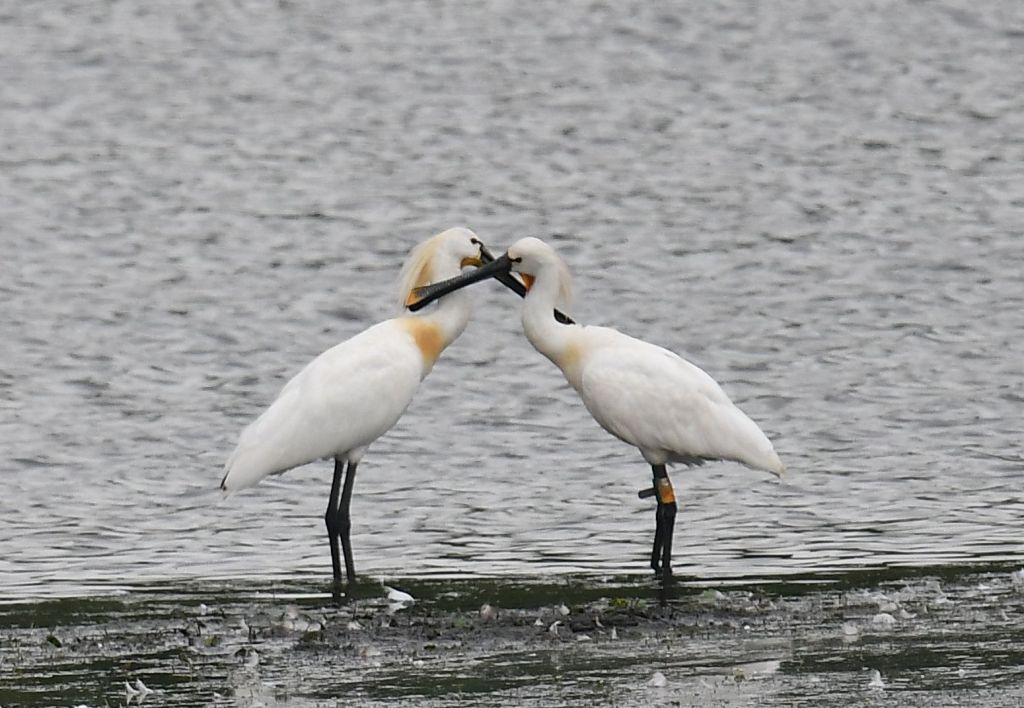
There was a story going round in Christian circles a few years ago about a dream that someone had had, of people sitting at a long table covered in food, but with knives and forks that were too long to actually get the food into their mouths. The solution was simple: they just fed each other. It’s a lovely illustration of how God wants us to live: not for ourselves, but for others. I saw an illustration of this principle operating in the natural world the other day, when I had the pleasure of watching these two spoonbills recently at a nature reserve near Leeds in the UK. Their beaks are too long to preen their own necks, so they preen each other’s.
After teaching the crowds with the parables of the Sower and the revealed light, Jesus says this: “Therefore take heed how you hear. For whoever has, to him more will be given; and whoever does not have, even what he seems to have will be taken from him.” (Luke 8: 18). Immediately after that He illustrates exactly what he meant by that. Luke’s account continues: “Then His mother and brothers came to Him, and could not approach Him because of the crowd. And it was told Him by some, who said, “Your mother and Your brothers are standing outside, desiring to see You.” But He answered and said to them, “My mother and My brothers are these who hear the word of God and do it.” (vs 19-21)
The sequence here is not random: He told the parable of the Sower at that moment, following it with the illustration of the revealed light, because He knew in His Spirit what was going to happen next. We can either hear actively or passively. When we hear actively –“with a noble and good heart”- we do the sayings of Jesus and we bear fruit. Choose your metaphor: our talent multiplies; our seed bears fruit; our light shines; the river flows. When we hear passively, like someone who looks in the mirror and turns away (see James 1:24), we bury our talent in the ground, we hide our light under a bushel, our seed has no root or is choked with thorns, our river is silted up. The Greek word “kalos”, translated here as “noble,” has a strong sense of ‘goodness in action.’ One of the top-level Strong’s definitions is “good, excellent in its nature and characteristics, and therefore well adapted to its ends.” A good and noble heart is a heart with integrity; the opposite of the heart of the hypocrites, of whom God says they “draw near to Me with their mouths and honour Me with their lips, but their hearts are far from Me.” (Matt 15:8). The fruitful heart, the light that shines so others may see it, is the one that will “hear the word of God and do it.”
James 1:17 tells us that “All good and perfect gifts come down from the Father of Lights.” I have written about the Father’s waterfall here: the Father calls us to it so that we can pass on what we have received. This chapter of Luke carries on with a sequence of miracles; illustrations of faith in action beginning with Jesus calming the storm and culminating in the raising of Jairus’s daughter. Our spoons are for sharing. The Gospel is “for babes:” it might not be easy, but it’s simple. Carry your cross and walk after the Spirit who always wants to give life, and don’t walk after the flesh that always wants to hang onto it. We all want to see Jesus, but we stay outside unless we do what He says. And when we do, and those seeds of His take root in a noble and good heart, anything can happen.
“Since you have purified your souls in obeying the truth through the Spirit in sincere love of the brethren, love one another fervently with a pure heart, having been born again, not of corruptible seed but incorruptible, through the word of God which lives and abides forever, because
“All fleshis as grass, And allthe glory of manas the flower of the grass. The grass withers, And its flower falls away,But theword of the LORD endures forever.”
Now this is the word which by the gospel was preached to you.” (1 Pe 1 22-25)
I was on a mission trip to Switzerland in May, staying at a Bible college up in the hills overlooking a lake, facing some prominent peaks of the Alps. I was walking down a path one morning to check out the bird life, having read the above passage from1 Peter before I left. In all the times I have read that scripture, I had never thought about “the flower of the grass,” until this moment when I found myself standing in it, looking across the valley at the view which the photo above captures a corner of. I took the picture from where I stood with the flower of the grass at my feet, the Bible school behind me, representing the enduring Word of God, looking across the valley at the beauty and majesty of God’s creation, drinking in liquid bird song and the flutter of butterflies among the wildflowers, drenched in peace, and above all feeling cradled in the love of the one who had made it all. After nearly 40 years in the Lord, I felt the Father’s love in a new, intimate way that morning. And while I was standing there trying to contemplate the majesty of my loving Father through this tiny fragment of His creation the thought occurred to me: the flower of the grass doesn’t even last anything like as long as the grass itself. And this is as much as our glory is worth!
The thoughts tumbled in: how often do we try to elevate ourselves with our opinions, our superior “wisdom,” our spirituality, our ”rightness” – especially our rightness? But our glory is no more than the flower of the grass at my feet compared with the glory of God in all His majesty and the eternal truth of His Word, and my opinions are of no more value by comparison than a used bus ticket buried in the folds of my pocket. “All fleshis as grass, And allthe glory of manas the flower of the grass.” And yet we carry within us the glory of the One who made the mountains. How can I possibly offer people my bus tickets instead of letting them know something of the love, the peace and the glory that has been poured out into my heart by the Holy Spirit of Creator Father God? Why do I even look at them?
Without love, we stand alone, and all we manifest is what is corruptible; the flower of the grass. When we reach out in love to others we can manifest the glory of God and the incorruptible truth of His word, quickened by the power of His Spirit. Switzerland is full of waterfalls. I was telling a wise friend about my experience on the hillside, and likened the idea of standing in the flow of God’s love to standing under a waterfall (I am hardly the first person to do so…) My friend said “A waterfall pours into a pool, then flows out of it. Our job (actually he said “your job,” but it applies to all of us) isn’t to try and direct the flow of the water, but just to stand beneath it. It will take its own course out of the pool.”
Our hearts are that pool. The love of God has been poured into them (Romans 5:5), and it pours out as rivers of living water (John 7:38). I don’t think we can truly love unless we stand under that waterfall. Jesus came and died to make it possible. The Father’s waterfall carries no negative pollutants; it always brings forgiveness, always drives away hurt. It always renews, always washes away the old, it is always fresh, always new, always clean, always pure. It is the Father’s waterfall that drives the dynamo of His power on the Earth. When we stand beneath it we cannot hold onto pain and disappointment, but letting go we can let the water come, and in our own situations we can be like Jesus, “who, when He was reviled, did not revile in return; when He suffered, He did not threaten, but committed Himself to Him who judges righteously.” (1 Peter 2:23)
“Every good and perfect gift comes down from the Father of lights” (James 1:17), and so the greatest and most perfect gift of all, the love of God, must also come down from above. It can’t return from where the waterfall has already passed. If we look to any other source to meet our deepest need we are looking for secondhand water.
“Deep calls unto deep at the noise of Your waterfalls; All Your waves and billows have gone over me. The LORD will command His lovingkindness in the daytime, And in the night His song shall be with me— A prayer to the God of my life. |(Psalm 43:7-8)
Isaiah exhorts all who are thirsty to “Come to the waters” (Isaiah 55:1). When we do, it is not just our thirst that is quenched, but the thirst of those around us as the Lord commands His lovingkindness with the water that pours out of the pool of our hearts. If we will stand in the Father’s waterfall we will see the glory of the mountains made manifest, not just the flower of the grass.
Jesus said “I will build my church, and the gates of hell so not prevail against it.“ We are in the world, but we are not of it. Jesus was from above; we too are born from above. All good and perfect gifts come down from the Father of lights. All that Jesus builds of his Church is from above. When the kingdom of God comes on Earth as it is in Heaven, it comes from above, and what is built is from above. What is built is not of the world, even though it is in it. What is of the world is passing away; what Christ brings into the world is eternal. As the apostle John wrote: “The world is passing away, and the lust of it; but he who does the will of God abides forever.” (1 John 2:17) Even in the rubble and devastation of war, the eternal Kingdom of God is being built in the hearts of men and women who love him. (Other references from this paragraph: Matt: 16:18, John 17:16, John 8:23, James 1:17.)
That is all solid scriptural truth, and it’s easy for me to sit in my armchair and dictate it into my iPhone, in the comfort and convenience of the Western world and its technology. But if a bomb landed on my house now as they are landing in Ukraine, and took away in seconds all that I have built over 40 years, where would my heart be?
David wrote “I will walk within my house with a perfect heart.” (Psa 101:2) If my house collapsed around me, I wonder if my heart still be perfect? I think not. I don’t have to look back very far over the last 24 hours without seeing glaring imperfections in my heart. In fact there is only Jesus, whom David prophesied in that psalm, who can say in truth that He walks within His house with a perfect heart. And we are all His house; (Heb 3:6) By His Spirit He does walk among us, building His Kingdom as we give Him the building materials of our lives. As Christina Rosetti wrote in the words of the Christmas Carol, all that we can give Him is our hearts, and when we give Him our hearts, He builds with them. His house is the place where righteousness dwells, and where love, truth, peace, and joy are found.
Paul wrote: “He died for all, that those who live should live no longer for themselves, but for Him who died for them and rose again.“ (2 Cor 5:15) If I’m living for myself I’m not building His house, but I’m building my own. If my heart is attached to the house that I build, to my own satisfaction, my own peace and joy, and it falls down around me, I will be devastated. But If my heart is truly devoted to building His house, and I live for Him through loving others, I will not care if mine collapses, but I will pick my way through the rubble looking for people who have been hurt by falling stones. And as I do that His kingdom will be built in that place on Earth, even though not a stone of my house remains standing.
I am a long way from this, as I expect most of us are. But we can choose on a daily basis to build His house rather than stay huddled in our own, simply by preferring one another…
The map of Europe has been pencilled in by man, country divided against country. When divisions arise and nation rises against nation, all that happens, as a friend of mine said, is that the lines are etched in more deeply; and so I saw recently a newspaper report on the Ukraine crisis that declared: “The map of Europe is being re-drawn in blood.“ If the war in Ukraine – any war, in fact – makes one thing clear, it is that only God can erase those pencil lines and bring unity; it’s only when the government is on His shoulders that will this happen, and until then nation will continue to rise against nation.
We however are citizens of another country; we are pilgrims in the world and citizens of the kingdom that is to come. We don’t belong to a nation; we belong to the kingdom of God. His Kingdom is the realm of love, peace and unity. What happens when divisions arise between us? I would not like to count the number of times that I have been in an argument with someone (usually my wife) and told myself how completely untenable the their position is, and have done nothing except justify where I stand (usually in the vain belief that by raising my voice I increase my powers of persuasion), convinced that ultimately they will see my point and change their ideas. I don’t see that the place where I am standing is actually on their toes and it hurts. When I keep explaining why I am sanding there, all I am doing is hurting them all the more.
God’s ways and God’s thoughts are not our ways and our thoughts. God’s way is the way of love. If what I am doing and saying makes complete sense to me but you are hurt by it, the fact that you are hurt is of far more importance to God than the fact that what I’m saying makes sense to me. It’s His righteousness that goes before us, not my rightness. If the fear of the Lord is the beginning of knowledge (Prov 1:7) I don’t fear God if I say I know better than you. If one ministry is pulling down another, it is not in the Spirit of Jesus that they are ministering.
When we are about to let our overbearing attitudes crush and invade another person or another ministry let’s remember Ukraine, because it’s the same bear that is trying to work in our own hearts.




 Notes From The Winepress