Category Archives: Walking in the Spirit

God gives the Spirit without limit. Jesus gave the Holy Spirit to the church to equip us to be His witnesses and carry on the work that He started by that same power. To deny that the power and gifts of the Holy Spirit are available to the believer today, or to say, as some do, that God does not speak supernaturally to His people today, is effectively taking Christ out of Christianity.

Rooted and grounded in love

The great grey shrike on Cannock Chase

“That you, being rooted and grounded in love, may be able to comprehend with all the saints what is the width and length and depth and height— to know the love of Christ which passes knowledge; that you may be filled with all the fullness of God.” (Eph 3: 17-18)

Love is the ground where the word of God takes root.  It’s the foundation where the house is built. It brings stability and strength. Love characterises the “good and noble heart” of Luke 8:15 that keeps the word of the kingdom and bears fruit with patience. The Greek word translated as “Noble” is Agathos. It’s the same word used in Mark 10:18, when Jesus says only God is good. Similarly, the Strong’s definition of Kalos (“good”) relates to every manner of perfection; flawlessness, in a word. A good and noble heart Is one that is flawless and perfect, not one that is corrupted by sin.

By contrast, Jeremiah 17 :9 tells us “the heart of man is deceitful above all things, and desperately wicked. Who can know it?” The Hebrew word “anas,” translated as “desperately wicked,“ has the sense of weakness and frailty associated with an incurable illness. If ever there was a word to describe our sinful nature, this is it. It is definitely not good ground, and never will be. The only “good and noble” heart that Scripture shows us is the heart of God Himself. And the wonderful thing is, that when we are born again of the Father and He has given us a new heart, this is the very “heart of flesh” that we receive. It seems to me that the seed of the word of God can only be sown in the heart of flesh that we receive by the Spirit at the new birth. This is the ground of love with the word takes root and bears fruit.

This is not just theology and spiritual ideas: it works. When we choose to build on the ground of love we experience God‘s blessing. “Give, and it shall be given to you“ does not just refer to money or resources: when we choose to give love to others, God gives back to us, even in the small things. In fact, He often teaches us through the small things so we can apply his teaching to the bigger ones. If you know me, or have read some of my other articles, (eg “Between the Chapel and the Damned”) you will know that I am a bird watcher. A hobbyist bird photographer, to be precise. The picture above is of a distant great grey strike. They are very rare winter visitors to the UK, and there has been one this Winter on Cannock Chase, just a few miles from my house. There are apps that pinpoint the location of these rarities, so people in the birding community know roughly where they are. Yesterday morning I went out to try and find the great grey shrike. I only had a couple of hours, because I needed to meet with Anne by 10.30 so we could be on the same page about what to say at the retirement party that was being given in our honour (we have just retired from our business) at 12.00 o’clock. In other words, I had a relational commitment, a commitment to prioritize love.

I spent about an hour walking around and waiting in the area where the shrike had last been seen, but to no avail. My time was running out, and I was going to check one more likely place, but then I felt quite strongly that the Lord said: “No. It’s time you headed back now.“ On this occasion I did what I was told (on many occasions I don’t!) and started back down the path towards the car park. After a couple of hundred yards I turned the corner, and there was a little group of birders with their  cameras and telescopes all pointing in one direction. Yes: it was the great grey shrike. It was a good distance away, but happily I was able to see it and take some pictures. Five minutes after I arrived it flew off. If I had gone to check that other area before turning back, I would have missed it. God wants to bless us, even in our hobbies.

The word from Jeremiah about the heart of man goes on to say: “I, the Lord, search the heart, I test the mind, even to give every man according to his ways, according to the fruit of his doings.“ (Jer. 17:10) He blessed me by allowing me to see that bird, of which there are at the time of writing only three records currently in the UK. But, and more importantly, it blessed Him that I listened to what He said and did what I was told, and put my love for other people before my personal interests.

The point is this. I know full well that my natural heart, my heart of stone, would have gone to check that other place before heading home. I would have said to myself, “It will only take five minutes, and that won’t make any difference to the circumstances of the rest of the day.” And indeed it wouldn’t have: when I got home events had actually been delayed by half an hour or so, so I would have had plenty of time. But my new heart, my heart of flesh, was open to hear the word to prioritise Love, and because I was able to respond to it I walked into the blessing that God had planned. “Seek ye first the Kingdom of God and His righteousness, and all these things shall be given unto you.”  (Matt 6:33)

Even, in this case, a great grey shrike.

Ears to Hear

Paul wrote to the Galatians: “Foolish Galatians, who has bewitched you? He who supplies the Spirit and works miracles among you, does He do so by the works of the law, or by the hearing of faith?”  (Gal 3:1)

When we read this our initial, instinctive, impression of the Galatian church is probably something like “Bad Galatians! Paul is telling you off!” But actually if we look at our own church and compare the active presence of God at work among us, “supplying the Spirit and working miracles,” how do we compare with Galatia, where the text suggests that the miraculous is the norm? And alongside that expectation of seeing the miraculous power of God at work through the “supply” of the Spirit is also the assumption that the believers there are exercising the “hearing of faith” as a norm. Again, is this true of us today?

Paul is addressing a serious issue in the letter to the Galatians, specifically the heresy creeping into the church at Galatia that believers needed to be circumcised and to put themselves under Jewish law to attain salvation, but the context – the “lump” where the enemy is trying to insert his false “leaven” (Gal 5:9)- is that of a church of Spirit-filled believers who had “begun in the Spirit” (Gal 3:3), who hear God and walk by faith, and who experience the presence of God among them in power. The Galatians were a new church, and this level of life in Christ was where Paul feared they would fall away from. Many of us are in churches that have been in existence for decades, or even centuries, and we still haven’t attained to it. Maybe the same leaven is at work today.

Jesus talks about having “ears to hear.” Isaiah says: “Behold, a king will reign in righteousness,… The eyes of those who see will not be dim, And the ears of those who hear will listen.” (Isaiah 32: 1,3) We  can hear the Word with our eardrums and process it with our natural brains, but it doesn’t mean that we are hearing with our spiritual ears, and if we don’t have those “ears to hear,” we won’t be listening. It’s when the King reigns in righteousness in our lives that our hearing ears start to listen. We don’t just listen to Him when we want a miracle; we listen to him all the time and let his word direct our steps. We listen because He is the King.

Maybe this is why we so often don’t often see the miraculous: Maybe we don’t walk in it when we don’t need it. But when we walk in obedience and seek His direction in our lives at every step, we walk in the dimension of the miraculous, so we can expect the miraculous to be part of the landscape. Just as in the natural world we can turn a corner and see a flower by the path or a bird on the branch, so we can expect to see a gift of the Holy Spirit in front of us whenever He has chosen to put it there. As the prophet wrote, “The eyes of those who see will not be dim.”

Paul said he was “exceedingly zealous for the traditions of my fathers.“ (Gal 1:14) As God is preparing the Church for the upheavals of the last days and ultimately the return of the Bridegroom for His bride, we need to be vigilant that we too aren’t in thrall to the traditions of our own “fathers,” slavishly ‘doing church’ the way we always have done or the way it’s done in our particular denomination of network, rather than doing today what He wants today, which may be different from what He wanted yesterday, or last week, or last year. If this is the case we may not be walking in obedience to the King, and it could be that we are being even more foolish than the Galatians.

The desert and the camel

A couple of months ago the Lord gave me the following word, but I think now is the time to release it:

“I am the God of the universe. I put the stars in the sky. I put every vein on every leaf on every tree. Not a sparrow falls to the ground without my knowing. When those kairos moments, those “god- incidences,” happen in your life where you see my hand at work, arranging and organising your situations, it is because I have knitted the universe together to meet you in that moment and to open up my path for you.

You look ahead and you see an expense of barren desert. A rocky plane, stretching into the distance, with no path turning to the right or to the left. You say “I do not know which way to go. In every direction it looks the same, and the distance seems so great wherever I look.”

But I say I am calling you to walk by faith and not by sight. You cannot see a path because if I were to reveal it, you would be walking by sight and not by Faith. But I will guide you with my eye, even though your eye cannot see where to go. And you will hear a voice behind you, saying: “this is the way, walk in it,“ and you will step forward, one step at a time on my word. Because my word in you is living and active, and as you step on my word I will create that path for your feet and I will build structures that you can’t see through the active power of my word, even the structures of my kingdom. Will you trust me to knit the universe together anew at every step of obedience that you take? Will you trust my word, by which the worlds were made? Will you walk with me? Will you trust the power of my Spirit in your life?”

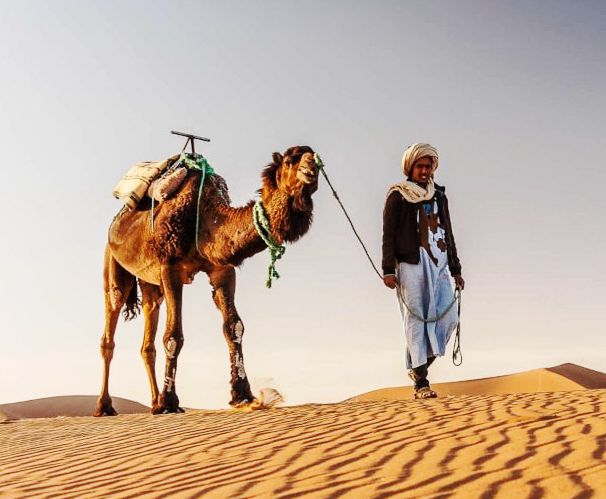
At around the same time the Lord also showed me a camel. It was, again, in the desert. Someone was trying to lead it with a rope, but it was resisting. I think the Lord was – is – saying that the camel knows that it’s got everything it needs to cross the desert: water stored in its hump; big flat feet to help it to walk across the soft sand without its feet sinking in, but we can be like camels who don’t know what they are carrying in their humps, and are resisting the person who is trying to lead them out across the desert. He says: “You have everything you need. You have my Spirit, and you have my word. I am holding the rope and I know the way you should go. You won’t wander off and get lost, so trust me and come with me across the desert. You may think it’s forbidding and barren, but it is also beautiful, and I will show you things, hidden things, that you have never seen before, because you have never been this way until now. Come, because now is the time.”

The God of David’s deliverance.

One of David’s great psalms of faith is Psalm 18, which he wrote, according to 2 Sam 22: 1, “on the day that the Lord delivered him from his enemies and Saul.” Many of the truths expressed both in Psalm 18 and in the book of Psalms as a whole – not to mention the rest of the Bible – are encapsulated in the section from verses 28-34. I wrote last week about the walk of faith. If we can allow the Holy Spirit to write the following promises on our hearts, as He did for David, I believe our walk will be strengthened. Here is the whole passage, followed by a few thoughts on each verse.

For You will light my lamp;
The LORD my God will enlighten my darkness.

For by You I can run against a troop,
By my God I can leap over a wall.

As for God, His way is perfect;
The word of the LORD is proven;
He is a shield to all who trust in Him.

For who is God, except the LORD?
And who is a rock, except our God?

It is God who arms me with strength,
And makes my way perfect.

He makes my feet like the feet of deer,
And sets me on my high places. (Psalm 18: 28-34)

He teaches my hands to make war,
So that my arms can bend a bow of bronze.

(Psalm 18: 28-34)

For You will light my lamp;
The LORD my God will enlighten my darkness
.

This is a promise. Sometimes we find darkness has descended on us like a cloud. It seems like the Lord is enthroned in another universe – if He even exists at all – and all we have is the experience of our flesh and our immediate circumstances. But the Lord promises that He will light our lamp. The light shines in the darkness, and the darkness has not overcome it. If we can keep this word in our hearts, believe it, speak it out, and ask the Lord to manifest its reality, it will strike the match that lights the lamp.

In addition, He promises to give us direction when we are lost or confused. His word is a lamp unto our feet and a light unto our path: he will show us not only where to put our feet next, but – although sometimes we have to wait for this – He will shine a light on the direction of our path ahead.

And finally, this is a promise of revelation. We can, and do, read the word diligently; we can quote promises of healing and provision, or whatever else we need, but our lamp can remain unlit. If the Word of God is the  sword of the Spirit, we need the Spirit to wield it; it’s not enough to quote it mechanically. And if it is a lamp unto our feet we need the Spirit to light it: a memory verse that is not breathed into us by the One who wrote it is not likely to guide our feet anywhere. We need the Word, and we need the Spirit. This applies as much to our personal devotions as it does to our church services.

For by You I can run against a troop,
By my God I can leap over a wall

Jeremiah 12:5 says “If you have run with the footmen, and they have wearied you, Then how can you contend with horses?”  As deep darkness spreads across the nations (Isaiah 60:2) we will need to be moving in the opposite direction to the troop of the world. Temptation, persecution, hardship, financial pressure are all “horses” that we could face. But God promises that He will be with us in our trials, and if we do not allow ourselves to be swept along by “the troop” but trust in His faithfulness and the power of His Spirit, we will see the glory of the Lord appear over us as He promises in Isaiah 60:2.

We can apply the second part of this verse to many metaphorical “walls,” but one wall that the enemy is always trying to fortify is that of division within the body of Christ. Jesus wants us united so that the blessing can be commanded (Psalm 133); Satan will do all he can to prevent this from happening. The flesh will always seek to protect its own interests, so it is only by the Spirit, in the love of Christ, that we can be one with our brothers and sisters in Christ and attain to “the unity of the Spirit in the bond of peace.” (Eph 4:3)

As for God, His way is perfect;
The word of the LORD is proven;
He is a shield to all who trust in Him.

God says: “I will instruct you and teach you in the way you should go; I will guide you with my eye.“ (Psalm 32:8) As I have written elsewhere, if someone is going to guide us with their eye we need to be looking at them in order to see what they are looking at. In general terms His way will always be the way of Love, and because love fulfils the whole of the law it will always be perfect, but in the specific context of our own daily need for direction, His way will always be our perfect option when we follow his guidance. Man’s wisdom at best is relative and incomplete, whereas God’s word contains no impurities: the Hebrew word translated as “proven” has the connotation of smolten metal that has had all the dross removed. So His proven word can always be relied upon to give us perfect direction: our part is to trust Him. It is not the words themselves that are our shield, like some sort of spell or mantra; it is the God who speaks them. When we look to Him and trust Him to be our shield, it is not so difficult to follow in the direction that He gives us.

For who is God, except the LORD?
And who is a rock, except our God?

There is one God, Father, Son and Holy Spirit, world without end. Salvation, deliverance, Life itself, an only be found in Him. Is God the rock on which we build our lives, or is it our career, our family, our wealth, our status, our marriage, our ministry? This verse needs very little comment, except the concluding words of the first epistle of John: “Little children, keep yourselves from idols.” (1 John 5:21) An idol is anything that takes the place of God in our hearts. Only He can have the place of lordship.

It is God who arms me with strength,
And makes my way perfect.

The word translated here as “arms” actually means “clothes,” or “girds,” as in being girded with armour. The verse actually speaks of the strength provided by the armour of God. Another meaning of the word translated here as “perfect” is “complete.” When we have put on the Ephesians 6 armour of God we are complete in Christ. Putting on the armour is the same as putting on Christ.  Psalm 93:1 says, “The Lord is clothed, He has girded Himself with strength.”  The armour that He is wearing is the strength that He arms us with. “Putting on the armour” isn’t a ritual to go through in our morning devotions: what we need to do regularly is to check that we have never taken any of it off. When we are “armed with” faith, salvation, righteousness, truth, and peace, wielding the Word of God, our way is perfect and we stand clothed in Christ. If any of them are missing we are less than complete.

He makes my feet like the feet of deer,
And sets me on my high places.

Have you ever seen a deer slip on a mountain path? Exactly: they don’t.  Ephesians 2: 6 tells us that we are seated with Christ in heavenly places; and Zechariah 3:9 tells us that, in Christ, we will  have “places to walk among those who stand here” (in the courts of Heaven). We are called to walk after the Spirit and not after the flesh (Romans 8:4), and to walk after the Spirit is to walk in the high places where God has set us. He wants us to be sure-footed, not taking a couple of spiritual steps then falling into carnality. He gives us those deer’s feet, and He lifts us to our high places: the truth of these words only manifest in our lives when we are yielded to His Spirit. And it is “my high places” where He sets me; not someone else’s. Each of us has a place of authority, the place of our call, where His anointing will flow. If you don’t know yet what your “high places” are, ask the Lord to show you.

He teaches my hands to make war,
So that my arms can bend a bow of bronze.

Finally, we are called to battle, whether we want to recognise it or not. A bow of bronze would have been a formidable weapon in David’s time, but you couldn’t use one effectively without training. And this isn’t all theory and interesting ideas: after we had studied this passage in School of Prophesy recently, Anne and I went for a walk on Cannock Chase (an area of wooded heathland near our home). While we were there we saw a small group of people – four or five – join hands round a tree and appear to pray, but they looked, and felt in our spirits, shifty and dark. If they were praying, they were not praying to Jesus. When they had gone, we went to the tree to investigate, and found a couple of memorials there to people who, presumably, had died. We prayed, for light to come into the darkness there, and for curses to be broken. God was teaching our hands to make war.

He will lead us into victory, and His glory will rise over His church as the times get darker; but we will need to fight for it.

The Pool of Bethesda

Take up your bed and walk! From a painting by Karl Bloch (1834-1890)

A awake sleeper, and rise from death, and Christ will shine on you.“ (Ephesians 5:14)

“After this there was a feast of the Jews, and Jesus went up to Jerusalem. Now there is in Jerusalem by the Sheep Gate a pool, which is called in Hebrew, Bethesda,  having five porches. In these lay a great multitude of sick people, blind, lame, paralyzed, waiting for the moving of the water. For an angel went down at a certain time into the pool and stirred up the water; then whoever stepped in first, after the stirring of the water, was made well of whatever disease he had. Now a certain man was there who had an infirmity thirty-eight years. When Jesus saw him lying there, and knew that he already had been in that condition a long time, He said to him, “Do you want to be made well?” The sick man answered Him, “Sir, I have no man to put me into the pool when the water is stirred up; but while I am coming, another steps down before me.” Jesus said to him, “Rise, take up your bed and walk.” (John 5: 1-8)

I woke up this morning and got out of bed, and what did I do next? I started walking. it’s the first thing we do when we get out of bed: if we are able to walk, we walk somewhere. it might not be long before we sit down again, but we have walked. When we are born again the first thing we do it to start walking. Our spiritual being that has just risen from death needs to put its feet somewhere.

The word Jesus uses for the man who was lying by the Pool of Bethesda is the same as that used in Ephesians 5:1 – its primary meaning is to rise from the sleep of death. When someone has been born again – risen from spiritual death – we encourage them to join a church. As a rule, it is “our” church that they join: they may have come along to a service as visitors, or they may have responded to a gospel outreach that our church has put on; but most of us would agree that this is secondary to their need to become part of a local expression of the body of Christ where they can be fed, nurtured and supported in their new walk with Jesus. When they get out of bed, the first spiritual steps of their new life will usually be on the “floor” of a church.

The House of Mercy.
So what is the meaning of Bethesda, where the sick were gathered in their multitudes? It’s an Aramaic word meaning “house of mercy.” The Strong’s citation also gives “flowing water.” Whether we take the meanings individually or in combination, it’s hard to see that they point anywhere other than to the church, where the water of the Holy Spirit flows in the house of God’s mercy.

The pool is by the sheep gate. We, the body of Christ, are “the sheep of His pasture.” The sheep gate was the entrance through which the sheep will lead into the temple where they would be sacrificed. When Jesus said “I am the gate (also translated door) all the sheep“ (John 10:) He was pointing to his own sacrifice, through which we have access to the temple. The Sheep Gate is a picture of the blood of Jesus, the only means of our salvation.

Sick, lame, paralysed and blind
In many of the gospel accounts, the sick and the demon-possessed are grouped together in the record of those whom Jesus healed or who came to him for healing (eg Mark 1:32, Matt 4:24, and Matt 8:16). However there is no mention of demon- possessed people here, which again suggests a connection between Bethesda and the Church. Christians can be oppressed by the devil, but I think most readers of this article would subscribe to the belief that a born-again spirit cannot be possessed. As in the Church, it would appear that no-one at the Pool of Bethesda was demon-possessed. What is true, however, is that many were sick, lame, paralysed or blind. Alongside those of us who need healing of “whatever disease they have,” there are many who are blind, lame, or paralyzed. They – or we – can’t see, can’t walk, or can’t move.

The Porches
God said to Jeremiah (and I’ve quoted it before on these pages): “If you have run with the footmen, and they have wearied you,
Then how can you contend with horses?
And if in the land of peace,
In which you trusted, they wearied you,
Then how will you do in the floodplain of the Jordan?”
(Jer 12:5)

The porches were a covered colonnade, where people sheltered from the elements. We come to salvation through the Sheep Gate, and in the porches we find shelter, rest for our souls. We are sheltered from God‘s judgement on sin; we are under the shadow of His wings. From our place of shelter, or to quote Jeremiah, our “land of peace,” we can see the pool and enjoy the power of the Holy Spirit. Sometimes the waters are stirred, we see people step in, and we see their lives transformed. But it’s not our turn, not today. Nevertheless it’s great to have the pool…

Days of turmoil are on us. The waters are rising, and the hoofbeats of horses are in the wind. Those who can’t walk, can’t move and can’t see in the spiritual realm will find it difficult to survive in this season, let alone live a victorious life. But Jesus is walking by the Pool with healing in His wings, strengthening us and and encouraging us to take up our beds and walk.

Some of us have been there a long time, waiting for someone to help us in. While we are strongly exhorted in the Bible to love one another, bless one another, and pray for one another, we still need to “work out our own salvation with fear and trembling.“ (Phil 2:12) To live in the good of our salvation, we need to rely on the Lord ourselves and not depend on the ministry of others. It is the Holy Spirit himself who is the Helper, not the pastor, the prophet, or a small group leader. We must have our own encounter  with Jesus, even if we are lying down in the shelter of Bethesda and watching the waters move.

Pure Joy

A few weeks ago a visiting speaker came to our church. Before she started speaking, she said that the Holy Spirit had highlighted a certain gentleman in the second row, three seats along … It was me. She brought a very encouraging word, with enough detail about myself (she had never seen me before) to confirm its accuracy, but the thrust of it was that ‘a door would be opening to me that would draw me closer to Him.’

Don’t we love it when someone brings an encouraging prophesy, underlined by another gift of the Spirit, the word of Knowledge, that speaks into our spiritual life and affirms us in our walk with God? I did not know what door she was referring to, but open doors often speak of opportunities. More time with Him and therefore less time at work? Ministry opportunities? I didn’t know and didn’t try and guess, but I certainly left church feeling good and played the recording of her word to me a few times over.

A couple of weeks after that we were praying for each other at School of Prophesy. One of the guys said that he could see our business going down a waterfall. There would be churning in the pool at the bottom; we would come out afterwards, but the watercourse would be different. That too was accurate: two days later our expected sales for this time of year plummeted, and there is definitely churning going on as I write. I have had to hold on  to the Lord as the water takes us on its course.

Then a few days ago the penny dropped: this was that. The open door that would draw me closer to Jesus is the waterfall that is rocking our business. When God speaks to us of blessing – and to be drawn closer to Him has to be a promise of blessing, because “at His right hand are pleasures for evermore” (Psalm 16:11) – our flesh tends to interpret that, in some way, in terms of advancement and comfort. (Well, mine does anyway…) But God has a different angle:

Consider it pure joy, my brothers and sisters, whenever you face trials of many kinds,  because you know that the testing of your faith produces perseverance.” (James 1: 2-4)

When the Holy Spirit spoke to me of that door that was going to open, did it ever occur to me that it was going to be an opportunity for my faith to be tested in order to produce perseverance? I think not. Did I imagine a trial, or a mountain top experience? Certainly the latter.  But God’s ways are not our ways. How different are the values of His Kingdom to those things our soulish minds hold dear. We value our comfort and advancement, our security and the approval of our peers; God values that we “act justly, … love faithfulness, and … walk humbly with your God.” (Micah 6:8) The Narrow Way has a totally different trajectory to the way of the world. God’s priority for us is that we walk with Him, and that we “Seek first the Kingdom of God.” And it is only by faith that we can take any steps with Him at all, so if trials are the best way to strengthen our faith and bring us into that place of blessing which is increased closeness to Him, there is a good chance that trials are what we are going to get.

My business is a tiny little pool: the world itself is going through a state of churning, and none of us know what the watercourse will look like when it comes out the other side. But one thing is true: we all need to let Jesus draw us closer to Him, because there is no other place that is more secure. One of the worship songs that came out of the charismatic movements starts “This is my desire, to worship you…” We love to lift our hearts and voices, and probably our hands, and tell the Lord how much we want to come close to Him. The Son shares our desire, and expresses it to the Father just before going to the cross: “Father, I desire that they also whom You gave Me may be with Me where I am, that they may behold My glory which You have given Me; for You loved Me before the foundation of the world.” (John17:24) We lift our voices to draw near to God; Jesus lifted His body onto the cross to have us close to Him. His Spirit in us will always be working towards that goal, because that is His desire. This was the joy set before Him.

Probably the best-known “resurrection psalm” is Psalm 16, where, by the Spirit,  Jesus expresses that joy through the words of David:

I have set the LORD always before me;
Because He is at my right hand I shall not be moved.

Therefore my heart is glad, and my glory rejoices;
My flesh also will rest in hope.

For You will not leave my soul in Sheol,
Nor will You allow Your Holy One to see corruption.

You will show me the path of life;
In Your presence is fullness of joy;
At Your right hand are pleasures forevermore
.
(Psalm 16: 8-11)

Jesus faced the greatest trial of all for the joy of seeing our faith bring us into the glory of unity with Him and the Father for ever. So when we are facing trials, let’s remember to “consider it pure joy” as Jesus did: our faith is being tested, to enable us to persevere in the things that really matter.

Between the Chapel and the Damned

The Parable of the pectoral sandpiper

The Chappel Hide
The pectoral sandpiper (shown above) – or “Pec” as it is known in the birding community – is a wader that is scarce in the UK. (Waders are long legged, long billed birds that feed mostly around water margins.)   One had turned up in our local bird reserve, so  I decided one night I would go there before work if I got up early enough. Pecs are usually “passage migrants” – they stop by somewhere for a few days before moving on to their breeding or wintering grounds somewhere hundreds of miles away- so when there is one around, most birders make an effort to go and see it if they know where it is. According to the bird club blog, this one seemed to favour one particular part of the reserve, conveniently just in front of one of the hides. All the hides have names – this one is called the Chappel Hide.  I woke at 5 am and said: “No that’s too early. Lord, if I’m going birding, please wake me at 6 o’clock.” ( Nothing like spiritualising one’s hobby) But God seemed clearly happy with my hobby on this occasion, because I woke at 6 am exactly, practically to the second. What I didn’t realise at the time was that what He got me up for was rather more important than the bird…

I set off after coffee and a quiet time and got to the reserve at about 7.30. There are two very experienced and dedicated birders, Steve and Mark, who are often on the dam wall at one end of the reservoir at that time of day, scanning the whole reserve with their telescopes. The Hide is towards the other end. I felt quite strongly that when I got there, I had to go straight to the hide, and that I would see the pec if I did. However when I got to the end of the path and reached the edge of the water where the path forked I saw my two friends on the dam wall, and instead of turning left to go to the hide, I turned right to go and talk to them. I thought that they would probably know where it was, so it was worth checking with them first. But when I got there, Steve said, “it’s at the Chappel Hide!“ I knew what he was talking about of course. I stayed and chatted for a couple of minutes then set off for the Chappel Hide. However, when I got there, the pec was nowhere to be seen. I waited half an hour for it to show again but to no avail. Then the door to the hide opened and Steve walked in. “Have you seen it? he said.
“No.”
“It was just there,” he said, pointing to a very open spot just in front of the hide, where it would have made a perfect photograph. He scanned the whole area expertly with his binoculars and said, “No it must be skulking in the undergrowth again. But when you came up onto the dam it was there in front of the hide. I could see it with my telescope!”

Confluence of circumstance
When I had decided to go and talk to Steve and Mark where the path branched, it was about equidistant between the dam and the hide. If I had turned left, as I felt the Holy Spirit, who got me up at 6 o’clock practically to the second to go there, had told me, I would’ve seen my bird. But instead, I had decided to go and listen to man, as if their advice would be better than the Lord’s. Chappel? Chapel? Is that a coincidence? And what about the Dam wall? I was between the chapel and the damned, and I chose the damned. And when you start thinking about how God organized that confluence of circumstance the mind slowly explodes…

Driving home I was kicking myself for my stupidity. But the Lord made it clear that He knew what I was going to do, and that it was an important lesson for me that He wanted me to learn. It might only have been about a bird that I didn’t photograph or even see on that particular occasion, but the principal was one that had to be applied in much more important situations. It can be drawn from a number of scriptures, such as

The wisdom of this world is foolishness to God (1 Cor 3:19)
Blessed is the man who has not walked in the counsel of the ungodly (Psalm 1:1)
There is therefore now no condemnation to them which are in Christ Jesus, who walk not after the flesh, but after the Spirit (Rom 8:1)
We ought to obey God rather than men. (Acts 5:29)
There is a way that seems right to a man, But its end is the way of death.
(Prov 14:12)

There is one more, too, because this isn’t quite the whole story. Isaiah 30:21 says “Whether you turn to the right or to the left, your ears will hear a voice behind you, saying, “This is the way; walk in it.” The path that I took was path B (below). But there was another path, path A, which is the one that I had intended to take and which I had seen myself taking as I drove to the reserve. If you are going along with my “leading of the Spirit” assumption, this is the one that I felt God was showing me. Path A was the way I should have been walking in. When I decided to take B instead – “just to see if Steve and Mark are on the dam” – I had actually already decided to go and talk to them if they were there. When I took that path I was already  in “the way that leads to death.” But what do we all pray? “Lead us not into temptation…” If I had gone the way I had been shown at the beginning, when I “heard the voce behind me,” I would not have been led into temptation…

The Valley of Decision
Is this all ridiculously over-cooked? Well, maybe; but it worked for me. Because when I got to work the same day (I am CEO of an educational supplies business when I am not writing or birding) there was a very important financial decision to be made. All “human” thinking pointed strongly in one direction, but we (myself, my wife Anne, and two other Christians in senior management) chose to seek God instead of doing what circumstances seemed to dictate. Anne had already felt that the Lord had told her not to “go down to Egypt,” which represented the obvious choice in the particular circumstance where we found ourselves, but if it hadn’t been for the pectoral sandpiper I would have been inclined to override her. Then as we prayed, we received a very clear course of action that no-one had seen before, which has turned out to be the wise choice, for a number of reasons. God is faithful, and His sheep hear His voice. But we have to be prepared to go to the chapel…

There will be more decisions for us all to make: as darkness covers the Earth and world systems tremble and collapse we will need increasingly to follow the paths that God shows us, and not the ways “that seem right to a man.” We need to be yoked to Jesus, because in that day there will be “multitudes in the valley of decision;” and if we can listen to that voice behind us – and obey it –   we will be following the right paths ourselves, and many will follow us to the chapel instead of going to the damned.

(The photo is the only other pectoral sandpiper I have seen. I took the picture in 2021, at Titchwell Marsh, in Norfolk UK.)

Whatever you bind on earth will be bound in heaven

“Assuredly, I say to you, whatever you bind on earth will be bound in heaven, and whatever you loose on earth will be loosed in heaven. Again I say  to you that if two of you agree on earth concerning anything that they ask, it will be done for them by My Father in heaven. For if two or three are gathered together in my name I am there in the midst of them.“ (Matthew 18 : 18 – 20)

Symphony
To agree is to be an accord, in harmony. The Greek word is where our “symphony“ comes from: sum (together) and phoneo (to sound), so to sound together. This is more than just intellectual assent: it is hearts in harmony. We regularly quote verse 20 at our gatherings as evidence that Jesus is “in our midst,” particularly if only “two or three” have turned up at the prayer meeting; but I think we also have to remember the significance what it is to be in His name. The Greek word onoma means a lot more than what is written on our birth certificates. Strong’s defines it like this: “the name is used for everything which the name covers, everything the thought or feeling of which is aroused in the mind by mentioning, hearing, remembering, the name, i.e. for one’s rank, authority, interests, pleasure, command, excellences, deeds etc.” It doesn’t mean we’re in His name because we’re Christians or church members: to be in His name because is to be sharing in His identity. We are part of who He is. He is love and truth and grace. If, on earth, we are not gathered together in love and truth and grace we are not in His name.

I can’t say I really understand the dynamics of just how Jesus is more in the midst of us  when we are gathered in love and truth in this way, because Jesus is in each of us anyway. Maybe our unity in some way allows the Holy Spirit to transcend the limitations of our flesh so that He really does become “the fourth man in the fire“ (as in the story of Shadrach, Mishach and Abednigo): however it happens there has to be some connection between this Scripture and the words of Ps 133 that declare “the unity commands the blessing.“ But I also think these are the conditions for verse 18. I can’t imagine that anything happens in heaven without the Father’s authority. Anything that is bound or loosed in heaven has to be so because the Father decreed it. As well as the physical and metaphorical sense, the Greek words for binding and loosing can also be much more generic such as preventing and allowing, obliging or releasing. The Son and the Father are one so when we are in agreement on earth, in love and in truth, Jesus is agreeing with us too; and if Jesus agrees with us, then so does the Father. John 17:21 is fulfilled: “that they all may be one, as You, Father, are in Me, and I in You; that they also may be one in Us, that the world may believe that You sent Me.” And then whatever we ask on earth, whether it’s binding or loosing, is authorised in heaven, it shall be so, and the Father is glorified. (See John 14:13)

Unanswered prayer
I think one of the answers to the thorny question of unanswered prayer may be found here. We may be praying God will and God’s provision, and quite probably quoting God’s word;  but if we are not at the level of unity needed to be genuinely in His name we cannot really expect Jesus to be “in the midst” in the way that He expresses it here. We may well quote the Truth from Scripture, but Truth needs to be spoken in Love. Prayer is always about God’s will being done on earth as it is in heaven, and thus extending His Kingdom among and through us. We all know what Jesus says in the Sermon on the Mount: “But seek first the kingdom of God and His righteousness, and all these things shall be added to you.” (Matt 6:33). God is Love, and “Love is the Fulfillment of the Law” (Romans 13:10), so both God’s Kingdom and His righteousness are expressions of His love. I think God’s kingdom must be real among us before it can be extended through us.  It cannot be without significance (nothing in Scripture is!) that these verses are sandwiched in the middle of Jesus teaching, then answering Peter, on the subject of forgiveness. If we really want to be in agreement when we pray, with all that this means, I think it’s important that we examine our hearts towards each other and ask God to reveal any areas of criticism or unforgiveness that we may be harbouring, before we say “amen.” If there isn’t genuine unity, we can’t expect the blessing.

The Courts of Heaven
The other aspect of binding and loosing is the one most commonly used among charismatics (I use the term loosely: I’m sure I mean Pentecostals as well, and I have a suspicion that Jesus doesn’t use either of them…), and refers to “binding” spiritual forces of evil, and “loosing” people from their bonds. Jesus healed a woman whom He said Satan had bound for 18 years, (Luke 13:16) Her healing is often used as a template for spiritual warfare, but if the truth were told how often do we see a change in someone’s condition when we make these decrees?

In Zechariah 3:7, the Lord says to Joshua

‘If you will walk in My ways,
And if you will keep My command,
Then you shall also judge My house,
And likewise have charge of My courts;
I will give you places to walk
Among these who stand here.”

In Christ, we too walk in those places of spiritual authority. It was when Jesus gives Peter the keys to the Kingdom of Heaven (Matt 16:19) that He first made the promise that is repeated, word for word in Matt 18:18: “Whatever you bind on earth will be bound in heaven, and whatever you loose on earth will be loosed  in heaven.” Those keys are symbols of authority. I think we often have the mindset that our “binding and loosing” on earth are words of authority that release actions in heavenly places, but if that is true what is going on in heaven isn’t happening on the earth, at least in most cases that I have seen. But what if we turn it round and say that whatever is bound or loosed in heaven is bound and loosed on earth? In other words, we can only bind/loose on earth what has already been bound/loosed in heaven? That actually makes a lot more sense to me, and it means that we have to know what is bound and loosed in heaven before we can see it happen on earth. Jesus only did what He saw the Father doing, so He loosed the woman that Satan had bound for 18 years because He saw the Father do it in Heaven.

Kingdom Authority
Joshua was a prophetic type of Jesus. Jesus did on Earth what He saw the Father doing in heaven, because he was walking there.  I think that the occasions when we see binding and loosing actually happen are when we’ve seen it or heard it in the place where we too have walked “among those who stand” in the courts of heaven and have seen what the Father is doing. The earthly realm has been given over through sin to the control of the evil one, but we are no longer under that control; we are above it, and we are taking it back for the King. If we want to at least have the opportunity to see what the Father is doing, we need to “Set (our) mind on things above, not on things on the earth.” (Col 3:2)  Jesus tells us (Matt 28:18) that  “All authority in heaven and on earth has been given to Me.”  In Christ, we are in the place of all authority.  To bind and to loose is to express that authority on earth as it is in heaven, whether it is over demons, sickness, finance, or any other circumstance, great or small. We will see it happen more often when we keep His command (Love one another) and walk in His ways, with our minds set on the places that He has given us to walk among those who stand in the courts of heaven.

Yes and No: Life and death in the power of the tongue.

Jesus said: “By your words you will be justified, and by your words you will be condemned.” (Matt 12:27), and Proverbs 18:21 reminds us that “Life and death are in power of the tongue.” Every  time we open our mouths we release life or we release death.  Paul wrote the following to the Corinthians:

“The things I plan, do I plan according to the flesh, that with me there should be yes, yes, and no, no? As God is faithful, our word to you was not yes and no. For the son of God, Jesus Christ – who was preached among you by me Sylvanus and Timothy- was not yes and no, but in him was yes . For all the promises of God in him are yes, and in him amen, to the glory of God through us.“ (2 Cor 1: 17-20)

In Christ there is only Yes
“In Him was yes.” There are no negatives in Jesus. He only spoke words of Life. There are negatives in the flesh – “yes, yes, and no, no” – but in Christ there is only “Yes.” In the realm of the Spirit, where all the promises of God are ours and where we are called to live, there is only Yes and Amen, and for every yes and amen God receives the glory. Whatever context Paul was referring to here when he talks about his plans, the statement he makes is absolute and so I think we can rightly apply it to our own lives. In Christ there is only Yes. Does this mean that we say yes to every request or agree with every suggestion made by others? Of course not. But it does mean at the least that we remain affirming of the people whose requests or suggestions we refuse; at the most it means that what looks like a “no” to our flesh is actually a massive “yes” in the Spirit; and always it presents an opportunity to release something of the promises of God into the circumstances where we find ourselves.

So how do I move from the flesh, with its yes yes and no no, to the spirit of Jesus Christ and the life affirming faithfulness of God that is always Yes?

The answer begins with a question. When we read the account of the woman with the issue of blood in Luke (Luke 8: 43-48) we see Jesus on a mission, pressed by the thronging crowds, to raise to life the dead daughter of one of the local rulers of the synagogue. Here indeed was one of the “lost sheep of the house of Israel“ coming to worship him in faith. Surely nothing could be more important than to demonstrate the sovereignty of the Son of Man to one of the religious hierarchy? But a woman in need touched his cloak, He put aside his urgent agenda, and He stopped to asked the question “Who touched me?”

We know what follows. Power had gone out of him. The Holy Spirit was responding to the woman’s need as she came to him in  faith.

The dynamic of the miraculous
This was the moment of choice. The disciples saw only the agenda of the flesh, which was to say no in response to the pressing crowds; but the Spirit had a different agenda, which was to respond with a life affirming Yes to the sick woman’s need. Jesus ignored the pressing of the flesh and the negativity of His disciples to stop and see where the Holy Spirit was flowing.

We see the same contrast at work when Jesus fed the multitudes. Faced with His compassion for the 4,000, the disciples only saw the impossibility of feeding them:  “Where could we get enough bread in the wilderness to fill such a great multitude?” (Matt 15:33), whereas Jesus saw the limitless resources of Heaven and “commanded the crowds to sit down.” The flesh said No, the Spirit said Yes. The blind, the deaf, the lame, the demon-possessed – yes, yes, yes, yes.

This dynamic of the miraculous is available to us in the details of our everyday lives, where we can choose to release life or death into every situation that we face. We may not be ministering healing on every street corner and in every conversation, but if we pay attention to the exhortation of James to be “quick to hear, slow to speak,” (James 1:19) we never know when those opportunities might arise, our eyes can be open to avenues that only the Holy Spirit can reveal, and even our objections and refusals can be clothed in Grace.

To walk after the Spirit and not after the flesh we need to silence the “No!” that rises up when the negative voices are clamouring in our ears and circumstances are pushing us along their road, and we must be open to the touch of need and  ready to stop to ask the question that will connect us to where Jesus is saying yes.

(See also “Pursuing Love” for more around the story of the woman with the issue of blood).

Through a glass darkly

“And as I began to speak, the Holy Spirit fell upon them, as upon us at the beginning. Then I remembered the word of the Lord, how He said, ‘John indeed baptized with water, but you shall be baptized with the Holy Spirit.’ If therefore God gave them the same gift as He gave us when we believed on the Lord Jesus Christ, who was I that I could withstand God? When they heard these things they became silent; and they glorified God, saying, “Then God has also granted to the Gentiles repentance to life.” (Act 11: 15-18)

In this passage, Peter is describing to the church at Jerusalem the events of Cornelius’s house that Luke had narrated in the previous chapter, when the gospel was preached to the Gentiles and they received the Spirit and spoke in tongues (Acts 10 : 44-46). This morning, I happened (happened?) to have been reading a little bit about a very well-known author and preacher who calls himself a “moderate cessationist;” wondering, as I often do, how somebody who talks and writes about prayer (and other aspects of Christian living) can leave out what to me is fundamental to my communication with God. Because I often “don’t know how to pay as I ought,” I am really grateful that ‘the Holy Spirit is helping me in my weakness,’ (Romans 8:26) so in my own opinion leaving Tongues out of one’s prayer life is like not putting the yeast in the bread machine when you are baking a loaf. Something comes out alright, and it is no doubt just as nutritious; but it’s heavy and flat, and just not something you want to go to for sustenance.

The cessationist position in the article I read taught that the whole counsel of Scripture provides a more solid and secure foundation for our Christian life that subjective experiences of the supernatural, be it “prophesies” that are products of the imagination, “healings” that are psychosomatic in origin and not at all miraculous, or “tongues” that are the product of the language centres of the human brain and not utterances of the Holy Spirit, so aware of that I found myself reading the passage that I am studying at the moment with this issue very much in my mind.

This episode in the Book of Acts is of course a frequently used justification for the Pentecostal/charismatic position on speaking in tongues: they got saved, the Holy Spirit fell as at Pentecost, and they spoke in tongues; therefore it follows that the gift of Tongues is there for everyone who gets saved. I fully believe this myself, but what struck me when I read the passage this morning was Peter’s comment that he “remembered the word of the Lord, how He said, ‘John indeed baptized with water, but you shall be baptized with the Holy Spirit,” and that he related this experience of the Holy Spirit among the Gentiles to “the word of the Lord” spoken by Jesus. Pentecostals and Charismatics make this connection frequently enough, and I remember Reinhart Bonneke preaching on this text many years ago; but this was the apostle Peter. Jesus Himself was the Word, the Logos; and the “word of the Lord” referred to by Peter was the “rhema” word, the “now” word spoken by Him into a specific context. So the baptism of the Holy Spirit by the laying on of hands with the evidence of speaking in tongues is as grounded in the scriptural foundations of our faith as it is possible to be: referenced by the apostle  Peter to a rhema word spoken by the Logos Himself.

It is essential that our experience always lines up with the Word of God, and that we always worship in Spirit and in Truth; and because of this our assemblies must be churches of the Word and of the Spirit – whether or not Smith Wigglesworth’s famous prophesy of the great revival based on the Word and the Spirit ever comes to pass. But even if some of our “spiritual” experiences are not supernatural at all, I would embrace them every time for the sake of not missing the ones that are, as long as it is always our trust in the truth of the Word of God, and not our (or other peoples’) personal experience, that is the basis of our faith.

To close, prayer is not often something I find difficult. I often come across articles or book extracts that suggest all sorts of props to one’s prayer life, whether they are Bible study programmes, or pathways through the Psalms, or daily notes whatever else, and I think to myself, “Why?” Isn’t it enough to have the Holy Spirit helping me to pray?” Maybe some of these people are “moderate cessationists” as well, avoiding the gifts of the Spirit for the sake of keeping their faith in the Word unsullied by untrustworthy experiences. Maybe they find prayer difficult at times because they have left the yeast out of the bread mix and find the loaf heavy and indigestible as a result. I don’t know, and it’s not for me to judge. Maybe my own prayer life is full of yeast bubbles and has little substance…

But I know this: when I was a baby Christian in a charismatic church in the 1980s I used to doubt that people who didn’t pray in tongues were even saved, never mind just missing out on one of the God’s many blessings for His children, and by the grace of God I am wiser and less arrogant than that now; but I still think It is better see through a glass darkly than never to look in the mirror at all.

NOTE: Material on the power of the Holy Spirit in the life of the believer is (loosely) grouped under “Spirit without Limit.” A useful starting point is “The Name of the Father,” which looks at the baptism in the Holy Spirit in the context of the beginnings of the Ephesian church.