Tag Archives: bible

Bread from Heaven: 3

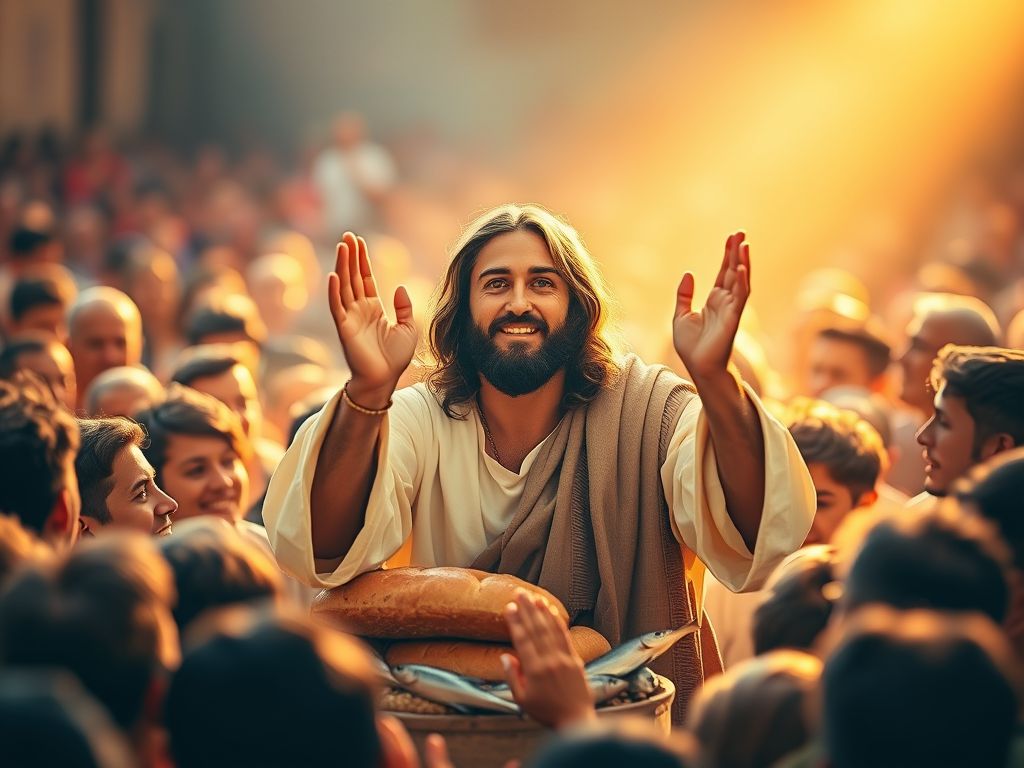
And Jesus took the loaves, and when He had given thanks He distributed them to the disciples, and the disciples to those sitting down; and likewise of the fish, as much as they wanted. (John 6:11)

He knew what He would do
In our attempts to bring up our children to say “please,” the parents among us might well have said at times: “And what’s the magic word?” However in the Kingdom it’s not please, it’s thank you. Jesus didn’t ask the Father to multiply the loaves and fishes; he thanked Him for them. This miracle, along with its “twin“ where the 4000 are fed in the accounts of Matthew and Mark, is one of only three occasions in the New Testament where Jesus gives thanks to the Father. The Greek word used for giving thanks is eucharisteo, and Jesus uses it when He feeds the multitude, when He thanks His Father for always hearing His prayers at the raising of Lazarus, and at the last supper, when He gave thanks for the bread and wine.

Eucharisteo: We use the same Greek word ourselves when we remember the cross at the Eucharist, and for me, this is the key to understanding much of the significance of this miracle. Andrew looked at the loaves and fishes with eyes of flesh and asked: “What is this among so many?”, but Jesus looked with the eyes of the spirit and saw the riches in glory that would meet the need of the multitude above all that the disciples could ask or imagine. He could see the limitless creative powers of heaven, and He knew that “all that the father has is mine,” (John 16:15) so it is no surprise that John’s account of the miracle tells us that “He himself knew what He would do.” (John 6:6)

In everything give thanks
In his letter to the Philippians, Paul exhorts us to “be anxious for nothing, but in everything, by prayer and supplication, with thanksgiving, make your requests known to God.“ (Philippians 4:6) We know that Jesus had direct access to the Father’s provision because of who He was, and there are no barriers to our faith in that regard. But it is much harder to believe that we have the same access to that provision, because we know who we are as well. We can, and do, believe that Christ dwells in our hearts through faith, that in Him we are seated in heavenly places, and that all things are possible through Him; but we also know that we have only experienced the boy’s family picnic when faced with a multitude, and not the feast.

When Jesus gave thanks at the feeding of the 5000, I don’t think He was thanking His Father for the loaves and fishes in His hand, but for the provision that was in heaven. Demonstrating what He told His disciples in Mark 11:24, He believed He had received it, gave thanks for it, and it was done for Him. His Father passed the food to Jesus, and He passed it to the disciples to give out.

God wants us to give thanks in everything. Whether we are faced with abundance or lack, and whether or not we are petitioning heaven for something, we are to be thankful at all times. Paul expresses this sentiment in his letter to the Romans:

“… He who eats, eats to the Lord, for he gives God thanks; and He who does not eat, to the Lord he does not eat, and gives God thanks. For none of us lives to himself, and none of us die himself. So if we live, we live to the Lord; and if we die, we die to the Lord. Therefore, whether we live or die, we are the Lord’s.” (Romans 14:6–8).

Our Inheritance
As I have mentioned, the only occasion outside of feeding the multitudes and giving thanks for the bread and the wine at the last supper, was when Jesus thanked the Father for hearing Him at the raising of Lazarus. His Eucharist there was more about His relationship with the Father than what He was about to do. Our constant thanksgiving to God is not for what we do or don’t eat – or do, or receive -, but it’s for a relationship with Him which we can indeed be thankful for in all things. We can be thankful to Jesus every moment of the day for the fact that we are His, and what we have is His. But more than that, amazingly, what He has is also ours:

“And if you are Christ’s, then you are Abraham‘s seed, and heirs according to the promise.”(Galatians 3:19)

“And because you are sons God has sent forth the spirit of His son into your hearts, crying out, “Abba, Father!“ Therefore you are no longer a slave but a son, and if a son than an heir of God through Christ.” (Galatians 4:6–7)

We are heirs of God through Christ. We have an inheritance to be forever thankful for. Just as everything that the Father has belongs to Jesus, everything that Jesus has is ours in Him. Of course this does not mean that my neighbour’s house, or wife, or goods belong to me because they are His: the key phrase is “in Him.” “In Jesus name” is not just a phrase that turns a request into a prayer, but it’s the declaration that what we are asking for in prayer is something that we are requesting on His behalf because He has told us that He wants us to have it, whether it’s to accomplish His Kingdom purposes through us or for us. Whatever we are doing, we have an inheritance to be thankful for, and which is at our disposal all the time we are walking alongside Him. What is His is ours. If I am sitting at the dinner table with my wife and I ask her to pass the salt, she is not going to question my action: the salt on the table is a shared possession. Of course she is going to let me have it.

Paul makes this clear in his first letter to the Corinthians:

“Therefore let no one boast in men. For all things are yours. Whether Paul or Apollos or Cephas, or the world, or life, or death, or things present, or things to come – all are yours. And you are Christ’s, and Christ is God’s.” (1 Corinthians 3:21-23)

Just as Jesus is the transition from earth to heaven for our spirits, He is also the transition for us from heaven to earth for our inheritance. So whatever the loaves and fishes or the starving crowd may represent, what do we have available to meet the need? Jesus can make our lack into His abundance if we remember to thank Him for our inheritance. Pass the salt, please, Lord. Thank You.

Bread from Heaven: 2

Make the people sit down
In his letter to the Galatians, Paul says that what matters most of all is “faith working through love.” So here we are on the mountainside. We have kept in step with the Spirit; we have lifted our eyes with love, we are aware of how God has led us to and provided for this moment, and so we believe that Jesus wants to meet the need that is now before us. Even though He knows what He is going to do, we don’t. What next?

Jesus says, “Make the people sit down.” Some miracles require preparation, and that preparation has to be in obedience to what the Lord has asked us to do. The disciples could not see with their natural eyes what might happen next, but they got their instructions and complied with them. Like the unprofitable servant (Luke 17:10), they simply did what they were told to do. And more than that, they had to do so with authority. 12 men had to exercise crowd control on 5000, many of whom had their families with them, and all of whom were ravenous and will have wanted to be first in the queue for whatever goodies Jesus was going do dish out. We have probably read and heard the story many times, but if you imagine the scene and do the maths it’s not hard to see that the first miracle was actually getting that crowd ready to receive the food in the first place. When I was a teacher I found it hard enough to control a group of thirty, so I needed to exercise authority – and that was when I knew what it was I was going to deliver.

The disciples could organise the crowd because the Lord had clearly given them the mandate to do so, and they put their trust in His authority without question. I wonder what they thought He was going to do? Elijah and Elisha both worked miracles of multiplication, but the nearest thing to supernatural provision of food at this level that they would all have known of was the manna in the wilderness. It was a story that they would have heard many times, and it was deeply embedded in their culture. Maybe when they heard it they wondered what it was like, and now they were thinking, “Wow, we’re going to see manna! Awesome!” How often we have one expectation, and God does something completely different, often meeting our need at a deeper level. But one thing we do know, is that God is “able to do exceedingly abundantly above all that we ask or think, according to the power that works in us.” (Eph. 3:20) We can be expecting manna when God has multiplication in mind.

Authority follows the Anointing
So when God gives us an instruction, we don’t know what we are being prepared for: all we know is what we have heard and the One who is doing the preparing. But because we have had the instruction, we have the authority to carry it out. I have a friend, Andrew, who tells the story of a meeting when he stepped up to preach at a conference towards the end of the worship time, and the Holy Spirit said to him “The anointing isn’t on you; it’s on the lady who is ministering with the flags.” He knew the Lord’s voice well enough and had the humility to obey, laying down his message and releasing the flag ministry to become the focus of that part of the conference. Authority followed the anointing.

In how many churches, every Sunday, is manna on the programme when God has multiplication planned? Our meeting this week will be basically the same format as last week. And the week before, and next week. We know what to expect, and we know what we will do: it’s time to gather the manna.  We prepare our sermon or our worship set and it’s what we do. If we are Pentecostals or charismatics we probably ask God to anoint it, but what we are much less likely to do is to ask Him to replace or change it if He wants to. If it’s a smaller group we might be more likely to be flexible, but a hungry crowd at a conference, waiting to be fed? Will we put down the important message we have spent a week preparing and praying over, and move aside for the flags? Andrew did just that, the power of God fell, His manifest presence came into the room, and lives were changed. Andrew didn’t know what was going to happen: he just “made the people sit down.” If we will hear God’s word in faith and act in authority, He will provide more than we can ever ask or imagine. All we have to do is lay down our lives.

Manna, or Mission?
We have sometimes hosted gap year students from Germany who have come to spend the year as interns working with the children and young people in our church. We have kept in touch with most of them, and recently one of them, David, invited us over to his wedding. We accepted the invitation, and decided to visit two of the others while we were in Germany. We weren’t driving and it meant quite complicated travel arrangements, but we knew they would like to see us, and we wanted to see them. (We were actually hoping to arrange a visit to a fourth family, but the travel arrangements just didn’t work in the time we had available. There was no grass in that place…) One of our friends referred to our trip as a “mission.” That’s a bit high-sounding, I thought – we are just going to a wedding and visiting a couple of other young friends and their families. But God had plans that we knew nothing of, because we walk in works prepared beforehand. (Eph 2:10)

What God had prepared for the young man we visited first of all was to organise an outreach in his town three days after we arrived, which gave us time to prepare and pray with him and spend time with his family. We went into the town with the outreach team, met some of his friends in his church, identified a spiritual stronghold over the town and pulled it down in prayer.  Next we moved on for David’s wedding. We had two days there, but couldn’t stay at the venue on the night of the reception because it was fully booked, and we were going to have to stay in another hotel a few miles away. But God! The owner/manager of the venue gave a free room, already paid for by guests who had not shown up, and even arranged to collect our luggage from the other hotel, where we had already taken it that afternoon. This enabled us to have a precious time of prayer with David and his new wife the following morning as well as some good conversations with his unsaved aunt and uncle, which wouldn’t have happened if we hadn’t been able to stay there on the second night.

After the wedding we went to see our third and most recent gap-year student, to find that her father, an elder in their village Lutheran church, was considering leaving it because, as he put it, ‘the pastor just gave history lessons and didn’t preach Jesus.’ We prayed with the family and were able to encourage them, and we had a lovely day together on a Rhine cruise, which further cemented our friendship. The mission didn’t end there, because we called in to see our daughter on the way home back in the UK, and our visit coincided with a visit from one of her friends who had been planning to go to her house for months, who had been wanting to meet us, and who, again, was in need of prayer.

No-one got dramatically healed, no-one got saved – although someone did on the outreach – but love took us to Germany, we did what we were told, there was “much grass in that place” (including a free hotel room), and Jesus did some building in His church from plans that we knew nothing of. A bit like the disciples, who were probably just expecting some time out with Jesus in the hills and found themselves managing a large-scale outreach, we just thought we were going on a trip to celebrate David’s wedding and visit two other families; but it turned out that God had planned the three sets of circumstances to coincide in different parts of Southern Germany for us to walk in a mission that He had prepared beforehand. Potentially, every day can be a mission where loaves and fishes are ready to be multiplied. So are we in the promised land yet? Because when we arrive, the manna stops.

The name of the Lord is a strong tower.

The name of the Lord is a strong tower; the righteous run into it and are safe.” (Proverbs 18:10)

I am not someone who likes to do “actions“ with songs in church, and this proverb is the chorus of a song (“Blessed be the name of the Lord“ by Clinton Utterbach) that is often used (in the UK at least) to get a congregation – particularly children – engaged in praise. Personally, I like to think about the words as I’m singing them, and I can’t do that if I’m running on the spot and waving my arms about, but I guess that’s just me. And there’s actually some great stuff to think about here.

The lyrics of the chorus are slightly different from the proverb. The lyrics are “the righteous run into it and they are saved,“ but the proverb tells us that the righteous run into it and are safe. It’s the word “safe” that struck me when I looked it up. It doesn’t just mean in a place of safety, nor is it specifically just “rescued.” The Hebrew word śāḡaḇ means “too high for capture.” The place of safety isn’t created by the walls, but by the elevation. The person who runs into this strong tower is lifted to a place that is inaccessible to the enemy. And if we know Ephesians 2:6 we know that the place where we have been raised up to is together with Christ in heavenly places. When we are raised up in the spirit, we are inaccessible to the enemy.

I have also just been reading the prayer of Jabez, which is in 1 Chronicles 4:10. He prayed “Oh that you would bless me indeed, and enlarge my territory, that your hand would be with me, and that you would keep me from evil, that I may not cause pain!“ When we pray the Lord‘s prayer, we also ask Him to deliver us from evil. I don’t know about you, but I’ve always thought of this in terms of keeping me safe so that evil things don’t happen to me. Jabez isn’t praying selfishly here: he turns it round to say “keep me safe from evil so that I don’t bring it upon anybody else.” If we bring this reflection to our safety in the name of the Lord, we get an added dimension to the proverb: when we run to the place of safety, the people around us are also protected from any pain that the enemy would seek to cause through us.

So how do we run into the name of the Lord? As I have said elsewhere, (and not just me of course!) to be “in the name” of Jesus isn’t just about a position of faith, but it’s about where we are putting our feet in actuality. The name of the Lord isn’t just what we call him, but it’s who He is, and to be in His name we have to be true to Him. If we have spent the day following our own selfish desires we can hardly expect to pray “in the name of Jesus” at the end of it, because we haven’t been in His strong tower; we have walked after the flesh and not after the spirit, by sight and not by faith. It’s the righteous who run into the strong tower: righteousness is only ours by faith, and “all that is not of faith is sin.” (Romans 14:23).

So when we are walking by faith we are lifted into the heavenly tower of the name of Jesus, out of reach of the enemy who has no access to our spirits, and a blessing, not a danger, to those around us.  Where are you today? Are you up in His strong tower? If not, start running, before anybody gets hurt.

I Will Build My Church

The Kingdom Of God is not a matter of eating and drinking, but of righteousness peace and joy in the Holy Spirit (Romans 14:17)

I woke up this morning singing a song we had in church on Sunday:
“Father let Your kingdom come,
Father let Your will be done,
On earth as in heaven,
Right here in my heart.“

It is, of course, one of several settings to music of the Lord’s prayer, and it’s one of my favourites. But it’s got me thinking about the Kingdom Of God (never a bad thing) and how we perceive it. In particular, I’m thinking about our experience of the Kingdom In our church situations, and the relationship between the two. If you are feeling at all disappointed in, critical of, or hurt by what’s going on in your church at the moment, then this is for you. That probably means all of us at some time or another.

We can all get lost in our own imaginings of what the Kingdom Of God is like in heaven, but what do we know about the Kingdom Of God on earth? We know it is within us, we know that it’s eternal, we know it’s wherever we see the rule and reign of the Lord Jesus manifested, and we know it’s “righteousness peace and joy in the Holy Spirit.” if we think about the rule and reign of Jesus in the light of John 10:10, we know that the kingdom is manifested when we see the works of the enemy destroyed and life in abundance established. And if we think of the heart’s desire of the King himself, we have to land on John 17:21 and His prayer in Gethsemane that “That they all shall be one, just as you, my Father, are in me, and I am in you, so that they also shall be one in us.”

Paul is clear about the ultimate purpose of the church and how to attain it in Ephesians 4: 15-16, which is that “speaking the truth in love, (we) may grow up in all things into Him who is the head—Christ— from whom the whole body, joined and knit together by what every joint supplies, according to the effective working by which every part does its share, causes growth of the body for the edifying of itself in love.” When the body of Christ has attained this goal we will have become the answer to the Lord’s prayer in Gethsemane and to the Lord’s prayer that He gave us on the Mount of Olives: His kingdom will have come on earth.

Unfortunately, it can seem at times that some people in our churches are either writing chapter 7 of Ephesians, or have never read the epistle at all. The Holy Spirit reminds us in Isaiah 26:3 that “You will keep him in perfect peace whose mind is stayed on you, because he trusts in You.” To live in the good of this verse, we need to remember Matthew 6:33: “seek first the kingdom of God and His righteousness,” whether we are finding it in church or not. Ephesians 4:3 tells us that we find the unity of the spirit in the bond of peace, so if we have peace in our hearts about our bonds with other members of the church, we know that we have done our part to maintain the unity of the spirit with them, and our hearts are prepared for the rule of the Kingdom of God.

The Ecclesia
Jesus is building His church in truth and love, because truth and love are who He is, and the church is His body on earth. My Church isn’t, but His church is. Where there is truth and love in the assembly of the saints we find His body, and when we are in truth and love we are part of it, whether we are in my church, your church, their church, or someone’s church on the other side of the world. Jesus said I will build My church, not My churches. Paul says we are one body, not many bodies (1 Cor 10:17), and that we are being “built together as a dwelling place of God in the Spirit.” (Ephesians 2:22) Peter says: “You also, as living stones, are being built up a spiritual house, a holy priesthood, to offer up spiritual sacrifices to God through Jesus Christ…(who) has become the chief cornerstone.” (1 Peter 2:5-7)

The word that is used for this building, the church, is ecclesia. In the Christian context, ecclesia refers to a gathering of believers called out from the daily concourse of society to worship God, but the prime meaning of the word refers to an assembly of people called out of their houses to convene at a meeting place for the purpose of deliberation. So there is an implication of government here: when we meet to worship God, we also assemble to administer the government of His Kingdom. In fact Psalm 149 reminds us that our praise is integral to establishing His rule on earth. When Jesus says that the gates of hell won’t prevail against His church, He is saying that the councils of the powers of darkness won’t prevail against the government that is on His shoulders.

The government of the cross
And here’s the thing: Isaiah ‘s prophecy (Isaiah 9:6) wasn’t just a metaphor: Jesus did, literally, carry the government of His kingdom on His shoulders, when He carried the cross to Calvary. When we carry our cross as Jesus instructed and genuinely die to self, we are also carrying His authority to rule. We are part of the governing ecclesia of His kingdom on earth. Neither the many churches in your city nor the 45,000 denominations on Earth today are meant to be little microcosms of the Church of Christ: they are simply parts of it. More than that, they are only parts of it where they reflect the life of Christ and the government of the cross.  And since, according to 1 Corinthians 13:13,  it’s faith, hope, and especially love, that are the only things that last forever (“remain” or “endure,” depending on your translation), they have to be the three elements that make up the DNA of the everlasting life of Christ. Alongside those three it’s the word of God that endures forever. The cross, the DNA of the life of Christ, and the word of God: if we want to find the ecclesia of Jesus where His kingdom is governed, this is what we look for.

What if we don’t find it, or if or own church seems to be missing the mark? This doesn’t mean we spend our lives in the ranks of the spiritually homeless. On the contrary, God puts us into imperfect fellowship to teach us how to love one another, and to prepare our hearts to be carriers of His Kingdom. Our churches are training grounds for the government of His ecclesia, whether we govern in our local church or not. We can’t cause growth of the body by speaking the truth in love if we have no-one to speak it to, no relationships in which to exercise Kingdom values, and no arteries where the life of Christ can flow.

I was in a meeting the other day when I sensed the Holy Spirit showing me that His church was like an orchestra, with different instruments scattered far and wide, but where all the instruments were in tune with each other, all eyes were on the conductor and everyone was playing the same piece of music. The prophetic word He was giving me was that He was changing the (musical) key to a higher pitch. In my spirit I found myself looking at a violin that was far away. Just at that moment I received a phone call from a friend who pastors a church in East Germany. Not a coincidence, I felt, but a confirmation of what the Lord was showing me about His church.  

Pillars and sandcastles
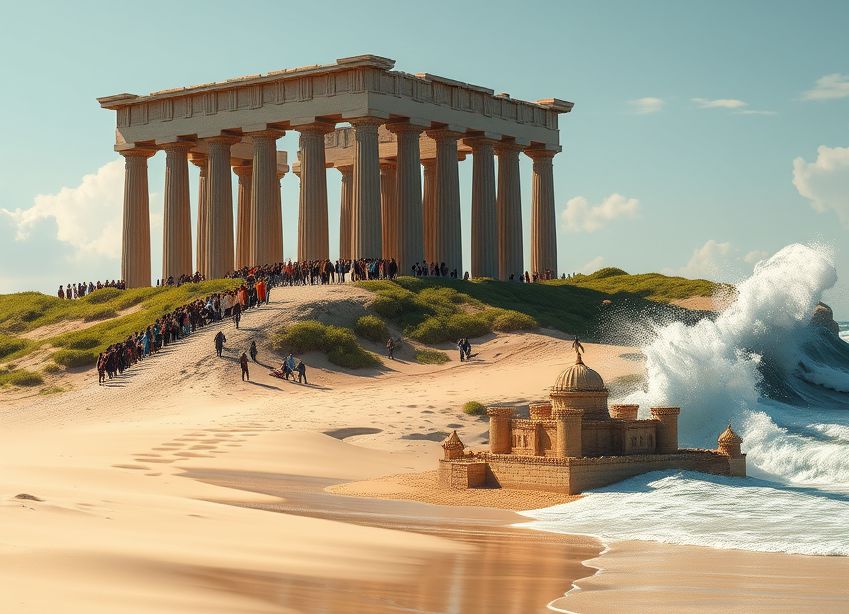
People are hurt and Churches fail or divide when they become houses of the government of man and not of the government of Jesus, building castles of sand instead of being built as living stones. The church at Philadelphia was clearly of the latter type, and Jesus makes this promise to those that would “hold fast to what they have:”

 He who overcomes, I will make him a pillar in the temple of My God, and he shall go out no more. I will write on him the name of My God and the name of the city of My God, the New Jerusalem, which comes down out of heaven from My God. And I will write on him My new name.” (Revelation 3:12.)

This is the reward for those who belong to the ecclesia of Christ. By contrast, a sandcastle is recognisable by its turrets and not by its pillars, and in the turrets flags are sometimes planted, where men like to write their own names. When someone seems to be waving their flag in our faces, we don’t want to snatch it out of their hands, but we need to pray that they, and we, will be pillars in the temple of our God where He can write His own name on our lives. If someone tells us how to “eat and drink,” we respond with righteousness, peace and joy in the Holy Spirit. Because a wave is coming when the sandcastles will be washed away, and only the pillars of the ecclesia will stand.

Bread from Heaven

After these things Jesus went over the Sea of Galilee, which is the Sea of Tiberias. Then a great multitude followed Him, because they saw His signs which He performed on those who were diseased. And Jesus went up on the mountain, and there He sat with His disciples. Now the Passover, a feast of the Jews, was near. Then Jesus lifted up His eyes, and seeing a great multitude coming toward Him, He said to Philip, “Where shall we buy bread, that these may eat?” But this He said to test him, for He Himself knew what He would do. (John 6: 1-6)

Jesus lifted up His eyes
When Jesus saw the crowds coming towards them and asked Philip “Where shall we buy bread, these might eat?” (John 6:5), He knew not only the eternal words that the Holy Spirit had spoken through Isaiah hundreds of years previously, but He also know what He was going to say to the Jews the following day, and, more significantly, what He wanted His church to learn from it from that time until His return.

John introduces the narrative by presenting Jesus on a mountain with His disciples. This must be every believer’s favourite place: a mountaintop experience with the Lord, in the company of a few close friends. When we are in that place, we want it to go on for ever. Eventually it will, but John also tells us that “a great multitude followed Him, because they saw His signs which He performed on those who were diseased.” (John 6:2) If we are spending time with Jesus on Earth, the crowds are never going to be far behind.

It’s all about the harvest
When He met the Samaritan woman, Jesus said to His disciples: “Behold, I say to you, lift up your eyes and look at the fields, for they are already white for harvest!” (John 4:36). Now John echoes this exhortation in his account of the fourth sign, reminding us that it is not just about the significance of the Lord’s supernatural power to multiply bread, or even about His compassion for the hungry: it’s all about the harvest. Jesus lifted up his eyes. So one challenge to us as we consider this sign is this: how much time do we spend with our eyes on the ground instead of lifting them up to the harvest?

If you are the same as me, you probably equate ‘lifting your eyes’ with Psalm 121 – lifting our eyes to the hills, and seeing that our help comes the Lord “who made heaven and earth.” Although Jesus clearly does get help from heaven here- a lot of help – He is not looking away from His circumstances and comforting Himself, as we do, with eyes of faith: He is looking at the circumstances with eyes of love so that He can comfort the people He can see. If I was on a mountain and saw a hungry crowd below me, I would either want to go further up the mountain, or round to the other side, and down. Quickly. But He is not thinking about how the circumstances affect Him; He is only thinking of how He can affect the circumstances. This is a standout Kairos moment of His ministry, and He knew what He would do.

Facing the hungry crowd
As for us, there are times when we are on that mountain and there is a “hungry crowd” coming towards us. It might only be one person, but we know what it will mean: they will make demands. Certainly our time and energy, quite probably our money and/or resources, possibly our emotions, but one thing we know is true: they are hungry, and we’ve only got a few loaves and fishes. But the other thing that is true is that we are there with Jesus. We know that He only did what the Father told Him to do and didn’t always minister to everyone He met, and it might be that the He tells us not to get involved and to get down off the mountain. But assuming He doesn’t, how do we face the “hungry crowd” with the crumbs that we have to offer?

“He said to Philip, “Where shall we buy bread, that these may eat?” But this He said to test him, for He Himself knew what He would do.”

I don’t think that He was testing Philip on his knowledge of Isaiah 55. Jesus wanted to know if Philip was starting to see with the eyes of the Spirit, or if he was still limited to the material world. At this stage, it looks like his score was zero (which is encouraging for us, as the same Philip completely by-passed all the confines of the material world in the power of the Holy Spirit when he preached the gospel to the Ethiopian Eunuch!). I think Jesus is regularly testing our faith. Since He said “Will the Son of Man find faith on earth when He comes?” (Luke 18:8), it makes sense that He will be putting us in situations where He can see where we are on the faith-o-meter. He wants all our readings to increase.

There was much grass in that place.
God knows what our faith is ready for, and He also knows whether or not this is a Kairos moment for us, where He has got everything lined up for us to operate in the power of the Spirit. Wisdom says “ponder the path of your feet.” (Prov 4:26) The hungry crowd is approaching. Where has the “path of our feet” led us? Are we on a rocky slope, or is there “much grass?” People will be filled if they are in a place where they can be sufficiently at peace to receive from the Lord. If they are struggling just to keep on their feet and stay upright, it is less likely that we are going to reach into their situation, and that God hasn’t planned for us to try: if that moment hasn’t yet arrived we are just going to be emptied ourselves, and no-one is going to get any bread.

Verse 10 tells us that “There was much grass in that place.” For the miracle to take place the crowd needed somewhere to sit down and rest so that they could receive and partake of what Jesus was going to give them. Jesus hadn’t yet drawn on His heavenly resources, but the natural setting was in place – indeed it had been developing ever since that grassy plateau on the mountain had been created through Him and for Him (Colossians 1:16) at the beginning of time. Part of the convergence of that moment was that the hungry crowd should be there with Jesus just where there was provision for them to stop and sit down: not on a rocky slope or a narrow path, but on a flat area where “there was much grass.” If God can provide that visible abundance in the earthly realm just at the right time, how much more are heavenly resources available?

The Kingdom of Abundance
Paul writes to the Ephesians: “Now to Him who is able to do exceedingly abundantly above all that we ask or think, according to the power that works in us, to Him be glory in the church by Christ Jesus to all generations, forever and ever. Amen. (Eph 3:20) Jesus is Lord over a kingdom of abundance. “God does not give the Spirit by measure,” (John 3:34) because there is no limitation in the Kingdom of God. The writer to the Hebrews tells us that the earthly tabernacle and its rituals were a “copy and a shadow of heavenly things.” (Heb 8:5). There are clues in Scripture that this applies to the rest of the earthly creation as well, and that the temporal is a shadow of the eternal. The earthly Jesus is the Son of Man who goes to the cross, and we get a glimpse of the heavenly Jesus when He appears on the Mount of Transfiguraton. We have the Jerusalem of Israel, and the “New Jerusalem coming down out of heaven;” (Revelation 21:2) and we have John’s revelation that “it does not yet appear what we shall be.” (1 John 3:2).

The disciples could only see five loaves and two fishes, but Jesus could see the bread of heaven. When we pray for the Kingdom of God to come “on earth as it is in heaven,” we are praying for limitless heaven to come to limited earth. So when we lift our eyes and sense that Jesus is showing us a need that He wants to meet, and we know that there is “much grass in that place,” we can look with the eyes of faith and see that the single packed lunch which is the most our brains can grasp will convert to 5,000 by the power that works within us. At least.

The prayer of agreement

I think that one of the most overused verses in the Bible is Matthew 18:20 “For if two or three are gathered in my name, there am I in the midst of them,” and one of the most disappointing is the verse immediately preceding it, which promises “If two of you agree on anything you ask, it shall be done for them by my Father in heaven.“

Verse 19 – if two of you agree – is often quoted to encourage people to pray together in pairs or small groups. “God promises to answer!” is the exhortation. Unfortunately, experience often proves otherwise, so the encouragement to meet is without substance. How many times do two or more pray together, yet what we’ve asked for isn’t done for us by our Father in heaven? Yet God’s word is true and His promises are trustworthy, so if our experience does not line up with the Word we must look more deeply into Scripture to see what our experience is missing, not hold up our experience as the truth and dismiss the Word.

The problem here is that the words do what they say on the tin: agree means agree, shall be done means shall be done. There is nothing in the Greek that suggests that they do not mean exactly what they say: there is not even a let out in the tense as there is in Matthew 7:7, where the tense of “ask and it shall be given” actually means ask persistently and it shall be given. The tense of “ask” means just once is enough.

So we gather, we agree, we ask, and yet nothing seems to happen. Why is that? One reason could be that we simply don’t wait long enough for the answer: we give up, and faith (if it ever really existed) evaporates. The promise doesn’t say when it will come, and the Bible has much to say about waiting. In fact “Wait” can seem like one of God’s favourite words. But although I think that can be true at times, I don’t think it is the main point here. I think the reason that a lot of “prayers of agreement” seem to go unanswered is in the first word of verse 20: “for.” Jesus says that the promise of answered prayer is a consequence of two or three being gathered in His name. Only when that is the case does He say He is present in the gathering, “there in the midst of them.“

First of all, what is it to be “gathered together?“ The Greek word means anything from being drawn together like fishes in a net, or assembled as a crowd, to the idea of those who were previously separated becoming one. Given that the heart of Jesus as He prayed in Gethsemane for us “all to be one,” and that the thrust of much of Paul’s teaching is that we are one body in Christ, I think the meaning of “gathering” tends towards the last definition. And “In His name“ does not just mean wearing our church name badges: the Greek word onoma means everything He is; His whole identity. To be in His name means to be the fullness of who we are in Christ. I think that to be gathered in His name means to be one in the spirit, not just in theory, “in faith,” or according to our theology; but experientially, in the lived reality of that moment. If this is the case, and since verse 19 (“when two of you agree…“) is conditional upon verse 20 (“For if two or three of you are gathered…”) the concept of agreement is elevated from being one of verbal and intellectual consensus to a shared understanding in the spirit of a prayer request that we know by revelation is in the Father’s will.

In those conditions we are together in unity according to Jesus’s prayer of John 17:21: that they all may be one, as You, Father, are in Me, and I in You; that they also may be one in Us, that the world may believe that You sent Me.”  When our hearts are in agreement like this and there is no doubt or discord, we are already in the Father’s will, so the answer to our prayer is standing right there with us.

I was in a prayer meeting this morning, when a brother mentioned that there was a photo in a ministry prayer letter from a meeting we had both attended that included me a girl that I had been praying with in. I had my hands raised in a posture of worship, and she was on her knees. I guess it made a good photo. We prodded at various things throughout the morning, then just as the meeting was ending (how often has that happened?) The Holy Spirit fell powerfully. At that moment, my friend showed me the prayer letter with the photograph. In hushed voices, we agreed in prayer that the Lord would grant that girl her petition, and we knew immediately that the prayer was answered. Jesus was there “in the midst” according to Matthew 18:20: we could feel His presence.

When Jesus promised that He would send the Holy Spirit He said “I will not leave you as orphans; I will come to you.” (John 14:18) But I think we pray like orphans far too often in our corporate prayer times. Instead of meeting the conditions of “gathering in His name,” we talk to a Father who isn’t there, and then we wonder why He doesn’t appear to be listening.

The kaleidoscope of liberty

“Where the Spirit of the Lord is, there is freedom.” (2 Cor 3:17)
“You shall know the truth and the truth will set you free.” (John 8:32)

We are not just set free from our personal limitations or bondages: we are set free from the limitations of self and released into the understanding that we are one with God in Christ. Truth isn’t what you know; it is not wrapped up in knowledge. Truth will never be found in opinions, however well they are proven and however eloquently they are justified. Truth is a person who is the Way the Truth and the Life. Knowing the truth is knowing Jesus, and understanding that the greatest height and deepest layers of human knowledge are never more than one piece of coloured glass in a kaleidoscope, and cannot even begin to reach the dimension of truth that is only found in Jesus. If our God is the Truth, then truth is a heavenly commodity; we cannot find it through the evidence of science or even the insights of theology, because it exists beyond all things that pass away. Jesus, who is the Truth, tells us that Truth can only be revealed by the Holy Spirit whom we receive from God and whom the world cannot know:

“And I will pray the Father, and He will give you another Helper, that He may abide with you forever—”the Spirit of truth, whom the world cannot receive, because it neither sees Him nor knows Him; but you know Him, for He dwells with you and will be in you.”

 (John 14:16-17) Knowledge itself will pass away, as well as this world, and in that day all our truth will turn to ashes. But we can speak truth and we can know truth when we speak love and know love, for this is where the truth resides. When we speak the truth in love “we will grow to become in every respect the mature body of him who is the head, that is, Christ.” (Eph 4:15) It is when we love one another that we walk in the truth.

I feel that the Lord is saying this to the Church:

“You are my kaleidoscope. Each one of you is like one of those little pieces of coloured glass. I made you all different, to be different shapes and colours, so that my light can reflect off you in different ways. Just as the mirrors inside a kaleidoscope reflect images off each other to create the appearance of an infinite pattern, so it is that my light reflected off you is creating a pattern in the infinite dimensions of the spirit. As I move the kaleidoscope, so you are arranged differently and the pattern changes. Do not despise or judge those whose shape or colour is different from yours, for I created you that way in order to make my pattern with you. It is my pattern, not yours, and it is more wonderful and beautiful than you could ever imagine. When you love one another and are one with each other, my pattern emerges. When you stand alone in your opinion or ambition, or to fulfil the desires of your flesh or of your minds, you are not part of what I am doing and you create nothing. It is I who sees the pattern, not you; but when I choose to reveal it through you and in you the world will see and they will see me in it.

I am moving the kaleidoscope: some of you will find yourselves with new people in new situations, and they will not be like you. Love them and accept them, and always look to me knowing that I am creating a pattern that you cannot see. But a time is coming soon when it will indeed be visible and many more will come to know me because they will see what I am doing and will want to join themselves to the pattern that I am creating.”

Water what’s fruitful; burn what’s dead.

I am the vine and you are the branches. He who abides in me and I him bears much fruit, for without me, you can do nothing. If anyone does not abide in me, he has cast out as a Branch and is withered, and they gather them and throw them into the fire. If you abide in me and my words abide in you, you shall ask what you desire and it shall be done for you. By this, my father is glorified, that you very much fruit; so you will be my disciples.” (John 15:5 – 8).

I was in the garden a few weeks ago, burning rubbish in our garden incinerator in an enclosed area that used to be a chicken run. I had a hose pipe to hand in case any sparks jumped from the fire, and was directing it onto the roots of an apple tree on the other side of the enclosed area so that the water was doing something useful. I felt the Lord spoke to me quite clearly as I stepped back, away from the smoke for a moment. He said, “Water what is fruitful, burn what is dead.“ I took the above picture as a reminder to myself.

This is a time of transition. We have heard many times, and we know, that God is doing a new thing. So why do we persist in carrying on with our old ways? I wrote about making disciples in my last post. Jesus says that discipleship is this: abide in Him and let his words abide in us. What does this mean? I think it’s quite simple: Walk with him and do what he says. Forty years ago, before cars were computers on wheels, I rebuilt a car engine (a morris minor, if you remember them) from a DIY manual. You read the information and did what it said. It was tried and tested, and – unless you misread the instructions – it worked. For too long, we’ve been doing it ourselves in the church: repeating strategies that worked in a previous era in the hope that they will work for us today. But it’s time we threw away and burnt our DIY manuals and let Him build His church, because what He is doing today is not the same as it was 40 years ago.

I believe the Lord says:
 “You cry out to me to pour out my spirit and bring my anointing to what you do. But I will not pour my water on that which is cut off from me. I will not water your DIY efforts. Where is there life and growth in your church? Where is there life and growth in your family, in your marriage? Cry out to me for those areas, and I will water them. I will even water one little seedling, I will water a tree that only bears a single fruit. If it is growing, I will water it. Where there is love, I will water it. But I will not water a pile of dead branches, however big and impressive it is, however hard you’ve worked to assemble the pile, and however long it’s been there.

So burn what is dead, abide in me, listen for my word and do what I say. And I will watch over my word to perform it, and I will water what grows when my word springs forth through your obedience.”

Being disciples; making disciples.

We all know that Jesus calls us to “go and make disciples of all nations.“ Some of us obey the call geographically and go to other nations to make disciples; some of us find “the nations” in our own neighbourhood or workplace; some of us ignore the call altogether and leave it to the evangelist. But even if we don’t live in a mixed race neighbourhood and everybody at work was born in the same country as we were, our home country is still a nation, and we still have to “go” to it, and the purpose of “going” is to make disciples. So assuming we have “gone” with a willingness to share the gospel, how do we go about the business of discipleship?

“Follow me as I follow Christ,“ said Paul to the Corinthians. (1 Corinthians 11:1)  We can’t really expect to make committed disciples if our own discipleship is flabby and inconsistent. I don’t think it’s enough just to lead people through discipleship courses: the Holy Spirit has to be at work in and through the people leading the courses if the spirits of new believers are going to be impacted and their minds renewed. If we want new believers to grow to maturity and find their place in the Kingdom of God, we need to launch their walk with the power that they will eventually need to carry on without us and be discipling others themselves. The alternative is a church that is bloated with members but lacking in love and power – what Smith Wigglesworth called “leafy trees” that bear no fruit.

“Freely you have received, freely give,” said the Lord when he sent out the twelve. (Matthew 10:8) when we “go” to make disciples, we can only give what we have received ourselves.

In all your ways acknowledge Him
I found a key verse for discipleship in an unexpected place: proverbs 3:5. We all know it: “Trust in the Lord with all your heart and lean not upon your own understanding. In all your ways acknowledge him, and he will direct your paths” The first part of this verse tells us clearly where to place our trust, and it tends to be the one that is quoted the most often. But it’s the second part that caught my attention. The word translated – rather weakly, I feel – as “acknowledge,“ is yada. In Hebrew this is the word used for “knowing” in life-giving intimacy, as when Adam “knew” Eve. What the second part of Proverbs 3:5 says to me is that God will “direct our paths” when we take every step in intimate relationship with him. Following this, the word yasar, translated here as “direct“ our paths is the same word used in Isaiah 40:3 for “make straight” a highway in the desert.

The voice of one crying in the wilderness:
“Prepare the way of the LORD;
Make straight in the desert 
A highway for our God.”

When God is with us – not just notionally, but experientially – at every step, he won’t just be “directing” our paths in the sense of telling us where to go, but he will be ‘making them straight’ before us, clearing the ground and removing obstacles so that we can move forward with Him even though it may feel as if we are lost in the desert.

Zachariah 8:23 says this:

 “Thus says the Lord of hosts: In those days ten men from every language of the nations shall grasp the sleeve of a Jewish man, saying “let us go with you, for we have heard that the Lord is with you.”

It is when the men (and the women) of the nations know that the Lord is with us that they will want to “go with us.” Surely this is a picture of how we are to make disciples. As we walk closely with the Holy Spirit and He directs our paths, so we can direct the paths of others; not by weekly meetings following a discipleship course, but by walking alongside new believers who have joined themselves to us because they can see God at work in our lives. But there’s a health warning here, too, especially for people (like myself) who cherish their own space: when revival comes and we have ten people grasping our sleeves, we won’t have a lot of time for ourselves. Are we ready? Am I?

The Passion of Agape: Love and Fire in Revival

“Oh God of burning, cleansing flame,
Send the fire!
Your blood-bought gift today we claim,
Send the fire today!”

(William Booth)

Before Jesus saved me back in 1984, I was a New Ager. An old friend who knew me then – in fact he was one of the people who were praying for us at the time – has just sent me the following email: “Thought this might grab you.  Two New Agers moved to Stroud because they thought that’s where they’d find the answers.  Eventually, they turned up at John Street Baptist Church saying, “The New Age hasn’t worked.  What have you got to offer?” They became Christians and brought lots of friends along so that the New Age enquirers started to outnumber the members…”

God is clearly starting to move. People are hungry. But unless we are hungry for God ourselves we cannot expect to share our bread with others. The following is an extract from Wheat in The Winepress: I wrote this passage in 2017, but I’ve been feeling for the last couple of days that it’s appropriate to release it again now.

Our element
The zeal of the Lord of Hosts, the fire of the Holy Spirit which Jesus sends onto the world, and the perfect love, the agape, that casts out fear are all bound together: zeal expresses agape, agape sends zeal. Together they express the passion of the heart of God that yearns for the restoration of His Kingdom and the marriage of the Lamb. This is the Love that Jesus tells us to abide in. Like water to fish, as I’ve already said, the “sea of pure divine love” that they experienced at Azuza Street is actually the element in which we are called to live. It is no coincidence that the greatest miracles happened there when the fire was visibly present.

It is often said that in the developed, “free” world we don’t see the miracles of healing that seem to be much more the norm in third world countries and the persecuted Church. I, for one – and I think I speak for many here – have always explained this by saying “we think we don’t need faith: we have medicine!”   But as we know, Paul tells us that what counts – the only thing that counts – is “faith working through love” (Gal 5:6). Even if I have the faith that moves mountains, without love I am nothing (1 Cor 13:2). I don’t think it’s the faith that sets these churches apart, so much as the love through which it is working. They “love each other fervently, with a pure heart.” They need each other, are committed to each other, and are contemporary expressions of the Church of Acts 4. They are one as the Father and the Son are one. Their unity commands the blessing. Because they are obedient to the command to “love one another” they receive what they ask from the Father. They are swimming in that sea of perfect Love; they are abiding in Christ, immersed in the river of Ezekiel 47; they are in their element. Am I? Are you? Or are we fish out of water, flapping about on the deck, gasping for Life in the Spirit, knowing that there should be more but somehow unable to reach for it? 

The longing of the Bride and the Groom
Wherever it is that we see the fire burning today, or if we look into history and see where it has been, we find the same initial spark: Christians who are hungry for more of God. Not just a little bit more – “If I clear the cluttered desk of my life – actually no, just my church meeting as long as You don’t stay too long – a bit, I can fit a bit more of you on this corner, God” – but really MORE; the more that will take us from our dimension into His. “Lord, I’m sweeping everything off my desk. Will You come and fill it? Nothing else will do!”

The cry of the heart, a two-word prayer, that went out from Toronto in 1994 and still goes out today was “More, Lord!” Another two-word prayer that I remember singing as a worship song in a UK Catch the Fire meeting in 1995 was “Yes, Lord!”. If we want More, first we really need to be hungry: it’s “the effective fervent prayer of a righteous man (that) avails much” (James 5:16); and second: God wants our total Yes.

The story of Gideon shows us how we can respond when God’s fire begins to take hold. If we want to see in the Word how the fire starts we need to look elsewhere: not to a New Testament treatise on the Holy Spirit, or to an Old Testament prophesy of Holy outpouring, but to the love poem on the longing of the bride and the groom for one another. As the unfolding of the intimacy between the Shulamite and The Beloved draws to a close, the bride says, in words that encapsulate the essence of the zeal of the Lord:

 “Set me as a seal upon your heart,
As a seal upon your arm;
For love is as strong as death,
Jealousy as cruel as the grave; 
Its flames are flames of fire,

A most vehement flame” (Song, 8:6)

The jealous, passionate love of the Father and the Son, burning in the fire of the Holy Spirit: for the bride of the Bible, nothing else will do. Before the Beloved comes to her, He asks for one thing:

“You who dwell in the gardens,
The companions listen for your voice –
Let me hear it!”
(Song 8: 13)

And the bride responds, to end the poem:
“Make haste, my beloved,
And be like a gazelle
Or a young stag
On the mountains of spices.”
(Song 8: 14)

Not even Jesus could tell us when He is going to return, but we know two things. One is a collection of signs of the end of the age that He gives us in Matthew 24 – signs which many would say are being fulfilled in our day. The other thing that we know is that He will come in response to hearing our voice. “Let me hear you call me!” says Jesus, the Beloved. ‘Let me hear you say the words “Make Haste, my Beloved!” I want you to be hungry for Me!’ At the very end of the Bible we hear the echo of the Shulamite’s response: “And the Spirit and the Bride say, ‘Come!’” And we hear the Beloved say: “Let him who hears say, “Come!” And let him who thirsts come. Whoever desires, let him take the water of life freely.” (Rev 22:17)

It’s not just the Bride who calls out; it’s the Spirit and the Bride. Just as Jesus completed the work that the Father gave Him to do at the cross, the Holy Spirit will one day complete the work that He has been given to do on the earth: the preparation of the Bride for the marriage of the Lamb, and the handing over of the kingdoms of the world to the kingdom of our God and His Christ. And as individuals and churches, we are ready when we hear Him ask us to call out to Him. We are ready when we acknowledge that we are thirsty. We are ready when we desire to freely take the water of life. According to the Song of Songs, this will be when we say “More Lord, Yes Lord, nothing but the most vehement flame will satisfy!” 

The Fullness of God
One final thing we can be sure of is this: when holy fire does bring revival to our street, it won’t be anything like what we expect. However in the parable of the ten virgins (Matt 25: 1-13) Jesus does make it clear what we have to do: we need to be ready for Him with our lamps trimmed and full of oil. This isn’t just about trimming wicks: it’s about the whole lamp. The Strong’s definition of the Greek word for “trimmed”, kosmeō (from which comes our word “cosmetic”) means to arrange, decorate, adorn, or put in order. In the book of Revelation the seven lampstands represent the seven churches that the risen Lord is walking among (Rev 1:20). Jesus wants our churches to be brimming with the oil of the Holy Spirit, and beautified with all the fruit of lives laid down, hungry for Him.

The last words of Christ’s prayer in the Garden of Gethsemane were this: “I have declared to them Your name, and will declare it, that the love with which you loved Me may be in them, and I in them” (John 17:26). The Greek word onoma, name, means more than just the epithet by which a person is called – it refers to everything associated with the name, including character, rank, and all attributes. Jesus is saying that He has revealed the fullness of the Father to His disciples: as He said, “If you’ve seen me, you’ve seen the Father.” And He says He will reveal the fullness of the Father in the future: “I will declare it.” How? By the Holy Spirit, whom He will send to bring the same revelation that the twelve had when they were with Him. Why? So that His agape may be in us. The agape of God being poured out into our hearts by the Holy Spirit who is given to us is the fulfilment of John 17:26. Jesus tells us that it is by our love that the world will know we are His disciples. I don’t think that this is about the world looking at us and just seeing how much we love each other, or even looking at our humanitarian efforts and seeing how much we love the world. It means that when we truly walk in His agape WE WILL DO THE WORKS THAT HE DID, and revival will follow. This was Heidi Baker’s experience in Mozambique, and surely this is true discipleship.

Paul prayed (Eph 3 14-21) that we would be filled with all of God – the “fullness” of God, meaning that no aspect of the Divine nature (see 2 Peter 3-4) would be missing from our lives. This fullness comes from yielding our vain understanding to the truth that the Agape of Christ goes beyond anything we can humanly grasp; that it surpasses or goes beyond anything that we can call knowledge. Paul begins by praying that, with all the riches of His Glory at His disposal, God would give us the supernatural ability, the dynamis power, to enable the faith to rise in our hearts that Christ will make His home there as He promises (John 14:23). Paul uses the word katoikeō, meaning to dwell, inhabit, be always present. This prayer, for them and for us, is that the indwelling Christ would become a present, manifest reality in our lives so that agape can become the foundation for all we are and all we do; that Jesus would hold our gaze with that most vehement flame, reaching out through us with supernatural gifts to the people we are with, lifting our hearts into heavenly glory as we worship, and opening the storehouses of Heaven to all our needs as we bring His fire to the earth.

We are rooted and grounded in agape when the manifest presence of God is a reality in our lives and we walk in intimacy with Him, and this can only happen when we fully die to ourselves and yield our hearts to the mighty power of the Holy Spirit. Without dynamis there is no Gideon’s army and there is no agape; and without agape there will always be wheat in the winepress.

A picture has been with me as I have been thinking about this over the last few days, and it’s that of a bonfire that has burnt down from its original intensity and where the burning sticks have been scattered on the ground, charred black in places, still glowing red in places with a few small flames licking around them. I believe this is a picture both of the Church – where the sticks are individual congregations – and of churches, where the sticks are individual believers. For centuries the devil has been poking and scattering, isolating people, isolating congregations, always working to destroy unity and weaken the Church. I believe that God is gathering those burning pieces of wood together. He is leaning over them, His heart bursting with love, the marriage of the Lamb bright in His vision, blowing, blowing, blowing. As He rearranges those embers and burning brands new relationships will be formed and old structures broken. To be an army of Gideons in these last days we need to let Him gather us where the flames are and let His agape fill our lives: then we can set our world on fire.

(Adapted from “Wheat in the Winepress,” MD Publishing 2018)