Tag Archives: The Kingdom of God

One way or another, everything we do in our daily lives is governed to some degree by the laws and customs of the Kingdom that we live in, whichever country it is. But as Christians, we are citizens of another Kingdom and are called to walk in the King’s ways, not the ways of the world.

I Will Build My Church

The Kingdom Of God is not a matter of eating and drinking, but of righteousness peace and joy in the Holy Spirit (Romans 14:17)

I woke up this morning singing a song we had in church on Sunday:
“Father let Your kingdom come,
Father let Your will be done,
On earth as in heaven,
Right here in my heart.“

It is, of course, one of several settings to music of the Lord’s prayer, and it’s one of my favourites. But it’s got me thinking about the Kingdom Of God (never a bad thing) and how we perceive it. In particular, I’m thinking about our experience of the Kingdom In our church situations, and the relationship between the two. If you are feeling at all disappointed in, critical of, or hurt by what’s going on in your church at the moment, then this is for you. That probably means all of us at some time or another.

We can all get lost in our own imaginings of what the Kingdom Of God is like in heaven, but what do we know about the Kingdom Of God on earth? We know it is within us, we know that it’s eternal, we know it’s wherever we see the rule and reign of the Lord Jesus manifested, and we know it’s “righteousness peace and joy in the Holy Spirit.” if we think about the rule and reign of Jesus in the light of John 10:10, we know that the kingdom is manifested when we see the works of the enemy destroyed and life in abundance established. And if we think of the heart’s desire of the King himself, we have to land on John 17:21 and His prayer in Gethsemane that “That they all shall be one, just as you, my Father, are in me, and I am in you, so that they also shall be one in us.”

Paul is clear about the ultimate purpose of the church and how to attain it in Ephesians 4: 15-16, which is that “speaking the truth in love, (we) may grow up in all things into Him who is the head—Christ— from whom the whole body, joined and knit together by what every joint supplies, according to the effective working by which every part does its share, causes growth of the body for the edifying of itself in love.” When the body of Christ has attained this goal we will have become the answer to the Lord’s prayer in Gethsemane and to the Lord’s prayer that He gave us on the Mount of Olives: His kingdom will have come on earth.

Unfortunately, it can seem at times that some people in our churches are either writing chapter 7 of Ephesians, or have never read the epistle at all. The Holy Spirit reminds us in Isaiah 26:3 that “You will keep him in perfect peace whose mind is stayed on you, because he trusts in You.” To live in the good of this verse, we need to remember Matthew 6:33: “seek first the kingdom of God and His righteousness,” whether we are finding it in church or not. Ephesians 4:3 tells us that we find the unity of the spirit in the bond of peace, so if we have peace in our hearts about our bonds with other members of the church, we know that we have done our part to maintain the unity of the spirit with them, and our hearts are prepared for the rule of the Kingdom of God.

The Ecclesia
Jesus is building His church in truth and love, because truth and love are who He is, and the church is His body on earth. My Church isn’t, but His church is. Where there is truth and love in the assembly of the saints we find His body, and when we are in truth and love we are part of it, whether we are in my church, your church, their church, or someone’s church on the other side of the world. Jesus said I will build My church, not My churches. Paul says we are one body, not many bodies (1 Cor 10:17), and that we are being “built together as a dwelling place of God in the Spirit.” (Ephesians 2:22) Peter says: “You also, as living stones, are being built up a spiritual house, a holy priesthood, to offer up spiritual sacrifices to God through Jesus Christ…(who) has become the chief cornerstone.” (1 Peter 2:5-7)

The word that is used for this building, the church, is ecclesia. In the Christian context, ecclesia refers to a gathering of believers called out from the daily concourse of society to worship God, but the prime meaning of the word refers to an assembly of people called out of their houses to convene at a meeting place for the purpose of deliberation. So there is an implication of government here: when we meet to worship God, we also assemble to administer the government of His Kingdom. In fact Psalm 149 reminds us that our praise is integral to establishing His rule on earth. When Jesus says that the gates of hell won’t prevail against His church, He is saying that the councils of the powers of darkness won’t prevail against the government that is on His shoulders.

The government of the cross
And here’s the thing: Isaiah ‘s prophecy (Isaiah 9:6) wasn’t just a metaphor: Jesus did, literally, carry the government of His kingdom on His shoulders, when He carried the cross to Calvary. When we carry our cross as Jesus instructed and genuinely die to self, we are also carrying His authority to rule. We are part of the governing ecclesia of His kingdom on earth. Neither the many churches in your city nor the 45,000 denominations on Earth today are meant to be little microcosms of the Church of Christ: they are simply parts of it. More than that, they are only parts of it where they reflect the life of Christ and the government of the cross.  And since, according to 1 Corinthians 13:13,  it’s faith, hope, and especially love, that are the only things that last forever (“remain” or “endure,” depending on your translation), they have to be the three elements that make up the DNA of the everlasting life of Christ. Alongside those three it’s the word of God that endures forever. The cross, the DNA of the life of Christ, and the word of God: if we want to find the ecclesia of Jesus where His kingdom is governed, this is what we look for.

What if we don’t find it, or if or own church seems to be missing the mark? This doesn’t mean we spend our lives in the ranks of the spiritually homeless. On the contrary, God puts us into imperfect fellowship to teach us how to love one another, and to prepare our hearts to be carriers of His Kingdom. Our churches are training grounds for the government of His ecclesia, whether we govern in our local church or not. We can’t cause growth of the body by speaking the truth in love if we have no-one to speak it to, no relationships in which to exercise Kingdom values, and no arteries where the life of Christ can flow.

I was in a meeting the other day when I sensed the Holy Spirit showing me that His church was like an orchestra, with different instruments scattered far and wide, but where all the instruments were in tune with each other, all eyes were on the conductor and everyone was playing the same piece of music. The prophetic word He was giving me was that He was changing the (musical) key to a higher pitch. In my spirit I found myself looking at a violin that was far away. Just at that moment I received a phone call from a friend who pastors a church in East Germany. Not a coincidence, I felt, but a confirmation of what the Lord was showing me about His church.  

Pillars and sandcastles
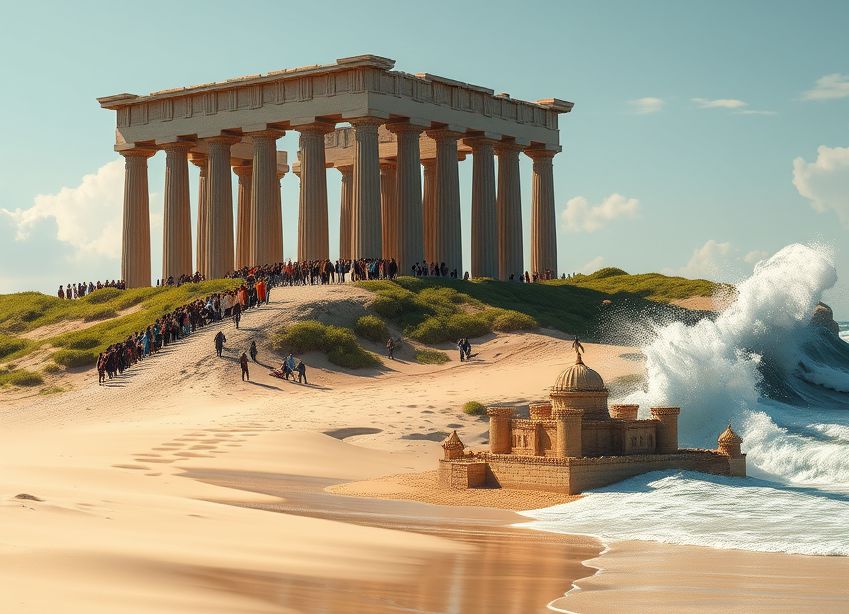
People are hurt and Churches fail or divide when they become houses of the government of man and not of the government of Jesus, building castles of sand instead of being built as living stones. The church at Philadelphia was clearly of the latter type, and Jesus makes this promise to those that would “hold fast to what they have:”

 He who overcomes, I will make him a pillar in the temple of My God, and he shall go out no more. I will write on him the name of My God and the name of the city of My God, the New Jerusalem, which comes down out of heaven from My God. And I will write on him My new name.” (Revelation 3:12.)

This is the reward for those who belong to the ecclesia of Christ. By contrast, a sandcastle is recognisable by its turrets and not by its pillars, and in the turrets flags are sometimes planted, where men like to write their own names. When someone seems to be waving their flag in our faces, we don’t want to snatch it out of their hands, but we need to pray that they, and we, will be pillars in the temple of our God where He can write His own name on our lives. If someone tells us how to “eat and drink,” we respond with righteousness, peace and joy in the Holy Spirit. Because a wave is coming when the sandcastles will be washed away, and only the pillars of the ecclesia will stand.


Breakfast on the Beach: the King and His Kingdom

“After these things Jesus showed Himself again to the disciples at the Sea of Tiberias, and in this way He showed Himself: Simon Peter, Thomas called the Twin, Nathanael of Cana in Galilee, the sons of Zebedee, and two others of His disciples were together. Simon Peter said to them, “I am going fishing.” They said to him, “We are going with you also.” They went out and immediately got into the boat, and that night they caught nothing. But when the morning had now come, Jesus stood on the shore; yet the disciples did not know that it was Jesus. Then Jesus said to them, “Children, have you any food?” They answered Him, “No.” And He said to them, “Cast the net on the right side of the boat, and you will find some.” So they cast, and now they were not able to draw it in because of the multitude of fish.”
(John 21: 1-6)

Anything eaten with bread
I don’t know how many times I have read this account since I first staggered into John’s gospel nearly 40 years ago, but it struck me this time that Jesus didn’t ask them the natural question that you put to fishermen, which is “Have you caught anything?” Instead He asked if they had got any food. I wondered why He addressed them in this way, so I looked up the Greek. The word He used is prosphagion, which is sometimes also translated as “meat,” but refers particularly to anything eaten with bread. Since the men were fishing, Jesus was obviously asking about fish, but what He was asking was “Do you have any fish to eat with bread?”

As we know, the answer was a big round zero. They had nothing that went with bread. When we look at this figuratively it becomes even richer in meaning, because whatever it is that our “fishing” entails, not only does its fruitfulness depend on whether or not we are being guided by the Holy Spirit, but it is incomplete without Jesus, the Bread.

The King and the Kingdom
The disciples had nothing, and Jesus, the Bread from Heaven, was there with everything. He had bread and fish to eat, and the fire it was cooking on. He could have just given his tired, hungry friends a breakfast to remember and they would have been filled and happy. But He wasn’t just meeting their needs, He was revealing Himself and demonstrating something of His Kingdom – the other side of the boat. Having given the disciples the “Life in abundance” that cannot be found outside of His Kingdom, He invited them to bring Him their catch. And just as their prosphagion – their food – was incomplete without Him, so His breakfast was incomplete without their catch. Jesus is Lord of a Kingdom: if we want to bring people to the King, we need to show them His Kingdom; and we cannot invite them to the Kingdom without introducing them to the King.

“As soon as they had come to land, they saw a fire of coals there, and fish laid on it, and bread. Jesus said to them, “Bring some of the fish which you have just caught.” Simon Peter went up and dragged the net to land, full of large fish, one hundred and fifty-three; and although there were so many, the net was not broken. Jesus said to them, “Come and eat breakfast.” Yet none of the disciples dared ask Him, “Who are You?”—knowing that it was the Lord. Jesus then came and took the bread and gave it to them, and likewise the fish.” (vs 9-13)

Sharing the feast
So whatever “catch” the Lord sovereignly provides for us, He still asks us to bring it to Him, because “By Him all things were created that are in heaven and that are on earth, visible and invisible, whether thrones or dominions or principalities or powers. All things were created through Him and for Him.” (Col 1:16). As we move into a season where reliance on the Holy Spirit’s direction and provision is going to become increasingly necessary, it is paramount that we remember that He wants us to share the feast with Him. Paul writes: “And whatever you do in word or deed, do all in the name of the Lord Jesus, giving thanks to God the Father through Him.” (Col 3:17) He hosts the breakfast, and He must have the glory, not just in name, but in the secret place of our hearts. Anyone can tag “in the name of Jesus” onto the end of a prayer or to cover an action, but the new testament “onama” means so much more than just a designation. Strong’s definition is “the name is used for everything which the name covers, everything the thought or feeling of which is aroused in the mind by mentioning, hearing, remembering, the name, i.e. for one’s rank, authority, interests, pleasure, command, excellences, deeds etc.” We cannot genuinely operate in Jesus’s name if we want our own name in lights as well. If we do not stay in this place of humility we risk drawing attention to the gifts and not to the Giver, and then the Holy Spirit is grieved and will eventually withdraw. Revivals die and ministries burn out when the breakfast is no longer shared with the Lord.

Feeding Others
But the story doesn’t finish here, because immediately after breakfast, Jesus asks Peter to feed and tend His flock. The two aren’t separate. Jesus didn’t just appear on the beach to tell Peter to feed His flock; He demonstrated how to do it by feeding him first. And as it was with Peter, so it is with us: if we have a calling to feed others, we must be able to point them to the abundant life on the Kingdom side of the boat, and then we must invite them into His presence, where the fire of the Holy Spirit is burning.

God’s Building Materials

Are we building with God’s materials, or ours?

Jesus has called us to join Him in the work of building His Kingdom. The question is: do we build with His materials, or ours?

We walk by faith and not by sight. If we aren’t walking “after the Spirit,” we are walking after the flesh (Galatians 5:16), and since the flesh and the Spirit “are contrary to one another” (Gal 5:17), we have no choice but to ensure that we only build with what comes to us from above. “Every good gift and every perfect gift is from above, and comes down from the Father of lights.” (James 1:17) Like snow…

The snow is beautiful, and it comes down from above. it’s also inconvenient: it stops us from doing many of the things that we normally do. In addition it is good for the soil, as it kills off a lot of unwanted pests and therefore makes the ground more fruitful. Finally, it’s fun to play in: if we wear the right clothes we can enjoy it and we can build with it. Holiness is like the snow: it comes from above, and it is beautiful; but it also stops us from doing some of the things that we would otherwise do. God wants us to draw near to Him and worship Him in the beauty of holiness. He wants us to enjoy His presence, dressed in our robes of righteousness, and to stop doing some of the things that we habitually do. He wants to kill off some of the pests in our soil, so it becomes more fertile for growing the fruit of the Spirit. If we will do this we will be equipped to do what He is longing for, which is to bring in many more people so that they too can play, and build, in the snow.

Are You a Believer?

“I also asked about the ten horns on the fourth beast’s head and the little horn that came up afterward and destroyed three of the other horns. This horn had seemed greater than the others, and it had human eyes and a mouth that was boasting arrogantly. As I watched, this horn was waging war against God’s holy people and was defeating them, until the Ancient One—the Most High—came and judged in favor of his holy people. Then the time arrived for the holy people to take over the kingdom.” (Daniel 7: 20-22 NLT)

Are you a believer? Do you believe that the Lord made the Heavens and the Earth? Do you believe that Jesus Christ is the Son of God who died for your sins, was resurrected on the third day, is seated at the right hand of God and will return one day, possibly quite soon, to judge both the living and the dead? Do you believe that Man was created in the image of God and did not evolve from lizards? Do you believe that unborn children should not be murdered? That you and I were designed to have a lifelong relationship with a member of the opposite sex? And do you support a political party that, in the main at least, upholds these values?

If you do, you are in good company: you are in “the general assembly and church of the firstborn who are registered in heaven.” (Heb 12:23) We belong, not because we know better, but because we believe.

But when you speak of these things that you believe, are you mocked and vilified? Are you made to feel at times that you are simple-minded, ignorant and foolish when you even think them; that it really is time that you woke (pun intended) up to reality? If this is you, remember that “we do not wrestle against flesh and blood, but against principalities, against powers, against the rulers of the darkness of this age,  against spiritual hosts of wickedness in the heavenly places.” (Eph 6:12) The voice that seeks to make you feel ashamed of what you believe is not the voice of the secular media, it’s not even the voice of the editor of that left-wing journal that claims to speak for freedom; it comes straight from the mouth of the prince of the power of the air whose servants they are, who “boasts arrogantly” against the Most High God and wages war against His people. The more arrogant the voice, the closer it comes to judgement.

And if you are a brother of sister in the USA right now, be encouraged, Child of God, for the Most High will, in His time, judge in favour of His holy people.

“See how very much our Father loves us, for he calls us his children, and that is what we are! But the people who belong to this world don’t recognize that we are God’s children because they don’t know him.” (1 John 3:1)

The Order of Melchizedek

This is the law of the temple: The whole area surrounding the mountaintop is most holy. Behold, this is the law of the Temple (Ezekiel 43:12)

If I were to give superhero epithets to Bible characters, I would call Peter “Pentecost Man,” because I think his apostolic ministry is defined by the power of Pentecost. Although the writer to the Hebrews introduces us to the concept of Jesus being a “priest forever under the order of Melchizedek” (Heb 7:17), it is Peter, “Pentecost Man,” who has the most to say to us about our priestly ministry as disciples of Christ. If Jesus, our great High Priest, is a “priest forever under the order of Melchizedek,” then our priestly ministry is under the same order, because as disciples we follow after the pattern of the Master.

We are probably familiar with the main principles of our order. Melchizedek was at once “priest of the most high God, and King Salem” (Heb 7:1): a priest-king, a role that did not exist in the ordinances of Old Covenant Israel where the priesthood was strictly separated from rulership. Jesus, of course, is at once the High Priest whose sacrifice satisfied once and for all every requirement of the Law, and He is King of Kings, seated on high over the entire universe. Jesus “The ruler over the kings of the earth… has made us kings  and priests to His God and Father” (Rev. 1: 5-6), so we too are, as 1 Peter 2:9 confirms, “a royal priesthood, a holy nation.” But over and above the ministry of Melchizedek was his immortality. Hebrews 7:3 tells us that he was “without father, without mother, without genealogy, having neither beginning of days nor end of life, but made like the Son of God.”

Like Jesus, Melchizedek was incorruptible. We too, have been “born again, not of corruptible seed, but of incorruptible, through the living and abiding word of God.” (1 Pe 1:23). “Of His own will He brought us forth by the word of Truth, that we might be a kind of firstfruiits of His creatures.” (James 1:18) We  have an “inheritance incorruptible and undefiled and that does not fade away.” (1 Pe 1:4). We, too, are incorruptible. We have been chosen to bear incorruptible fruit – “fruit that endures.” (John 15:16) Born of incorruptible seed, sown and brought forth by God; destined for an incorruptible eternity, and chosen to bear incorruptible fruit: what is the condition of the fruit tree?

Pentecost Man said this: “as He who called you is holy, you also be holy in all your conduct, because it is written, “Be holy, for I am holy.” (1 Pe 1: 15-16). We are priests of the order of Melchizedek. Our priestly service is to minister to the Lord in the Temple, and to minister to the people from out of our time in the temple, revealing Jesus to those who don’t know Him. “And they shall teach my people the difference between the holy and the common, and cause them to discern between the unclean and the clean. (Ezekiel 44:23) We cannot teach “the difference between the holy and the common” unless we live by it ourselves. The law that governs the Temple in which we serve is holiness.

The devil has worked hard over the centuries at belittling the notion of holiness. Phrases like “holy huddle,” “holier than thou,” etc besmirch the word with negative connotations, and the popular idea of the “holy man” living a life of asceticism halfway up a mountain somewhere can make the state of holiness seem somehow inaccessible. But if that which has been brought forth from incorruptible seed is to bear incorruptible fruit it has to remain true to its incorruptible nature: in other words it has to be holy. To be holy as He who called us is holy isn’t just an exhortation to sort out our wayward behaviour; it is a reminder of our true nature as new creations that carry the DNA of the incorruptible seed from which we have been “brought forth.”

If we wonder what this holiness looks like, we need search no further than the template Jesus gave us in His teachings, especially in the Sermon on the Mount. We are no longer of the world, but as those of incorruptible stock living in it we have to guard against the corruption of the world affecting us. Therefore we forgive so that we are not corrupted by hatred and bitterness. We remain meek so that we are not corrupted by pride. We are merciful so that we are not corrupted by vengeance. We love so that we are not corrupted by hatred. We give so that we are not corrupted by covetousness. We trust God so that we are not corrupted by fear and anxiety. We “abstain from fleshly lusts that war against the soul” (I Peter 2:11). To keep strong in all of these and many other principles of everyday holiness we sustain ourselves on the “living bread”, the Word of God, and not the “bread which perishes” that the world would give us. And like Peter, we have to be “Pentecost people,” because without the power of the indwelling Holy Spirit none of this is possible.

We don’t know what is ahead, but we do know that the Church is moving into a new season. For many of us, the time of lockdown has been like a time of consecration; of preparation before entering the Land where the goodness of God will be poured out in an unprecedented move of the Holy Spirit. But first comes Jericho, where the commander of the Lord’s army says to us:  “Take off your sandals, for the place where you are standing is holy ground.” (Joshua 5:15)

I believe we stand on the brink of a deeper fulfilment of our role as priests of the order of Melchizedek. It’s time to take seriously the law of the Temple.

Do not be conformed to this world

“Do not be conformed to this world, but be transformed by the renewing of your mind, that you may prove what is that good and acceptable and perfect will of God.” (Romans 12:2)

The other day Anne and I went to Curry’s buy a new vacuum cleaner (If you’re not in the UK, Curry’s is one of the major electrical retailers over here.) Yes, we WENT to Curry’s – we didn’t www it! But when we had made the purchase, the bullying began. “We just need your name and an email address for the invoice, please….”

“No,” said Anne.

The assistant was shocked. This is a normal procedure. People don’t say no.

“Madam, I can’t give you an invoice unless I have your name. It’s for the guarantee…”

“No.” (This is an abbreviated version of quite a few sentences, explaining that Curry’s were not, under any circumstances, going to have out personal details; and that their invoice wasn’t necessary because we can register directly with the manufacturer.)

I won’t spin this out: Curry’s didn’t get our details; we did register for the guarantee as soon as we got home: there was a huge QR code on the inside of the box lid. As we left the shop, Anne said this: “Conform, conform, conform. We’re bullied into conforming with their procedures, just so they can get our personal details on their records. How many other people today have refused to give their details? This week even? This month?”

The episode made me think of Paul’s word to the Romans, and to us: “Do not be conformed to this world, but be transformed by the renewing of your mind, that you may prove what is that good and acceptable and perfect will of God.” The word “conformed” – syschematizo – is only used in one other place in the New Testament, and it’s  by Peter: “Therefore gird up the loins of your mind, be sober, and rest your hope fully upon the grace that is to be brought to you at the revelation of Jesus Christ; as obedient children, not conforming yourselves to the former lusts, as in your ignorance” (1 Peter 1:13-14) It means to fashion oneself according to another person’s pattern. The word “schema” comes from it. Paul and Peter are both telling us the same thing: we need to free our minds from the schemas of the world and the flesh, so that we can say “No!” to their bullying and “Yes” to the Kingdom of God and to the gentle promptings of the Holy Spirit.

Peter tells us to “gird up the loins” of our minds. The image refers to tucking one’s long robe into a girdle in preparation for action, free of the restrictions of the garment. The key to not “conforming” – whether to the world, or to the flesh – is to act as “obedient children,” free to walk in “the wisdom that is from above.” (James 3:17) I was praying for someone recently and the Holy Spirit spoke to me about the memory card that I had just taken out of my camera. We need to let Him take out our memory cards that are full of all the mental habits that we have accumulated since childhood, and let Him put in a new one where the memory files consist of what He has promised, what He has done, and what He has told us to do. Most digital cameras today have SD cards, but some newer ones have more powerful XQD cards. SD stands for Sin and Death. We are new creations: we need new, powerful XQD cards.  XQD begins with a cross.

So which pattern are we conforming to? I have just been reading the story of Esther. I love the glimpse that account gives us into the sovereignty and providence of God as He acts for those whose lives are submitted to Him. Haman was the chief minister under Xerxes, King of Persia. He hated Mordecai because he would not bow down to him, so Haman vowed to destroy all the Jews in the Kingdom of Persia where they were exiled. It is interesting to note the meanings of the names here. Haman was the son of Hammedatha the Agagite. Agag was the king of the Amalekites, the nation that God had commanded Saul to completely destroy and a biblical type of the demonic. Fittingly, the name means “I will overtop.”  Haman means “magnificent,” and Hammedatha means “double.” Mordecai means “little man.”

Who is the magnificent one who was “the seal of perfection, Full of wisdom and perfect in beauty.” (Ezekeil; 28:12), whose desire was to “overtop” the very throne of God, and who, once cast out of Heaven, set himself up as the double of the true ruler of this world? The prime minister of Persia in the story of Esther stands for none other than the devil himself, whom Jesus called the prince of this world. The little man refused to bow down to him, and ultimately Haman was destroyed, having been made to lead Mordecai round the city in one of the King’s own robes.

We too are “little men.” Our enemy is a bully and a manipulator. He starts to build his thinking into us from the day we are born, teaching us independence rather than interdependence; self-preservation rather than trust in God; retaliation rather than gentleness; greed rather than generosity; pride rather than humility, and many other demonic “doubles” of godly values. We need to learn that we can, and must, say “No!” to his schemas; to “set the Lord before us at all times” (Psalm 16:8) just like obedient children looking to their parents for direction; and to let the Holy Spirit renew our minds by replacing our thinking with His.

In today’s world, especially in the West, this still may seem a little optional; extreme even. But even now the scene is changing, and we may already be heading into a very different world. Under the guise of health protection as virus infections threaten, “track and trace” can be used as a tool for persecution. As identity theft and financial crime proliferate, and as the debt burden of printed money increasingly threatens our fragile financial systems, a new, one-world blockchain digital currency (like bitcoins) would protect the interests of world trade and keep individuals safe from scammers. Excellent, for the world system. But for a persecuted Church it will call for endurance, as it would also mean that the authorities could follow the movements of every penny that is spent or given away, and it would have Christians finally staring down the barrel of the mark of the beast as the new financial system requires their unique bank details to be microchipped under the skin of their hand or their forehead.

However, as we know, it is the King of Kings who has the last word, not the prince of the world, who ‘has nothing on him.’ (See John 14:30) He has given us His royal robe, and our names are in the Book of Life: we do not have to put them anywhere else, whatever the pressure.

“For you are the fountain of life,
the light by which we see.
Pour out your unfailing love on those who love you;
give justice to those with honest hearts.
Don’t let the proud trample me
or the wicked push me around.
Look! Those who do evil have fallen!
They are thrown down, never to rise again.”
(Ps 36:9-12 New Living Translation)

This is “that good and acceptable and perfect will of God.”

The Narrow Door

A few weeks ago I published a word from a friend of ours called “You have not been this way before.” On the same day I felt the Lord showed me a little pathway that I have driven past hundreds of times, but have missed every time – until I slowed down to walking along the same road.

We often miss God’s direction and His word because we are in too much of a hurry, and instead we are pulled along by the flow of the world or the demands of our flesh. Jake had a vision of the abundance of God’s Kingdom and His provision for those who seek Him, where the entrance was just a nondescript building between two much more palatial ones. God doesn’t want us to miss what He has for us in the Spirit, but we have to take our eyes off the world’s standards, and open them to His if we are going to enter into all that He has for us.

“I had a picture of  a small door to what appeared to  be a narrow corridor type building with a  church type front between huge beautiful buildings looking great on the outside and very appealing to the eye. But as one entered it was was the most amazingly spacious and beautiful palace anyone has ever seen. The rooms and courtyard were vast and too many to ever count or explore in eternity. The vibrant colours were breathtaking; far more beautiful than an eternity on earth could reveal. Although it was so vast and so astoundly decorated, with amazing colours, gold , silver and all the most valuable jewelss and precious metals and materials it felt so welcoming and homely. The dining hall was huge;  full of more food more than the entire plant could consume in a  several hundred generations, and it never seemed  to be depleted : the more that was eaten, the more  it was instantly, in a blink of an eye, replenished. It was full of such joy, music and happiness.   I could see beautiful angels playing music, with living creatures similar to those in Revelation. The whole place was full of joy. The atmosphere in the dining hall was far more exciting than all the best sports events that have ever taken place. It spilt out all around the building, and could even be heard outside the front of the  building entrance, where people were standing outside listening in.

I felt that  this was like Heaven on Earth. This small narrow door in the corridor building is the entrance to the kingdom of God, and the inside is what God has prepared for us for us once we are saved. It is what living a spirit filled life as a disciple is like: endless adventures with a huge table that I believed to be the table that he has set out for us in the presence of our enemies. “

Jacob Dominy.

The Works of the Father

The heart of the Son was, and still is, always to reveal the Father. His expressed desire throughout His ministry was for the world to know that the Father sent Him, and was in Him, doing His Works, bringing Heaven to Earth. He tells the Jews “If I do not do the works of My Father, do not believe Me; but if I do, though you do not believe Me, believe the works, that you may know and believe  that the Father is in Me, and I in Him.” (John 10:38) He says the same thing to the disciples: “Believe Me that I am in the Father and the Father in Me, or else believe Me for the sake of the works themselves.” (John 14:11)

Jesus is clear; He is also emphatic. He says that the works He does by the power and in the authority of the Father who is in Him demonstrate the truth of the words He speaks.  There are not many instances where He repeats Himself in one gospel account, and nowhere else does He say the same, privately, to His disciples as He does openly to the Jews. So this is not just a footnote to the New Testament that we can choose to skip over or ignore; it is a headline statement that defines our understanding of our call to make disciples of all nations.

It is often repeated: we are not just called to preach the Gospel; we are called to make disciples. Jesus made disciples; His disciples made disciples, and disciples have kept making disciples for 2000 years. As cells of natural life multiply, so too do cells of eternal life. God’s principles work on every level, on Earth as in Heaven. Each cell reproduces its own DNA for life to continue. “And this is eternal life, that they may know You, the only true God, and Jesus Christ whom You have sent.” (John 17:3) When the Holy Spirit fell, the DNA of Jesus was passed on to His disciples so that they could continue to reveal the Father through His works (John 14:12). As disciples make disciples it continues in all who are born again into the Kingdom of God, “of water and the Spirit” (John 3:5).

To teach that Christians should not expect to reproduce the works of the Father not only denies the importance of the various scriptures that refer to signs and wonders following the preaching of the Word; it ignores the fact that Jesus Christ Himself validated the message of the Kingdom through them. If Jesus needed miracles for people to be convinced that He was the Son of God, how much more do we? The works of the Father are not an option; they are a necessity. They are in our DNA.  Ministries that deny the gifts of the Holy Spirit through which these works are accomplished “have a form of godliness but deny its power,” and Paul’s instruction is specific: we must “stay away from them.” (2 Tim 3:5) Their incomplete gospel is missing a gene and breeds a sick church.

I believe that the Bible is clear: we, as the brothers of Jesus (Romans 8:29), born of the same Father and filled with the same Spirit, are made of the same spiritual DNA; and one of our genes is the one that reproduces the works of the Father as proof that “God so loved the world that he gave his one and only Son, that whoever believes in him shall not perish but have eternal life.” (John 3:16) Without that gene we are incomplete. So let’s ask, seek, and knock; let’s wait on the Lord to renew our strength; let’s pray fervently; let’s repent of the unbelief that tells us that the miraculous would be nice, but isn’t really what we are looking for right now: whatever it is, let’s just get on our knees like Paul on the Damascus Road and say, “Lord, what would you have me do?”

Because if we want to convince the world that God loves it so much that He gave Jesus for its salvation, we need to see the works of the Father in our churches.

The Quest for the Presence of God

The Winepress

It’s 23rd March 2020, and the world is in the Grip of Coronavirus. This is a Christian bog, and I’ve launched it today because I wanted to open a channel whereby I could still continue to encourage and edify the church even though that is no longer an option, for the time being, on a Sunday morning.  If you don’t know me I’m a member of Wildwood Church, Stafford, UK – a Christ Central Church, part of New Frontiers. I lead the prophetic ministry there.

And here’s the first encouraging thought: whenever the devil thinks he can blow out the flame of the Body of Christ, all he does is blow away God’s dandelion seeds, and they spring up and multiply in different places. As it was in the time of Nero’s persecution, so it was in China in the late 20th century, so it is in Iran today, and so it will be during this coronavirus pandemic. We’ve been praying for revival, and I believe we’re going to see it soon. We just didn’t expect it to start with a plague. But then the journey into the Promised Land started with a plague as well…

So why the winepress?

Jesus is the vine, and we are the branches (John 15: 1-5). The purpose of the fruit – the grapes – is for them to be turned into wine. I believe this is what God is doing at the moment: he’s cut us off from our Sunday morning routines so that the good stuff that He has been growing inside us can be extracted. The winepress is not a very comfortable place for a grape, but it’s the purpose that we have been called to. And He is calling us to know His presence and His peace – “peace not as the World gives” – in the midst of the pressure.

We can expect transformations. I also think that we will find a new Unity in the Spirit, even while we are physically separated from one another. We have a message for the panic buyers in the supermarkets, which is that we have a Father who knows our needs, and whose Son taught us to pray “Give us TODAY our daily bread/pasta/toilet roll”-  not enough for the next six months.  If we go into that madding crowd as grapes, we’ll just get squashed and trampled on; but if we let the Lord transform us by His presence and go as wine, they will want a drink.

Finally, if God is transforming His church, we can’t expect to go back when this is all over and find things just as they were. Because I don’t think they’ll be there any more: they will have been blown away.

“Remember ye not the former things, neither consider the things of old. (I’ll be using the Kings James version here, as there are no copyright restrictions.) Behold, I will do a new thing; now it shall spring forth; shall ye not know it? I will even make a way in the wilderness, and rivers in the desert. The beast of the field shall honour me, the dragons and the owls: because I give waters in the wilderness, and rivers in the desert, to give drink to my people, my chosen. This people have I formed for myself; they shall shew forth my praise.” (Isaiah 43 18-21)

So as the winepress does its work, let’s remember whose hand is on it. What comes out is going to be different, and it’s going to be good!