All posts by Bob Hext

I am an author and bible teacher, and lead the prophetic ministry at Wildwood Church (A New Frontiers church) in Stafford, UK. I founded Crossbow Education Ltd, an educational supplies company for supporting people with dyslexia, in 1993, and retired as CEO on March 28th 2025. I married Anne in 1980: we have three children and 7 grandchildren. As a disciple of Jesus, my motivation is to see the Kingdom of God advance in every walk of life: workplace and business as well as marriage, family and church, and I write to fulfil Ephesians 4:12 - "for the equipping of the saints for the work of ministry, for the edifying of the body of Christ." Because the work of ministry is for all of us, all of the time. I don't spend all my time doing "spiritual" stuff though: I like to spend time with friends, to travel, and - my main hobby - to watch and photograph birds.

The Starling

I was looking at the beauty in the iridescent colours of a starling’s plumage this morning, and thinking of the inexhaustible wonder of Gods creation, down to the tiniest detail of the smallest feather. The 17th century  French theologian Blaise Pascal wrote about the two infinites, the infinitely small and the infinitely big, and how God encompasses them both. As I looked at the light on that starling’s plumage (the bird in the photo is the actual one I am talking about), somehow I felt as though I was looking into that space, and I remembered how Jesus said, as He was praying to His Father shortly before going to the cross, “Now this is eternal life: that they know you, the only true God, and Jesus Christ, whom you have sent.” (John 17:3)

Eternal life is knowing God. The whole of eternity is in God. He is inexhaustible, never ending. I was eating my dinner yesterday, and I noticed something moving on my trousers. It was a tiny little creature that had come from goodness knows where, no more than a couple of millimetres long, and it was crawling caterpillar fashion across my trousers. In that moment too, I thought of the wonder of life, and what it was in the little thing that was driving it to wander resolutely across the totally alien environment of my trouser leg. And one more moment: I was having a coffee with a friend on Friday morning, sitting outside Costa in the sunshine, and a beautiful red admiral butterfly came and settled on my leg (what is it about that leg at the moment?) and just stayed there for a couple of minutes. Right there in the concrete retail park, a living jewel just dropped onto me in all its beauty.

Butterflies, tiny moving creatures, starlings’ plumage: all amazing expressions of the wonder of life. What else did Jesus say? “I’ve come to bring them life, and that in abundance.“ (John 10:10)  Eternal life is knowing God, and Jesus Christ whom He has sent. In heaven, when the limitations of our bodies are finally dispensed with, we can know God  as spiritual beings, eternally and inexhaustibly. But on Earth now we can know Him too, and Jesus Christ whom He has sent, when we look at the inexhaustible wonder of the life all around us. I was actually asking God this morning why He wants us to worship Him; why did He sent His son so that we could know Him? I felt that His answer to me was quite simple: it is so we can know the source of everything we have, and be grateful for it. That was my answer – yours might be different of course.

A final picture, and of a bird again. I put birdseed on feeder trays on a table outside the window of the room where I have my prayer time in the morning. The starling is standing in one. I was watching a crow shovel up some of that birdseed. As soon as I move, the birds on the table fly away. All of life is a gift. We can shovel it up like that crow and fly away from the sight of the One who put it there, or we can come to Him and actually feed from His hand. I know what I would rather do. Whatever is happening around us in the world, He is always standing there, faithful, unshaken, with His hand held out, calling us to come to Him for our daily bread. The more we approach Him the better we know Him; and knowing Him is eternal life.

And here’s the thing: God chose to reach out His hand to us in the form of a Man, His Son Jesus Christ, who came in the flesh. We need to feed from His hand now, while we still have the life He has given us here on Earth. If we keep flying away from Him while we too are in the flesh, it will be too late when our flesh is dead.

A Royal Priesthood: 1) The Hill of the Lord

“Who may ascend into the hill of the Lord?
Or who may stand in His holy place?

I am currently re- reading my own book, Two Seconds to Midnight – not out of vanity, but because I felt God gave me that message and I want to be sure I am practising what I have preached. I have just finished the Chapter on our calling as a royal priesthood, and since it follows on well from the picture of the Narrow Way I am posting it here. It’s in two parts: this is the longer section.

Fire from the Lord

I think that one of the most shocking stories in the Bible is in Leviticus 10, when “fire went out from the Lord” and consumed Aaron’s two sons Nadab and Abihu because they offered the wrong type of fire to burn incense on His altar. Later, Moses told his dumbstruck brother that this was what the Lord meant when He said He would have the people recognise His holiness. Any reading of the Law pertaining to the priestly ministry in Leviticus yields a recurring theme, which can be summarised something like this: “I am the Lord who brought you out of Egypt to be My own possession among all the nations on earth. You must be Holy because I am holy. If you obey My laws and don’t defile yourselves or My sanctuary, My presence among you will make you Holy. You must distinguish between the sacred and the profane and keep yourselves holy, because I am the Lord, the Holy One who is in your midst.”

Be holy, because I am holy

We don’t have to drill far down into the detail before we agree that the flesh cannot adhere to the external requirements of holiness that the Law demands; that the Day of Atonement and the release of the scapegoat is no substitute for the blood of the Lamb, and therefore we cannot know God’s presence in our midst without Jesus. But I think that we would be wise to remember our calling as disciples of Jesus, which is to be “a royal priesthood, a holy nation” (1 Peter 2:9), “kings and priests unto God” (Revelation 1:6 KJV). We have a high calling, and the church will be recognised in these last days as a people “set apart unto God” among those of us who rise up to it. Although Jesus has fulfilled all the Law pertaining to Temple sacrifice on our behalf, God’s requirement of holiness hasn’t changed. God said to the Israelites, “Be holy, because I am holy” (see Leviticus 19:1-2), and Jesus repeated it under the New Covenant. The worldwide Pentecost that arose out of Azusa Street was rooted in the Holiness movement. Under the Law, nothing and nobody unclean could come near the Holy Place, but whoever and whatever was acceptable to God was made holy through contact with the altar and the sacred objects around it (Exodus 23 – 31). The priestly garments also had the power to transmit holiness (see Ezekiel 44:19).

Cut Flowers

So we come to the question: why was the Holy Spirit sent – whether at the first Pentecost, or any subsequent move of God, be it the Moravians, Azusa Street, the Hebrides Revival, or Toronto 1994? Yes, He comes to equip the church so that we receive the promised “power from on high” (Luke 24:49), without which we can accomplish nothing lasting. But the Holy Spirit also comes to make us holy, and to enable us to walk in holiness. Power from on high is not just power to work miracles in the world; it is power to walk in the holiness of the Spirit. To follow after a move of God without understanding that He requires His Temple to be a holy place is like cutting flowers off from their roots and placing them in a vase of water to be admired. They will last a few days, but they will surely die. While they remain rooted, they will produce seeds and multiply.

The Promise of Blessing

Our primary calling as priests is to serve the Lord in His holy Temple; and as kings it is to exercise His authority in whatever domain He has given us. There is an overlap here with the theme of provision: Just as the Aaronic priests received their portion from the offerings made by the people at the altar, so we too can expect God to provide for us as we minister to Him. But for our ministry to be acceptable, the requirement for holiness is no different from what it was in the days of the Tabernacle, for “I am the Lord, I do not change” (Malachi 3:6). Because we now live under grace we no longer die if we ignore the rules, and we can still be certain of our heavenly inheritance whatever mess we make of our earthly ministry. But Psalm 24:3-5 says:

“Who may ascend into the hill of the Lord?
Or who may stand in His holy place?
He who has clean hands and a pure heart,
Who has not lifted up his soul to an idol,
Nor sworn deceitfully.
He shall receive blessing from the Lord,
And righteousness from the God of his salvation.”

God’s word wraps up a promise of material blessing (bread and fish*) in the assurance that our heavenly Father will always “give the Holy Spirit to those who ask Him” (Luke 11:13). We cannot clean our own hands or purify our own hearts: the blood of Jesus is the only cleansing agent that will wash away our sin, and only the Holy Spirit can lift us into this holy place. He longs to bless us, and He wants to see us walk in His provision because we are His children. Therefore He will always give us the Holy Spirit when we ask, so that, transformed by His holiness, we can ascend the hill of the Lord, we can stand in His holy place, and we can receive the blessing of our portion as priests.

(*This refers back to the previous chapter in the book)

Pictures from China: 3) The Narrow Way

Trust in the LORD with all your heart,
And lean not on your own understanding;

In all your ways acknowledge Him,
And He shall direct your paths.
(Prov 3:6)

Along with John 3:16, these are probably two of the best-known verses of the Bible: we all want God to direct our paths- especially if it is along the Psalm 23 route of quiet waters, with the table that He has set before us somewhere along the way. When we visited the Great Wall I knew I would write something about it, as it is such an iconic monument, but I didn’t know what it was going to be. What I’ve got is a few thoughts on the paths that He directs us on.

The paths of righteousness

The verb translated as “direct” our paths is to maintain the straight and right, from the same route as the word used to describe Job, who was an upright and blameless man. This verse doesn’t just mean God will tell us what to do, and where to go; it means that if we acknowledge Him in all our ways, He will lead us in His paths – the paths of righteousness. And not actually for our own benefit, but for His name’s sake, as Psalm 23 (v3) also tells us. The blessings and benefits do come our way of course, but it’s always when we seek His path and not our own…

Lifted up

Before walking along the path you have to reach it. And the way up is by cable car. We have to be lifted up to start the journey. Cue Eph 2:6 “And hath raised us up together, and made us sit together in heavenly places in Christ Jesus.” Or, if you want a more active version, Hab 3:19 “The LORD God is my strength, and he will make my feet like hinds’ feet, and he will make me to walk upon my high places.”

We can try and lift ourselves up of course, and indeed we can achieve a lot: in China and all over the world the testimony to mankind’s efforts to re-create the Tower of Babel is multiplied in taller and taller concrete towers, like these office blocks in Dubai.

Or, we can let God lift us up and build with His stones. We need to be lifted up to walk this path. God’s kingdom doesn’t go up towards Heaven; it comes down from it. What we build in the spirit is always in the higher place, and when the work is complete, the New Jerusalem will come down from Heaven.

The Unprofitable Servant

So what the Great Wall has left me with is a picture of discipleship. The paths that God will direct us in are the paths of righteousness. Righteousness is by faith (Romans 3:21), but living faith is evidenced by works (James 2: 14-24). To walk in the works that God has prepared for us (Eph 2:10) we obviously have to do what He asks us to do, just like the “unprofitable servant” of Luke 17:7-10; and it is this obedience to Jesus (not the words we sing on a Sunday) that is the evidence of our love for Him: “If you love me, you will do as I command.” (John 14:15). And we all know what He has commanded us to do. When we love Jesus, we love one another. Unless we do, there is no walk of faith.

It’s not about you

Faith can be a lot closer to home than the stories in the Bible or the books we read. In fact it needs to be, because without faith in our hearts that recognises that God has a plan that we cannot see but that we nonetheless desire to serve, we do not have the ability in ourselves to lay down our lives and die to self. It is Faith that says “I can’t see the point of this, and I don’t want to do it, but if it will bless somebody else that the Lord loves I won’t think about what it costs me. Instead I will rejoice in the blessing it is bringing to the other person and will trust that God is going to look after me as well.”

To apply faith to our daily life like this is difficult, and the path along the Great Wall is also difficult at times: you don’t go far before you reach a flight of steep steps. But the word that Jesus brought to Nabeel Quereshi (author of “Seeking Allah, finding Jesus”) at his moment of revelation was: “This is not about you.“ It is faith that keeps these words alive in all our hearts, and when we can walk in their truth we are walking the narrow way.

Pictures from China: 2) Sojourners and Pilgrims

As we often remind ourselves, we are no longer of this world if we are born again of the Spirit of God; we are merely in it. We are sojourners and pilgrims (1 Peter 2:11), looking for that heavenly city which is to come as we walk after the spirit and not after the flesh. At least, that is how it’s supposed to be. What is true is that our spirits have been born again into the spiritual dimensions, but our flesh still lives in the world that it was created for – or indeed that was created for it. Our challenge as Christians is to respond to the messages that come to us in the Spirit, and not override them with the signals from the world and the flesh.

Another missed call

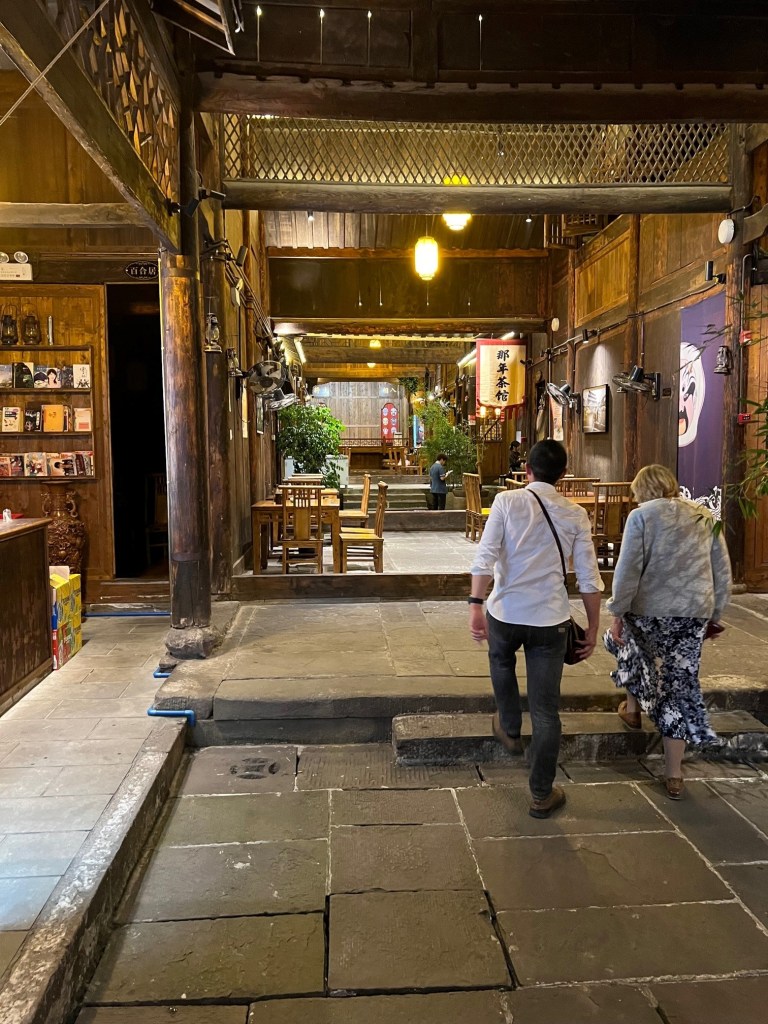
Sometimes though, spiritual life is like walking along that street in China, shown above. We are there by faith, but we don’t understand much of what is going on, and if we are getting any signals we often don’t recognise them or understand what they mean until the moment has passed and they are like another missed call on our cellphone. How often do we lament, “Oh, I knew the Lord was telling me (not) to do that! If only I’d listened!” The signals that we follow the most faithfully are the ones generated by our own bodies and our own minds. We might be spiritual beings, surrounded by spiritual realities, but often we might as well simply be creatures of the flesh for all that we are responding to the spiritual dimension.

Our Guide

What we need of course in an alien environment is a guide, and Jesus has given us just that: a guide to walk with who will make sense of the spiritual world that we have become citizens of. I mean the Comforter of course, the Holy Spirit. But He is a gentleman: He won’t translate for us unless we ask Him. And as well as being a gentleman, He is love, so He won’t guide us in His purposes unless our purposes are committed to His. I have a feeling that God is dealing with many of us as individuals to set us free from our self-centred agendas and align our hearts with His own, so we can be prepared for whatever He is about to do on the Earth. We need to be walking with our Guide.

Solid Food

Because I think the Lord wants to lead us into far greater revelation that we have been accustomed to – the “greater things” He spoke of – and He is saying to many of us that the season of spiritual milk is over. We’re  no longer babes, and we need solid food. We have had plenty of lessons in how to operate in the gifts of the Holy Spirit and we have seen something of the reality of the power of God, but these have mainly been school days and now it’s time to grow up. Classes will always continue for those who need them, but the solid food of living in this world as citizens of the kingdom of God is the same food that Jesus spoke of to His disciples, which is to do the will of the One who sent us. As He sent out the 12 and the 70, He sends the Church out today. To graduate from the classroom requires faith and sacrifice, but it is when we are in touch with the reality of love that we can expect the truth of love to guide us in spiritual realms, and the Power of Love to quicken our lives and flow into the lives of others. We will start to read the signs all around us as we walk: “Reach out here. Touch there. Speak these words. Bring my healing to this sick person. Intercede for this city.  Cast out this demon…”

“Mercy and truth met together.
Righteousness and peace have kissed.
Truth shall spring out of the Earth,
And righteousness shall look down from heaven.

Yes, the Lord will give what is good;
And our land will yield its increase.
Righteousness will go before Him
And shall make His footsteps our pathway.”

(Psalm 85, 10–13).

Pictures from China: 1) The confluence.

A Pattern of Heavenly Things

Anne and I have just arrived in China, where we’re going to be for the next three weeks.  Our hotel window looks out onto the confluence of the two rivers that join to become  the Yangtze Qiang, one of the world’s greatest rivers. Before we left the UK, a friend commented that this will be a time of attack and a time of revelation; and indeed it is, because what is on earth is “a shadow and a pattern of heavenly things.” (Heb 5:8) Every time the Lord takes His people to a new place, it is an opportunity to learn new things from Him and take new steps on the path of faith. So whenever God takes us to new places, the enemy will have a contingent targeting our movements and briefed to keep us out of  God’s purposes for as much of the time as possible. This is an article about relationships and warfare.

Swirling currents

Where the two rivers join, the currents swirl around one another before they merge into the greater stream. For every Christian couple seeking looking to move forward in unity, the enemy will seek to pit one partner’s flesh against the other, aiming always for a clash of interests, arguments, and fruitless discord. His plan is for the currents of the two rivers to keep swirling around each other and never to become one, and he has his forces constantly on the lookout to goad us into self-centred and unsubmitted decisions that will ensure that this happens for as long as possible.

God’s Way

But where the Yangtze is flowing, the other two rivers have ceased to exist: you cannot pick out their identities anymore. They have died. We cannot choose God’s direction and still maintain our own. When we die to self and pick up our cross we have to let go of our personal agendas. But when we do, we are free to flow in God’s direction as one, it is His current that carries us, and we can rest in His peace, knowing that we are flowing His way.

Being sober and vigilant

It is no use deceiving ourselves that the battle is only raging at key moments in our lives: it is all around us all the time, whether we are getting in the car, putting the children to bed, washing up, or just going out in the garden.  Unless we are “sober and vigilant,” as Peter writes, the enemy is always prowling around, seeking to divert our attention from the purposes of Love and the Kingdom of God onto the purposes of self, the flesh, and ultimately destruction. If the devil shoots us down while we’re clearing away breakfast, we’re no use to the Holy Spirit when we’re leading worship. And Peter knew from his own experience with Jesus how easy it is to be taken unawares in the most well-meaning moments…

Epistles of Christ

Walking in the Spirit is not just about seeking spiritual experiences and looking for opportunities to preach the gospel, prophesy, or bring healing; it is about winning the battle at the confluence of streams and applying the words that are spirit and life to everyday actions, moment by moment, so that we become the gospel ourselves, or as Paul puts it  living “epistles of Christ.“  (2 Cor 3:3) It is  actually when we are carrying our own cross  that other people can see the cross of Christ most clearly.

One heart and soul

“Now the multitude of those who believed were of one heart and one soul; neither did anyone say that any of the things he possessed was his own, but they had all things in common. And with great power the apostles gave witness to the resurrection of the Lord Jesus. And great grace was upon them all.” (Acts 4:32-33)

In the edition of the Bible that I use (the Spirit filled life Bible, published by Nelson), there is a thread of annotations called “kingdom dynamics.“ One of the kingdom dynamics themes is the power of unity, and in the commentary on acts 4:32 it says this:

“it is reported that the growing multitude of believers were experiencing a profound dimension of spiritual unity. First, they were “of one heart,“ which is a description in the original Greek meaning “in tune“ or “In sync“ with one another. To put it another way they were all going in the same way, spiritually together. Second they were of “one soul“ (Sometimes translated as “one mind”). This has a wonderfully deep meaning in the original Greek. It literally means “to breathe“  or “to breathe spiritually together.“ The results of this quality of spiritual unity were both powerful and practical. They had all things in common (shared everything they had); they witnessed “with great power“; and “Great Grace was upon them all.“

The backbone
Jesus made it clear – and through many of the New Testament writings the Holy Spirit abundantly reinforced – that the backbone of our life in the Spirit is that we love one another: without this backbone, the church simply does not stand up. When we love one another, the world can see that we are disciples of Christ.  Yet when we think about evangelism we can (and I frequently do) easily head down the exciting track of power evangelism, and all the miraculous works that it implies, and leave behind the main road of love. We can detach the hand that reaches out from the backbone it is connected to. But in these verses, it is clear that the context of revival in the early church was that the multitude of those who believed were are one heart and one soul. In other words, they lived out, in depth, the practicalities of loving one another: the life of Christ that flowed among them was the same Life that reached out to the lost with healing and salvation.

When, Lord?
It is clear that a wave of revival is starting to break on the shores of the nations as God fulfils His declaration of Hebrews 12:26: “Once again I will shake not only the earth but the heavens also.” Those of us who long to see the power of God move in our churches and on our streets follow the news with an expectation that cries out ”When, Lord?” But God will give to us as many as we can keep. If we want to witness with great power, and experience an outpouring of great grace, we need to be of one heart and one soul. We need to demonstrate the rule of God’s Kingdom in our lives if we want others to respond to an invitation to meet our King. So before we see God’s power break out among us I think we are going to see a re-awakening of genuine love in the church, because if we don’t love one another in the grace of God, how can we love the needy who join us? I think it is when we have truly learned to stretch out our hands to each other that God will stretch out His hand, through us, to the world.

Pebbles on the Beach and The Mind of Christ

I’m not the only pebble on the beach. Sometimes I think I am: I see a situation or a person through my eyes, and consider what I see is the truth. I may be standing with someone or even a group of people who are looking at the same situation. What do they see? Do they have the same view and the same perspective as me? Do they bring the same history, the same thought processes and the same perceptions? No. So why and how can I possibly believe that what I think about a situation – or, even worse, a person – is the whole truth? Yet so often this is what I do. And we know what the book of Proverbs says about the man who is wise in his own eyes: “There is more hope for a fool than for him.” (Prov 26:12)

There is only one person who sees the whole truth, and that is the person who is the Truth. There are millions of pebbles on the beach – billions even. Each one of us is different, each one of us is unique, and each one of us sees through a different pair of eyes. Only God can see the real truth. One day we will “know as we are known,“ but until then what He wants us to do is to love one another, serve one another and submit to one another – and look to Him for the truth. If we succeed in this, and at least achieve some degree of unity in whatever little group we belong to – two or three gathered in his name – then we are in a position to look together to see the truth that the Truth reveals to us. If we are not in this place, we are forever in danger of arrogant opinions and warped imaginings that do not reveal the beauty of the Giver of Life.

I was recently discussing with someone how animals and birds “think.” We were considering the behaviour of different animals and birds and how complex their thought processes can be in their specialist areas, and also how alien they must be to our own. How much further beyond ours, then, are the thought processes of the One who says “my thoughts are not your thoughts?“

So how easy it is to think we know the truth, and how far our “truth“ can be from what is in the mind of Christ. Yet as Paul says, we actually have the mind of Christ. I think that we, His body, will be able to access more of  those thoughts that aren’t our thoughts that are flowing through our wonderful mind, when each of us remembers that we are not the only pebble on the beach.

The vine and the brambles

“I am the true vine, and My Father is the vinedresser. Every branch in Me that does not bear fruit He takes away;  and every branch that bears fruit He prunes, that it may bear more fruit” (John 15: 1-2)

How easy it is, when things don’t seem to be happening, to be discouraged. We say, “Lord, should I be doing this? Should I be doing that? It doesn’t seem to be going anywhere.“ And the Lord answers: “Do not be discouraged. Look at the vine, and look at the brambles.“

There is the vine, the true vine, which is Jesus; and there are brambles, which are the things of the world. If we love Jesus, we are in the vine. Brambles grow quickly and spread everywhere; but the vine is tended by the vinedresser and only grows according to the vinedresser’s plan, which is to maximise its fruitfulness. Fruitfulness comes from nurturing selected shoots and pruning others.

And alongside the pruning comes the clearing. In 2 Cor 16-18 Paul writes:

And what agreement has the temple of God with idols? For you are the temple of the living God. As God has said:
I will dwell in them
And walk among them.
I will be their God,
And they shall be My people.”
Therefore “Come out from among them
And be separate, says the Lord.
Do not touch what is unclean,
And I will receive you.”
I will be a Father to you,
And you shall be My sons and daughters,
Says the Lord Almighty.’”

As well as the fact that our Vinedresser is always watching over us with his pruning shears in His hand, some of us in the vine have got brambles filling up the space in our lives: we need to come out from among them. They scratch and tear, we cannot move freely because of their thorns, and they choke our growth, as Jesus reminds us in the parable of the sower. God is looking for holiness, and it’s only in the separated vine, tended in its own uncluttered patch, where the Life of Jesus can flow freely and bring His growth.  Brambles maximise the berries they bear by spreading opportunistically wherever they can. It is not so with the vine: the vine bears clusters of grapes under the vinedressers hand, maximising every branch in the vineyard. When we are being pruned we need to feel the Father’s loving hand in our lives, and not just the sharpness of the blade.

It is so easy to look to the world’s model of growth – the bramble – and to be discouraged because we don’t see that rampant growth in our own lives and ministries. But Father says this: “Don’t be discouraged. Look to where I am pruning. Has there been a little growth there? Yes there has. I am pruning It so that there will be more. And see that branch, that I have just cut away? You won’t miss it, even though you think you will. It was using up your life no purpose.”

Wherever I turn at the moment, it seems that God is clearing and pruning: in my own life, in my business, in church (mine and others), in people I meet. The devil wants us to look at the brambles and feel dissatisfied. But we are not unaware of his schemes (2 Cor 2:11), so but let’s be prepared and let’s be encouraged: if God is pruning, it’s because fruitfulness is coming.

The Economy of Heaven

The banking system is falling through thin ice

We are currently hearing a lot about the collapse of the Silicon Valley Bank and its potential effect on the world economy: another sheet of the thin ice of debt upon which our financial systems are built has cracked, and it won’t be the last. I’m about to go away for a few days and was glancing through my book “Two Seconds to Midnight” this morning (thinking ‘Should I read through this again and make sure I am practising what I preach??’) and landed on this passage in the section on God’s Provision. The wider context in the book is our priestly calling, but I am sharing it here as a signpost to all of us, in these times of financial shaking, of the certainties of God’s economy.

Ho! Everyone who thirsts,
Come to the waters;
And you who have no money,
Come, buy and eat.
Yes, come, buy wine and milk
Without money and without price.
Why do you spend money for what is not bread,
And your wages for what does not satisfy?
Listen carefully to Me, and eat what is good,
And let your soul delight itself in abundance.”
(Isaiah 55:1-2)

So we find our provision in the presence of God, and we receive His abundance when we take our priestly calling seriously and allow the Holy Spirit to do His work of holiness within us. Indeed, unless we do “come to the waters” I don’t believe we can fully appreciate what it means to “buy and eat” without money. Before the Holy Spirit was sent, the twelve had given up everything to follow Jesus and spent every day in His company, yet they certainly had not grasped that He was Jehovah Jireh and that they could trust Him entirely for their needs. We see this clearly in Mark 8:14-21:

“Now the disciples had forgotten to take bread, and they did not have more than one loaf with them in the boat. Then He charged them, saying, ‘Take heed, beware of the leaven of the Pharisees and the leaven of Herod.’ And they reasoned among themselves, saying, ‘It is because we have no bread.’ But Jesus, being aware of it, said to them, ‘Why do you reason because you have no bread? Do you not yet perceive nor understand? Is your heart still hardened? Having eyes, do you not see? And having ears, do you not hear? And do you not remember? When I broke the five loaves for the five thousand, how many baskets full of fragments did you take up?’ They said to Him, ‘Twelve.’ ‘Also, when I broke the seven for the four thousand, how many large baskets full of fragments did you take up?’ And they said, ‘Seven.’ So He said to them, ‘How is it you do not understand?’”

We are not given any discussion of what they hadn’t understood, because the account moves straight onto the healing of a blind man. But we can read the context clearly enough. Jesus wanted to feed the spirits of His disciples, but they were too worried about their stomachs to receive what He was saying. Yet they had just witnessed Him miraculously providing a good couple of tons of bread (enough for 9,000 men, plus women and children), maybe more, for the needy crowds, with enough left over to feed the disciples for weeks. “Don’t you get it?” He was saying. “You’re sitting in the boat with Jehovah Jireh and you’re worried about food? Why do you think I told you back on the Mount of Olives not to worry about what to eat, or what to wear? You should know by now that I’ve got all that under control, so you can pay attention to the important stuff! ‘Listen carefully to Me, and eat what is good, and let your soul delight itself in abundance.’”

The Baskets Full

There is yet another layer to this story that concerns God’s supply for us. Take either of these two miracles: the sequence is exactly the same. Someone gives a tiny amount to the Lord; He multiplies it and involves His disciples in the miraculous distribution of the food, then there is an abundance left over for the disciples to enjoy. The first priority for the disciples was to give out what God had provided, and after the distribution they received their baskets full. In the world’s economy we receive first – income, wages, salary, etc. – then we give out of whatever spare is left in the baskets at the end. If we’re feeling generous there might be as much as half a loaf left out of our original five. In the economy of heaven there is a different dynamic: first we give what God tells us to give (if He is telling us, of course), then what is left in the basket afterwards is ours. But there is an additional element in the heavenly model: the loaves and fishes have passed through the hands of the Saviour, so what had been earth’s ration becomes heaven’s abundance. God wants us to give out of heaven’s abundance so He can multiply our portion accordingly: “Give, and it will be given to you: good measure, pressed down, shaken together, and running over will be put into your bosom. For with the same measure that you use, it will be measured back to you” (Luke 6:38).

God’s provision is in His presence

The important lesson for us is that God’s provision is in His very presence. What He wants from us is our hearts: a willingness to trust Him with what is ours, and to place it in His hands. We catch a glimpse, literally, of God’s perspective on our economy when we see Jesus sitting outside the Temple watching people putting their gifts into the treasury. We know the story: the poor widow, whose two mites represented all she had, had put in far more than the wealthy who gave leftovers from their abundance. We don’t see that widow again, but we can be sure that God gave back to her in the same measure that she had given to the Temple. Wealth and poverty have traded places. Our God is a creator, and loves to create, and we can so easily forget that when we look at our bank statements. But if our hearts are rich towards Him, we will see Him create in our material circumstances and fill our baskets, whereas if our hearts are bound by our bank accounts we remain in poverty, and will only ever see the loaves and fishes that we can provide for ourselves.

(From “Two Seconds to Midnight,” pp 130-133. MD Publishing 2021)

The Pillars of Evangelism

The fields are white unto harvest

In his second letter to Timothy, Paul wrote: “But you be watchful in all things, endure afflictions, do the work of an evangelist, fulfil your ministry.” (2 Tim 4:5) If we stopped anyone in the street, Christian or atheist,  (OK anyone over 40 who has lived in an English-speaking country), and asked them to name an evangelist and say what they did, we would almost certainly hear the name of Billy Graham and be told that they stood up in public places and preached about Jesus/ God/ the Bible. I think this image of “the evangelist” is still prevalent in the church today, and that “evangelism” is a special activity carried out at special events by a few gifted people, often in full-time ministry and “living by faith; and that the rest of us can only expect to occasionally “witness” or “share our faith” now and then, “sowing seeds” that we do not necessarily expect to see coming to fruition. But I don’t think this is the truth. In fact I think that it is an enfeebling dilution of the legacy that Jesus left to the Church, and doesn’t really help anyone to fulfil their ministry.  If we combine the “Great Commission” verses in Matthew and Mark into one paragraph, we get the following:

And Jesus came and spoke to them, saying, “All authority has been given to Me in heaven and on earth. Go therefore into all the world and preach the gospel to every creature, and make disciples of all the nations, baptizing them in the name of the Father and of the Son and of the Holy Spirit. He who believes and is baptized will be saved; but he who does not believe will be condemned.  And these signs will follow those who believe: In My name they will cast out demons; they will speak with new tongues;  they will take up serpents; and if they drink anything deadly, it will by no means hurt them; they will lay hands on the sick, and they will recover. Teach them to observe all things that I have commanded you; and lo, I am with you always, even to the end of the age.” And they went out and preached everywhere, the Lord working with them and confirming the word through the accompanying signs.” (Matt 28:18-30 combined with Mark 16: 15-20)

Just as the church has specialist prophets but “All can prophesy,” (1 Cor 14:31) and has specialist pastors and teachers  but we are all called to love one another and to “teach and admonish one another in all wisdom;” (Col 3:16) we are all called, as Timothy was, to do the work of an evangelist and preach the gospel, even though the church also has specialist evangelists. (See Ephesians 4. It’s not the subject of this article, but leadership in every church should comprise all these specialist ministries. I’m just saying… ) So here are eight principals, eight “pillars of evangelism,” that we can take from Christ’s command. To do the work of an evangelist properly I think we need to take all of them seriously.

  1. All the world
    We Go into all the world. Our workplace as disciples of Jesus is primarily the world. We don’t expect the world to come to the church; we take the church into the world.
  2. Every creature
    We preach to every creature – old, young, rich and poor. God is no respecter of persons. In the parable of the wedding feast Jesus said: Therefore go into the highways, and as many as you find, invite to the wedding.’ So those servants went out into the highways and gathered together all whom they found, both bad and good. And the wedding hall was filled with guests.” Our commission is to make sure that the hall is filled with guests: whatever they are wearing, rags or riches, is all replaced by the wedding garment.
  3. Saved… condemned
     We preach the full gospel: salvation and condemnation. To preach is to proclaim, with authority, something that has been done, in the manner of a herald. (From the Strong’s definition.)  We are heralds of what Christ has done for us and its consequences, both for those who believe and those who don’t believe.
  4. Baptizing them
    We baptize converts in water and we baptize in the Holy Spirit by the laying on of hands. “Therefore leaving the principles of the doctrine of Christ, let us go on unto perfection; not laying again the foundation of repentance from dead works, and of faith toward God,  of the doctrine of baptisms, and of laying on of hands, and of resurrection of the dead, and of eternal judgment. (Heb 6: 1-2) The Ephesian church was birthed through baptism and the laying on of hands: “When they heard this, they were baptized in the name of the Lord Jesus. And when Paul had laid hands on them, the Holy Spirit came upon them, and they spoke with tongues and prophesied.” (Acts 19: 5-6) Being filled with the Holy Spirit has experiential results. If we do not ourselves have the faith and the personal experience to pray for someone to be filled with the Holy Spirit and to experience some consequences of that infilling, we need to leave that ministry to someone who does. In the case of the Ephesians, it was Paul. Otherwise we are offering a hungry person cornflakes and just giving them an empty packet.
  5. I am with you always
    We go, therefore, knowing the presence of God, who with us always, because we are in Christ, baptized into Him, into His death and His resurrection (Romans 6:3). We operate “in the name of Jesus” because we have been baptized into His identity. A Christian is a “little Christ,” not a partial Christ.
  6. All authority
     We go in His authority: When Jesus sent out the seventy, He said “Behold, I give you the authority to trample on serpents and scorpions, and over all the power of the enemy, and nothing shall by any means hurt you.” (Luke 10:19) This was before Pentecost. Whether or not it is in the realm of our current experience, we are now in the day of the Greater Things; we are raised together with Him and seated with Him in Heavenly places. We have more authority now than the seventy, not less.
  7. These signs will follow
     Knowing what it means to be sent in His name, we go in the full expectation of signs and wonders following the preaching of the gospel. Paul writes: “I am not ashamed of the gospel, for it is the power of God unto salvation to everyone who believes.” (Romans 1:16) To preach the gospel is to proclaim Christ’s authority over all of heaven and earth, over all the works of the enemy including sickness and demonisation. If we have no expectation of His authority being manifested when we preach “the power of God unto salvation,” we are like people who get into their company car and don’t start the engine. Not only are we going nowhere, but we are not honouring the One who paid with His life for us to have the car in which we have been told to “Go.”
  8. Teach them
     Finally, as “fishers of men,” we keep those whom we have caught. Jesus said “Those whom You gave Me, I have kept. And none of them is lost, except the child of perdition.” (John 17:12) God will give us as many as we can keep, therefore we make sure that we teach them all the things that Jesus has commanded us, so that they in turn can go and make disciples.

Jesus said that it’s the harvest field that needs workers, not the seedbed. It’s time the Church took seriously the work of the evangelist, and started reaping. In Matthew 9: 36-38, we read this:

“But when He saw the multitudes, He was moved with compassion for them, because they were weary and scattered, like sheep having no shepherd. Then He said to His disciples, “The harvest truly is plentiful, but the labourers are few. Therefore pray the Lord of the harvest to send out labourers into His harvest.”

The Greek word that he uses for pray, deomai, means to petition, bag, beseech. It implies a felt need, a longing. We “go” because Jesus tells us to. And yes, the reluctant brother (Matt 21: 28-32) was commended for his obedience. But if we really want to enter into the joy of the reaper (John 4:36) and experience the harvest firsthand, we need to feel the Lord’s compassion for the lost in our own hearts, we need to be aching ourselves for the lack of harvesters, and we need to be beseeching the Lord of the harvest for co-workers who will join us in the task.

In that spirit, Go, therefore!