Category Archives: Be prepared; hold on.

As we approach the last days, sound doctrine will be diluted in many churches to appease the spirits of liberalism as large in the world, and persecution of those believers who hold on to the fullness of the gospel message will intensify. We need to “build ourselves up in our most holy faith” so that we can be prepared for whatever the enemy might throw at us, and be ready at the last, a spotless bride, to receive our Lord into the Kingdom of our God and His Christ.

Bread from Heaven: 2

Make the people sit down
In his letter to the Galatians, Paul says that what matters most of all is “faith working through love.” So here we are on the mountainside. We have kept in step with the Spirit; we have lifted our eyes with love, we are aware of how God has led us to and provided for this moment, and so we believe that Jesus wants to meet the need that is now before us. Even though He knows what He is going to do, we don’t. What next?

Jesus says, “Make the people sit down.” Some miracles require preparation, and that preparation has to be in obedience to what the Lord has asked us to do. The disciples could not see with their natural eyes what might happen next, but they got their instructions and complied with them. Like the unprofitable servant (Luke 17:10), they simply did what they were told to do. And more than that, they had to do so with authority. 12 men had to exercise crowd control on 5000, many of whom had their families with them, and all of whom were ravenous and will have wanted to be first in the queue for whatever goodies Jesus was going do dish out. We have probably read and heard the story many times, but if you imagine the scene and do the maths it’s not hard to see that the first miracle was actually getting that crowd ready to receive the food in the first place. When I was a teacher I found it hard enough to control a group of thirty, so I needed to exercise authority – and that was when I knew what it was I was going to deliver.

The disciples could organise the crowd because the Lord had clearly given them the mandate to do so, and they put their trust in His authority without question. I wonder what they thought He was going to do? Elijah and Elisha both worked miracles of multiplication, but the nearest thing to supernatural provision of food at this level that they would all have known of was the manna in the wilderness. It was a story that they would have heard many times, and it was deeply embedded in their culture. Maybe when they heard it they wondered what it was like, and now they were thinking, “Wow, we’re going to see manna! Awesome!” How often we have one expectation, and God does something completely different, often meeting our need at a deeper level. But one thing we do know, is that God is “able to do exceedingly abundantly above all that we ask or think, according to the power that works in us.” (Eph. 3:20) We can be expecting manna when God has multiplication in mind.

Authority follows the Anointing
So when God gives us an instruction, we don’t know what we are being prepared for: all we know is what we have heard and the One who is doing the preparing. But because we have had the instruction, we have the authority to carry it out. I have a friend, Andrew, who tells the story of a meeting when he stepped up to preach at a conference towards the end of the worship time, and the Holy Spirit said to him “The anointing isn’t on you; it’s on the lady who is ministering with the flags.” He knew the Lord’s voice well enough and had the humility to obey, laying down his message and releasing the flag ministry to become the focus of that part of the conference. Authority followed the anointing.

In how many churches, every Sunday, is manna on the programme when God has multiplication planned? Our meeting this week will be basically the same format as last week. And the week before, and next week. We know what to expect, and we know what we will do: it’s time to gather the manna.  We prepare our sermon or our worship set and it’s what we do. If we are Pentecostals or charismatics we probably ask God to anoint it, but what we are much less likely to do is to ask Him to replace or change it if He wants to. If it’s a smaller group we might be more likely to be flexible, but a hungry crowd at a conference, waiting to be fed? Will we put down the important message we have spent a week preparing and praying over, and move aside for the flags? Andrew did just that, the power of God fell, His manifest presence came into the room, and lives were changed. Andrew didn’t know what was going to happen: he just “made the people sit down.” If we will hear God’s word in faith and act in authority, He will provide more than we can ever ask or imagine. All we have to do is lay down our lives.

Manna, or Mission?
We have sometimes hosted gap year students from Germany who have come to spend the year as interns working with the children and young people in our church. We have kept in touch with most of them, and recently one of them, David, invited us over to his wedding. We accepted the invitation, and decided to visit two of the others while we were in Germany. We weren’t driving and it meant quite complicated travel arrangements, but we knew they would like to see us, and we wanted to see them. (We were actually hoping to arrange a visit to a fourth family, but the travel arrangements just didn’t work in the time we had available. There was no grass in that place…) One of our friends referred to our trip as a “mission.” That’s a bit high-sounding, I thought – we are just going to a wedding and visiting a couple of other young friends and their families. But God had plans that we knew nothing of, because we walk in works prepared beforehand. (Eph 2:10)

What God had prepared for the young man we visited first of all was to organise an outreach in his town three days after we arrived, which gave us time to prepare and pray with him and spend time with his family. We went into the town with the outreach team, met some of his friends in his church, identified a spiritual stronghold over the town and pulled it down in prayer.  Next we moved on for David’s wedding. We had two days there, but couldn’t stay at the venue on the night of the reception because it was fully booked, and we were going to have to stay in another hotel a few miles away. But God! The owner/manager of the venue gave a free room, already paid for by guests who had not shown up, and even arranged to collect our luggage from the other hotel, where we had already taken it that afternoon. This enabled us to have a precious time of prayer with David and his new wife the following morning as well as some good conversations with his unsaved aunt and uncle, which wouldn’t have happened if we hadn’t been able to stay there on the second night.

After the wedding we went to see our third and most recent gap-year student, to find that her father, an elder in their village Lutheran church, was considering leaving it because, as he put it, ‘the pastor just gave history lessons and didn’t preach Jesus.’ We prayed with the family and were able to encourage them, and we had a lovely day together on a Rhine cruise, which further cemented our friendship. The mission didn’t end there, because we called in to see our daughter on the way home back in the UK, and our visit coincided with a visit from one of her friends who had been planning to go to her house for months, who had been wanting to meet us, and who, again, was in need of prayer.

No-one got dramatically healed, no-one got saved – although someone did on the outreach – but love took us to Germany, we did what we were told, there was “much grass in that place” (including a free hotel room), and Jesus did some building in His church from plans that we knew nothing of. A bit like the disciples, who were probably just expecting some time out with Jesus in the hills and found themselves managing a large-scale outreach, we just thought we were going on a trip to celebrate David’s wedding and visit two other families; but it turned out that God had planned the three sets of circumstances to coincide in different parts of Southern Germany for us to walk in a mission that He had prepared beforehand. Potentially, every day can be a mission where loaves and fishes are ready to be multiplied. So are we in the promised land yet? Because when we arrive, the manna stops.
I Will Build My Church

The Kingdom Of God is not a matter of eating and drinking, but of righteousness peace and joy in the Holy Spirit (Romans 14:17)

I woke up this morning singing a song we had in church on Sunday:
“Father let Your kingdom come,
Father let Your will be done,
On earth as in heaven,
Right here in my heart.“

It is, of course, one of several settings to music of the Lord’s prayer, and it’s one of my favourites. But it’s got me thinking about the Kingdom Of God (never a bad thing) and how we perceive it. In particular, I’m thinking about our experience of the Kingdom In our church situations, and the relationship between the two. If you are feeling at all disappointed in, critical of, or hurt by what’s going on in your church at the moment, then this is for you. That probably means all of us at some time or another.

We can all get lost in our own imaginings of what the Kingdom Of God is like in heaven, but what do we know about the Kingdom Of God on earth? We know it is within us, we know that it’s eternal, we know it’s wherever we see the rule and reign of the Lord Jesus manifested, and we know it’s “righteousness peace and joy in the Holy Spirit.” if we think about the rule and reign of Jesus in the light of John 10:10, we know that the kingdom is manifested when we see the works of the enemy destroyed and life in abundance established. And if we think of the heart’s desire of the King himself, we have to land on John 17:21 and His prayer in Gethsemane that “That they all shall be one, just as you, my Father, are in me, and I am in you, so that they also shall be one in us.”

Paul is clear about the ultimate purpose of the church and how to attain it in Ephesians 4: 15-16, which is that “speaking the truth in love, (we) may grow up in all things into Him who is the head—Christ— from whom the whole body, joined and knit together by what every joint supplies, according to the effective working by which every part does its share, causes growth of the body for the edifying of itself in love.” When the body of Christ has attained this goal we will have become the answer to the Lord’s prayer in Gethsemane and to the Lord’s prayer that He gave us on the Mount of Olives: His kingdom will have come on earth.

Unfortunately, it can seem at times that some people in our churches are either writing chapter 7 of Ephesians, or have never read the epistle at all. The Holy Spirit reminds us in Isaiah 26:3 that “You will keep him in perfect peace whose mind is stayed on you, because he trusts in You.” To live in the good of this verse, we need to remember Matthew 6:33: “seek first the kingdom of God and His righteousness,” whether we are finding it in church or not. Ephesians 4:3 tells us that we find the unity of the spirit in the bond of peace, so if we have peace in our hearts about our bonds with other members of the church, we know that we have done our part to maintain the unity of the spirit with them, and our hearts are prepared for the rule of the Kingdom of God.

The Ecclesia
Jesus is building His church in truth and love, because truth and love are who He is, and the church is His body on earth. My Church isn’t, but His church is. Where there is truth and love in the assembly of the saints we find His body, and when we are in truth and love we are part of it, whether we are in my church, your church, their church, or someone’s church on the other side of the world. Jesus said I will build My church, not My churches. Paul says we are one body, not many bodies (1 Cor 10:17), and that we are being “built together as a dwelling place of God in the Spirit.” (Ephesians 2:22) Peter says: “You also, as living stones, are being built up a spiritual house, a holy priesthood, to offer up spiritual sacrifices to God through Jesus Christ…(who) has become the chief cornerstone.” (1 Peter 2:5-7)

The word that is used for this building, the church, is ecclesia. In the Christian context, ecclesia refers to a gathering of believers called out from the daily concourse of society to worship God, but the prime meaning of the word refers to an assembly of people called out of their houses to convene at a meeting place for the purpose of deliberation. So there is an implication of government here: when we meet to worship God, we also assemble to administer the government of His Kingdom. In fact Psalm 149 reminds us that our praise is integral to establishing His rule on earth. When Jesus says that the gates of hell won’t prevail against His church, He is saying that the councils of the powers of darkness won’t prevail against the government that is on His shoulders.

The government of the cross
And here’s the thing: Isaiah ‘s prophecy (Isaiah 9:6) wasn’t just a metaphor: Jesus did, literally, carry the government of His kingdom on His shoulders, when He carried the cross to Calvary. When we carry our cross as Jesus instructed and genuinely die to self, we are also carrying His authority to rule. We are part of the governing ecclesia of His kingdom on earth. Neither the many churches in your city nor the 45,000 denominations on Earth today are meant to be little microcosms of the Church of Christ: they are simply parts of it. More than that, they are only parts of it where they reflect the life of Christ and the government of the cross.  And since, according to 1 Corinthians 13:13,  it’s faith, hope, and especially love, that are the only things that last forever (“remain” or “endure,” depending on your translation), they have to be the three elements that make up the DNA of the everlasting life of Christ. Alongside those three it’s the word of God that endures forever. The cross, the DNA of the life of Christ, and the word of God: if we want to find the ecclesia of Jesus where His kingdom is governed, this is what we look for.

What if we don’t find it, or if or own church seems to be missing the mark? This doesn’t mean we spend our lives in the ranks of the spiritually homeless. On the contrary, God puts us into imperfect fellowship to teach us how to love one another, and to prepare our hearts to be carriers of His Kingdom. Our churches are training grounds for the government of His ecclesia, whether we govern in our local church or not. We can’t cause growth of the body by speaking the truth in love if we have no-one to speak it to, no relationships in which to exercise Kingdom values, and no arteries where the life of Christ can flow.

I was in a meeting the other day when I sensed the Holy Spirit showing me that His church was like an orchestra, with different instruments scattered far and wide, but where all the instruments were in tune with each other, all eyes were on the conductor and everyone was playing the same piece of music. The prophetic word He was giving me was that He was changing the (musical) key to a higher pitch. In my spirit I found myself looking at a violin that was far away. Just at that moment I received a phone call from a friend who pastors a church in East Germany. Not a coincidence, I felt, but a confirmation of what the Lord was showing me about His church.  

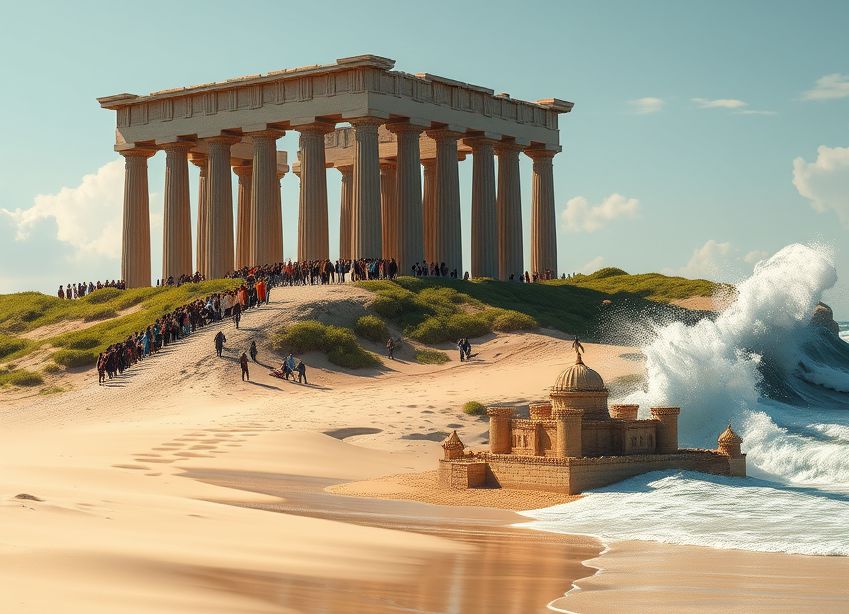
Pillars and sandcastles
People are hurt and Churches fail or divide when they become houses of the government of man and not of the government of Jesus, building castles of sand instead of being built as living stones. The church at Philadelphia was clearly of the latter type, and Jesus makes this promise to those that would “hold fast to what they have:”

 He who overcomes, I will make him a pillar in the temple of My God, and he shall go out no more. I will write on him the name of My God and the name of the city of My God, the New Jerusalem, which comes down out of heaven from My God. And I will write on him My new name.” (Revelation 3:12.)

This is the reward for those who belong to the ecclesia of Christ. By contrast, a sandcastle is recognisable by its turrets and not by its pillars, and in the turrets flags are sometimes planted, where men like to write their own names. When someone seems to be waving their flag in our faces, we don’t want to snatch it out of their hands, but we need to pray that they, and we, will be pillars in the temple of our God where He can write His own name on our lives. If someone tells us how to “eat and drink,” we respond with righteousness, peace and joy in the Holy Spirit. Because a wave is coming when the sandcastles will be washed away, and only the pillars of the ecclesia will stand.

First Love: The letter of Jesus to the Ephesians

If we want to read about how the church is built up in love through the Holy Spirit, we probably turn to chapter 4 of the book of Ephesians. If we want to read Paul’s prayer for understanding the great width and depth of Christ’s love for us, we find it in Ephesians chapter 1. If we want to find the passage on how to be equipped for spiritual warfare, we find it in Ephesians chapter 6. If we are looking for wisdom on marriage and other relationships, we will probably look first in Ephesians chapter 5. The letter to the Ephesians is probably the number one go-to resource on how to live the Christian life: Paul spent about three years with them, teaching them the principles that we read about in the letter, and his farewell message to them in Acts 20 has been described as one of the most moving passages in the Bible. Ephesus is where the term “Christian“ was originally used to describe the followers of Jesus, and since the word means “little Christ” they must have been getting something right.  Ephesus was the prototype Christian Church. About 35 years after it was founded, Jesus writes another letter to the Ephesians:

“I know your works, your labour, your patience, and that you cannot bear those who are evil. And you have tested those who say they are apostles and are not, and have found them liars; and you have persevered and have had patience, and have laboured from my name’s sake and have not become weary.“ (Revelation 2: 2-3)

If Jesus visited our church, especially today at a time when many high profile ministries may be said to come into the category of “those who say they are apostles and are not,“ we would probably feel very pleased with ourselves and consider that heaven looks upon us as a model church. But as we know, this is not the case. In fact their very existence as a church at all is precarious. Jesus goes on to say:

“Nevertheless I have this against you, that you have left your first love. Remember therefore from where you have fallen, repent and do the first works, or else I will come to you quickly and remove your lamp stand from its place – unless you repent.” (Revelation 2:45)

Sovereignty and Presence
The message to the Ephesians is the first of the seven that John transcribes in his book. Jesus reveals himself to them as “ He who holds the seven stars in His right hand, who walks in the midst of the seven golden lampstands,” emphasising His sovereignity over the churches and His presence among them. Nothing is more important to the church of Jesus than that we love one another: if we fail in this, we deny His Lordship and spurn His presence. So what does the Lord mean by “you have left your first love?”

He is talking here about “agape“ love, the self sacrificing love which Jesus demonstrated at the cross and which He calls us to show to one another. He is not talking about passionate worship, extended prayer times, or time spent in ministry, all of which can, and often do, come at no personal cost to ourselves. When He calls the Ephesians to repentance, He commands that they should do the “first works“ the works of love, again.

We don’t know what these works were, but I think we can safely assume that the first Christians in Ephesus would have responded wholeheartedly to Paul’s teaching, and that the “little Christs” would genuinely have been, to a degree, recognisably Christlike people. If Paul’s letter encapsulates the main theme of his three years’ ministry among them, we see that they would have been a people who were “being built together as a dwelling place for God in the spirit” (Ephesians 2:22) that they were “rooted and grounded in love” (Ephesians 3:17)) and therefore “knew the love of Christ that surpasses knowledge” (3:19), that they “walked with all loneliness and gentleness, bearing with one another in love, endearing to keep the unity of the spirit in the bond of peace,” (4:12) that they ministered to one another as a body, “building themselves up in love” by the “effective working by which every part does it share,” (4:16) that they were kind to one another, tender hearted, and forgiving (4:32), and that they lived out their marital, family and work relationships according to godly principles. And of course none of this would have been possible without putting Jesus first in their hearts, laying down their lives, and living for one another out of the agape love of God “which has been poured out into our hearts through the Holy Spirit, who has been given to us.” (Romans 5:5) Their “first love” had to be for Jesus and for one another, “for he who does not love his brother whom he has seen, how can  he love God whom he has not seen? (1 John 4:20)

As the Lord walked around this lamp stand, He would have been blessed by its light, but now that light was going out and He was threatening to remove it altogether. The Greek word aphiemi, translated as “left” in verse 4, suggests a conscious act, a decision made to leave it behind, a turning away, rather than just negligence and neglect. It seems that the Ephesians had decided over the years that their labour, patience, hatred of evil, “outing” of false apostles, and perseverance were more important than gentleness, unity, and building one another up in Love. They valued ministry above Love, their church above their Lord.

The Tree of Life
However, all the admonishments in the seven letters to the churches are encouragements to overcome in their areas of defeat, as opp0sed to just reprimands and warnings, and in each case the overcomers are promised the reward that Jesus deems to be the most appropriate to their victory. To the Ephesians He says: “To him who overcomes I will give to eat of the tree of life, which is in the midst of the paradise of God.“ (Revelation 2:7). I pondered over this, because – unless we have got our theology terribly wrong – we are saved by grace and not by works, so surely everyone who has accepted the lordship of Christ gets to eat of the tree of life? And the thought that came to me was this: just as Jesus “has life in Himself“ (John 5:26) and is thus able to impart that life to others in healing and other creative miracles, not to mention resurrection, maybe for us to eat of the tree of life is in some way connected to our own ability to impart God‘s life to others? How many resurrections have we seen lately?  For that matter, how many miraculous healings? I recall one meeting in our church this year was there were definitely a couple of healings, but that’s all. Maybe we aren’t eating of the tree of life? Maybe we have some repenting to do?

That thought has to be seen as speculation and not revelation, of course. But what is certainly true from the letter that Jesus wrote to the Ephesians is that we need to prioritize how we love Him and love one another above every other aspect of Christian life. And maybe, just maybe, if we do this we will start to see the miraculous happening more frequently among us.

The Great Deception

(Image generated by AI from its “reading” of my text…)

Every time I ask Google a question read the detailed AI overview of its answer, I think about the Great Deception that Paul writes about in 2 Thessalonians 2 1-12. Is artificial intelligence part of it? Recently I stumbled on a blog on the subject of the great deception and how to be sure not to fall away, and I read it with interest. It was all Bible based and made a lot of sense: basically it was telling us that if we keep our eyes on Jesus and remain grounded in faith and the word of God we won’t be led astray by Satan’s lies. All good stuff, followed by lots of practical applications for family life, similar to material we find across a broad swathe of Christian writings.

I scrolled down the article, and came to other material written by the same guy. But I stopped short when I saw an article that claimed to be “a detailed study of the biblical proof for a flat and motionless earth.“

Is someone who is exhorting Christians to believe the word of God, hold fast to Jesus, and be guided through the complexities of life and the snares of satanic deception by discernment of the truth, suggesting that I believe that the world is flat and that I can find evidence of this in the Bible? I really hope not, yet I believe it’s probably true.

I know the Earth is not flat: I’ve travelled a lot of the way round it, I’ve seen the curved horizon, and I’ve seen photographs from space. I know that none of Magellan’s ships fell off the edge between 1519 and 1522. I’ve got enough experience to tell me that science has got this right.  But it made me think:  what do I do in the areas where the Bible tells me that science is wrong and I don’t have the experience to align with my acceptance of its authority? Did God really create the earth in six days, less than 7000 years ago? Did Methuselah really live to be 969? What about the other end of the Bible: Is there really going to be a rapture? How can the new Jerusalem come down from heaven, for example? And then of course we come to the basics of Christian Faith. Virgin birth? Resurrection? Ascension? Science tells us that none of this is possible, but our faith says it’s true. It’s totally understandable that many people who genuinely ask the question “is there a God?” dismiss faith because it doesn’t make sense. Faith is a “a gift of God, that none may boast,” (Eph 2:9), but it also has to be a gift of God because the human brain simply can’t comprehend it.

I do believe that God is in and through all things, and that he has progressively guided the man that He created through an understanding of the world that He put him in. I think that this is sometimes has been by revelation, and sometimes by exploration. God has given us science. But He has also given us His son, and He has given us the Holy Spirit. He has given us brains, but we also have the mind of Christ. The universe is material and it is spiritual. Spiritual things are spiritually discerned: we can no more understand the mind of Christ with our human reason than we can prove whether or not Christ will return to the Earth in the manner that He ascended, if there really was a worldwide flood and Noah’s Ark, or if we will all be raised up at the last day, and more importantly which eternal existence we will be raised up to – the resurrection of Life or of condemnation. (John 5:29).

Ultimately, truth is neither science nor the printed pages of the Bible, which can be taken at face value to prove almost anything – even, it appears, that the Earth is flat. Truth is a person. Jesus said “I am the way, the truth, and the life.“ We are called to follow His way, walk in His truth, and to share in His life. The truth can’t be separated from the way and the life any more than one can separate the heart from the brain and the nervous system and expect them to carry on functioning. Whatever the great deception ultimately is, its main purpose will be to lead us away from the person who is the way the truth and the life.

I do happen to think that AI will play its part in this, and I think it is part of the fulfilment of Daniel‘s end time prophecy that “there will be a increase in knowledge; (Daniel 12:4) however Paul writes “knowledge puffs up, but Love builds up.“ (1 Cor 8:1)  Knowledge alone, whether we gain it from Google’s AI overviews or from our own intellectual understanding of the Bible, is not the truth. The truth is only in Jesus, the fulfilment and the flesh of the word, and we live in the truth when we walk in Him. And since God seeks worshippers who worship “in spirit and in truth,“ we cannot walk in the truth unless we also walk in the spirit, and none of the fruit of the spirit even marginally hints at the supremacy of the intellect. In fact the Holy Spirit tells us in Proverbs 12:15 that “the way of a fool is right in his own eyes.” One of the most brilliant people the world has ever known, Leonardo Da Vinci, said “The greatest deception that men suffer from is from their own opinions.”

Our understanding of the truth as it is in Jesus will always find its expression in God-given faith and love, and our first rule in gaining this understanding will be to learn from Him and be yoked to His gentleness and humility of heart. (Matthew 11:29) This means that if any of us thinks he is a “better” Christian than anyone who doesn’t share our theology they have missed the point entirely. God’s goodness, revealed to us in Christ, is as far above ours as the heavens are from the earth, so the differences between us are as insignificant as the differing widths of two grass stems in the face of the sun. Paul wrote to the Thessalonians that the Lawless one was already at work in their time, and I believe that a part of the great deception that Satan had been working on since the birth of the church is to convince us that one person’s idea of how to follow Jesus might make them “a better christian” than someone with different ideas.

As for me, I choose to believe the Apostles’ creed over the atheistic writings of Richard Dawkins or the algorithmic manipulations of AI, however convincing their deceptions may be. And whether a brother or sister in Christ chooses to believe that the Earth is 6000 or 6 billion years old, or even that it is flat, there is nothing in the Apostles’ Creed or in what I know of scripture that tells me that I should correct their beliefs. If we build each other up in love we will all come “to the unity of the faith, and of the knowledge of the Son of God, to the perfect man,” (Eph 4:13) whatever views we hold about science or prehistory, or about Great Deception itself; and when we do that we will really know the truth, because we will be seeing Him face to face.

Vigilance in the Face of Spiritual Threats

Your enemy is prowling … Photo by Michael Parsons.

A matter of life and death
This picture is of an oyster catcher chasing away a crow. Crows predate the eggs and chicks of birds, so for the oyster catcher this skirmish is serious: it’s a matter of life and death. Ground nesting birds like oyster catchers are particularly vulnerable to predation: I read an account recently of a goshawk taking the nearly full grown chick of another oyster catcher at one of my local sites. On that occasion the parent bird didn’t manage to chase away the predator. In the natural world the battle between predator and prey is always a matter of life and death: there is no in between layer. How different it is for us. We have so many layers of protection, whether it is our insurance policies, our security cameras, our fancy doorbells that tell us who’s outside, health, police and emergency services – the list goes on. Rarely is a potential threat immediately threatening. Or is it?


The Unseen World
While on holiday recently, I went snorkelling. Above the water, nothing of the undersea world was visible. However the hotel had made snorkelling equipment freely available to residents, and as soon as I put on my mask and flippers I saw a different reality: the reef below me was alive with a myriad of darting fish and other colourful creatures, waving weeds, canyons, mountains, sand, stones, and seashells. The small fishes were flashing away because they were constantly wary of potential threats. In some of the crevices lurked sea urchins of different sizes; their poisonous spines waiting for an unsuspecting touch from any passing creature, or indeed from my flailing hands. When I took off the snorkelling equipment and went back to my sun lounger, I was struck not only by the natural beauty that I had just witnessed, but also of the reality of an unseen world below the water’s surface that is both beautiful and dangerous, and how we live much of the time on the surface of life, completely blind to the present reality and imminent dangers of the unseen world of the spiritual dimension.


The Prowling Predator
 Yet, like the oystercatcher, we have a predator. As Peter writes, “your enemy, the devil, prowls around like a roaring lion seeking whom he made devour.“ (1 Peter 5:8) Paul writes  that we “wrestle… with the spiritual hosts of wickedness in heavenly places.” (Eph 6:12) Jesus tells us that “The thief does not come except to steal, and to kill, and to destroy.” (John 10:10) Because of the prowling predator, Peter warns us to “be sober, be vigilant.“ In other words, we are to keep our heads clear and our eyes open, because we don’t know where the next attack is coming from. The word Peter uses here for being vigilant is gregoreo, and it is particularly significant for Peter. It was He who was sleeping, along with James and John, in the garden of Gethsemane when they were there with Jesus just before his betrayal. Jesus said to him: “What, could you not gregoreo with me just for one hour? Gregoreo and pray, less you enter into temptation. The spirit indeed is willing, but the flesh is weak.“ (Matthew 26: 40–41). We all know how the flesh failed Peter when Jesus was on trial, so his exhortation to vigilance was written with feeling. But by the time Peter was writing his letters, he also knew that God has made spiritual mask and flippers – the gifts of the Holy Spirit – freely available to the church to help us keep our eyes open underwater.

For want of a nail…
What we need to remember is that the devil plays the long game. There is a proverb, often attributed to Benjamin Franklin, that goes: “For want of a nail the shoe was lost, for want of a shoe the horse was lost, for want of a horse that rider was lost for want of a rider the battle was lost, for want of a battle the kingdom was lost, and all for the want of a horseshoe nail.” As a rule, the spiritual hosts of wickedness are not waiting round the corner with an axe to take us out at one fell swoop: they are more likely to tempt our flesh into negligence of a horseshoe nail so that we fall all by ourselves while they are busy tempting others. How often we say, “Oh that won’t matter…“ And then we find out further down the road that it really did matter, a lot.  The little thought that we were ignoring was actually the Holy Spirit showing us where the enemy had loosened a nail.


Ultimately, we know that the kingdom is the Lord’s, and that no amount of lost nails will compromise the final outcome of the victory that He has already won on the cross. But if we will keep our eyes open to the unseen spiritual realm we can avoid the lurking sea urchins that would take us out of the battle, temporarily or permanently, even though the final outcome will not be affected.

Redeeming the Time: The Biblical Call to Action

“See you then that you walk circumspectly, not as fools but as wise, redeeming the time, because the days are evil.” (Ephesians 5:15)

The Greek word translated as “circumspectly” is Akribos. It means diligently, accurately, perfectly, not deviating in any way from the set path.  Akribos is how we have to drive a car: “with due care and attention.” It describes doing something in manner that doesn’t ignore some aspects of the situation, checking that everything is in order, that all requirements are met, and nothing is left out. Luke uses Akribos  to describe how he wrote his “orderly account” of Jesus’s life and ministry (Luke 1:3). Paul uses it when he writes to the Thessalonians to remind the them that they know perfectly well (akribos) that “the day of the Lord comes as a thief in the night.” (1Thess 5:2) To walk circumspectly is to pay full attention to every step we take. The scripture tells us it’s how we “redeem the time:” we don’t just skip along n the light; we watch our every step. The question is, what does redeeming the time actually mean?

It’s one of those phrases that I think I have glossed over until now, when I started studying Ephesians. What’s opened it up for me is that word translated here as “time“ is kairos, which is a definite and fixed measure of time, (it could be a moment or a longer period, even an epoch. It is sometimes used today in the term “Kairos moment” to describe a moment of special significance when God‘s kingdom purposes intersect our lives.) Redeeming the time seems to mean bringing God’s purposes into our current situation; in other words seeing God‘s will done on earth as it is in heaven.

The days are evil
The temporal context is also relevant. Paul exhorts us to redeem the time “because the days are evil.” Does he mean the particular days that he is writing in, or does he mean that all days are evil outside of God’s Kingdom rule? I think it must be the latter. The Holy Spirit was addressing the body of Christ through the ages, not just Paul’s contemporaries, therefore the text must mean that all the days are evil. Evil is the default setting until and unless we redeem the time. Microsoft has a default setting called oneDrive where it will save your work unless you choose another folder. You can’t change the setting, but you can override it. I never use oneDrive, so I always choose my own folder. When we redeem the time, we choose to override the default setting and save the kairos into God’s folder and not the devil’s.

In the previous verses, Paul has already shown us that we “find out what is acceptable to the Lord“ when we walk as Children of light (see my previous article, “Walking as Children of Light: Discovering God’s Will”), but he’s reminding us here that we also need to watch our steps as we walk. It is when we are diligent in our walk as Children of light that we redeem the time, and that in doing so we walk in wisdom because we have an understanding of God‘s will. The instruction “walk circumspectly, not as fools but as wise“  suggests that we are not being wise when we are not walking circumspectly. If we are not diligent in how we walk, we are actually being fools.

Paul continues his letter to the Ephesians by giving specific examples of applying this godly wisdom to how we conduct ourselves  in the world and in our relationships, and then he returns to the theme to close the letter. I think we tend to separate the famous passage on the armour of God from the rest of the text, but I don’t think this is what Paul intended. “The days are evil” (Eph 5:16) because they are ruled by the powers of evil whenever God‘s kingdom rule is not established. Evil is the fallen world’s default setting. We put on the armour of God in order to “withstand in the evil day.” When is the evil day? It’s today, tomorrow, the next day, and every day that the time is not redeemed.

Putting on Christ
Putting on the armour of God is the same as putting on Christ: He is our armour. To put on God‘s armour is to put on Christ, and to put on Christ is to put on the new man. (Again, see “Walking as Children of Light: Discovering God’s Will.”) The analogy is a practical step-by-step illustration of how to be diligent when we do so. We must put on all the armour, and we must wear it all the time. The picture tells us exactly what we are wearing and why. Unless we are circumspect and make sure we are wearing it all, the new man is incomplete and won’t walk very far before the enemy has tripped him up. But when we wear it, we are walking as Children of light and are in full understanding of God’s will, redeeming the time because the powers of darkness flee before the light.

The conclusion of Paul’s letter to the Ephesians is not an additional section dealing with spiritual warfare for those who have the mettle to take it on, but is a summary of what has gone before. It’s worth repeating his introduction to the armour here:

Finally, my brethren, be strong in the Lord and in the power of His might. Put on the whole armour of God, that you may be able to stand against the wiles of the devil. For we do not wrestle against flesh and blood, but against principalities, against powers, against the rulers of the darkness of this age,  against spiritual hosts of wickedness in the heavenly places. Therefore take up the whole armour of God, that you may be able to withstand in the evil day, and having done all, to stand.” (Eph 10-13)

The days are evil because the prince of this world has been given dominion by fallen man, and his wiles are carried out by the “the rulers of the darkness of this age,” and the “spiritual hosts of wickedness in the heavenly placeswho administer his evil rule. (Eph 6:12) Our calling as the army of God is to seize back that dominion and to place it under the feet of our heavenly Captain, or, has He himself said, to take the kingdom by force. (Matt 11:12) This is what it means to redeem the time. Every day is an evil day unless we redeem the time by walking circumspectly, which means paying careful attention to our Captain, seeing that we are fully equipped as Children of light to carry out His commands, and being careful to watch our every step as we advance through the battlefield.

Walking as Children of Light: Discovering God’s Will

Walk as Children of light, finding out what is acceptable to the Lord.” (Ephesians 5:10)

I spent my working life in the world of education and dyslexia, and went to countless conferences where the title revolved round the notion of “putting theory into practice.“ Whether it is learning how to drive and doing our theory test first, or learning how to teach children with learning difficulties, our model is that: first we learn the principles, then we have an examination to get our qualification, then we apply them.

Not so the biblical model of Christian discipleship. We don’t need to get a qualification, because Jesus got it for us at the cross:  we start with the practice straight away, and as we go, we discover the enduring reality of the principles that God has given us.

Paul wrote letters to 6 different churches. They all had specific issues that he wanted to cover, but behind his instruction there was only one body of truth, and one passion for all of the churches (2 Cor 11:28), which was that they grow to maturity in Christ. So sometimes we find him saying the same thing to different churches but using different words. Our English translations of his words can sometimes obscure the meaning rather than clarify it. For example, Ephesians 5:10 in the translation I use (NKJV) says that we “find out” what is acceptable to the Lord by walking as Children of light, whereas in his letter to the Romans he tells him that they will “prove” God’s will if they renew their minds. The word translated as both “find out” and “prove” is Dokimazo, which means to test, to prove, to examine, to scrutinise to see if something is genuine. Here are both passages:

 “For you were once darkness, but now you are light in the Lord. Walk as children of light (for the fruit of the Spirit  is in all goodness, righteousness, and truth)  finding out what is acceptable to the Lord. (Ephesians 5: 8-10)

“And do not be conformed to this world, but be transformed by the renewing of your mind, that you may prove what is that good and acceptable and perfect will of God.” (Romans 12:2)

Because of how we tend to read the Bible, we will probably approach these scriptures independently and come to different conclusions about what they mean. But actually, they mean the same thing. We Dokimazo the Will of God by walking as Children of light, and we Dokimazo the good and perfect Will of God by renewing our minds,. How do we renew our minds? Not by studying for the qualification, but by walking as children of light, step by step.

Paul instructs the Ephesians as well as the Romans on the theme of renewing the mind, in chapter 4 21-24:

“…  the truth is in Jesus: that you put off, concerning your former conduct, the old man which grows corrupt according to the deceitful lusts, and be renewed in the spirit of your mind, and that you put on the new man which was created according to God, in true righteousness and holiness.

He explains here that we are “renewed in the spirit of our minds“ when we put on the new man, which he also tells us was “created according to God in all true righteousness and holiness.” The new man seeks the Kingdom and not the self, and so thinks differently. The use of the word “spirit” here refers to the motivating power; what drives our thinking. He expresses the idea in Romans 8:5: “Those who live according to the flesh set their minds on the things of the flesh, but those who live according to the Spirit set their minds on the things of the Spirit.” Being renewed in the spirit of our minds is what we do whenever we fix our eyes on Jesus. When we walk as children of light and find out what is acceptable to the Lord, we can’t produce anything except the fruit of the Spirit, which Paul says is in “all goodness, righteousness, and truth.” If we are children of light we are born of the light, what is in us is light, we walk in the light, what we emanate is light, and also that light can bring revelation, because “whatever makes manifest is light.” (Eph 5:13) Light, as the parenthesis in verse 9 explains, is “all goodness, righteousness and truth.” These are the elements of our new nature, which as we have already seen was “created according to God, in true righteousness and holiness.” (Eph 4:24) Light is what comes out of us; it’s the fruit that we bear. We are all familiar with the different attributes of the fruit of the spirit that are listed in detail in Galatians 5:22-23: the verse in Ephesians summarises them well.

Aaron’s Rod
Numbers 17 gives us the story of Aaron’s rod, which budded, blossomed and fruited overnight to confirm Aaron’s appointment as high priest. We are a royal priesthood ourselves (1 Pe 2:9); “Kings and priests unto God” (Rev 1:6), so what applies to Aaron applies to us. So I think that the biblical model for the fruit of the Spirit is actually the supernatural fruiting of Aaron’s rod, rather than the natural development of earthly fruit that matures over time, which is how we tend to see it. If the Spirit is not confined to time, nor is His fruit; and to claim that self-control, for example, is taking its time to develop in my character is like anchoring the work of the Holy Spirit, who makes all things new, to the old man of flesh in the body of sin and death. If I am struggling with self-control it is because I am not seeking the Kingdom of God and I haven’t put on the new man in that situation. The same applies to love, peace, joy and the rest of the Galatians 5 list. To think otherwise seems like natural thinking; a good excuse for bad behaviour.

So we learn from Ephesians 5:9 that we manifest the fruit of the spirit by taking steps as Children of light, and in doing so we discover God‘s will for us. Our new nature is complete from the start: we “put it on“ just like we put on our clothes in the morning. It doesn’t develop gradually, any more than we start the day just wearing one sock and walking around naked until we’re ready to put on another one. Our new nature is “God‘s workmanship, created in Christ Jesus for good works, that we should walk in them.“ (Ephesians 2:10) It is raised with Christ and seated in heavenly places, Aaron’s rod waiting to blossom, ready for us to put on at every moment of the day, every day. Walking in the spirit isn’t just about encountering God in supernatural manifestations and impossible adventures of Faith, although it can be both of those; it is about choosing the new creation’s priestly garments in our daily life and our dealings with other people instead of the old man’s rags of selfishness and sin. Paul sums up the immediacy of this fruitfulness in Ephesians 5:14

“Therefore He says:

“Awake, you who sleep,
Arise from the dead,
And Christ will give you light.”

We will obviously fail, a lot, and mess up our new clothes; but when we do we repent, we receive forgiveness, we get up, and we start walking again. Because of God’s amazing grace, our new creation is as spotless again as it was the day it was born, and we will have been renewing our minds, putting on the new man, walking in the spirit, and bearing the fruit of righteousness at every step. “If we walk in the light as He is in the light, we have fellowship with one another, and the blood of Jesus Christ His Son cleanses us from all sin.” (1 John 1:7)  I don’t think the process of sanctification is about letting this fruit grow in us over time, because according to Ephesians 4:24 it’s all there from the start: I think it’s all about learning to walk for longer in the Light without falling over, as Jesus “sanctifies and cleanses us with the washing of water by the word.”  (Eoh 5:26) And as we walk into those works prepared beforehand we experience the divine appointments, supernatural moments and miraculous provision that we long for.

We often quote Jeremiah 29:11, that tells us that God knows the plans that he has for us. If we want to know what those plans are, we make up our minds to keep walking as children of light, and we will step into them.

The Season of the Lowly

There is a word that the Holy Spirit is bringing to the church in this season, and which many prophetic ministers are catching and releasing in different ways, and which can be summarised like this: ”I am bringing revival in unprecedented ways to show my glory and my power in these last days before the King returns. And it will be now as it was at the beginning of the gospel: I will choose and use the unknowns, the unqualified, and the unrecognised; the fisherman, the labourers and the tax collectors, because they are the ones who will show for my glory and not desire to keep it for themselves. I will demolish ministry platforms and pull down the strongholds of pride and selfish ambition that have divided my church; the church, the Father and the Son will be one in the Spirit, and the glory of the Lord will cover the Earth as the waters cover the sea.”

We have heard this word in many ways, and we acknowledge its truth. But I believe the Holy Spirit is grieved by those who would build a platform for themselves to pronounce it against others; who lift themselves up in order to declare that this is the season of the lowly.

The book of Obadiah is a prophecy against the Edomites, the house of Esau, whom God judges for their arrogance and “violence against your brother Jacob.“

The prophet writes:

“The pride of your heart has deceived you,
You who dwell in the clefts of the rock,
Whose habitation is high;
You who say in your heart,
‘Who will bring me down to the ground?’

Though you ascend as high as the eagle,
And though you set your nest among the stars,
From there I will bring you down,” says the LORD”
(Obadiah 1: 4-5)

Galatians 6:5 says “each one should carry his own load.“ In other words each one of us is responsible for his own faults and shortcomings . Revival has to begin in our own hearts. Peter writes “for the time is come the judgement must begin at the house of God: and if it first begin at us, what will be the end of them that have been not the gospel of God?“ (1 Peter 4:17).

I believe the Holy Spirit is saying, “Do not judge your brother as Esau did, for the pride of your heart has deceived you, and I will bring you down from the place where you exalt yourself.”

If we want to be part of the wave of God’s mercy that is going to flood this earth, let us beware of judging those who we think might be standing in its way, because in doing so we come under the judgement of the One who is “meek and humble of heart” whom we claim to be exalting.

The house of Jacob shall be a fire,
And the house of Joseph a flame;
But the house of Esau shall be stubble;
They shall kindle them and devour them,
And no survivor shall remain of the house of Esau,”
For the LORD has spoken.”
(Obadiah 1:18)

The Big Reshuffle

Prophesy from Andrew Baker for 2025

There is coming a big reshuffle, a time, a season, in fact a year, to put things in place for this new season. There will be a very big, noisy rattling, like going over rapids, a time such has not seen been seen before. There will be an upheaval of nations all over the world. There will be a repositioning and a realigning in the practical, financial and even the spiritual area, affecting your position and call, and all aspects, in fact, of ministry. There will be a recalibration, a shifting, so that God’s people, and many others in the secular world, are ready for 2026 onwards.

2025 is the year of holding tight to God as He moves things about. Huge changes are coming; new things and developments appearing; fresh ways of looking at things and new ways to accomplish them.

His people will be required to have a deeper walk of faith, walking right in the centre of corruption at many levels, yet holding the light of the Lord to show the way. God will position His people, and those secular people whom He will use, to bring light, hope, provision and direction during an upheaval that’s coming next in the world and in the church.

Do not panic, be calm. Get the lifeboats ready and practise your drills. This is a different year, 2025, not the same as any other you have experienced. Lay down the thinking that says that things can only be done the way they have always been done. Be free and flexible to operate in new ways, methods and plans. He can see ahead, now He wants you to understand the reality and get ready now! Change is here. You have not been this way before.

God’s ministers will loose, release and relinquish many things and people, even projects. You will collect many new ones but also there will be many challenges but also answers from heaven that you have not seen before, in your lifetime.

It’s a time to step up to the plate and do things you felt unable to do before. Get yourself ready in mind and in faith. Great is your God in the midst of you. He will enable you, bless you, anoint you, fill you and give you all you need in every way. His people will become the head and not the tail. Eventually, His leaders will help people into safety, like an ark, from drowning.

This is the season, enter it with joy and faith. There will be new adventures, and 100% commitment and submission will be required of God’s children and servants. Now the miracles, rescues, upbuilding of new, of good things, and the falling of old things. This is your day coming now. 2025 is your Esther season, Esther chapter 4 verse 14. This is your time, your moment, your season, your era. Don’t miss this! Rise up and be the ones who would take hold of the season with great courage. Be like Jesus, who for the joy set before Him in eternity, endured the cross as well as brought changes to the world. It is not a time to think of self, but to expand the kingdom of God. Be God’s people of this final season! Be those who will give, release, loose, relinquish, and yet pick up, run with and enjoy it, gathering, on the way forwards, an abundance of all that is needed and many new believers, too. It’s time to disciple the new and the younger; teaching with your experience, showing them how to walk in faith and in power. It’s time to see the last revival and the resources to do the job.

This is a time of fire and faith, not fear. It is a time for victory, not running from the enemy, for believing, rising up and seeing the kingdom increase in depth, height, wisdom, numbers, and, in particular, commitment to Jesus.

There will be an upheaval of nations, world finances, climate issues, lawlessness, power struggles and all that goes with this. You have authority and peace in Me. Take up your positions, allow the preparations to take place step by step, during the coming year, as you hear and obey. These changes and directions are not just to carry you through future issues coming on the earth and in the church, but are to give you the foreknowledge, the ability and the enabling to help so many more. The Lord is saying that we must now take time aside and meditate on these things.

The Pool of Bethesda

Take up your bed and walk! From a painting by Karl Bloch (1834-1890)

A awake sleeper, and rise from death, and Christ will shine on you.“ (Ephesians 5:14)

“After this there was a feast of the Jews, and Jesus went up to Jerusalem. Now there is in Jerusalem by the Sheep Gate a pool, which is called in Hebrew, Bethesda,  having five porches. In these lay a great multitude of sick people, blind, lame, paralyzed, waiting for the moving of the water. For an angel went down at a certain time into the pool and stirred up the water; then whoever stepped in first, after the stirring of the water, was made well of whatever disease he had. Now a certain man was there who had an infirmity thirty-eight years. When Jesus saw him lying there, and knew that he already had been in that condition a long time, He said to him, “Do you want to be made well?” The sick man answered Him, “Sir, I have no man to put me into the pool when the water is stirred up; but while I am coming, another steps down before me.” Jesus said to him, “Rise, take up your bed and walk.” (John 5: 1-8)

I woke up this morning and got out of bed, and what did I do next? I started walking. it’s the first thing we do when we get out of bed: if we are able to walk, we walk somewhere. it might not be long before we sit down again, but we have walked. When we are born again the first thing we do it to start walking. Our spiritual being that has just risen from death needs to put its feet somewhere.

The word Jesus uses for the man who was lying by the Pool of Bethesda is the same as that used in Ephesians 5:1 – its primary meaning is to rise from the sleep of death. When someone has been born again – risen from spiritual death – we encourage them to join a church. As a rule, it is “our” church that they join: they may have come along to a service as visitors, or they may have responded to a gospel outreach that our church has put on; but most of us would agree that this is secondary to their need to become part of a local expression of the body of Christ where they can be fed, nurtured and supported in their new walk with Jesus. When they get out of bed, the first spiritual steps of their new life will usually be on the “floor” of a church.

The House of Mercy.
So what is the meaning of Bethesda, where the sick were gathered in their multitudes? It’s an Aramaic word meaning “house of mercy.” The Strong’s citation also gives “flowing water.” Whether we take the meanings individually or in combination, it’s hard to see that they point anywhere other than to the church, where the water of the Holy Spirit flows in the house of God’s mercy.

The pool is by the sheep gate. We, the body of Christ, are “the sheep of His pasture.” The sheep gate was the entrance through which the sheep will lead into the temple where they would be sacrificed. When Jesus said “I am the gate (also translated door) all the sheep“ (John 10:) He was pointing to his own sacrifice, through which we have access to the temple. The Sheep Gate is a picture of the blood of Jesus, the only means of our salvation.

Sick, lame, paralysed and blind
In many of the gospel accounts, the sick and the demon-possessed are grouped together in the record of those whom Jesus healed or who came to him for healing (eg Mark 1:32, Matt 4:24, and Matt 8:16). However there is no mention of demon- possessed people here, which again suggests a connection between Bethesda and the Church. Christians can be oppressed by the devil, but I think most readers of this article would subscribe to the belief that a born-again spirit cannot be possessed. As in the Church, it would appear that no-one at the Pool of Bethesda was demon-possessed. What is true, however, is that many were sick, lame, paralysed or blind. Alongside those of us who need healing of “whatever disease they have,” there are many who are blind, lame, or paralyzed. They – or we – can’t see, can’t walk, or can’t move.

The Porches
God said to Jeremiah (and I’ve quoted it before on these pages): “If you have run with the footmen, and they have wearied you,
Then how can you contend with horses?
And if in the land of peace,
In which you trusted, they wearied you,
Then how will you do in the floodplain of the Jordan?”
(Jer 12:5)

The porches were a covered colonnade, where people sheltered from the elements. We come to salvation through the Sheep Gate, and in the porches we find shelter, rest for our souls. We are sheltered from God‘s judgement on sin; we are under the shadow of His wings. From our place of shelter, or to quote Jeremiah, our “land of peace,” we can see the pool and enjoy the power of the Holy Spirit. Sometimes the waters are stirred, we see people step in, and we see their lives transformed. But it’s not our turn, not today. Nevertheless it’s great to have the pool…

Days of turmoil are on us. The waters are rising, and the hoofbeats of horses are in the wind. Those who can’t walk, can’t move and can’t see in the spiritual realm will find it difficult to survive in this season, let alone live a victorious life. But Jesus is walking by the Pool with healing in His wings, strengthening us and and encouraging us to take up our beds and walk.

Some of us have been there a long time, waiting for someone to help us in. While we are strongly exhorted in the Bible to love one another, bless one another, and pray for one another, we still need to “work out our own salvation with fear and trembling.“ (Phil 2:12) To live in the good of our salvation, we need to rely on the Lord ourselves and not depend on the ministry of others. It is the Holy Spirit himself who is the Helper, not the pastor, the prophet, or a small group leader. We must have our own encounter  with Jesus, even if we are lying down in the shelter of Bethesda and watching the waters move.