Category Archives: Be prepared; hold on.

As we approach the last days, sound doctrine will be diluted in many churches to appease the spirits of liberalism as large in the world, and persecution of those believers who hold on to the fullness of the gospel message will intensify. We need to “build ourselves up in our most holy faith” so that we can be prepared for whatever the enemy might throw at us, and be ready at the last, a spotless bride, to receive our Lord into the Kingdom of our God and His Christ.

Anything You Ask: Resurrection Life

“Lord,” I said. “I need a word from you!”

It was the evening before School of Prophesy and I felt I had nothing to bring to the group. In fact I had been feeling barren all week, so I wasn’t just asking Him for a word for School of Prophesy, it was for me as well. “John 11:22” came into my head, clear and specific. It was Martha talking to Jesus after Lazarus had been dead for four days. The verse God gave me was this:

“But even now I know that whatever You ask of God, God will give You.”

Jesus says practically the same words to us in John 14: 13. We know them well: “And whatever you ask in My name, that I will do, that the Father may be glorified in the Son.” John will have heard what Martha said to Jesus: he recorded it. So her words won’t have been lost on him when he heard Jesus say to the disciples who were with him, and us of course, that He would give us whatever we ask in His name, just as the Father gave Him whatever he asked. Through the Son, Abba Father is open-handed to all his children, because “both He who sanctifies and those who are being sanctified are all of one, for which reason He is not ashamed to call them brethren.” (Hebrews 2:11) Whether it is Jesus, the firstborn, who is asking, or any of His brothers and sisters, the Father will give us all whatever we ask, because He is our heavenly Father who loves us, and because by giving to us because Jesus is our brother, He is demonstrating to the principalities and powers in heavenly places that His Son is the Messiah, and that “there is no other name under Heaven given among men by which we must be saved.” (Acts 4:12)

No born again believer will deny the doctrinal truth of what I have written above. But straight away we hit a problem: our experience does not reflect the doctrine. We ask God for things, and He doesn’t give them. James addresses this when he writes: “You ask and do not receive, because you ask amiss, that you may spend it on your pleasures.” (James 4:3) Yet when we are praying for someone else and God doesn’t seem to be paying attention, are we asking for ourselves? We know that we aren’t. So the issue is never resolved, and disappointment creeps in to weaken our faith. Yet Jesus promised to give us whatever we ask in His name, and we know that He doesn’t just speak the truth; He is the Truth. So how do we understand a truth that doesn’t always ring true?

When Jesus asked for the stone to be rolled away, Martha said:  “Lord, by this time there is a stench, for he has been dead four days.” (John 11:39) Whether we are looking at personal situations or at a global crisis, we can find ourselves in circumstances that stink. But I believe that the Lord is emphasing today that He is with us outside that tomb. Just as He promised Martha that her brother would rise again, He says to us that however hopelessly entombed and stinking our situation might be, He will bring resurrection life. He says to us, as He said to Martha: “Did I not say to you that if you would believe you would see the glory of God?” (John 11: 40)

I don’t think that Jesus is just talking here about having faith for the specific circumstance – our “specific Lazarus.” I think a key to understanding this passage is in verses 25-27: “Jesus said to her, “I am the resurrection and the life. He who believes in Me, though he may die, he shall live. And whoever lives and believes in Me shall never die. Do you believe this?” Her answer was to say: “Yes, Lord, I believe that You are the Christ, the Son of God, who is to come into the world.” Once she had declared the truth of His identity, the Lord never asked her whether or not she believed that Lazarus would be raised. If our hearts are full of faith in who Jesus IS, we will have no problem believing what He can DO. He is the Resurrection and the Life, and He stands with us, actually alive in the very heart of our being, outside that tomb. He will give us whatever we ask, and the answer will come in resurrection life.

How then do we keep our faith in who He is strong, until we see Him bring the answer to our prayer? We felt the Holy Spirit reminded us of three things in School of Prophesy this morning. Elaine saw in her spirit something like a heavy line drawn underneath a bank of rain-filled clouds. The rain of blessing that was in the clouds and that should have been falling was being held back. We need to discern if there is opposition to us receiving the answer to our prayers, and pray until that opposition is broken. We have the authority to bind and loose, so we might need to bind the power of the opposition and loose what is held for us in heaven so that we can receive it on earth.

Eva shared that a strategy for her to stay strong in her faith is to ask the Lord to give His peace in the area where she is awaiting her answer. Isaiah 26:3 tells us “You will keep him in perfect peace, Whose mind is stayed on You, Because he trusts in You.” Our peace comes from our trust in Jesus, and we can trust Him because we know who He is. If we find our trust is wavering and our peace is broken we need to spend some time “staying our minds on Him,” dwelling on exactly who it is that lives within us, and say with Martha: “Lord, I believe that You are the Christ, the Son of God, who is to come into the world.” In that place of peace patience is born. And it is “through faith with patience” that we inherit the promises. (Hebrews 6:12)

Finally, we were reminded of the importance of praise. We don’t have to look far in scripture to find an exhortation to praise God in all our circumstances, because He is always worthy of our praise. Again, when we praise Him, we remind ourselves of who it is who is standing with us outside that tomb. Hebrews 2: 12 quotes Psalm 22:22, saying: “I will declare Your name to My brethren; In the midst of the assembly I will praise You.” When the Holy Spirit within us lifts our hearts in praise to God it is Jesus Himself praising the Father, and revealing Him to us. And not only does it do our own spirits good to praise the Lord, but the enemy hates it, as Psalm 149 vs 5-9 makes clear:

“Let the saints be joyful in glory;
Let them sing aloud on their beds.
 Let the high praises of God be in their mouth,
And a two-edged sword in their hand,
To execute vengeance on the nations,
And punishments on the peoples;
To bind their kings with chains,
And their nobles with fetters of iron;
To execute on them the written judgment—
This honour have all His saints.”

So when the situation stinks, we need to focus on who Jesus is rather than what we want Him to do. We need to stay in His peace and praise the glory of His name, and if, as we do that, any demonic powers standing in our way haven’t already fled in the face of our resistance ( James 4:7), we need to do battle with them until they have.

I believe that the Lord wants us, His Church, to expand our vision of resurrection life so that we can live in it more fully. If we think about wheels and moving vehicles our imagination will be based on what we see on the road, what we work with, what’s on our drive or what we would like to see on our drive. But it will all be rooted in our experience. We catch a glimpse of God’s version of wheels and moving vehicles in Ezekiel 1 16-21. Here is just one detail: “As for their rims, they were so high they were awesome; and their rims were full of eyes, all around the four of them…” Because Jesus has gone to the Father, we will do greater works than He did, provided that we believe in Him: “Most assuredly, I say to you, he who believes in Me, the works that I do he will do also; and greater works than these he will do, because I go to My Father.” (John 14:12) Jesus doesn’t elaborate on how much “greater” these works will be, but Andrew Baker catches a glimpse of it in the “Amazing Plane” vision that God gave him recently. It’s worth reading Andrew’s prophesy again and revisiting Ezekiel 1, and asking the Lord to expand our vision of what we can expect from Him.

I am not writing this out of my own imagination or knowledge. The same afternoon as our John 11:22 meeting, Muyiwa (one of our group if you aren’t at Wildwood Church) received a message from an aunt in Nigeria. It started: MATTHEW 7:7 “Ask and it will be given to you; seek and you will find; knock and the  door will be opened to you.” God confirmed His word from thousands of miles away. Another one of our group, Linda, needed a riser recliner chair for her disabled father-in-law. Not an everyday requirement. We are clearing my late mother-in-law’s house on Wednesday, where there are two. God is speaking to us, and He wants us to walk in the truth of what He is saying. Nothing is impossible for our God. The wheels on His vehicle are awesome.

The answers to our prayers are being stored up, and when they come they will come in resurrection life. I believe the time is coming soon that the church is being preparing for now, when He will do “exceedingly abundantly above all that we ask or think, according to the power that works in us.” We will “run against horses.” (Jer 12:5). Our enemies will “come out against you one way and flee before you seven ways.” (Deut 28:7). Our calling until that time is to ask the Father, in the name of Jesus, to bring resurrection Life into those stinking situations that currently appear to be entombed in a cave, to thank Him for the answers that are on their way, and to wait in faith, peace, patience and praise until we see them arrive. Because we believe that Jesus, who lives in us by His Spirit and who stands with us outside the tomb, is “the Christ, the Son of God, who is to come into the world.” We need who He is to come into our thinking.
The Ride up the Mountain

The Lord has taken his people off the road and He is leading us up a mountain track on mountain bikes. He says: “This is a new way that you haven’t been along before. You’re no longer in your vehicles, driving along the road that you are used to. This is my way. I am your guide and only I can lead you. I am drawing you closer to me as you move up the mountain track. You feel exposed and vulnerable on your bikes, because I am calling you in these days to be close to me and to rely on me. You do not have a vehicle to rely on, you cannot just follow the voices and the direction of others, because I am teaching you to rely on hearing my voice and seeing my direction for yourself. And I am saying to you keep moving, keep turning the pedals, because as you do your bicycle will stay upright, even though you can’t see round the next bend in the track. There will be times when your paths cross the paths of others who are also on their bikes on their own paths up the Mountain. You will stop and share refreshments with them, you will encourage each other and share stories about your journey, then you will go your separate ways and move on, always with me and always up the mountain.

There will be times when you will come to settlements hidden in little folds of the mountain, little groups of lights clustered together. You will get off your bike in these places and rest a while, and while you are resting I will overhaul your bike, oiling the chain, pumping up the tyres, tightening nuts and replacing broken spokes, and then you will get on again to continue your journey, always with me and always up the mountain. You are not in a vehicle loaded with equipment to carry out work, because you’re not working; you’re concentrating on riding your bike with me. For it is I the Lord who do the work in you and through you. And you will not always even see what I am doing. You will say “Nothing is happening! I am just on my bike all alone on this mountain!” But do not fear and do not be discouraged, because I am always with you and I am always working. You just have to keep moving forward towards the top, enjoying my presence and the beauty of my creation.

All the time you keep moving, you are being strengthened for what lies ahead and purified by the mountain air. And as you move towards the top, you will also be drawing closer to each other as your paths converge. Then the time will come when you reach the summit and you find yourselves all gathered together in one place. For this is My Mountain, My Holy Mountain. And your purpose in climbing it until you are all gathered together at the summit is to receive me and welcome me when I return for you, my bride, prepared and purified through your journey, spotless and without blemish.

And I will be returning for you just in the same way as I left this earth, at the top of the mountain.

Soldiers in Training: Resistance Esercises

I’m feeling that God wants to remind us this morning that we are soldiers on a training program. There is a war going on, between the kingdom of God and the kingdom of darkness. Of course we all know that Christ has already won it, at the cross, but that doesn’t make the battles any less intense now. Where we usually experience this war the most keenly in our own lives is quite simply in the war between the flesh and the spirit. The Bible tells us that the two are in conflict with each other: “For the flesh desires what is contrary to the Spirit, and the Spirit what is contrary to the flesh. They are in conflict with each other, so that you are not to do whatever you want.” (Gal 5 17 NIV) I think God is going to increasingly give us opportunities to hear and obey his word in personal areas now, so that we can grow as overcomers in the spirit in order to be fit for greater battles that may lie ahead. We cannot grow without exercise.

Above is the word that I had for the church this morning (25th Oct 2020). Some reflections follow.

A common form of exercise is weight training. Weight training is just one form of resistance training, which refers to any form of exercise that causes the muscles to contract against an external source of resistance, causing an increase in strength, power, endurance etc. The apostle James gives us an exercise in resistance training. He says “resist the devil and he will flee from you.” (James 4:7) Paul writes: “God is faithful, who will not allow you to be tempted beyond what you are able, but with the temptation will also make the way of escape, that you may be able to bear it.” So when the devil – or one of his legions, that is – comes and dangles a temptation in from of our flesh, we need to remember that God has allowed it because he wants our spirits to grow in strength and endurance. Temptation is an exercise in resistance training; spiritual weight-lifting.

However the body of Christ isn’t built up to look good in front of a mirror, but to carry on the work of the Kingdom of God in the hostile environment of a fallen world. On an occasion when Jeremiah was telling God how difficult his life was, the Lord said to him: “If you have raced with men on foot and they have worn you out, how can you compete with horses? If you stumble in safe country, how will you manage in the thickets by the Jordan?” (Jeremiah 12:5) The answer to the question God put to Jeremiah is that we do it through training and practice. Small steps lead to bigger ones; small weights to bigger ones. The Christian life is not static. One step on the water today before Jesus has to pull us out; but two tomorrow. And the beauty of it is this: when we do “compete with horses” we are ready for them, and it’s no more of a struggle than “racing against men on foot.”

Paul alluded sometimes to the many trials he faced as  he continued to “press (a resistance word!) on towards the goal for the prize of of the upward call of God in Christ Jesus.” (Philippians 3:14) By the time he wrote to the Ephesians Paul had done a lot of pressing. His heartfelt prayer for them, and through the words given to him by the Holy Spirit a prayer of Jesus for us as He intercedes before the Father, is “That He would grant you, according to the riches of His glory, to be strengthened with might through His Spirit in the inner man, that Christ may dwell in your hearts through faith, that you, being rooted and grounded in love, may be able to comprehend with all the saints what is the width and length and depth and height—to know the love of Christ which passes knowledge; that you may be filled with all the fullness of God.” (Eph 3: 16-19)

The Ephesians 3 prayer lists three wonderful consequences of being “strengthened with might through His Spirit in the inner man” – they all start with the word “that.” Do we want to be “filled with all the fullness of God?” Part of God’s plan for us is that we do our resistance exercises.

The Plough and the Island

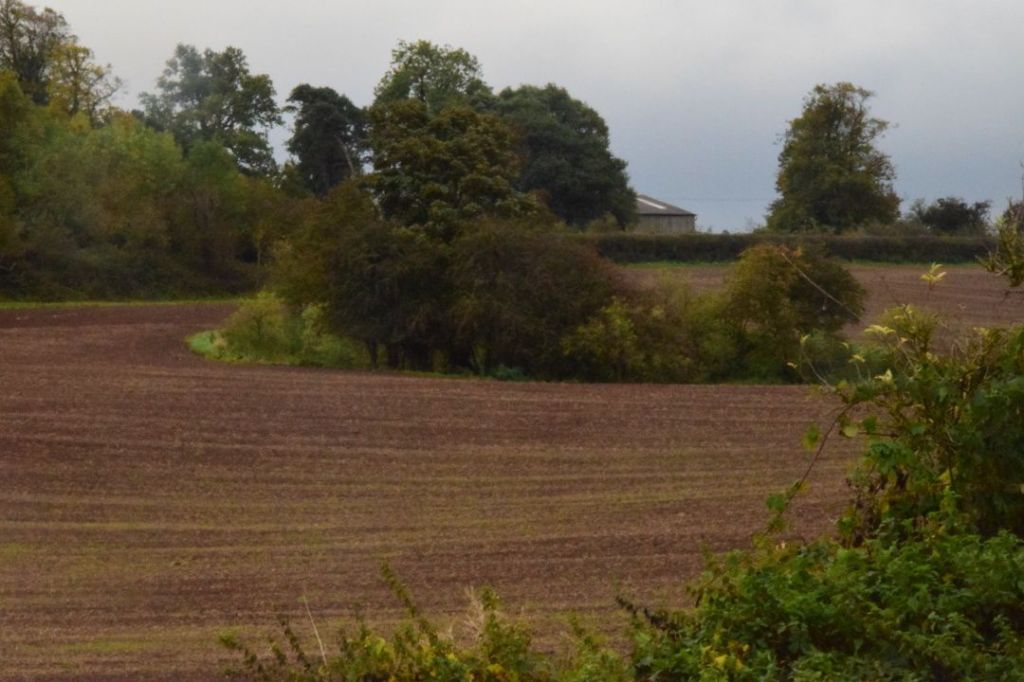
An Island in the ploughing season.

“I am ploughing the soil, cutting off old and unfruitful roots and connections. My church is to be an island in the ploughing season. While turmoil and disruption is going on around My Church, My church will be stable and show My glory when churning and instablity is happening all round. I want My church to stand out be different, not criticizing one another, not criticizing leaders of nations. All this will dim the light of my glory. Instead I want you to be praying for the leaders of the world and publicly praising them for what I am doing through them. For I Have set them in place for such a time as this. For if you do this your ears will be open to My Spirit and to what I am doing. My Glory will shine out to those around you and beyond if you dare to be different and do not conform to what is going on around you.”

Jake saw this “island” in the ploughed field while out on a walk. The Lord spoke to him through it, and he took the photo above. The picture of the church as a place of strength and refuge in the midst of desolation strongly echoes the “tall building” message given through two different people. 2 Corinthians 13:1 tells us that “A matter must be established by the testimony of two or three witnesses.” Here we have one message being confirmed by three witnesses. In other words it’s been underlined three times: we must not ignore what the Holy Spirit is saying to the Church.

“Do not conform to the pattern of this world, but be transformed by the renewing of your mind. Then you will be able to test and approve what God’s will is—his good, pleasing and perfect will” (Romans 12:2)

Our most Powerful Weapon

If we know the New Testament at all, we will know – even if we can’t quote it verbatim –  that “ the weapons of our warfare are not carnal but mighty in God for pulling down strongholds, casting down arguments and every high thing that exalts”, (2 Cor 10: 4-5) What we might not be quite so sure about is what the weapons of our warfare are. Some things are clear: Psalm 149 tells us that the high praises of God in our mouths and the two-edged sword in our hands will bind the enemy kings and nobles “in fetters of iron,” (vs. 6-9) so that gives us some guidance on dealing with the “principalities and powers in heavenly places” that Ephesians 6 vs 12 tells us we are struggling with. The gospels tell us specifically that we will be able to cast out demons by the power of the Holy Spirit. Jesus did this “with a word,” so we should expect, as His disciples with His power and the authority of His name, to be able to do the same. But more often than not, the most intense battles we face are not in situations where we can launch into high praise or begin calling out the demonic: they are in our marriages and families, and those with whom we have the closest relationships.

Jesus tells us explicitly how to deal with conflict in Matthew 5: 39. He famously says “If anyone slaps you on the right cheek, turn to them the other cheek also.” This command has become embedded in Christian doctrine as one that promotes non-violence and non-resistance and a decision to forsake vengeance for the sake of pursuing love for one’s enemy. “The other cheek” is not commonly seen as a “weapon of our warfare…mighty in God for pulling down strongholds.” Yet that is precisely what it is. Jesus didn’t just come to Earth in order to build an alternative Kingdom of love and peace, where we all turn away from violence in the hope that others will see our example and come over to us from the dark side: He came to “destroy the works of the evil one,” so that the strongholds he has built in our lives will crumble, the knit together threads of anger and fear will unravel, and the roots of bitterness exposed and completely pulled out. The other cheek is a weapon “mighty in God” that we turn against the enemy.

Romans 12: 20-21 picks up the theme from the sermon on the Mount, but this time the act of loving one’s enemy is actually defined as an act of warfare: “If your enemy is hungry, feed him; if he is thirsty, give him a drink. For in so doing, you will heap burning coals on his head. Do not be overcome by evil, but overcome evil with good.” We are not called to just ignore evil, but to meet it head-on and overcome it. The burning coals certainly imply shame and remorse, and may also be taken to suggest purification and judgement. But more than these, heaping burning coals on someone’s head strikes me as a powerful and effective act of warfare: that enemy is not going to show his face again.

To bring this back to that “other cheek:” what actually happens when we turn it? Here’s an illustration. Terry and Jean have been married 25 years and are about to celebrate their silver wedding. They both are Christians with leadership roles in church. Terry loves his wife and loves the Lord, but he has a very defensive side to his nature, particularly when accused of something that he either didn’t do, didn’t mean to do, or had a very good reason for doing. So Terry also loves his own reputation, and for 25 years he has run to shore up his reputation when Jean has been hurt by something he has done, rather than simply address the specific problem and ensure that he isn’t going to hurt Jean again. While Terry’s focus is on strengthening his own defensive shell, he is not really thinking about how deeply the wounds run that his bickering comments inflict on his wife. She feels increasingly alone and unloved; he feels increasingly frustrated and misunderstood. A problem arises concerning their silver wedding celebration plans. Jean is hurt and angry; Terry feels unjustly blamed. The enemy is rubbing his hands: can he give Terry another cast-iron reason for justifying himself and pulling down his wife? Can he make Jean feel so despondent about their relationship that she finally gives up, not just on their wedding anniversary but on their marriage itself?

The enemy nudges the argument nicely along the well-worn “You always…!” and “Well, you did…!” tracks. But what’s happening? Terry has walked away and gone into his den to sit down. He has his eyes shut. Danger! Is he praying? And now he is opening his Bible… the demon assigned to prowl around their marriage turns his attention to Jean, but she has put on some worship music, so he won’t be able to sow any negatives into her mind for a while…

Terry is pouring his heart out to the Lord. The Holy Spirit speaks to us in many different ways, but just imagine this as a dialogue between Terry and Jesus:

“Lord, why do I always end up here? Why will she never admit that she is wrong to accuse me of being thoughtless like that, and that I could never have known that they have changed the menu? Nothing I say is ever any good, and it’s always my fault! And it isn’t – in fact it hardly ever is!”

“You’re right, Terry.”

“Sorry, Lord?”

“You’re right. Nothing you say is ever any good. Actually you’ve only got one option.”

“What’s that, Lord?”

“Love your wife.”

“Yes, I do! But…”

“No buts. It’s not about you and what she thinks of you: it’s about the fact that she’s hurting.”

“But it’s like she’s just slapped me in the face!”

“Exactly. So turn the other cheek. This is just one slap. But if you face this slap and are prepared to let her slap you again I’ll tell you what will happen: the barrier of self-defence that you have put up all your life will crumble away, and you will see Jean for who she is and respond to what she is feeling. She will see that you care about her more than you care about yourself, and your marriage will have new life.”

At that moment Terry sees a single shining tear on Jesus’s cheek. Reflected in it are streaks of red; faint reflections of His shed blood, then Jesus disappears. The tear remains, suspended. He sees that tear and that blood shed for him; he sees the dirty footprint trail of self-justification and cries of “it’s not fair!” winding through his life from as far back as he can remember, then the tear falls on the footprints and they all burn up like a fuse and are no more. When Terry goes in to apologise to Jean it isn’t just for tonight’s argument, but for every excuse he has ever made since they first met.

Jesus turned the other cheek at the cross and brought salvation to mankind. The spiritual overcame the carnal forever. When Jesus asks us to do the same it is not in a passive attempt at emulating godly behaviour, but in an active expression of His victorious Spirit that demolished the very stronghold of death itself. When we use this most powerful weapon we can demolish strongholds that bitter arguments have built up over decades. Christian marriages are always in the devil’s sights for some of his most virulent attacks, but Jesus has given us one act that will undo many years of his most careful work.

The Battle and our part in it

I have been asked: “If the battle in the heavenlies is intensifying, what should our response be on earth?“ The following are a few thoughts on certain aspects of the battle and what the nature of our involvement might be.


The American Eagle

We know, from prophetic words that have been given, that battle forces on both sides are arrayed. They are lined up in both heavenly realms and here on Earth. We can see the battle being fought in various locations, but I’d like to think here about the USA in particular. As an Englishman, I won’t have the same perspective as an American citizen, but I do recognise that the founding fathers established America as a land based on the principles of the word of God; and that the liberty which the USA stands for among the nations is ultimately  not just about personal, political and social freedoms, but it’s about the freedom for which Christ has set us free, which is freedom from the law of sin and death.

At the risk of oversimplification, I see the USA as unique in the extent to which the division between Christian and non-Christian agendas has broadly polarised into a choice between two political parties, one of which represents God’s agenda, and the other which represents the world’s. If the symbolism of the American Eagle ultimately points to freedom from sin, the vote is about whether the eagle keeps flying, or if the enemy shoots it down. Legislation already exists in the USA, passed under the Obama administration, that makes it illegal for churches to preach what the Bible tells us about sexuality and “lifestyle choices,” so this is not empty polemic: the pulpit is already being gagged. Already the eagle is not soaring so freely. The political state of the USA and its spiritual state are closely connected, and they affect us in the UK: it’s important that we don’t think of the USA as miles away over the Atlantic, but that we see that the nation is connected to us in the Spirit, and that we need to uphold in our prayers.

Israel
But the battle of the USA is not just about America: it is part of a bigger picture still. Ultimately, the big picture is always about Israel. Trump’s support for Israel is evident, and he has already caused not a little stir, both among the nations and among the principalities and powers in heavenly places, by moving the US embassy to Jerusalem. The Democrats on the other hand align with Palestine, with all that that implies. The enemies of Israel are gathering. Turkey is flexing its muscles, and is establishing control of Libya from afar, with an eye on its oil, of course. President Erdogan is now flying the flag of the ancient Ottoman empire. Squeezed by sanctions, Iran has dropped its own nuclear program but is forming an alliance with North Korea, which hasn’t, as we know. The inflated egos of power-hungry world leaders unwittingly roll out the red carpet to welcome demonic control, while the eye of Mordor is fixed unblinkingly on Israel.

The USA is Israel’s “Big Brother,” the ally they will turn to for support and resources when conflict escalates, so the enemy will do everything he can to minimise that support as he continues his long-running campaign to eliminate Israel. The party he wants in control in the USA is the party that will distance itself from Israel.  Satan has read the scrolls, and he knows that Jesus will be returning to reign from Jerusalem. He cannot eliminate Jesus, so he is trying to eliminate the nation that He is returning to. By praying for the outcome of the USA election in November we are aligning ourselves with the spiritual forces that are blowing the trumpet to herald the return of Christ.


Draining the Swamp
Many prophetic voices in the USA and elsewhere are in agreement that there is a level of sin in certain political circles that is almost too shocking to name, and that God is going to expose it. Some say that this sin goes to the deepest level of Luciferian involvement, with all the nefarious activities that this entails. Some prophetic voices and secular whistleblowers have started to reveal similar things: names involved in the Epstein and “pizzagate“ scandals are floating to the surface like scum. Clandestine handshakes have been revealed prophetically in recent months, and now deals worth billions of dollars between individuals in the highest political circles and America’s enemies are being exposed. Things that have been seen in the Spirit are starting to happen in the flesh.

Donald Trump came to power promising to “drain the Washington swamp.“ Many people say that this isn’t happening because the imbalances in American society haven’t changed and the revolving door into the White House of collusion and kickbacks doesn’t seem to have slowed down. But I think people are looking at the wrong swamp. I think Trump was speaking prophetically without knowing it: through his administration, upheld by the prayers of the saints, God will drain a far deeper and darker swamp than many people know exists. It is for the exposing of that level of corruption that we must be praying. And if God is exposing corruption and sin, we have to be squeaky-clean ourselves, ensuring that we keep short accounts with God and one another so that “the blood of Jesus cleanses us from all sin.”

What’s our part in this?
I felt the Lord gave me two specific verses when I was asking Him about how to pray. They were Isaiah 30:31-32:

For through the voice of the LORD
Assyria will be beaten down,
As He strikes with the rod.
And in every place where the staff of punishment passes,
Which the LORD lays on him,
It will be with tambourines and harps;
And in battles of brandishing He will fight with it.

There are five things here.

  1. The voice of the Lord. God’s voice is heard through His prophets. As His word goes out in power the enemy forces will be weakened. I see this happening in the heavenly realms, but on earth as well as the deeds of darkness are exposed by words of truth.
  2. The “Staff of punishment” will fall on prominent individuals as they are brought to justice. The word translated as “staff” is the same as used for the rod of Moses: it is the rod of authority.
  3. Praise. God’s move is accompanied by “tambourines and harps”. Psalm 149: 6-7 comes to mind: “Let the high praises of God be in their mouth,
    And a two-edged sword in their hand
    To execute vengeance on the nations,
    And punishments on the peoples.”

    The word of God – the two-edged sword- goes out, God executes judgement, and we praise the glory of His name. This is a part that we play, and it is essential to the battle.
  4. Battles of Brandishing. Central to our victory is of course the Cross. The word “brandishing” is the same as the word used for “wave offerings.” It is a word associated with sacrifice. Part of our warfare is to declare and “brandish” the supremacy of the sacrifice of Jesus over anything that might be sacrificed to the “gods” of the enemy. The forms of things and the battlefields may change, but the spiritual realities are still the same: we have the Ark of the Covenant, and just as in the days of Jehoshaphat we are still the tribe of Judah leading the battle and singing “God is good, and His mercy endures forever.”
  5. The Assyrians. According to the revelations given to Pastor Dana Coverstone, the most violent persecution of the church is going to come from within the wider church family; from “lukewarm” churchgoers who accept lifestyle compromises and therefore reject the full gospel of Christ. Their Christianity is mixed with humanism and is not centred firmly on the teachings of Scripture, and fulfills 2 Tim 3 vs 1-5: “in the last days perilous times will come. For men will be lovers of themselves, lovers of money, boasters, proud, blasphemers, disobedient to parents, unthankful, unholy, unloving, unforgiving, slanderers, without self-control, brutal, despisers of good, traitors, headstrong, haughty, lovers of pleasure rather than lovers of God, having a form of godliness but denying its power. And from such people turn away!”

With this scripture in mind, we turn now to the story of Ezra, where we find these verses: “When the adversaries of Judah and Benjamin heard that the descendants of the captivity were building the temple of the LORD God of Israel, they came to Zerubbabel and the heads of the fathers’ houses, and said to them, “Let us build with you, for we seek your God as you do; and we have sacrificed to Him since the days of Esarhaddon king of Assyria, who brought us here.” (Ezra 4:1-2)

The foundation of the new temple had been laid, just as our foundation has been laid in Christ. Those who resisted building were already inhabiting the land, and claimed to worship God, but their worship of him was just one element of their pagan mix. They had a form of godliness, but denied its power. Long before Paul and Timothy, the leaders of the people turned away from them:

But Zerubbabel and Jeshua and the rest of the heads of the fathers’ houses of Israel said to them, “You may do nothing with us to build a house for our God; but we alone will build to the LORD God of Israel, as King Cyrus the king of Persia has commanded us.” (Verse 3)

The chapter continues the account of how “the people of the land tried to discourage the people of Judah,” and we know the eventual outcome. What is especially interesting for us in these days is that the people already dwelling in the land who resisted the building of the Temple came originally from Assyria, and it was “the King of Assyria” who took them there.

Parallels with the West
I think the parallels with the church in the West, and particularly in the USA, are striking. The temple of worship “in Spirit and in Truth”, including the truth that Scripture declares about marriage, sexuality and related “lifestyle choices,” has fallen into ruin. God has commissioned and sent His servants to set about the rebuilding programme, but it is resisted, and will be even more so, by “the people of the land:” those who claim to share the same faith but who reject biblical, evangelical Christianity as narrow-minded and extreme, and whose hearts are in reality far from God. I believe that these are today’s “Assyrians.” But they will be vanquished, and the Temple will be rebuilt.

So there is a battle in the Heavenlies, and it’s played out on Earth. It is God who wields the sword, and God who destroys. We play our part by accompanying the battle with our praise and by interceding for church leaders, that they remain true to the gospel and resist the discouragement and the schemes of “the people of the land.” We need to pray for the prophets who are the mouthpiece of “The voice of the Lord.” We need to pray for Attorney-General William Barr, who plays a key part in the battle as the one who holds that “staff of punishment” referred to above, and who has the actual power to bring indictments against individuals. We participate in the “battles of brandishing” by proclaiming the great sacrifice of the Cross and the name of Jesus, that is “above every other name that is named.” If you pray in tongues use the gift as much as we can, and if you find a “warfare” tongue comes to you, keep praying that way until the Holy Spirit takes that particular anointing off you. You will know. This probably won’t be in Church meetings (see 1 Cor 14 guidelines) but when you are on your own. I believe that this is part of the “brandishing” as well.

And more than ever in these times, we keep our hearts pure and soft and our hands clean. We seek our God in repentance for the sin in our own lives, in our churches and in our nations. We seek the Unity of the Spirit above every doctrinal difference. The trumpet is sounding. Let’s arise.

Faith: the Frame.

By faith we understand that the worlds were framed by the word of God, so that the things which are seen were not made of things which are visible. (Heb 11:3)

This morning I saw a hearse coming towards me on the road with a long queue of cars behind it. I was glad I was driving in the opposite direction. Then, very briefly, I saw the number-pate: on it were my initials. My first thought – because the flesh tends to butt in before the spirit – was: “That’s you, Bob! Could that be an omen?” But then the Spirit spoke to me with the truth: “You are already dead, Bob. You were crucified with Christ. It is not you who live, but Christ who lives in you!” So by the time the line of cars had passed, I was thinking: “Halleluia! I’m dead to my flesh, and alive in Christ!” This is what the Word of God says; it’s what my experience of the Holy Spirit confirms every day; and it’s what my heart believes even if my head is assailed by doubts. It is the confession of my faith. Faith is the frame that holds the entire bicycle together.

By faith we understand… that the things which are seen were not made of things which are visible. Hebrews 11:1 tell us “Now faith is the substance of things hoped for, the evidence of things not seen.” Faith is a substance. Whether we believe this or not is our choice. But if we can allow the substance of faith to become a reality in our hearts we can look into it and see that which our brains cannot fathom. “The Just shall live by faith” was the revelation given to Martin Luther and is the central plank of the Protestant reformation. The scripture occurs three times in the New Testament (Romans 1:17,Galatians 3:11,Hebrews 10:38), and these in turn refer back to Habakkuk 2: 4: “Behold the proud, His soul is not upright in him; But the just shall live by his faith.” So what do we see when we look into the substance of faith?

Faith is so much an idea that our minds can grasp, as the very substance of a dimension that our spirits walk in. If I go out into my garden I walk on grass. If my spirit enters the Heavenlies I walk in faith.  It is where Truth is defined by the Word of God and not by the word of science, and where Life is defined not by the ageing and wearing out of the body, but by its resurrection. In this dimension, we see the rule of Heaven established on Earth:

“Behold, a king will reign in righteousness,
And princes will rule with justice.
A man will be as a hiding place from the wind,
And a cover from the tempest,
As rivers of water in a dry place,
As the shadow of a great rock in a weary land.
The eyes of those who see will not be dim,
And the ears of those who hear will listen.
Also the heart of the rash will understand knowledge,
And the tongue of the stammerers will be ready to speak plainly.

(Isaiah 32: 1-4)

We see the King of righteousness Himself

The Spirit of the LORD shall rest upon Him,
The Spirit of wisdom and understanding,
The Spirit of counsel and might,
The Spirit of knowledge and of the fear of the LORD.
His delight is in the fear of the LORD,
And He shall not judge by the sight of His eyes,
Nor decide by the hearing of His ears;
But with righteousness He shall judge the poor,
And decide with equity for the meek of the earth;
He shall strike the earth with the rod of His mouth,
And with the breath of His lips He shall slay the wicked.
Righteousness shall be the belt of His loins,
And faithfulness the belt of His waist.
(Isaiah 11: 2-5)

And in this dimension of faith, as “the earnest expectation of the creation eagerly waits for the revealing of the sons of God.” (Romans 8:19), we see the redeemed, sin-free world that creation is earnestly expecting:

The wolf also shall dwell with the lamb,
The leopard shall lie down with the young goat,
The calf and the young lion and the fatling together;
And a little child shall lead them.

The cow and the bear shall graze;
Their young ones shall lie down together;
And the lion shall eat straw like the ox.

The nursing child shall play by the cobra’s hole,
And the weaned child shall put his hand in the viper’s den.

They shall not hurt nor destroy in all My holy mountain,
For the earth shall be full of the knowledge of the LORD
As the waters cover the sea.
  (Isaiah 11: 6-9)

I make no apology for quoting these scriptures at length, as I believe they are among the most beautiful verses in the entire Bible. They describe the society and the landscape of the Mountain of God where our bike ride is taking us. And this place is real: its substance is faith. If we can allow our spirits to walk there we will find that our own judgements won’t be “by the sight of our eyes or by the hearing of our ears” either, but they will come to us by the spirit of the King of the Mountain who dwells within us.

Free of the curse of sin, beyond the reach of the devil, and untrammelled by the limitations of the world and the flesh, the substance of faith determines the abundance of God’s supply, whether this is of provision, healing, spiritual gifts or any other blessing. Ephesians 1:3 says “Blessed be the God and Father of our Lord Jesus Christ, who has blessed us with every spiritual blessing in the heavenly places in Christ.” Every spiritual blessing has already been given to us in heavenly places. They are a reality. Their substance is faith. When we read about them in the Word of God we are reading the Maker’s handbook on all the resources that we have in our personal cupboards of His provision in Heavenly Places.

Jesus tells us “ whatever things you ask when you pray, believe that you receive them, and you will have them.(Mark 11:24) Our English word “receive” has a fairly passive connotation: there is a sense of holding out one’s hands for something to be placed into them. The Greek word, lambanō, that is used here, is far more active. Here are the primary definitions. They are all involve actively taking hold of rather than passively receiving:

  1. to take with the hand, lay hold of, any person or thing in order to use it
    1. to take up a thing to be carried
    1. to take upon one’s self
  2. to take in order to carry away
    1. without the notion of violence, i,e to remove, take away
  3. to take what is one’s own, to take to one’s self, to make one’s own
    1. to claim, procure, for one’s self

Jesus is telling us to take hold of those things that we ask for, believing that they already exist – which they do, made of the substance of faith. He is telling us to reach into our heavenly “provisions cupboard” and take hold of that spiritual blessing which the Father has provided. I remember a healing meeting with Ian Andrews in the late 1980s. If I remember correctly, he said that God had showed him a warehouse full of all the body parts that exist, and when he prayed for healing he just reached into the warehouse and took hold of a new part to replace the one that was malfunctioning. He believed he received, and he had what he prayed for. On Earth as it is in Heaven: what was made of the substance of faith in the heavenly realms became flesh and blood on Earth.

Of course, that is easier to write than to do. If you’re anything like me, most of us blunder around and get hold of something occasionally; but as John Wimber discovered the more we blunder the more chance we have of actually taking hold of what God has provided. I’m sure Ian Andrews did  a lot of blundering, and probably still does some! And of course we are always in a battle: God may have provided; we might be reaching out into the right place, but the devil is standing in front of the cupboard. Sometimes we have to fight for what we’re reaching for, and keep praying until we know in the Spirit that the battle is won.  Proverbs 23: 12 says “Apply your heart to instruction, And your ears to words of knowledge.”  The word of knowledge is really helpful in enabling us to take hold of the substance of faith, so if you are praying for people ask the Holy Spirit for that gift – and take hold of it! I have seen a small number of miraculous healings when I have prayed for people, including a broken toe being instantly mended and a deaf ear being opened; and they have always followed a word of knowledge.

This is one of my pet topics, and I could keep writing – but you might not keep reading. The frame of faith touches every part of the bike – the wheels, the handlebars, the brakes, the saddle, the pedals. If we can understand that faith is a substance and that we do not have to ask God for what He has already given but learn to take hold of it instead of just holding out our hands; and if we can really believe in our hearts that the Word of God is all true and is describing a dimension that our spirits have access to, then I believe we will progress further and faster in our discipleship as we walk – or cycle – after the spirit and not after the flesh.

Bob Hext Sept 2020

The Chain: Linked to the Body

“”I in them, and You in Me; that they may be made perfect in one, and that the world may know that You have sent Me, and have loved them as You have loved Me.” (John 17:23)

The focus of Jesus’s ministry was always to glorify the Father, and to demonstrate that He was the Son whom the Father had sent, because He loved it so much, to bring eternal life to all who accepted Him. His master plan – His only plan – was to build His church to destroy the works of the enemy and reveal the love of the Father that He poured out into the hearts of His children by the power of the Holy Spirit. The church is the chain that makes the wheels of the bike go round: unless we are linked in with other believers our discipleship is not going to progress.

Paul prays: “that Christ may dwell in your hearts through faith; that you, being rooted and grounded in love, may be able to comprehend with all the saints what is the width and length and depth and height— to know the love of Christ which passes knowledge; that you may be filled with all the fullness of God.” (Eph 3: 15-17) The pre-requisite to knowing the love of Christ and being filed with all the fullness of God is being “rooted and grounded in love.” The arena in which we fulfll the command to love one another and keep pedalling forward (as I wrote earlier in this series) is the local church, where Jesus is Lord, the Father is glorified, and the life of the Holy Spirit flows; where believers pray for one another, serve one another, minister to one and other and are accountable to one another.

If there were a  prize for the most-quoted verse of scripture, Matthew 18:20 would probably be in contention for runner -up: (the winner, of course, being John 3:16.) “Where two or three are gathered in my name, there am I in the midst of them.” Jesus “in the midst” is the essence of church. I think if we all took discipleship a lot more seriously Jesus would probably be a lot more evident in the midst than He often is, but that’s not for this chapter. I think what is important here is for us always for us to remember where we are headed as we cycle up the mountain:

“In Him we have redemption through His blood, the forgiveness of sins, according to the riches of His grace which He made to abound toward us in all wisdom and prudence, having made known to us the mystery of His will, according to His good pleasure which He purposed in Himself, that in the dispensation of the fullness of the times He might gather together in one all things in Christ, both which are in heaven and which are on earth—in Him.” (Eph 1: 7-10)

God is gathering us together in Christ, and His vehicle is the church. “He put all things under His feet, and gave Him to be head over all things to the church, which is His body, the fullness of Him who fills all in all.” (Eph 1:22-23) This is the goal of our discipleship, and it’s why we cannot follow Jesus on our own. It’s why Jesus prayed “May they all be one as you and I are one” (John 17:21). And it’s why we cannot  be walking in the Spirit if we “bite and devour one another” (Galatians 5:15)

Because the heart of God breaks at division in His church. Revival will sweep the nations when brothers and sisters in Christ set aside petty doctrinal and stylistic differences and gather round the standard of our Saviour to destroy the works of the devil in His name. But when one ministry denounces or criticises another, they are allowing those very works of the devil into their own ranks. For what is more important: what we think we know about what God thinks, or whether we obey His commandment to love one another? Whether we criticise and condemn one another, or whether we  are “kind to one another, tenderhearted, forgiving one another, even as God in Christ forgave you?” (Ephesians 4:32)

The Lord needs His chain to be well-oiled. Jesus is always there, ready to pour the oil of the Holy Spirit onto each one of His links.  We need to be connected to one another with links that are supple and yielding. Without the oil of His anointing we become rusty and rigid, set in our ways, insensitive to one another and out of touch with the three cogs on the crankshaft – the  Father, the Son and the Holy Spirit. It is for each one of us to keep seeking the Lord so that we remain well-oiled individually in order for the corporate chain of the life of the Body to function smoothly. Again, as I wrote above, it is not for one link to assess whether another is functioning as it should, or even whether or not it should be there. We are nothing on our own: it is only through our connections to those three cogs and to one another that we have purpose. Paul writes this to the Galatians:

“If anyone thinks himself to be something, when he is nothing, he deceives himself. But let each one examine his own work, and then he will have rejoicing in himself alone, and not in another. For each one shall bear his own load.” (Gal 6: 3-5)

Jesus says to the church at Sardis: “I know your works, that you have a name that you are alive, but you are dead. “Be watchful, and strengthen the things which remain, that are ready to die, for I have not found your works perfect before God.” (Rev 3: 1-2). The “things that remain” are Faith, Hope, and Love, and the greatest of these is Love. (1 Cor 13:13). These three are the gold, silver, and precious stones that remain from our works after the wood, hay and stubble have been consumed in the fire. (1 Cor 3:12) We are alive in Christ to the degree that we are linked to one another in Love, and the body of these connections is the Church of Christ. To be disciples we must be in the chain, and we must be vigilant to overcome any thoughts and attitudes that would tempt us to break our connections.

Hold on at all times: the handlebars

“Giving all diligence, add to your faith virtue, to virtue knowledge, to knowledge self-control, to self-control perseverance, to perseverance godliness, to godliness brotherly kindness, and to brotherly kindness love.” (2 Peter 1: 5-7)

We have all seen cyclists – usually young men or boys – cycle along without holding the handlebars. I remember when I was a boy and first learnt the skill. I also remember that, as a rule, it was only a skill I employed when I knew other people were watching…  But there are two circumstances that every cyclist riding “no hands” has in common: this particular skill can only be accomplished on as smooth terrain, generally a road or another paved surface; and it is not something that can realistically be attempted when cycling uphill. As Christians, we have left the paved surface of the road, and are heading up the mountain on a dirt track. If there is one thing we need to do, it is to keep hold of the handlebars.

There are many exhortations in the New Testament, whether from Jesus, Paul or any of the other writers, to persevere in our faith. Perhaps the most frequently quoted is from Pauls’ letter to the Philippians:

“Brethren, I do not count myself to have apprehended; but one thing I do, forgetting those things which are behind and reaching forward to those things which are ahead, I press toward the goal for the prize of the upward call of God in Christ Jesus.” (Phil 3: 13-14)

The word translated as “diligence” in the introductory passage is spoude, which means earnestness, eagerness, being full-on, not just in the desire to accomplish something but in the energy and persistence applied to carrying it out. Elsewhere Peter writes be diligent to be found by Him in peace, without spot and blameless.” (2 Pe 3:14) Paul exhorts Timothy to be diligent in pursuing godliness “so that (his) progress may be seen by all,” (1 Tim 4:15), and to the Galatians he writes “And let us not grow weary of doing good, for in due season we will reap, if we do not give up.” (Gal 6:9). References to being committed and wholehearted are set like precious stones throughout Proverbs. The rewards held out by the Lord to the seven churches in the Book of Revelation are all for those who “endure.” And these references only scratch the surface of what is a very deep-veined theme running through the whole of Scripture. Diligence is the name written on our handlebars: if we don’t hold on, we will fall off.

At this point there might appear to be a tension between the fundamental truth that we are saved by Grace (the Cross of Christ) and not by works (staying on the bike) However there isn’t one. The bike itself is a gift from God. The desire to ride it and to stay on is a gift from God, just as faith itself is a gift from God (Eph. 2:8; 2 Peter 1:1). And Psalm 37:24 tells us: “Though he fall, he shall not be utterly cast down: for the Lord upholds him with His hand,” so even our ability to stay on the bike is by the Grace of God. The very words that are given to us by the Holy Spirit encouraging us to be diligent and to endure also give us the desire and the ability to carry them out. I think it can reasonably be said that those who to fall away are the ones who never really got on the bike in the first place – who confessed with their mouths that Jesus Christ is Lord, but never really believed it in their hearts. (Romans 10: 9) So if you, like me, are picking your bike off the ground and getting on again for the fiftieth time this week, don’t beat yourself up over it and call yourself a failure. The good news is, you never were a success in the first place! All of that glory belongs to the Lord. The fact that you are getting on your bike again is proof that you are, by the grace of God, being diligent.

So, holding onto the handlebars, we press on towards the goal of the upward call of God in Christ Jesus. We carry on pedalling along the mountain track. Sometimes there are downhill stretches and easier sections, but the call is upward and the overall direction of the track is always to take us ultimately “further up and further in,” as Aslan says in the final book of the Chronicles of Narnia. And this leads us to the other essential function of the handelbars: they are what gives the bike direction. We don’t just hold on “with all diligence” in order to stay on the bike; we hold on to stay on the path. And we always look forward: looking back brings disaster. With our eyes fixed on Jesus, the Author and Finisher of our faith, we steer along His track to  the top of the mountain.

Being born again isn’t about boarding a train in this life and stepping onto Heaven’s platform in the next one: it’s about the slow process of growing to maturity in Christ as we consistently reveal to the watching world that He is the one who is keeping us on track. The higher up and further in we go, the closer to Him we get and the more like Him we become, so that “Many peoples will come and say, “Come, let us go up to the mountain of the LORD, to the temple of the God of Jacob. He will teach us his ways, so that we may walk in his paths.” (Isaiah 2:3)

The Mountain of God is the Mountain of His presence, where Love rules and His Glory dwells. It’s where He met with Moses and gave the Old Covenant to His people, and it’s where He meets with us to lead us forward by His Spirit today. There is one simple test that will tell us if we are on our bikes or completely off track, and it’s the question I referred to in the chapter on the pedals: are we learning to love? Jesus has individualised lessons for each one of us, and they will all be somewhere along the route that Peter maps out in the scripture that opens this section. But learn them we must if we are to progress up the mountain, because

They shall not hurt nor destroy in all my holy mountain: for the earth shall be full of the knowledge of the LORD, as the waters cover the sea. (Isaiah 11:9)

This is where our direction must be set. We can keep moving, with both wheels on the ground, our feet on the pedals and our hands close to the brakes, gripping the handlebars tightly. But whenever we hurt or destroy we’ve lost our way.

Blowing the Trumpet

Beginning on Sept 18th and ending on Sept 20th, the Jewish Feast of Trumpets, or Rosh Hashanah, heralds the Jewish New Year and commemorates the sounding of the first trumpet, when the Law was given to Israel and they became God’s covenant people. Following the feast of trumpets are eight “Days of Awe,” during which time Jewish people prepare themselves, through prayer and repentance, for Yom Kippur, the Day of Atonement, when the shofar is blown again. Rosh Hashanah and Yom Kippur are the only two Jewish festivals when the shofar is blown ceremonially.

In the second vision of “The Battle Belongs to the Lord” Jacob Dominy prophesies that “The roar of the Lion is near and the blast of the shofar trumpet is about to be heard.” I posted that yesterday evening, and decided then to publish as a download the chapter in “Wheat in the Winepress” entitled “Blowing the Trumpet,” as it is relevant to what the Holy Spirit seems to be saying at the moment. Shortly afterwards I was drawn to pick up a messianic newsletter that we receive. When I opened it, I found that most of the content was about these two forthcoming festivals when the shofar is blown. Not knowing the Jewish festival calendar as well as I could (or should), I was unaware of these forthcoming dates until then, so when I saw them I felt the Lord was making a connection between the festivals and what I had just published.

Yom Kippur, the Day of Atonement, is over the 24 hours from 27-28th September. If Jake’s visions were from the Lord, and I believe that they were as they are very much in keeping with what the Holy Spirit is saying through other prophetic voices at the moment, the shofar is about to be sounded in the heavenlies and the Lord’s army will be going into battle. On Earth as it in Heaven: what more strategic moment could there be than the day when the sound of the shofar reminds Christians and Jews alike of God’s wonderful provision of atonement for His people? What better moment for the commander of Heaven’s armies to launch His attack on the enemy than the commemoration of the Victory that He has already won?

I am not saying for certain that I have heard from God on this, but I think I may have done. If the battle really is about to intensify, (and even if it isn’t!) we need to make sure that we are right with God to avoid being a target for the enemy. I can think of no better time than to stand with the Jewish people as they prepare themselves for the Day of Atonement.

To download Blowing the Trumpet, click the title link here or go to the Free Downloads section.