Category Archives: Christian Life

Seeking God’s presence and walking in His ways as a Spirit-filled believer.

Bread from Heaven: 3

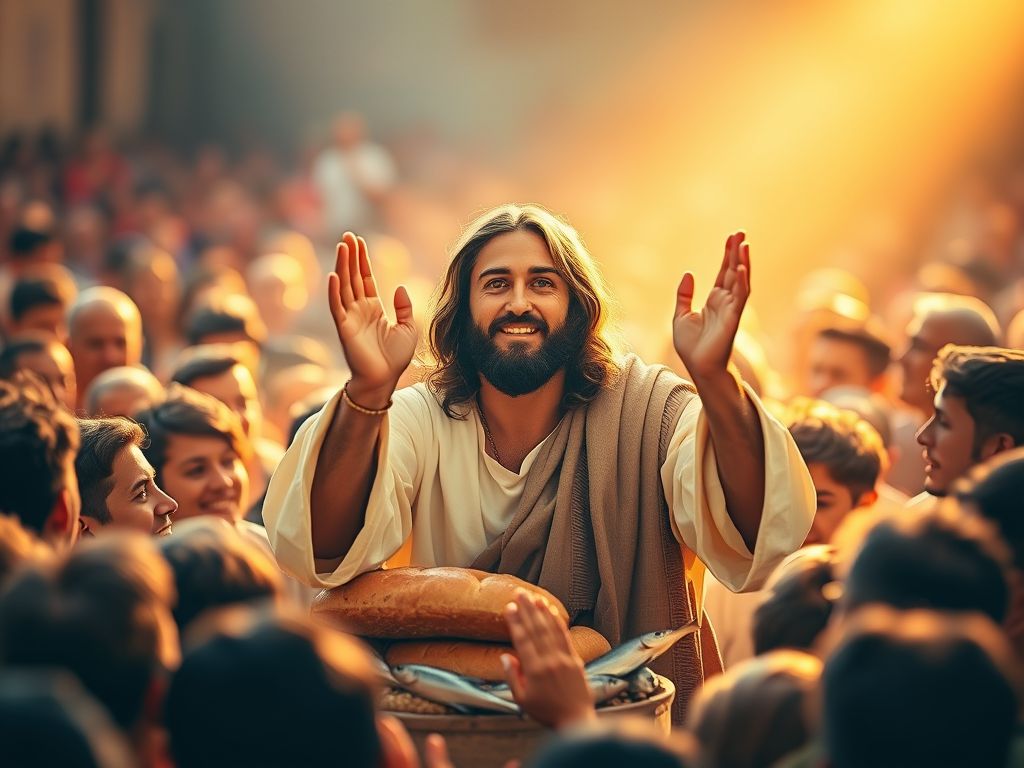
And Jesus took the loaves, and when He had given thanks He distributed them to the disciples, and the disciples to those sitting down; and likewise of the fish, as much as they wanted. (John 6:11)

He knew what He would do
In our attempts to bring up our children to say “please,” the parents among us might well have said at times: “And what’s the magic word?” However in the Kingdom it’s not please, it’s thank you. Jesus didn’t ask the Father to multiply the loaves and fishes; he thanked Him for them. This miracle, along with its “twin“ where the 4000 are fed in the accounts of Matthew and Mark, is one of only three occasions in the New Testament where Jesus gives thanks to the Father. The Greek word used for giving thanks is eucharisteo, and Jesus uses it when He feeds the multitude, when He thanks His Father for always hearing His prayers at the raising of Lazarus, and at the last supper, when He gave thanks for the bread and wine.

Eucharisteo: We use the same Greek word ourselves when we remember the cross at the Eucharist, and for me, this is the key to understanding much of the significance of this miracle. Andrew looked at the loaves and fishes with eyes of flesh and asked: “What is this among so many?”, but Jesus looked with the eyes of the spirit and saw the riches in glory that would meet the need of the multitude above all that the disciples could ask or imagine. He could see the limitless creative powers of heaven, and He knew that “all that the father has is mine,” (John 16:15) so it is no surprise that John’s account of the miracle tells us that “He himself knew what He would do.” (John 6:6)

In everything give thanks
In his letter to the Philippians, Paul exhorts us to “be anxious for nothing, but in everything, by prayer and supplication, with thanksgiving, make your requests known to God.“ (Philippians 4:6) We know that Jesus had direct access to the Father’s provision because of who He was, and there are no barriers to our faith in that regard. But it is much harder to believe that we have the same access to that provision, because we know who we are as well. We can, and do, believe that Christ dwells in our hearts through faith, that in Him we are seated in heavenly places, and that all things are possible through Him; but we also know that we have only experienced the boy’s family picnic when faced with a multitude, and not the feast.

When Jesus gave thanks at the feeding of the 5000, I don’t think He was thanking His Father for the loaves and fishes in His hand, but for the provision that was in heaven. Demonstrating what He told His disciples in Mark 11:24, He believed He had received it, gave thanks for it, and it was done for Him. His Father passed the food to Jesus, and He passed it to the disciples to give out.

God wants us to give thanks in everything. Whether we are faced with abundance or lack, and whether or not we are petitioning heaven for something, we are to be thankful at all times. Paul expresses this sentiment in his letter to the Romans:

“… He who eats, eats to the Lord, for he gives God thanks; and He who does not eat, to the Lord he does not eat, and gives God thanks. For none of us lives to himself, and none of us die himself. So if we live, we live to the Lord; and if we die, we die to the Lord. Therefore, whether we live or die, we are the Lord’s.” (Romans 14:6–8).

Our Inheritance
As I have mentioned, the only occasion outside of feeding the multitudes and giving thanks for the bread and the wine at the last supper, was when Jesus thanked the Father for hearing Him at the raising of Lazarus. His Eucharist there was more about His relationship with the Father than what He was about to do. Our constant thanksgiving to God is not for what we do or don’t eat – or do, or receive -, but it’s for a relationship with Him which we can indeed be thankful for in all things. We can be thankful to Jesus every moment of the day for the fact that we are His, and what we have is His. But more than that, amazingly, what He has is also ours:

“And if you are Christ’s, then you are Abraham‘s seed, and heirs according to the promise.”(Galatians 3:19)

“And because you are sons God has sent forth the spirit of His son into your hearts, crying out, “Abba, Father!“ Therefore you are no longer a slave but a son, and if a son than an heir of God through Christ.” (Galatians 4:6–7)

We are heirs of God through Christ. We have an inheritance to be forever thankful for. Just as everything that the Father has belongs to Jesus, everything that Jesus has is ours in Him. Of course this does not mean that my neighbour’s house, or wife, or goods belong to me because they are His: the key phrase is “in Him.” “In Jesus name” is not just a phrase that turns a request into a prayer, but it’s the declaration that what we are asking for in prayer is something that we are requesting on His behalf because He has told us that He wants us to have it, whether it’s to accomplish His Kingdom purposes through us or for us. Whatever we are doing, we have an inheritance to be thankful for, and which is at our disposal all the time we are walking alongside Him. What is His is ours. If I am sitting at the dinner table with my wife and I ask her to pass the salt, she is not going to question my action: the salt on the table is a shared possession. Of course she is going to let me have it.

Paul makes this clear in his first letter to the Corinthians:

“Therefore let no one boast in men. For all things are yours. Whether Paul or Apollos or Cephas, or the world, or life, or death, or things present, or things to come – all are yours. And you are Christ’s, and Christ is God’s.” (1 Corinthians 3:21-23)

Just as Jesus is the transition from earth to heaven for our spirits, He is also the transition for us from heaven to earth for our inheritance. So whatever the loaves and fishes or the starving crowd may represent, what do we have available to meet the need? Jesus can make our lack into His abundance if we remember to thank Him for our inheritance. Pass the salt, please, Lord. Thank You.

The name of the Lord is a strong tower.

The name of the Lord is a strong tower; the righteous run into it and are safe.” (Proverbs 18:10)

I am not someone who likes to do “actions“ with songs in church, and this proverb is the chorus of a song (“Blessed be the name of the Lord“ by Clinton Utterbach) that is often used (in the UK at least) to get a congregation – particularly children – engaged in praise. Personally, I like to think about the words as I’m singing them, and I can’t do that if I’m running on the spot and waving my arms about, but I guess that’s just me. And there’s actually some great stuff to think about here.

The lyrics of the chorus are slightly different from the proverb. The lyrics are “the righteous run into it and they are saved,“ but the proverb tells us that the righteous run into it and are safe. It’s the word “safe” that struck me when I looked it up. It doesn’t just mean in a place of safety, nor is it specifically just “rescued.” The Hebrew word śāḡaḇ means “too high for capture.” The place of safety isn’t created by the walls, but by the elevation. The person who runs into this strong tower is lifted to a place that is inaccessible to the enemy. And if we know Ephesians 2:6 we know that the place where we have been raised up to is together with Christ in heavenly places. When we are raised up in the spirit, we are inaccessible to the enemy.

I have also just been reading the prayer of Jabez, which is in 1 Chronicles 4:10. He prayed “Oh that you would bless me indeed, and enlarge my territory, that your hand would be with me, and that you would keep me from evil, that I may not cause pain!“ When we pray the Lord‘s prayer, we also ask Him to deliver us from evil. I don’t know about you, but I’ve always thought of this in terms of keeping me safe so that evil things don’t happen to me. Jabez isn’t praying selfishly here: he turns it round to say “keep me safe from evil so that I don’t bring it upon anybody else.” If we bring this reflection to our safety in the name of the Lord, we get an added dimension to the proverb: when we run to the place of safety, the people around us are also protected from any pain that the enemy would seek to cause through us.

So how do we run into the name of the Lord? As I have said elsewhere, (and not just me of course!) to be “in the name” of Jesus isn’t just about a position of faith, but it’s about where we are putting our feet in actuality. The name of the Lord isn’t just what we call him, but it’s who He is, and to be in His name we have to be true to Him. If we have spent the day following our own selfish desires we can hardly expect to pray “in the name of Jesus” at the end of it, because we haven’t been in His strong tower; we have walked after the flesh and not after the spirit, by sight and not by faith. It’s the righteous who run into the strong tower: righteousness is only ours by faith, and “all that is not of faith is sin.” (Romans 14:23).

So when we are walking by faith we are lifted into the heavenly tower of the name of Jesus, out of reach of the enemy who has no access to our spirits, and a blessing, not a danger, to those around us.  Where are you today? Are you up in His strong tower? If not, start running, before anybody gets hurt.

I Will Build My Church

The Kingdom Of God is not a matter of eating and drinking, but of righteousness peace and joy in the Holy Spirit (Romans 14:17)

I woke up this morning singing a song we had in church on Sunday:
“Father let Your kingdom come,
Father let Your will be done,
On earth as in heaven,
Right here in my heart.“

It is, of course, one of several settings to music of the Lord’s prayer, and it’s one of my favourites. But it’s got me thinking about the Kingdom Of God (never a bad thing) and how we perceive it. In particular, I’m thinking about our experience of the Kingdom In our church situations, and the relationship between the two. If you are feeling at all disappointed in, critical of, or hurt by what’s going on in your church at the moment, then this is for you. That probably means all of us at some time or another.

We can all get lost in our own imaginings of what the Kingdom Of God is like in heaven, but what do we know about the Kingdom Of God on earth? We know it is within us, we know that it’s eternal, we know it’s wherever we see the rule and reign of the Lord Jesus manifested, and we know it’s “righteousness peace and joy in the Holy Spirit.” if we think about the rule and reign of Jesus in the light of John 10:10, we know that the kingdom is manifested when we see the works of the enemy destroyed and life in abundance established. And if we think of the heart’s desire of the King himself, we have to land on John 17:21 and His prayer in Gethsemane that “That they all shall be one, just as you, my Father, are in me, and I am in you, so that they also shall be one in us.”

Paul is clear about the ultimate purpose of the church and how to attain it in Ephesians 4: 15-16, which is that “speaking the truth in love, (we) may grow up in all things into Him who is the head—Christ— from whom the whole body, joined and knit together by what every joint supplies, according to the effective working by which every part does its share, causes growth of the body for the edifying of itself in love.” When the body of Christ has attained this goal we will have become the answer to the Lord’s prayer in Gethsemane and to the Lord’s prayer that He gave us on the Mount of Olives: His kingdom will have come on earth.

Unfortunately, it can seem at times that some people in our churches are either writing chapter 7 of Ephesians, or have never read the epistle at all. The Holy Spirit reminds us in Isaiah 26:3 that “You will keep him in perfect peace whose mind is stayed on you, because he trusts in You.” To live in the good of this verse, we need to remember Matthew 6:33: “seek first the kingdom of God and His righteousness,” whether we are finding it in church or not. Ephesians 4:3 tells us that we find the unity of the spirit in the bond of peace, so if we have peace in our hearts about our bonds with other members of the church, we know that we have done our part to maintain the unity of the spirit with them, and our hearts are prepared for the rule of the Kingdom of God.

The Ecclesia
Jesus is building His church in truth and love, because truth and love are who He is, and the church is His body on earth. My Church isn’t, but His church is. Where there is truth and love in the assembly of the saints we find His body, and when we are in truth and love we are part of it, whether we are in my church, your church, their church, or someone’s church on the other side of the world. Jesus said I will build My church, not My churches. Paul says we are one body, not many bodies (1 Cor 10:17), and that we are being “built together as a dwelling place of God in the Spirit.” (Ephesians 2:22) Peter says: “You also, as living stones, are being built up a spiritual house, a holy priesthood, to offer up spiritual sacrifices to God through Jesus Christ…(who) has become the chief cornerstone.” (1 Peter 2:5-7)

The word that is used for this building, the church, is ecclesia. In the Christian context, ecclesia refers to a gathering of believers called out from the daily concourse of society to worship God, but the prime meaning of the word refers to an assembly of people called out of their houses to convene at a meeting place for the purpose of deliberation. So there is an implication of government here: when we meet to worship God, we also assemble to administer the government of His Kingdom. In fact Psalm 149 reminds us that our praise is integral to establishing His rule on earth. When Jesus says that the gates of hell won’t prevail against His church, He is saying that the councils of the powers of darkness won’t prevail against the government that is on His shoulders.

The government of the cross
And here’s the thing: Isaiah ‘s prophecy (Isaiah 9:6) wasn’t just a metaphor: Jesus did, literally, carry the government of His kingdom on His shoulders, when He carried the cross to Calvary. When we carry our cross as Jesus instructed and genuinely die to self, we are also carrying His authority to rule. We are part of the governing ecclesia of His kingdom on earth. Neither the many churches in your city nor the 45,000 denominations on Earth today are meant to be little microcosms of the Church of Christ: they are simply parts of it. More than that, they are only parts of it where they reflect the life of Christ and the government of the cross.  And since, according to 1 Corinthians 13:13,  it’s faith, hope, and especially love, that are the only things that last forever (“remain” or “endure,” depending on your translation), they have to be the three elements that make up the DNA of the everlasting life of Christ. Alongside those three it’s the word of God that endures forever. The cross, the DNA of the life of Christ, and the word of God: if we want to find the ecclesia of Jesus where His kingdom is governed, this is what we look for.

What if we don’t find it, or if or own church seems to be missing the mark? This doesn’t mean we spend our lives in the ranks of the spiritually homeless. On the contrary, God puts us into imperfect fellowship to teach us how to love one another, and to prepare our hearts to be carriers of His Kingdom. Our churches are training grounds for the government of His ecclesia, whether we govern in our local church or not. We can’t cause growth of the body by speaking the truth in love if we have no-one to speak it to, no relationships in which to exercise Kingdom values, and no arteries where the life of Christ can flow.

I was in a meeting the other day when I sensed the Holy Spirit showing me that His church was like an orchestra, with different instruments scattered far and wide, but where all the instruments were in tune with each other, all eyes were on the conductor and everyone was playing the same piece of music. The prophetic word He was giving me was that He was changing the (musical) key to a higher pitch. In my spirit I found myself looking at a violin that was far away. Just at that moment I received a phone call from a friend who pastors a church in East Germany. Not a coincidence, I felt, but a confirmation of what the Lord was showing me about His church.  

Pillars and sandcastles
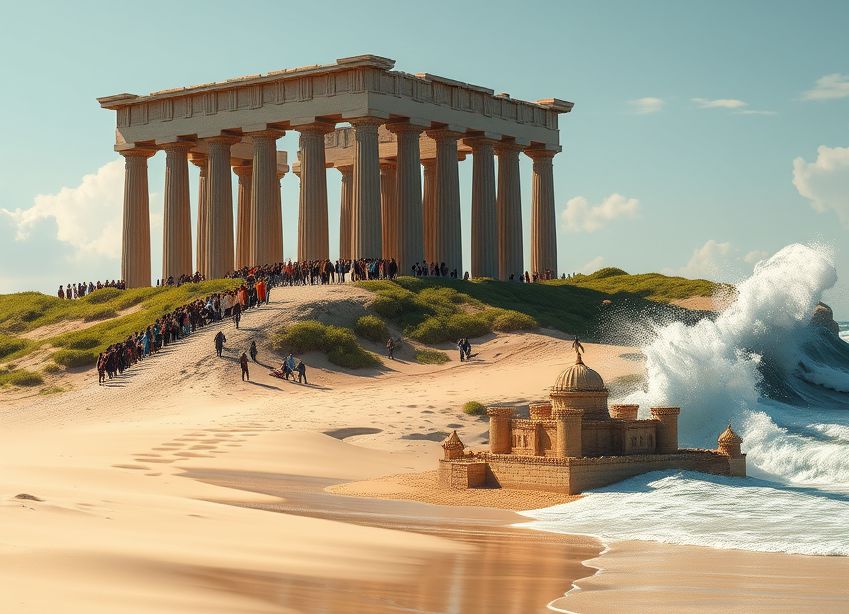
People are hurt and Churches fail or divide when they become houses of the government of man and not of the government of Jesus, building castles of sand instead of being built as living stones. The church at Philadelphia was clearly of the latter type, and Jesus makes this promise to those that would “hold fast to what they have:”

 He who overcomes, I will make him a pillar in the temple of My God, and he shall go out no more. I will write on him the name of My God and the name of the city of My God, the New Jerusalem, which comes down out of heaven from My God. And I will write on him My new name.” (Revelation 3:12.)

This is the reward for those who belong to the ecclesia of Christ. By contrast, a sandcastle is recognisable by its turrets and not by its pillars, and in the turrets flags are sometimes planted, where men like to write their own names. When someone seems to be waving their flag in our faces, we don’t want to snatch it out of their hands, but we need to pray that they, and we, will be pillars in the temple of our God where He can write His own name on our lives. If someone tells us how to “eat and drink,” we respond with righteousness, peace and joy in the Holy Spirit. Because a wave is coming when the sandcastles will be washed away, and only the pillars of the ecclesia will stand.

The kaleidoscope of liberty

“Where the Spirit of the Lord is, there is freedom.” (2 Cor 3:17)
“You shall know the truth and the truth will set you free.” (John 8:32)

We are not just set free from our personal limitations or bondages: we are set free from the limitations of self and released into the understanding that we are one with God in Christ. Truth isn’t what you know; it is not wrapped up in knowledge. Truth will never be found in opinions, however well they are proven and however eloquently they are justified. Truth is a person who is the Way the Truth and the Life. Knowing the truth is knowing Jesus, and understanding that the greatest height and deepest layers of human knowledge are never more than one piece of coloured glass in a kaleidoscope, and cannot even begin to reach the dimension of truth that is only found in Jesus. If our God is the Truth, then truth is a heavenly commodity; we cannot find it through the evidence of science or even the insights of theology, because it exists beyond all things that pass away. Jesus, who is the Truth, tells us that Truth can only be revealed by the Holy Spirit whom we receive from God and whom the world cannot know:

“And I will pray the Father, and He will give you another Helper, that He may abide with you forever—”the Spirit of truth, whom the world cannot receive, because it neither sees Him nor knows Him; but you know Him, for He dwells with you and will be in you.”

 (John 14:16-17) Knowledge itself will pass away, as well as this world, and in that day all our truth will turn to ashes. But we can speak truth and we can know truth when we speak love and know love, for this is where the truth resides. When we speak the truth in love “we will grow to become in every respect the mature body of him who is the head, that is, Christ.” (Eph 4:15) It is when we love one another that we walk in the truth.

I feel that the Lord is saying this to the Church:

“You are my kaleidoscope. Each one of you is like one of those little pieces of coloured glass. I made you all different, to be different shapes and colours, so that my light can reflect off you in different ways. Just as the mirrors inside a kaleidoscope reflect images off each other to create the appearance of an infinite pattern, so it is that my light reflected off you is creating a pattern in the infinite dimensions of the spirit. As I move the kaleidoscope, so you are arranged differently and the pattern changes. Do not despise or judge those whose shape or colour is different from yours, for I created you that way in order to make my pattern with you. It is my pattern, not yours, and it is more wonderful and beautiful than you could ever imagine. When you love one another and are one with each other, my pattern emerges. When you stand alone in your opinion or ambition, or to fulfil the desires of your flesh or of your minds, you are not part of what I am doing and you create nothing. It is I who sees the pattern, not you; but when I choose to reveal it through you and in you the world will see and they will see me in it.

I am moving the kaleidoscope: some of you will find yourselves with new people in new situations, and they will not be like you. Love them and accept them, and always look to me knowing that I am creating a pattern that you cannot see. But a time is coming soon when it will indeed be visible and many more will come to know me because they will see what I am doing and will want to join themselves to the pattern that I am creating.”

Water what’s fruitful; burn what’s dead.

I am the vine and you are the branches. He who abides in me and I him bears much fruit, for without me, you can do nothing. If anyone does not abide in me, he has cast out as a Branch and is withered, and they gather them and throw them into the fire. If you abide in me and my words abide in you, you shall ask what you desire and it shall be done for you. By this, my father is glorified, that you very much fruit; so you will be my disciples.” (John 15:5 – 8).

I was in the garden a few weeks ago, burning rubbish in our garden incinerator in an enclosed area that used to be a chicken run. I had a hose pipe to hand in case any sparks jumped from the fire, and was directing it onto the roots of an apple tree on the other side of the enclosed area so that the water was doing something useful. I felt the Lord spoke to me quite clearly as I stepped back, away from the smoke for a moment. He said, “Water what is fruitful, burn what is dead.“ I took the above picture as a reminder to myself.

This is a time of transition. We have heard many times, and we know, that God is doing a new thing. So why do we persist in carrying on with our old ways? I wrote about making disciples in my last post. Jesus says that discipleship is this: abide in Him and let his words abide in us. What does this mean? I think it’s quite simple: Walk with him and do what he says. Forty years ago, before cars were computers on wheels, I rebuilt a car engine (a morris minor, if you remember them) from a DIY manual. You read the information and did what it said. It was tried and tested, and – unless you misread the instructions – it worked. For too long, we’ve been doing it ourselves in the church: repeating strategies that worked in a previous era in the hope that they will work for us today. But it’s time we threw away and burnt our DIY manuals and let Him build His church, because what He is doing today is not the same as it was 40 years ago.

I believe the Lord says:
 “You cry out to me to pour out my spirit and bring my anointing to what you do. But I will not pour my water on that which is cut off from me. I will not water your DIY efforts. Where is there life and growth in your church? Where is there life and growth in your family, in your marriage? Cry out to me for those areas, and I will water them. I will even water one little seedling, I will water a tree that only bears a single fruit. If it is growing, I will water it. Where there is love, I will water it. But I will not water a pile of dead branches, however big and impressive it is, however hard you’ve worked to assemble the pile, and however long it’s been there.

So burn what is dead, abide in me, listen for my word and do what I say. And I will watch over my word to perform it, and I will water what grows when my word springs forth through your obedience.”

Being disciples; making disciples.

We all know that Jesus calls us to “go and make disciples of all nations.“ Some of us obey the call geographically and go to other nations to make disciples; some of us find “the nations” in our own neighbourhood or workplace; some of us ignore the call altogether and leave it to the evangelist. But even if we don’t live in a mixed race neighbourhood and everybody at work was born in the same country as we were, our home country is still a nation, and we still have to “go” to it, and the purpose of “going” is to make disciples. So assuming we have “gone” with a willingness to share the gospel, how do we go about the business of discipleship?

“Follow me as I follow Christ,“ said Paul to the Corinthians. (1 Corinthians 11:1)  We can’t really expect to make committed disciples if our own discipleship is flabby and inconsistent. I don’t think it’s enough just to lead people through discipleship courses: the Holy Spirit has to be at work in and through the people leading the courses if the spirits of new believers are going to be impacted and their minds renewed. If we want new believers to grow to maturity and find their place in the Kingdom of God, we need to launch their walk with the power that they will eventually need to carry on without us and be discipling others themselves. The alternative is a church that is bloated with members but lacking in love and power – what Smith Wigglesworth called “leafy trees” that bear no fruit.

“Freely you have received, freely give,” said the Lord when he sent out the twelve. (Matthew 10:8) when we “go” to make disciples, we can only give what we have received ourselves.

In all your ways acknowledge Him
I found a key verse for discipleship in an unexpected place: proverbs 3:5. We all know it: “Trust in the Lord with all your heart and lean not upon your own understanding. In all your ways acknowledge him, and he will direct your paths” The first part of this verse tells us clearly where to place our trust, and it tends to be the one that is quoted the most often. But it’s the second part that caught my attention. The word translated – rather weakly, I feel – as “acknowledge,“ is yada. In Hebrew this is the word used for “knowing” in life-giving intimacy, as when Adam “knew” Eve. What the second part of Proverbs 3:5 says to me is that God will “direct our paths” when we take every step in intimate relationship with him. Following this, the word yasar, translated here as “direct“ our paths is the same word used in Isaiah 40:3 for “make straight” a highway in the desert.

The voice of one crying in the wilderness:
“Prepare the way of the LORD;
Make straight in the desert 
A highway for our God.”

When God is with us – not just notionally, but experientially – at every step, he won’t just be “directing” our paths in the sense of telling us where to go, but he will be ‘making them straight’ before us, clearing the ground and removing obstacles so that we can move forward with Him even though it may feel as if we are lost in the desert.

Zachariah 8:23 says this:

 “Thus says the Lord of hosts: In those days ten men from every language of the nations shall grasp the sleeve of a Jewish man, saying “let us go with you, for we have heard that the Lord is with you.”

It is when the men (and the women) of the nations know that the Lord is with us that they will want to “go with us.” Surely this is a picture of how we are to make disciples. As we walk closely with the Holy Spirit and He directs our paths, so we can direct the paths of others; not by weekly meetings following a discipleship course, but by walking alongside new believers who have joined themselves to us because they can see God at work in our lives. But there’s a health warning here, too, especially for people (like myself) who cherish their own space: when revival comes and we have ten people grasping our sleeves, we won’t have a lot of time for ourselves. Are we ready? Am I?

Those who wait on the Lord shall renew their strength

Have you not known?
Have you not heard?
The everlasting God, the LORD,
The Creator of the ends of the earth,
Neither faints nor is weary.
His understanding is unsearchable
.

He gives power to the weak,
And to those who have no might He increases strength.

Even the youths shall faint and be weary,
And the young men shall utterly fall,

But those who wait on the LORD
Shall renew their strength;
They shall mount up with wings like eagles,
They shall run and not be weary,
They shall walk and not faint.

(Isaiah 40: 28-31)

I have always seen “waiting on the Lord” in the context of extended time frames: waiting for the Holy Spirit to show up in a worship service; waiting for an answer to prayer; waiting days or weeks for a word from God before making a decision. In addition, I have never thought deeply about running and not growing weary, or walking and not growing faint, although in my advancing years I certainly look longingly at those verses and hope they will apply to my physical state. Mounting on wings like eagles has been a  metaphor for growth, increase, victory, in fact any undefined superior state that can be attained under God’s blessing: the verse has never had a very practical application for me, just a rather undefined sense of promise that I can’t say I have often known to materialise outside of some worship services where “rising up” to a higher level of worship in the Spirit has been the goal. I have never applied the scripture to short term, immediate contexts.

Until today. When I was a child, my mother used to say to me “Bobby, you’re always rushing.“ (A word to the wise: if you know me, please do not call me Bobby!) It’s a character trait I’ve battled with (or maybe so much not battled as be driven by…) all my life. I’m a “fast adopter“ when it comes to decision-making; I tend to try to do things quickly so I can finish them rather than aim for thoroughness ; I seem to miss significant details on the few occasions when I’m trying to think things through, and – probably most importantly – I tend to say the first thing that comes into my head in conversation without really checking if it’s coming from a positive or a negative place. This is at age 74, after more than 40 years of being a Christian, when I really should know better. Not much about me seems to have slowed down except my body.

But this morning I saw these verses differently. It was in an all too familiar context, where I had gone into something without giving it sufficient forethought, when I realised that “waiting on the Lord“ can also mean waiting for as short a time as a few seconds for my flesh to die and “the wisdom from above” to rule my thinking before responding to words or circumstances. And then I saw the rest of the scripture. Mounting on Eagles wings takes me into the heavenly places where my new man is seated in Christ, where I can draw on all I have been given in the Spirit. When I do this, I renew my strength in the Lord. I can “walk worthy of my calling” (Eph 4:1) and “not grow weary of doing good.“ (Galatians 6:9). I can “run with perseverance to race marked out for us,“ not growing faint, but “fixing my eyes on Jesus the author and finisher of my faith.“ (Hebrews 12:1–2)

When we “mount up with wings like eagles” we take our place in the Spirit, in the Lord who “neither faints nor is weary.” We don’t grow faint or weary because He doesn’t, and we are in Him. Out of His unsearchable understanding comes the wisdom we need, “the wisdom from above,” which is “ first pure, then peaceable, gentle, willing to yield, full of mercy and good fruits, without partiality and without hypocrisy. (James 3:17). In our weakness we are strong. (2 Cor 12:10)

Verse 30 says this:
Even the youths shall faint and be weary,
And the young men shall utterly fall…

I have always seen this verse as a dramatic contrast with the favourable consequences of waiting on the lord in the rather woolly sense that I have always understood it, but now I understand it more as a contrast between walking ( or running) after the flesh, which always leads to failure, and walking in the Spirit. “Waiting on the Lord” becomes taking the time to step  into the Spirit  – or as Graham Cooke calls it, to “step back into the Lord” – to receive all that there is for our situation from where we are seated in Christ in heavenly places. Yes, we need to wait for Him in our meetings if we want to see the power of God move and His Presence fall. Yes, we need to wait in faith for Him to answer our prayers. But, and just as importantly, we need to wait for Him in the dynamic of our daily walk with God if we want to walk after the Spirit and not after the flesh.

In the light of this, the urgency of psalm 27:14 takes on a new meaning:

“Wait on the LORD;
Be of good courage,
And He shall strengthen your heart;
Wait, I say, on the LORD!”

Let’s do it. It appears to be a recommended route to victory in Christ.

Understanding the Sabbath: Peace in Christ

“He Himself is our peace.” (Eph 2:14)

“For this reason the Jews persecuted Jesus, and sought to kill Him, because He had done these things on the Sabbath.” (John 5:16)

There is a lot more to the Sabbath law than observance of the fourth commandment, which instructed the Jews to “Remember the Sabbath Day, and keep it holy.” Just as Jesus’s “work” on the Sabbath was emblematic to the Jews of His disrespect for the whole of the Old Covenant law, the sabbath itself looks forward to the New Covenant in His blood that sets us free from condemnation under the Law and into the peace of His Sabbath rest.

The Bible tells us: “And on the seventh day God ended His work which He had done, and He rested on the seventh day from all His work which He had done. Then God blessed the seventh day and sanctified it, because in it He rested from all His work which God had created and made.” (Genesis 2:2-3) The new testament adds another layer to the Creation account: the specific involvement of Jesus in the work of creation.

“For by Him all things were created that are in heaven and that are on earth, visible and invisible, whether thrones or dominions or principalities or powers. All things were created through Him and for Him.” (Col 1:16) “All things were made through Him, and without Him nothing was made that was made.” (John 1:3) God rested from his work on the Sabbath, or the seventh day, so the Sabbath was instituted. But it wasn’t only the Father who rested: the Son rested too.

A way of life, not just an observance
God rested when the work of creation was finished. And He rested again when the work of the new creation was finished on the cross. When God blessed the sabbath day and sanctified it under the old covenant, He was looking forward to the time when, in Jesus, His rest would be a way of life, not just an observance. But in the era of the Old Covenant also, God’s rest extended beyond the seventh day. The writer to the Hebrews says:  “To whom did He swear that they would not enter His rest, but to those who did not obey?” (Heb 3:18) For the rebellious Hebrews, who “did not enter because of unbelief,” (Heb. 3:19) entering God’s rest equated to entering the Promised Land, where they would find rest from the toil of slavery.

Just as Canaan represented God’s rest for the Israelites, we enter our rest in Christ when we believe in His promises to us, or as Hebrews 3:14 puts it, “if we hold the beginning of our confidence steadfast to the end.” The Greek word used for God’s rest is “katapausis,” which means “a calming of the winds.” Katapausis Is the spiritual atmosphere of Heaven. Jesus tells us “My peace I give to you; not as the world gives do I give to you” (John 14:7), and when we walk in His peace we walk in the atmosphere of Heaven and find “rest for our souls.” (Matt. 11:29). All the winds are calm, because – as Jesus physically demonstrated – it is He who calms the storm.  As every Christian knows, He famously said, “The Sabbath was made for man, not man for the Sabbath.” (Mark 2:27). God gave us the Sabbath to enshrine in His Law that we need to enter His rest, not that we need to stop working every seven days.

Finished – but still working
Two notions that seem to be at odds with each other are that “God finished His work” on the seventh day, and the words of Jesus to the Pharisees when they confronted Him over healing the man at the pool: “My Father has been working until now, and I have been working.” (John 4:17) What is the difference between the work that the Father and the Son finished on the seventh day, and the work that they were – and still are – continuing to do?

I think the answer lies in the fact that creation was perfected on the seventh day, so all of God’s dealings with Man – Father, Son, and Holy Spirit – from then on were from His place of rest. Whether it was Christ’s miracles of healing and deliverance, God’s victories in the reign of David and many other heroes, or His repeated call to His errant people through His prophets to return to Him, the focus of God’s work has always been to restore His people to their Sabbath state of wholeness and relationship with Him. The lame man was healed on the Sabbath so the he could walk in the wholeness that the Sabbath represents. Just as the first creation was finished on the Sabbath day, so the new creation was perfected when Jesus cried out from the cross “It is finished!” And so the writer to the Hebrews says: “We who have believed into that rest.” (Hebrews 4:3) Through faith in the redeeming blood of Jesus that was shed on the Cross, we become “the righteousness of God in Him,” (2 Cor 5:21) and enter into the perfection of God’s rest.

“True righteousness and holiness.”
This perfect state is the condition of the new man, “which was created according to God, in true righteousness and holiness.”  (Eph 4:24) Peter exhorts us to  “be diligent to be found by Him in peace, without spot and blameless,” (2 Pe 3: 13) while Hebrews 4:9-11 says “There remains therefore a rest for the people of God. For he who has entered His rest has himself also ceased from his works as God did from His. Let us therefore be diligent to enter that rest, lest anyone fall according to the same example of disobedience.” The peace of His sabbath rest is the gift of God’s grace through Jesus, yet two new testament writers exhort us to be diligent to “enter” that gift. So while we cannot earn God’s peace by our religious works, we need to “work” at keeping a short account of sin in our lives (“without spot and blameless”) and “work” at remembering who we are in Christ, what He has purchased for us, and that “The Spirit of God, who raised Jesus from the dead, lives in you.” So rest does not come without some effort (Romans 8:11), but if we are diligent to keep these truths foremost in our thinking we will walk away from the paralysis of religion and into God’s rest.

Only in that place we can really access everything that is our promised inheritance in Christ.

(The topic of “entering into God’s rest” is also explored in “Walking in Newness of Life.”)

The Pool of Bethesda (2): the paralysis of religion

After this there was a feast of the Jews, and Jesus went up to Jerusalem. Now there is in Jerusalem by the Sheep Gate a pool, which is called in Hebrew, Bethesda,  having five porches. In these lay a great multitude of sick people, blind, lame, paralyzed, waiting for the moving of the water. For an angel went down at a certain time into the pool and stirred up the water; then whoever stepped in first, after the stirring of the water, was made well of whatever disease he had. Now a certain man was there who had an infirmity thirty-eight years. When Jesus saw him lying there, and knew that he already had been in that condition a long time, He said to him, “Do you want to be made well?” he sick man answered Him, “Sir, I have no man to put me into the pool when the water is stirred up; but while I am coming, another steps down before me.” Jesus said to him, “Rise, take up your bed and walk.” And immediately the man was made well, took up his bed, and walked. And that day was the Sabbath. (John 5: 2-9)

God’s house of mercy
The healing at the pool took place on the Sabbath. In the sequence of signs as John recorded them, this was the first time that Jesus challenged the religious order by “working” on the designated day of rest, and John records it as the opening skirmish of His battle with the pharisees that ended at Calvary. “For this reason the Jews persecuted Jesus, and sought to kill Him, because He had done these things on the Sabbath.” (John 5:16) “Bethesda” means “house of mercy,” or “flowing water,” and it was by the Sheep Gate. This is not just a place in Jerusalem: it is a picture of the church. The healing at Bethesda was certainly a sign pointing to our need for an encounter with the living Christ, but it also tells us that there are many sheep in God’s house of mercy and flowing water who are immobile on their beds by the pool, and that one of the main types of paralysis is the paralysis of religion.

Paralysed by religion
The dictionary definition of religion refers to worship of a God or gods and the activities surrounding that worship, and in a broader sense to “enthusiastic and repeated engagement” in a particular pursuit. Avid sports fans are often referred to as making a religion of their sport, for example. However, I worship the Christian God, enthusiastically and repeatedly, yet if someone asks me the question “are you religious?“ I say, “No I’m not religious; I have a living faith.“ So in the church many of us now see the term religion as not so much describing our worship of the living God, but the practice of those who, in the words of Paul to Timothy, have “a form of godliness but deny its power.” (2 Timothy 3: 5–7). The question for those of us who say we have a living faith is this: is it possible for us also to be paralysed by religion?

We tend to Pillory the Pharisees today as archetypal examples of everything we want to avoid in our worship of Christ. And so we should: they lived by the law and missed Jesus. There is no need to quote here any of the many things that Jesus said against them: the important point is that we don’t follow their example and find ourselves as paralysed and lifeless as they were. They too were lying by the pool on their bed, the bed of the law, waiting for the waters to be stirred by the Messiah – who was standing right in front of them.

Flowing in the spirit?
The Bible tells us, “Whatever was written in the past was written for our instruction so that we could have hope through endurance and through the encouragement of the scriptures.”  (Romans 15:4) The Holy Spirit hasn’t just made it clear how tragically fruitless the religion of the Pharisees was so that we could feel superior in our relationship with Him: those scriptures are also there for our instruction so that we can take care not to follow any of their practices. How much of this instruction are we actually taking on board? For example – and I know I’m far from being the first person to say this – I was born again In 1984, when the charismatic movement was surging through the established church. We used to think of ourselves as “flowing in the spirit,“ and (I’m ashamed to say) how superior we were to the church down the road whom we saw as ossified in their “hymn– prayer sandwich“ format. I now belong to one of the larger modern evangelical Charismatic/Pentecostal networks. We consider ourselves to be free in the spirit, and to be hosts of the presence of God during our meetings. But before I go to church on a Sunday, I know that we will start with a couple of fairly lively praise songs, the host for the day will do the notices, the children and teenagers will go out to their respective groups, we will continue with worship for about another half an hour, then there will be a preach (we used to call them sermons, but that was  too religious) for about 30 minutes, and then a closing song and an appeal for ministry at the end. We will start at 10:30 and finish around 12:15; gather for refreshments after the meeting, and will be out of the building by about 12:45. We do make room for the gifts of the Spirit during the worship time, so three or four people might bring a word of encouragement, a prophecy or a word of knowledge; maybe a tongue and an interpretation – but how different is this really from the “hymn-prayer sandwich?“ The fillings might be a bit different, but it is no less predictable, and I suspect that we are not very different from many modern evangelical churches.

The Spirit of God does graciously meet with us in the little box that we give him, and we rejoice in the fact that we have been in his presence, even though it may have just been the hint of a reflection of a glimmer. We say, and pray, that we want more of him; we long to see healings and deliverance; yet how much more of ourselves will we give? Would we know more of His presence and His power if we gave him more of our time? Or even if we took the compartments out of the box and, for example, allowed the allocated time for worship to eat into the allocated time for the sermon? Or even – shock horror – not have a sermon (sorry, a preach) at all?


The mountain and the chocolate box
I think we can be very easily satisfied with the experience that we describe as “entering the presence of God.“ When the presence of God came into Solomon’s temple at the time of its dedication, the priests were unable to stand. When the Roman soldiers came to Gethsemane to arrest Jesus, they fell to the ground when He identified himself with the words “I am He.” (John 18:6) In our own church we had a half night of prayer a couple of months ago (we should have them more often…), from 8 pm to 2 am. People came and went as they pleased; not many stayed for the whole six hours. But it wasn’t until about 1:30 that the presence of God really came, so powerfully that most of the few of us who were there had to fall to our knees; and then someone gave a prophetic word that brought a long awaited breakthrough in the life of one of those present. When the presence of God came to Toronto, He changed lives and impacted people like Heidi Baker, (Iris Global) Che Ann (Harvest International Ministries) Bill Johnson (Bethel Church) and Nicky Gumbel (the Alpha Course) whose ministries have brought the Kingdom of God into millions of lives. A hallmark of Toronto Airport Vineyard meetings in the 1990s, as well as of other revivals, was daily meetings that went by the clock in heaven and not the clock in the kitchen. I think we can package the presence of God in a chocolate box when He wants to take us up a mountain. God has a much bigger space to move in than we often allow Him. If the dimensions of our box are so far away from His, it’s because our religion keeps it small and keeps us too easily satisfied.

The dynamic of Life
Jesus said , “For as the Father has life in himself, so he has granted the Son also to have life in himself,” (John 2:26) and that He had come to “give life, and that in abundance.” (John 10:10) I love to go out and take photographs of birds. One of the great difficulties in bird photography is the fact that the subjects rarely keep still. Life is always on the move. When the cells in a body become motionless, that body is dead. When Jesus told the paralytic to pick up his bed and walk on the Sabbath day, He was giving him life: He was asserting the dynamic of Life over the inertia of religion.

So how much are we really free from the constraints of religion that we see in the Pharisees of Jesus‘s day? Anne and I lead one of the small groups in our church (we call them “life groups.“ What do you call yours?) This Summer each life group is  leading an evening midweek meeting for the whole church. Everyone in our life group comes to the school of prophecy that we host at our house, and our vision is to encourage the other groups to pursue the presence of God more actively in their gatherings. I had planned how I felt our meeting should flow, and who should contribute what. Anne was most dismissive. “And where exactly is the Holy Spirit in control of all of this??“ she asked. And she was right. How easy it is to operate in the flesh when we think we are being spiritual. When man controls he brings religion. When the Holy Spirit controls, he brings liberty.

A living, breathing bride
Jesus comes to give life. His words are words of life. Walking is not doing the same things the same way, but doing what He says, when He says it. Life is movement. When He speaks, the life He speaks brings into us movement. We can be walking in the Spirit while we have a meal out with friends because we can be responding to His promptings between mouthfuls in the conversation, and we can be walking in the flesh every Sunday at our Church meetings because we are following our prepared format and not His dynamic instructions. When He returns, He will coming back for a living,  breathing bride that He has perfected and made beautiful in His presence, and He is longing for us to run to meet Him, however our theological lens views that moment. We may not fully understand how we will be caught up in the air (1 Thessalonians 4:17), but one thing we do understand is this: He will not be pleased with a bride who sits in her pew and recites the litany of the wedding service without even looking into His face.

The Great Deception

(Image generated by AI from its “reading” of my text…)

Every time I ask Google a question read the detailed AI overview of its answer, I think about the Great Deception that Paul writes about in 2 Thessalonians 2 1-12. Is artificial intelligence part of it? Recently I stumbled on a blog on the subject of the great deception and how to be sure not to fall away, and I read it with interest. It was all Bible based and made a lot of sense: basically it was telling us that if we keep our eyes on Jesus and remain grounded in faith and the word of God we won’t be led astray by Satan’s lies. All good stuff, followed by lots of practical applications for family life, similar to material we find across a broad swathe of Christian writings.

I scrolled down the article, and came to other material written by the same guy. But I stopped short when I saw an article that claimed to be “a detailed study of the biblical proof for a flat and motionless earth.“

Is someone who is exhorting Christians to believe the word of God, hold fast to Jesus, and be guided through the complexities of life and the snares of satanic deception by discernment of the truth, suggesting that I believe that the world is flat and that I can find evidence of this in the Bible? I really hope not, yet I believe it’s probably true.

I know the Earth is not flat: I’ve travelled a lot of the way round it, I’ve seen the curved horizon, and I’ve seen photographs from space. I know that none of Magellan’s ships fell off the edge between 1519 and 1522. I’ve got enough experience to tell me that science has got this right.  But it made me think:  what do I do in the areas where the Bible tells me that science is wrong and I don’t have the experience to align with my acceptance of its authority? Did God really create the earth in six days, less than 7000 years ago? Did Methuselah really live to be 969? What about the other end of the Bible: Is there really going to be a rapture? How can the new Jerusalem come down from heaven, for example? And then of course we come to the basics of Christian Faith. Virgin birth? Resurrection? Ascension? Science tells us that none of this is possible, but our faith says it’s true. It’s totally understandable that many people who genuinely ask the question “is there a God?” dismiss faith because it doesn’t make sense. Faith is a “a gift of God, that none may boast,” (Eph 2:9), but it also has to be a gift of God because the human brain simply can’t comprehend it.

I do believe that God is in and through all things, and that he has progressively guided the man that He created through an understanding of the world that He put him in. I think that this is sometimes has been by revelation, and sometimes by exploration. God has given us science. But He has also given us His son, and He has given us the Holy Spirit. He has given us brains, but we also have the mind of Christ. The universe is material and it is spiritual. Spiritual things are spiritually discerned: we can no more understand the mind of Christ with our human reason than we can prove whether or not Christ will return to the Earth in the manner that He ascended, if there really was a worldwide flood and Noah’s Ark, or if we will all be raised up at the last day, and more importantly which eternal existence we will be raised up to – the resurrection of Life or of condemnation. (John 5:29).

Ultimately, truth is neither science nor the printed pages of the Bible, which can be taken at face value to prove almost anything – even, it appears, that the Earth is flat. Truth is a person. Jesus said “I am the way, the truth, and the life.“ We are called to follow His way, walk in His truth, and to share in His life. The truth can’t be separated from the way and the life any more than one can separate the heart from the brain and the nervous system and expect them to carry on functioning. Whatever the great deception ultimately is, its main purpose will be to lead us away from the person who is the way the truth and the life.

I do happen to think that AI will play its part in this, and I think it is part of the fulfilment of Daniel‘s end time prophecy that “there will be a increase in knowledge; (Daniel 12:4) however Paul writes “knowledge puffs up, but Love builds up.“ (1 Cor 8:1)  Knowledge alone, whether we gain it from Google’s AI overviews or from our own intellectual understanding of the Bible, is not the truth. The truth is only in Jesus, the fulfilment and the flesh of the word, and we live in the truth when we walk in Him. And since God seeks worshippers who worship “in spirit and in truth,“ we cannot walk in the truth unless we also walk in the spirit, and none of the fruit of the spirit even marginally hints at the supremacy of the intellect. In fact the Holy Spirit tells us in Proverbs 12:15 that “the way of a fool is right in his own eyes.” One of the most brilliant people the world has ever known, Leonardo Da Vinci, said “The greatest deception that men suffer from is from their own opinions.”

Our understanding of the truth as it is in Jesus will always find its expression in God-given faith and love, and our first rule in gaining this understanding will be to learn from Him and be yoked to His gentleness and humility of heart. (Matthew 11:29) This means that if any of us thinks he is a “better” Christian than anyone who doesn’t share our theology they have missed the point entirely. God’s goodness, revealed to us in Christ, is as far above ours as the heavens are from the earth, so the differences between us are as insignificant as the differing widths of two grass stems in the face of the sun. Paul wrote to the Thessalonians that the Lawless one was already at work in their time, and I believe that a part of the great deception that Satan had been working on since the birth of the church is to convince us that one person’s idea of how to follow Jesus might make them “a better christian” than someone with different ideas.

As for me, I choose to believe the Apostles’ creed over the atheistic writings of Richard Dawkins or the algorithmic manipulations of AI, however convincing their deceptions may be. And whether a brother or sister in Christ chooses to believe that the Earth is 6000 or 6 billion years old, or even that it is flat, there is nothing in the Apostles’ Creed or in what I know of scripture that tells me that I should correct their beliefs. If we build each other up in love we will all come “to the unity of the faith, and of the knowledge of the Son of God, to the perfect man,” (Eph 4:13) whatever views we hold about science or prehistory, or about Great Deception itself; and when we do that we will really know the truth, because we will be seeing Him face to face.