“Your gentleness has made me great.“ (Psalm 18:35)
The aspiration to greatness is probably hidden somewhere (and at times not so hidden) in every unredeemed heart, whereas personal greatness is no longer an attribute that a Christian disciple would want to appear in his spiritual CV. However, seated as we are in Christ with the unlimited power of His Spirit in our hearts, we are all have that greatness, however weak and foolish our actions in the flesh may be. His gentleness has made us great. But if I am great because of His gentleness, it is also true that I am only great in His gentleness, because gentleness is in His very character, as He describes it himself: “take my yoke upon you and learn from me, for I am gentle and humble of heart, my yoke is easy and my burden is light.” (Matt 11:29) Gentleness is a characteristic of the fruit of the Spirit that Jesus is looking for in the life of every believer.
Ephesians 2:10 tells me that I was “created in Christ of Jesus for Works prepared beforehand , that I may walk in them,” so if I am not walking in His gentleness, I am not walking in Him, and I’m not fulfilling my destiny in the works that He has prepared for me to walk in. And if I am not walking in His works, I must be walking in my own, and therefore I am walking after the flesh and not after the Spirit.
Gentleness is not weakness, it is enabling power. Gentleness does not push; it leads, because it knows where to go. Gentleness does not argue, but speaks the truth in love or does not speak at all. It does not react to situations and people out of fear, but out of knowledge of the truth. There is no uncertainty in gentleness: Jesus knew where he had come from where he was going, and so do we. We have come from above and will be returning there.
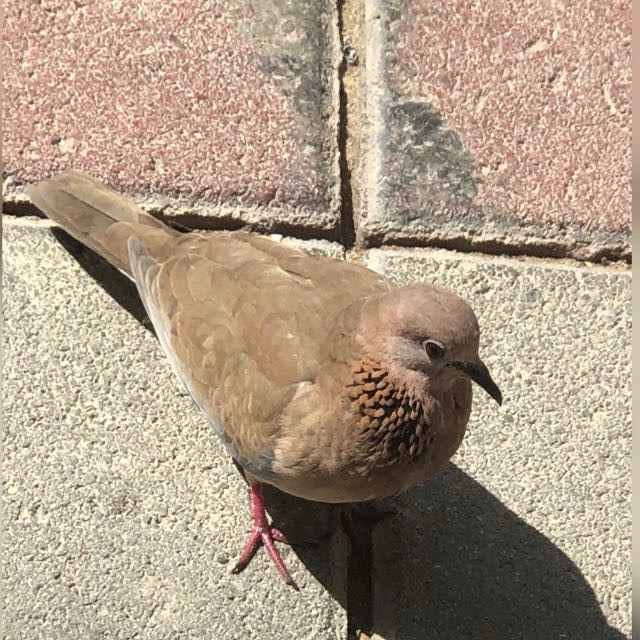
Gentleness is like the wavelets in a sheltered, cove: buoyant and supportive, never overwhelming and never crashing on the beach, yet moving with all the power of the tide. Those wavelets are seasoned with salt: it’s the salt that is supportive, and so should it be with our speech. (Col 4:6) Gentleness is the dove who baptised Jesus in the power of the Holy Spirit, and characterises the advance of the kingdom of God. Gentleness is the dove who brought the olive branch to Noah, and is a species of bird that can be seen and whose call can be recognised everywhere in the world.
Whatever may flood our circumstances and our emotions, it is gentleness who brings the promise of landfall in the kingdom of God. It is always at hand. Let us always be ready to hear and respond to the call of the dove.
(A note on the image: I took the picture of the dove in the Middle East. Traditionally we portray the biblical dove as white, but it’s quite likely to have looked more like this one.)
A few weeks ago a visiting speaker came to our church. Before she started speaking, she said that the Holy Spirit had highlighted a certain gentleman in the second row, three seats along … It was me. She brought a very encouraging word, with enough detail about myself (she had never seen me before) to confirm its accuracy, but the thrust of it was that ‘a door would be opening to me that would draw me closer to Him.’
Don’t we love it when someone brings an encouraging prophesy, underlined by another gift of the Spirit, the word of Knowledge, that speaks into our spiritual life and affirms us in our walk with God? I did not know what door she was referring to, but open doors often speak of opportunities. More time with Him and therefore less time at work? Ministry opportunities? I didn’t know and didn’t try and guess, but I certainly left church feeling good and played the recording of her word to me a few times over.
A couple of weeks after that we were praying for each other at School of Prophesy. One of the guys said that he could see our business going down a waterfall. There would be churning in the pool at the bottom; we would come out afterwards, but the watercourse would be different. That too was accurate: two days later our expected sales for this time of year plummeted, and there is definitely churning going on as I write. I have had to hold on to the Lord as the water takes us on its course.
Then a few days ago the penny dropped: this was that. The open door that would draw me closer to Jesus is the waterfall that is rocking our business. When God speaks to us of blessing – and to be drawn closer to Him has to be a promise of blessing, because “at His right hand are pleasures for evermore” (Psalm 16:11) – our flesh tends to interpret that, in some way, in terms of advancement and comfort. (Well, mine does anyway…) But God has a different angle:
“Consider it pure joy, my brothers and sisters, whenever you face trials of many kinds, because you know that the testing of your faith produces perseverance.” (James 1: 2-4)
When the Holy Spirit spoke to me of that door that was going to open, did it ever occur to me that it was going to be an opportunity for my faith to be tested in order to produce perseverance? I think not. Did I imagine a trial, or a mountain top experience? Certainly the latter. But God’s ways are not our ways. How different are the values of His Kingdom to those things our soulish minds hold dear. We value our comfort and advancement, our security and the approval of our peers; God values that we “act justly, … love faithfulness, and … walk humbly with your God.” (Micah 6:8) The Narrow Way has a totally different trajectory to the way of the world. God’s priority for us is that we walk with Him, and that we “Seek first the Kingdom of God.” And it is only by faith that we can take any steps with Him at all, so if trials are the best way to strengthen our faith and bring us into that place of blessing which is increased closeness to Him, there is a good chance that trials are what we are going to get.
My business is a tiny little pool: the world itself is going through a state of churning, and none of us know what the watercourse will look like when it comes out the other side. But one thing is true: we all need to let Jesus draw us closer to Him, because there is no other place that is more secure. One of the worship songs that came out of the charismatic movements starts “This is my desire, to worship you…” We love to lift our hearts and voices, and probably our hands, and tell the Lord how much we want to come close to Him. The Son shares our desire, and expresses it to the Father just before going to the cross: “Father, I desire that they also whom You gave Me may be with Me where I am, that they may behold My glory which You have given Me; for You loved Me before the foundation of the world.” (John17:24) We lift our voices to draw near to God; Jesus lifted His body onto the cross to have us close to Him. His Spirit in us will always be working towards that goal, because that is His desire. This was the joy set before Him.
Probably the best-known “resurrection psalm” is Psalm 16, where, by the Spirit, Jesus expresses that joy through the words of David:
I have set the LORD always before me; Because He is at my right hand I shall not be moved.
Therefore my heart is glad, and my glory rejoices; My flesh also will rest in hope.
For You will not leave my soul in Sheol, Nor will You allow Your Holy One to see corruption.
You will show me the path of life; In Your presence is fullness of joy; At Your right hand are pleasures forevermore. (Psalm 16: 8-11)
Jesus faced the greatest trial of all for the joy of seeing our faith bring us into the glory of unity with Him and the Father for ever. So when we are facing trials, let’s remember to “consider it pure joy” as Jesus did: our faith is being tested, to enable us to persevere in the things that really matter.
Jesus said: “for the son of man has come to save that which was lost.“ (Matthew 18:11), and continued with the parable of the lost sheep (verse 12). So when we read about the lost sheep , we tend to focus on the sheep and the miracle of salvation – the rejoicing in heaven – when one is returned to the fold. Another translation actually puts it: “to find lost people and to save them.”
As true as this is, I think there is a bigger picture as well. The Greek word translated as “lost” means much more than just wondered off track; it means killed, ruined, destroyed. Matthew quotes Jesus as saying this in the context of children being corrupted, but when Jesus talks about coming to save the lost in Luke’s Gospel He is referring to Zacchaeus the tax collector, who clearly was not a little child. Jesus’s statement is far more powerful and explosive than we tend to make it. I don’t think He is only talking about people who are lost to their Father’s love, but He is talking about the creation that the Father lost when Adam handed it over to Satan in the garden of Eden. He is talking about the heart of the Shepherd, not just the condition of the sheep. John 3:16, “For God so loved the world that He sent His only son, that whoever believes in Him should not perish but receive everlasting life,” is about lost people, but verse 17 is about the lost world: “For God did not send his son into the world to condemn the world, but that the world might him through him might be saved.“
Jesus left his Father’s side and the sheep fold of heaven, that through Him the ruined creation might be saved. Talking figuratively of Elijah, He says (Matt 17:11) that the Holy Spirit “will restore all things.” When Peter preached the gospel after healing the lame man at the Gate Beautiful, he said that heaven must receive Jesus “until the time times of restoration of all things, which God has spoken of by His holy prophets since the world began.” We can pick apart the phrase “restoration of all things“ to make it fit our theology until every Greek cypher is dust in our hands, but surely the restoration of all things means the restoration of all things. All things. Jesus came from heaven to gather the lost sheep into His arms to bring it back to the Father’s fold. Having completed the work of salvation at the cross, He and the Father sent the Holy Spirit to make it fit for heaven again. When Jesus comes for His bride all of creation will be restored: “For the earnest expectation of the creation eagerly waits for the revealing of the sons of God. … because the creation itself also will be delivered from the bondage of corruption into the glorious liberty of the children of God.” (Romans 8:19,21)
Sometimes we have to remind ourselves that God’s Geography isn’t the same as ours. The Kingdom of Heaven isn’t a place that we travel to; it’s a dimension that our spirits move in. Jesus told us where it is in Luke 17:21 “Nor will people say, ‘Look, here it is,’ or ‘There it is.’ For you see, the kingdom of God is in your midst.” When the miraculous happens in our lives the Kingdom of God crosses dimensions and comes to us, restoring another ruined corner of creation to God’s perfection. Jesus said, “The thief does not come except to steal, and to kill, and to destroy. I have come that they may have life, and that they may have it more abundantly.” The Holy Spirit is longing to restore every ruined area of our lives: it’s what He has come here for. Habakkuk gave us these wonderful verses at the end of his prophesy:
“Though the fig tree may not blossom, Nor fruit be on the vines; Though the labour of the olive may fail, And the fields yield no food; Though the flock may be cut off from the fold, And there be no herd in the stalls— Yet I will rejoice in the LORD, I will joy in the God of my salvation.
The LORD God is my strength; He will make my feet like deer’s feet, And He will make me walk on my high hills.”(Habakkuk 3: 17-19)
We may have been a Christian for many years and still find ourselves wandering in the midst of the devil’s ruin. Our spirits can feel a long way from the fold where they belong. When that happens we need to take our eyes off the barren fields and the empty stalls and focus them on the Good Shepherd and the abundant life of His Kingdom. Then He will come, gather us bleating in His arms, and make us ‘walk on our high hills’ again.
The Chappel Hide The pectoral sandpiper (shown above) – or “Pec” as it is known in the birding community – is a wader that is scarce in the UK. (Waders are long legged, long billed birds that feed mostly around water margins.) One had turned up in our local bird reserve, so I decided one night I would go there before work if I got up early enough. Pecs are usually “passage migrants” – they stop by somewhere for a few days before moving on to their breeding or wintering grounds somewhere hundreds of miles away- so when there is one around, most birders make an effort to go and see it if they know where it is. According to the bird club blog, this one seemed to favour one particular part of the reserve, conveniently just in front of one of the hides. All the hides have names – this one is called the Chappel Hide. I woke at 5 am and said: “No that’s too early. Lord, if I’m going birding, please wake me at 6 o’clock.” ( Nothing like spiritualising one’s hobby) But God seemed clearly happy with my hobby on this occasion, because I woke at 6 am exactly, practically to the second. What I didn’t realise at the time was that what He got me up for was rather more important than the bird…
I set off after coffee and a quiet time and got to the reserve at about 7.30. There are two very experienced and dedicated birders, Steve and Mark, who are often on the dam wall at one end of the reservoir at that time of day, scanning the whole reserve with their telescopes. The Hide is towards the other end. I felt quite strongly that when I got there, I had to go straight to the hide, and that I would see the pec if I did. However when I got to the end of the path and reached the edge of the water where the path forked I saw my two friends on the dam wall, and instead of turning left to go to the hide, I turned right to go and talk to them. I thought that they would probably know where it was, so it was worth checking with them first. But when I got there, Steve said, “it’s at the Chappel Hide!“ I knew what he was talking about of course. I stayed and chatted for a couple of minutes then set off for the Chappel Hide. However, when I got there, the pec was nowhere to be seen. I waited half an hour for it to show again but to no avail. Then the door to the hide opened and Steve walked in. “Have you seen it? he said. “No.” “It was just there,” he said, pointing to a very open spot just in front of the hide, where it would have made a perfect photograph. He scanned the whole area expertly with his binoculars and said, “No it must be skulking in the undergrowth again. But when you came up onto the dam it was there in front of the hide. I could see it with my telescope!”
Confluence of circumstance When I had decided to go and talk to Steve and Mark where the path branched, it was about equidistant between the dam and the hide. If I had turned left, as I felt the Holy Spirit, who got me up at 6 o’clock practically to the second to go there, had told me, I would’ve seen my bird. But instead, I had decided to go and listen to man, as if their advice would be better than the Lord’s. Chappel? Chapel? Is that a coincidence? And what about the Dam wall? I was between the chapel and the damned, and I chose the damned. And when you start thinking about how God organized that confluence of circumstance the mind slowly explodes…
Driving home I was kicking myself for my stupidity. But the Lord made it clear that He knew what I was going to do, and that it was an important lesson for me that He wanted me to learn. It might only have been about a bird that I didn’t photograph or even see on that particular occasion, but the principal was one that had to be applied in much more important situations. It can be drawn from a number of scriptures, such as
The wisdom of this world is foolishness to God (1 Cor 3:19) Blessed is the man who has not walked in the counsel of the ungodly (Psalm 1:1) There is therefore now no condemnation to them which are in Christ Jesus, who walk not after the flesh, but after the Spirit (Rom 8:1) We ought to obey God rather than men. (Acts 5:29) There is a way that seems right to a man, But its end is the way of death. (Prov 14:12)
There is one more, too, because this isn’t quite the whole story. Isaiah 30:21 says “Whether you turn to the right or to the left, your ears will hear a voice behind you, saying, “This is the way; walk in it.” The path that I took was path B (below). But there was another path, path A, which is the one that I had intended to take and which I had seen myself taking as I drove to the reserve. If you are going along with my “leading of the Spirit” assumption, this is the one that I felt God was showing me. Path A was the way I should have been walking in. When I decided to take B instead – “just to see if Steve and Mark are on the dam” – I had actually already decided to go and talk to them if they were there. When I took that path I was already in “the way that leads to death.” But what do we all pray? “Lead us not into temptation…” If I had gone the way I had been shown at the beginning, when I “heard the voce behind me,” I would not have been led into temptation…
The Valley of Decision Is this all ridiculously over-cooked? Well, maybe; but it worked for me. Because when I got to work the same day (I am CEO of an educational supplies business when I am not writing or birding) there was a very important financial decision to be made. All “human” thinking pointed strongly in one direction, but we (myself, my wife Anne, and two other Christians in senior management) chose to seek God instead of doing what circumstances seemed to dictate. Anne had already felt that the Lord had told her not to “go down to Egypt,” which represented the obvious choice in the particular circumstance where we found ourselves, but if it hadn’t been for the pectoral sandpiper I would have been inclined to override her. Then as we prayed, we received a very clear course of action that no-one had seen before, which has turned out to be the wise choice, for a number of reasons. God is faithful, and His sheep hear His voice. But we have to be prepared to go to the chapel…
There will be more decisions for us all to make: as darkness covers the Earth and world systems tremble and collapse we will need increasingly to follow the paths that God shows us, and not the ways “that seem right to a man.” We need to be yoked to Jesus, because in that day there will be “multitudes in the valley of decision;” and if we can listen to that voice behind us – and obey it – we will be following the right paths ourselves, and many will follow us to the chapel instead of going to the damned.
(The photo is the only other pectoral sandpiper I have seen. I took the picture in 2021, at Titchwell Marsh, in Norfolk UK.)
Jesus said: “By your words you will be justified, and by your words you will be condemned.” (Matt 12:27), and Proverbs 18:21 reminds us that “Life and death are in power of the tongue.” Every time we open our mouths we release life or we release death. Paul wrote the following to the Corinthians:
“The things I plan, do I plan according to the flesh, that with me there should be yes, yes, and no, no? As God is faithful, our word to you was not yes and no. For the son of God, Jesus Christ – who was preached among you by me Sylvanus and Timothy- was not yes and no, but in him was yes . For all the promises of God in him are yes, and in him amen, to the glory of God through us.“ (2 Cor 1: 17-20)
In Christ there is only Yes “In Him was yes.” There are no negatives in Jesus. He only spoke words of Life. There are negatives in the flesh – “yes, yes, and no, no” – but in Christ there is only “Yes.” In the realm of the Spirit, where all the promises of God are ours and where we are called to live, there is only Yes and Amen, and for every yes and amen God receives the glory. Whatever context Paul was referring to here when he talks about his plans, the statement he makes is absolute and so I think we can rightly apply it to our own lives. In Christ there is only Yes. Does this mean that we say yes to every request or agree with every suggestion made by others? Of course not. But it does mean at the least that we remain affirming of the people whose requests or suggestions we refuse; at the most it means that what looks like a “no” to our flesh is actually a massive “yes” in the Spirit; and always it presents an opportunity to release something of the promises of God into the circumstances where we find ourselves.
So how do I move from the flesh, with its yes yes and no no, to the spirit of Jesus Christ and the life affirming faithfulness of God that is always Yes?
The answer begins with a question. When we read the account of the woman with the issue of blood in Luke (Luke 8: 43-48) we see Jesus on a mission, pressed by the thronging crowds, to raise to life the dead daughter of one of the local rulers of the synagogue. Here indeed was one of the “lost sheep of the house of Israel“ coming to worship him in faith. Surely nothing could be more important than to demonstrate the sovereignty of the Son of Man to one of the religious hierarchy? But a woman in need touched his cloak, He put aside his urgent agenda, and He stopped to asked the question “Who touched me?”
We know what follows. Power had gone out of him. The Holy Spirit was responding to the woman’s need as she came to him in faith.
The dynamic of the miraculous This was the moment of choice. The disciples saw only the agenda of the flesh, which was to say no in response to the pressing crowds; but the Spirit had a different agenda, which was to respond with a life affirming Yes to the sick woman’s need. Jesus ignored the pressing of the flesh and the negativity of His disciples to stop and see where the Holy Spirit was flowing.
We see the same contrast at work when Jesus fed the multitudes. Faced with His compassion for the 4,000, the disciples only saw the impossibility of feeding them: “Where could we get enough bread in the wilderness to fill such a great multitude?” (Matt 15:33), whereas Jesus saw the limitless resources of Heaven and “commanded the crowds to sit down.” The flesh said No, the Spirit said Yes. The blind, the deaf, the lame, the demon-possessed – yes, yes, yes, yes.
This dynamic of the miraculous is available to us in the details of our everyday lives, where we can choose to release life or death into every situation that we face. We may not be ministering healing on every street corner and in every conversation, but if we pay attention to the exhortation of James to be “quick to hear, slow to speak,” (James 1:19) we never know when those opportunities might arise, our eyes can be open to avenues that only the Holy Spirit can reveal, and even our objections and refusals can be clothed in Grace.
To walk after the Spirit and not after the flesh we need to silence the “No!” that rises up when the negative voices are clamouring in our ears and circumstances are pushing us along their road, and we must be open to the touch of need and ready to stop to ask the question that will connect us to where Jesus is saying yes.
(See also “Pursuing Love” for more around the story of the woman with the issue of blood).
Jesus introduces the sermon on the mount with the statement: “”Blessed are the poor in spirit, for theirs is the kingdom of heaven.” It’s easy to miss the full meaning of “poor” in this context. The Greek word used here is ptochos – which Strong’s defines as “ reduced to beggary; asking for alms, destitute of wealth, influence, position , honour.” The Kingdom of Heaven belongs to those who know, deep in their spirits, that they have absolutely nothing of their own that could deserve it. As evangelicals we know that of course – or at least, we certainly should – which is why we have to come to the Cross for forgiveness and be born again. But what struck me is the connection between this opening statement of the Lord’s ministry and these verses in the middle and towards the end of the sermon:
“Seek first the kingdom of God and His righteousness, and all these things shall be added to you.” (Matt 6:33)
“Ask, and it will be given to you; seek, and you will find; knock, and it will be opened to you. For everyone who asks receives, and he who seeks finds, and to him who knocks it will be opened. Or what man is there among you who, if his son asks for bread, will give him a stone? Or if he asks for a fish, will he give him a serpent? If you then, being evil, know how to give good gifts to your children, how much more will your Father who is in heaven give good things to those who ask Him!” (Matt 7: 7-11)
Maybe it’s my own carnality at work here, but when I’ve thought about the “good things” that my Heavenly Father has in store for me I have tended to think more in terms of earthly “things” than heavenly ones. I think that this is mainly because it comes after verse 33 of the previous chapter, quoted above, where Jesus makes it very clear that we should trust our heavenly Father for our material needs, and keep our focus on the Kingdom of God and His righteousness. But in the context of this verse, what we surely “ask, seek and knock” for is the Kingdom and the righteousness of God, not our material provision. In fact Jesus tells us specifically not to worry about the other stuff that the Gentiles – the people who don’t know God – seek. He doesn’t say don’t ask for it at all, because He teaches us practically in the same breath to ask for our daily bread, but what He wants us to do is to trust our Father, Jehovah Jireh, as the faithful source of our provision and not to worry about it and “seek” it because we don’t know where it is coming from. We do know.
Manna from Heaven The tense of “Ask, seek and knock” is the present continuous: “ask and keep on asking…” If God gives us good things from the storehouses of Heaven when we ask for them, Jesus is telling us not only to seek, and keep seeking, the Kingdom of God; but also that He will give us what we ask for: “Ask, and it will be given to you, seek and you will find…” as indeed Luke adds in his rendering of this passage: “Do not fear, little flock, for it is your Father’s good pleasure to give you the kingdom.” (Luke 12:32)
This is where we return to our opening verse: “Blessed are the poor in spirit, for theirs is the kingdom of heaven.” Those who receive the blessing are the spiritual beggars, continually crying out to God for His Kingdom and His righteousness, but also knowing that it is His good pleasure to keep answering their prayers. God wants relationship: He want us to keep coming and receiving from His hand, not helping ourselves, like hopper-fed chickens, to the provision that he has downloaded and left for us. Manna from Heaven only lasts one day.
Therefore… Bible Teacher Andrew Wommack famously says, “Whenever you see a therefore, you must ask what it is there for.”
Verses 11-14 of Matthew 7 go like this:
“If you then, being evil, know how to give good gifts to your children, how much more will your Father who is in heaven give good things to those who ask Him! Therefore, whatever you want men to do to you, do also to them, for this is the Law and the Prophets. Enter by the narrow gate; for wide is the gate and broad is the way that leads to destruction, and there are many who go in by it. Because narrow is the gate and difficult is the way which leads to life, and there are few who find it.”
So what is this therefore there for? Jesus seems to jump completely from one topic to another. But if we work backwards through this statement I think we can see where He is going. To obey the Law – to do God’s will – we have to enter the narrow gate, and not travel the broad way. We can only enter by the narrow gate if we are poor in spirit and ask Father to give us what we need to live a Kingdom life. Only when we ask for His Kingdom provision can we truly achieve the love for others that the Royal Law demands. It is difficult; we have to keep asking for the Kingdom of God to be a reality in our lives (“Your Kingdom come..) to stay on this path. Like the hero of Pilgrim’s Progress, it is easy to wander off track. A comparison with Luke’s rendering is again useful here: instead of saying our Father will give “good things” when we ask, Luke says: “If you then, being evil, know how to give good gifts to your children, how much more will your heavenly Father give the Holy Spirit to those who ask Him!” (Luke 11:13)
Good Things The “good things” we need from the hand of God to love others as we love ourselves only come by the Holy Spirit, and we have to keep asking for them. Another well-know present continuous tense in the New Testament is Eph 5:18: “Be filled (keep being filled” with the Holy Spirit.” To keep being filled with the Holy Spirit isn’t just so that we can walk in supernatural gifting: we need to keep being filled because if we don’t we are spiritually destitute and lacking in the righteousness of the Kingdom of God. “Blessed are they who hunger and thirst after righteousness, for they shall be filled.”
As Jesus comes to the end of His message He makes it clear that it is not the gifting that we receive by the Spirit but our love –the love of God – “that has been poured out into our hearts through the Holy Spirit, who has been given to us” (Romans 5:5) – that qualifies us for Kingdom entry. When He tells us that it is “by their fruits” that we can tell the difference between true sheep and “ravenous wolves”, He says: “Many will say to Me in that day, ‘Lord, Lord, have we not prophesied in Your name, cast out demons in Your name, and done many wonders in Your name? And then I will declare to them, ‘I never knew you; depart from Me, you who practice lawlessness!” (Matt 7:23)
Building on the rock Those who ‘do many wonders’ but whom Jesus says He never knew are the ones who don’t obey “ the Law and the prophets,” which is to love others by our actions, doing to them as we would have done to ourselves. This is how we enter by the narrow gate. It is not our gifting that brings us into the kingdom of heaven, but our obedience to the Royal law, which produces our fruitfulness. (Matt 7:17) The great themes of this introduction to the Kingdom of God cascade right through the New Testament – abiding in the vine (John 15), bearing the fruit of the Spirit (Galatians 5), the deception of spiritual pride (The Church in Sardis, Rev 3) and much, much more.
The Sermon on the Mount ends with the picture of the house built on the rock. We build on the rock when we are obedient to God’s word, seeking Him continually for the “good things” of the Kingdom that are the foundations our house, being filled with the Holy Spirit to satisfy our hunger and thirst for righteousness. “Let your waist be girded and your lamps burning; and you yourselves be like men who wait for their master, when he will return from the wedding, that when he comes and knocks they may open to him immediately,” He says. (Luke 12: 35-36) By living in obedience to His Kingdom message today, we prepare ourselves for when He comes back tomorrow. It is possible to build a house with gifting alone, but it will be built on sand; and when trials and temptations come it will fall. We don’t have to look far across the landscape of the church to see the houses of gifted leaders in ruins on the sandy ground of their unsubmitted lives.
More houses will fall as God continues to shake heaven and earth and purifies His bride to prepare her for His return. How do we make sure we are building on the rock? Recognise that without Him we are destitute of the good things of the Kingdom that will enable us to love others as we are commanded, and have the faith to keep asking God to fill us with those things by His Spirit, trusting Him for our daily provision, which we keep second in line to our great spiritual need.
“Therefore if there is any consolation in Christ, if any comfort of love, if any fellowship of the Spirit, if any affection and mercy, fulfill my joy by being like-minded, having the same love, being of one accord, of one mind. Let nothing be done through selfish ambition or conceit, but in lowliness of mind let each esteem others better than himself. Let each of you look out not only for his own interests, but also for the interests of others. Let this mind be in you which was also in Christ Jesus…” (Phil 2: 1-5)
It’s easy to allow these verses to be eclipsed by the famous passage that comes next, in which Paul lifts Christ as our pattern of “lowliness of mind,” of doing nothing out of selfish ambition or conceit, of looking out for the interests of others. Love and Unity, writes Paul, will result If we have “this mind” in us; that to be like-minded is to have the mind of Christ, the mindset that took Jesus to the cross and brought Him glory. When we read this, our own witness to His light in our lives can seem like a flickering candle against the blazing sun of Calvary. But is this what Paul means?
The Starting Point Let’s look at verses 1-2 again:
“Therefore if there is any consolation in Christ, if any comfort of love, if any fellowship of the Spirit, if any affection and mercy, fulfil my joy by being like-minded, having the same love, being of one accord, of one mind.”
Paul wrote in Greek, not English. These are the words he used:
“consolation“ is paraklēsis. It has the same root as the word paraklētos, which is the name that Jesus gives to the Holy Spirit in John 15:26 and is variously translated as the Helper, the Comforter, the Advocate, depending on which emphasis the translators of the different versions have given to the word. Basically “consolation” is everything that the Paraclete brings.
“Comfort” is paramythion. Whether this is translated as “comfort” or as “consolation” (not to be confused with the paraklēsis brought to us by the Holy Spirit), this has one meaning in Greek: it means “persuasive address.” This is about the impact on our lives by God’s love. Are we touched by it, or not?
“Fellowship”, as we may know, is koinonia. It means intimacy, communion, close fellowship, joint participation. It marked the lives of the early church communities, and we seek for it to be the same for our churches today.
Affection (splagchnon ) and mercy (oiktirmos) are related: affection means “bowels” and is translated as such in the King James version. The “bowels“ were considered the seat of the tenderer emotions such as mercy, kindness and compassion that also characterise much of the fruit of the Spirit, and is the same word that Jesus uses for the place within us from which the living waters of the Spirit flow. Oiktirmos describes the emotions that flow from the splagchnon.
Basically verse one is saying “If there is actually is any expression of the Holy Spirit in Christ… if love has any impact on you at all, if there is any mercy in your heart , then the very least you can do is be one mind, care about each other, set aside your own ambitions and pride, and have the same mindset as Jesus when He went to the Cross.” When we look at what Paul has actually said rather than what our translations have made of it, one thing is clear: true unity, the unity of the Spirit, is the starting point of our Christian walk, not the destination. Wow.
The way forward Fortunately Paul gives the Philippians, and ourselves, a way forward as his letter unfolds, that enable us to ”press on toward the goal of the upward call of God in Christ.” (Phil 3:14) It is not a series of ministry sessions or intense or prolonged Bible study; and it is not an expectation to spend an hour and a half from 5:30 every morning seeking the presence of God before going to work- although all of these may well have their place at times. They start in Phil 1: 9-11:
“And this I pray, that your love may abound still more and more in knowledge and all discernment, that you may approve the things that are excellent, that you may be sincere and without offence till the day of Christ, being filled with the fruits of righteousness which are by Jesus Christ, to the glory and praise of God.“
The “things that are excellent” that our love will abound in when we let the mind of Christ fill our thinking are defined towards the end of the letter, in chapter 4:
Finally, brethren, whatever things are true, whatever things are noble, whatever things are just, whatever things are pure, whatever things are lovely, whatever things are of good report, if there is any virtue and if there is anything praiseworthy—meditate on these things. The things which you learned and received and heard and saw in me, these do, and the God of peace will be with you. (Phil 4:8-9)
Pressing out In Pentecostal/charismatic circles we often talk about “pressing in” to the presence of God, and seeking His peace. The challenge to us in these verses is different, though. 1 John 1:5 tells us this: “This is the message which we have heard from Him and declare to you, that God is light and in Him is no darkness at all,” and Jesus tells his disciples: “the ruler of this world is coming, and he has nothing in Me.” (John 14:30) There is nothing in the mind of Christ that is not excellent. The challenge to us is also a promise: if we fill our minds with the sort of things that Christ has in His, and if we live our lives out of them as he (Paul) did, God’s presence, and His peace, will manifestly be with us.
This is how we “approve what is excellent.” This is the filter for our lives. This is the place where we take our thoughts captive; where, along with pressing into God, we press out what isn’t of Him. It is how we “renew our minds,” and is central to seeing the fruit of the Spirit (“The fruits of righteousness which are by Jesus Christ”) abound in our lives. When Paul wrote this letter to the Philippians, he is returning to a theme he had already expressed to the Romans three or four years earlier, when he wrote: “Do not be conformed to this world, but be transformed by the renewal of your mind, that by testing you may discern what is the will of God, what is good and acceptable and perfect.” (Romans 12:2)
If we want to know the transformation that will result in us shining as lights to the world in this crooked and perverse generation, we start by filling our thinking with the light of Christ.
“For once you were darkness, but now you are light in the Lord. Walk as Children of light.” (Ephesians 5:8)
The New Self Ephesians 4: 17-24 give us some clear principles of how to walk in the spirit as new creations:
“This I say, therefore, and testify in the Lord, that you should no longer walk as the rest of the Gentiles walk, in the futility of their mind, having their understanding darkened, being alienated from the life of God, because of the ignorance that is in them, because of the blindness of their heart; who, being past feeling, have given themselves over to lewdness, to work all uncleanness with greediness. But you have not so learned Christ, if indeed you have heard Him and have been taught by Him, as the truth is in Jesus: that you put off, concerning your former conduct, the old man which grows corrupt according to the deceitful lusts, and be renewed in the spirit of your mind, and that you put on the new man which was created according to God, in true righteousness and holiness.”
Paul sums this up in a single verse in the next chapter of this letter:
“For once you were darkness, but now you are light in the Lord. Walk as Children of light.“ (Ephesians 5:8)
Human thinking and the philosophy of the world tells us that what is natural grows and develops; it may become more complex and it may grow bigger, but in essence it remains the same: the genes of the baby are the genes of the adult. We might seek to improve the self, but we still keep the core.
The Bible gives us a different model: we “put off” the old self because everything that it grows in is based on desire and deception – “deceitful lusts” – and we “put on” a new self entirely. The first principle of the Christian life is that this old self dies at the cross and is replaced by a God-given new spiritual self that is born from heaven, “created according to God, in true righteousness and holiness.” While our human brains cannot adequately conceptualize the spiritual realm that we belong to, God has given us some revelation of heavenly realities through the Apostle John, including a glimpse of the details of something in particular that that comes down from heaven: the construction of the new Jerusalem.
“The construction of its wall was of jasper; and the city was pure gold, like clear glass. The foundations of the wall of the city were adorned with all kinds of precious stones: the first foundation was jasper, the second sapphire, the third chalcedony, the fourth emerald, the fifth sardonyx, the sixth sardius, the seventh chrysolite, the eighth beryl, the ninth topaz, the tenth chrysoprase, the eleventh jacinth, and the twelfth amethyst.” (Revelation 21: 18-20)
These are not just building bricks, they are stones of a different order, whose purpose is not just construction, but the reflection of light. And we are told unambiguously what is the nature of the light that shines there:
“The city had no need of the sun or of the moon to shine in it, for the glory of God illuminated it. The Lamb is its light. And the nations of those who are saved shall walk in its light, and the kings of the earth bring their glory and honour into it.” (Rev 21:23-24)
Since we ourselves are “light in the Lord“, and our call is to “walk as Children of light,“ born from above and walking in the spirit that comes from above, and since “the nations of those who are saved” will also be walking in this light, then it makes sense to consider in a little depth the nature of the heavenly light that shines in the dimension of the spirit and which God has chosen us to reflect into the world.
Pure Light It strikes me every time I read that description of the stones of the new Jerusalem that there are some notable gems missing: specifically diamonds and rubies – those that are probably the most highly prized on earth. In an attempt to understand more of the nature of those 12 foundation stones in the walls of the new Jerusalem, scientists took very thin slices of each of them, along with other precious stones not listed there, including diamonds and rubies, and shone pure light through them. To achieve “pure” light they polarised it twice, the second time at a 90° angle to the first. The result was astonishing. When this pure light was shown through the 12 “heavenly” stones it refracted into brilliant colours all around, irrespective of the angle that it shone through. In scientific language, the heavenly stones have isotropic properties. Diamonds and rubies however are anisotropic: when the pure light was shone through them there was no refraction at all. It was black – which is why they have to be specially cut so that a prism is created.
Paramount among the heavenly stones is Jasper. It was the first foundation Stone of the wall of the city, the wall itself was constructed of Jasper, and in Revelation 4:3 we read that the One who sat on the throne – God Himself – was “like a jasper and a sardius stone and appearance.“ In the world, “diamonds are a girl’s best friend.” But Jaspers?? When I was a boy, Jaspers were what were used to call wasps (don’t ask me why. But God has chosen the foolish things of the world to shame the wise…) The Lamb was the light that filled the new Jerusalem with glory and indescribable colour refracting from the wall made of a material that compared in beauty with the appearance of God Himself, and from the twelve isotropic gemstone settings of its foundations. The heavenly light that surrounds us where we are seated in spiritual realms turns the Kohinoor Diamond into a lump of coal.
Jesus said, “If … the light that is in you is darkness, then how great is that darkness!” (Matt 6:23)
The world’s values of success and prominence tempt us, whether in the church or out of it, to walk in the light of diamonds, but to walk as children of heavenly light we must be renewed in the spirit of our minds. Not the diamonds of success but the Jaspers of heaven, revealing the light of God whose children we are.
The Light of the World Jesus makes it clear that not only is He the light of the world, but so are we. (Matt 5:14) If our minds are filled with heavenly light, it will be revealed in our words and our deeds. David knew this when he prayed “Let the words of my mouth, and the meditation of my heart, be acceptable in thy sight,” and in Philippians 4: 8 – 9 we read:
“Finally, brethren, whatever things are true, whatever things are noble, whatever things are just, whatever things are pure, whatever things are lovely, whatever things are of good report, if there is any virtue and if there is anything praiseworthy—meditate on these things. The things which you learned and received and heard and saw in me, these do, and the God of peace will be with you.”
When we make it our focus to “meditate on these things,“ we are setting the foundations of our wall with God’s chosen gemstones. Furthermore, we are assured that if we do this, “The God of Peace will be with us.” If we are hungry for the presence of God, it seems that we begin with the renewal of our minds. Paul writes to the Corinthians “Imitate me, as I imitate Christ,“ (1 Cor 11:1) and in the above verses he tells us explicitly how to go about it. “The things which you learned and received and heard and saw in me, these do.” The more heavenly stones that we set into the walls of our thinking, the more easily their light can reveal the ones that don’t belong. Not diamonds, but jaspers.
My own “finally brethren,” is this: being renewed in the spirit of our minds is not just about being right with God in our thinking, although of course this will be the case. But the takeaway has to be the sheer rainbow beauty and brilliance of the heavenly light that Jesus has given us to walk in. This is His glory, and is no less than He deserves. I think it is when we truly put on our new self and walk in the light of who we are in Christ that Isaiah 60:3 can start to become a reality in our lives:
“Nations shall come to your light, and kings to the brightness of your rising.”
The material about the 12 foundations stones is from an In Depth Interview by David Aldous of GOD-TV (with David Pawson 2000) on The New Heaven and The New Earth. To watch the extract, click here: https://youtu.be/HFMrQUjp-Aw
“Most assuredly, I say to you, unless a grain of wheat falls into the ground and dies, it remains alone; but if it dies, it produces much grain.” (John 12:24)
When Jesus rode into Jerusalem on a donkey, the crown gathered in the belief that their King was arriving. As the Pharisees themselves put it: “the world has gone after him.“ The story gives us a stark contrast between how the world sees kingship, and the kingship of heaven; earthly glory against heavenly glory. When Philip told Jesus that some Greeks wanted to speak to Him, Jesus explains what heavenly glory means:
“But Jesus answered them, saying, “The hour has come that the Son of Man should be glorified. Most assuredly, I say to you, unless a grain of wheat falls into the ground and dies, it remains alone; but if it dies, it produces much grain. He who loves his life will lose it, and he who hates his life in this world will keep it for eternal life.” (John 12:23-25)
True glory is the multiplication of life. Jesus was glorified when He gave His life on the cross so that it could shine across the world. He calls us to do the same: to lay down our lives so that His light can be released for others.
Jesus says: “If anyone serves Me, let him follow Me; and where I am, there My servant will be also. If anyone serves Me, him My Father will honour.” (John 12:26)
To serve Jesus we have to be where He is and not follow our own inclinations. This always seems like a tough call, but the blessing is that when we die to ourselves we step into resurrection life. It is only when we do this that His life in us can be released for others. The relevance of our status to the Kingdom of God is zero. A friend pointed out to me the other day (which other day depends on when you read this, of course) that Paul endured a beating and imprisonment before revealing that he was a Roman citizen – which would of course have spared him the suffering. But it was when he was in the prison that God was glorified.
We have all seen pictures and videos of crowds gathering at an evangelistic rally, and there is always a temptation for us to wave our palm fronds before the evangelist. And there is also a temptation for the evangelist to count the palm fronds as a measure of his success, and to glory in the brightness of the fire that the people flock to. But while the fire may be spectacular, the glory is not in the flames but in the life that they bring.
Talking of John the Baptist, Jesus said: “He was a burning and shining lamp, and for a while you were content to rejoice in his light.” (John 5:35) The fact that the Jews “were content to rejoice ” in the light of John the Baptist didn’t make them followers of Jesus, and today people can warm themselves in the flames of a powerful ministry without letting it impact their lives, particularly when it shines across the internet; and it is tempting to desire that others will warm themselves in our flames as well. But we are neither performers nor applauding spectators: we are unprofitable servants (Luke 17: 7-10), and our job is to be close to Jesus and serve Him in all that He is doing so that only He gets the glory. We neither seek nor give applause. But if we lay down our own lives to serve and follow Jesus, the Father himself will honour us. When you walk in resurrection life, you don’t need palm fronds.
“After these things Jesus went over the Sea of Galilee, which is the Sea of Tiberias. Then a great multitude followed Him, because they saw His signs which He performed on those who were diseased. And Jesus went up on the mountain, and there He sat with His disciples.” (John 6: 1-3)
When Jesus saw the multitude coming, what did He do? He went up the mountain and sat there with His disciples. If there is one theme that has common to what the Holy Spirit is saying to the churches through His prophets today, it is that the multitudes are coming. There will be a revival such as the world has never seen before. Smith Wigglesworth prophesied it in 1947; Rick Joyner had seen it when he published The Harvest in 1997; Jarrod Cooper saw it in 1996 and wrote about it in Days of Wonder. Many less well-known prophets all around the world have had visions and words about this coming revival.
The multitudes are coming. Are we ready? As Smith Wigglesworth wrote (his prophesy is published in many places online), the prophesied glory will be nothing like the world has known. The glory of God has flickered briefly throughout the ages, but the new wine has always burst the old wineskin. In the past there was still hope in the world systems. There have always been signs of decay, but the grass was green, the water flowed, economies grew, and families looked forward: the future held promise. But today is different. The environment that seemed strong enough to bear the weight of its increasing population is now as fragile as wet paper, the debt-ridden international economy has about the strength of a cobweb, the most powerful nation in the world is governed by a senile old man, and moral confusion is so rife not even the basic polarities of gender are no longer a certainty in a child’s world. The multitude are coming, because promise has gone from the world.
Where do we go? Do we shore up our Church systems to prepare ourselves (or maybe, in some cases, to hide…)? Do we run to meet them in missionary fervour? Do we build great platforms from which we can address the crowds? No. We go up the mountain and we sit down with Jesus. We wait in His presence, and while we are waiting, we renew our strength and learn what it is to rise up on Eagles wings, because when the multitudes arrive He will give us our instructions, and one thing that we can be certain of is this: whatever He tells us to do it will not be what we expect, and it will be nothing that can be bought from the world, any more than the disciples could have bought enough bread from the local villages. Nobody will minister to the crowds from a platform built by human hands.
Jesus is bringing a revelation of His glory to the Church. He is God, through whom the worlds were made; whereas “all the glory of man is as the flowers of the grass,” (Ps 103:15) and even the nations are “like a drop in a bucket, and are reckoned as dust on the scales.” (Isaiah 40:15) God will provide for the multitudes out of His glory, in the presence of which our greatest achievements are less than dust. All we can bring to Jesus is our faith and our thankful love, and our desire for His presence above all things. He told the disciples to make the people sit down, even though they had still had nothing in their hands to give them, and they obeyed in faith. Then He gave thanks for the loaves and fishes, and handed them to His disciples to feed the crowd.
Up on the mountain, Jesus is fashioning a new wineskin that will not burst. The multitude will be fed by the insignificant in the hands of the glorious, distributed by the obedient.


 Notes From The Winepress