Category Archives: Living by Faith

Living by Faith is not just the calling of a few “full time” Christians who depend on God for their income: it is the substance of things hoped for, and without it one cannot please God. Only by faith do we have access into the grace in which we stand. And “just in case any should boast,” faith is itself a gift from God.

In the coming storm: hold on, rejoice, and follow!

The message for 2024 from Andrew Baker, who heads up the Eagles prophetic ministry.

I, Andrew, was asking the Lord for a word from His heart for the coming year. Sometimes I receive a “Thus says the Lord” word, but this time I was clearly led to some scriptures, already in a set order. Here is what the Lord showed me.

Philippians 3:13-14 is a well-known passage; “…one thing I do, forgetting those things which are behind and reaching towards those things which are ahead, I press toward the goal for the prize of the upward call of God in Christ Jesus.”

Most prophets are warning us of the change of season and that this new time will bring many things on the earth that we have not seen or experienced before. Indeed, we do not need to be a prophet, or even a believer, to see that these things are already coming upon us. I have no intention of listing such things here, as that is not what the Lord seems to be centring on today. We are aware of the present issues on the earth but many more that we have not thought of will touch the nations in the coming days. These will include certain nations taking a deliberate path in order to bankrupt the West.

God is moving His people who will, by faith, believe Him, into a completely different scene. It will be like the old circular stage at big West End Theatres in London. There was one scene showing (on the front of the circular stage, facing the audience at that time) and then, the button was pushed and the whole stage revolved 180 degrees and what was hidden behind the curtains (another scene, standing on the back half of the circular stage), suddenly arrived for the audience to see. It was a new scene completely, with new props, new view and new furniture and equipment on it. The only thing that would remain the same was the cast, of course, they simply moved from one scene to the next. So it will be in this new year and the season we are now moving into. The stage of the whole world is revolving, and we are starting to see what the new one will look like (from human perspective, not so very good). However, the Lord is not only saying that the world will change but that our world, as believers, will change just as much. The Lord says get ready to move into a scene and set that you have never seen or walked on before. Everything will be different except for the cast.

Hold On

As believers, I see that Lord telling us to hold onto, inside, the solid things of Jesus and the word; these things will be so, so important to us in this new world. However, all other things around you will change and you will need this new equipment, positioning and all that makes up this new scene, in order to function and have victory for souls and resources in this world that is changing for the worse in these latter days.

The Lord is saying to us all today that He foretold many of these things about a changing world in His Word, centuries, even millennia ago. Such is His ability to see ahead because He does not live in time but rather created it, and is before, during and after time; using it and yet outside and master of it. The Lord wants to remind us that when He walked the earth, He spoke clearly of these difficult times that would come in the last days. There is no doubt that the nations of the earth will be in the centre of all kinds of troubles, and we are seeing the beginnings of that right now.  However, as His message today adds in Philippians chapter four, these matters should not concern us or cause us fear. These things are coming on the earth but believers are taught and shown how to walk through these days in joy and victory, being led by the Spirit and seeing God’s hand upon those who will listen and walk in the way He leads.

Rejoice in the Lord

Philippians 4:4-9 says: “Rejoice in the Lord always”. Let’s take a moment with this. In the middle of even his own catastrophe Paul says rejoice, laugh and have lots of heavenly joy! This is a message, at the time, from a man who was in the deep dungeon with the rats, probably chained to the floor! I mention this because we may say that this message of joy cannot be shared with someone in a war zone, or someone who has just lost a loved one, someone in deep debt or who is suffering a terminal illness. I believe we would be wrong. I believe that we can heed the words and exhortation of Paul because he was in such dire straits himself at the time and had been many times before. Paul was experienced in listening to the Lord and following His divine advice, which is often so much different from human counsel. Yes, this is a word for us all for the coming year, as the world sinks to lower levels of evil but the Lord wants to carry His people through, round, over and past it all.

Remember Nehemiah 8:10, the joy of the Lord is your strength”, and Jesus who prayed that we would have His joy fulfilled in ourselves (John 17:13), that our joy may be full (John 16:24) and that His joy may remain in us (John 15:11). Yes, this Jesus was described in Luke 10:21 as having outbursts of joy too: “In that hour Jesus rejoiced in the Holy Spirit and said…”. Jesus knew what was ahead of Him but He concentrated on things above and the joy that was set before Him. Throughout these coming days, joy will be such a weapon and such a defence shield, along with our faith, that we had better start operating in this wonderful gift right now.

Many have been the days when the Lord just made me smile and then laugh and then continue to be filled with joy. It usually happens when I am becoming too serious. Today, sit quietly in the middle of the storm and allow the Lord to cause you to laugh, as He does. He is God, He can do or change anything. His thoughts are way above ours; His ability makes men’s wars and ‘threats’ look like a young child having a tantrum. God is on the throne. Paul knew this in this passage from Philippians, and we need to remind ourselves of just who the Lord is now.

Psalm 2 is relevant in this context. Verses 1-2 and 4 say this : “Why do the nations rage, and the people plot a vain thing? The kings of the earth set themselves, and the rulers take counsel together, against the Lord and against His anointedHe who sits in the heavens shall laugh; the Lord shall hold them in derision.”The Lord saw their hearts and ways back then, and He still sees now. Men’s hearts have not changed and neither has the devil’s desires and lies. Jesus has had the victory, and so all this stuff may appear terrifying to mere humans, but when viewed from the Lord’s balcony, it is futile, even to the destroying of the entire planet as we know it, because the Lord simply can makes us another when necessary!! We need to see things through His eternal eyes, not through our temporary ones.

We need to learn to relax in Him, trust His guidance and follow His leadings. Whilst we do this, we need to laugh a lot and give out a message of faith and hope that the Lord will always be on hand to bless, help and support those who are His and to help them rescue others from the stormy seas and bring them to eternal safety too.

Be Anxious for Nothing

Back to our passage. Verse 6 tells us: Be anxious for nothing, but in everything by prayer and supplication, let your requests be made known to God; and the peace of God which surpasses all understanding, will guard your hearts and minds through Christ Jesus.” After telling us to meditate on good things (instead of the troubles) we can settle our concerns and receive the peace of God in our anxious hearts. In another passage the Lord talks about things coming on the earth that will cause men’s hearts to fail with fear (Luke 21:25-26). This message in these verses is not for the believer! It is about those who do not know God! For us believers, when the fire gets hotter, the divine help, closeness, covering and grace get stronger.

We should know and understand what is happening around us, yes, don’t put your head in the sand, but the issue for us is to keep our eyes and meditation on the things of the Lord and our ears open to His direction. I am not saying that there are not among us some who are called to understand the things happening on the earth; neither am I saying that we should all stop doing everything and just sit around; I am certainly not saying that you should not continue with your call, mission, business, ministry and life’s work, but I am saying that our apostle Paul knew plenty of troubles but kept His eyes and ears on the things above. He knew which was temporary and which was eternal. He knew which would get him through the mess and what thoughts would bring confusion and possibly even his downfall. Eyes and ears on the Lord, follow His leadings very sensitively, and as you think upon the Lord and who He is, be filled with joy, laughter and faith that will lift you above the mess and help you through to the other side, along with enabling you to be a useful person to God to help others though too.

So let us see that this kind of joy will remove our anxiety. Be at peace and know that He is here in our midst, living inside of us and prepared to walk together with us and bring to the table all His abilities and attributes. This way we shall find personal victory, success in prayer for others and a way to complete the call and mission on our lives. We will also find the enabling us to steer clear of many problems before even reaching them on our walk and knowing His heart of love to melt us and help us in our own lives and relationships, too.

Luke tells us over and over again in chapter 12: “do not worry”, “do not have an anxious mind”, “do not fear”. He is not telling us to do something we cannot do. He knows that the Holy Spirit within will help us and settle our hearts when we keep our eyes on him. Isaiah 25:3 says: “You will keep him in perfect peace, whose mind is stayed on you, because he trusts you.” I know that I may have sent articles with some of these verses in before, but I have learned that the Lord wants us to constantly remind ourselves of truth. That is one reason why he asked us to break bread and take wine regularly, too.

So, as we rejoice, relax in Him, put our thoughts and eyes on Him, so His peace will flood in and bring us to the place where all things begin to disappear in the face of His glory and grace. Do you think you can’t do this? Well, read verse 13: “I can do all things through Christ who strengthens me.” Enough said!

Raise up the Josephs

The final verse the Lord was pointing out to me was Philippians 4:19: “And my God shall supply all your need according to His riches in glory by Christ Jesus.” Whilst dark days may be ahead for the world, and much lack and many shortages may be their lot, yet the Lord will not only help and bless His people but will take care of every need we have if we follow His ways and directions.

Many of you have heard the testimony of Carole and me – of God’s provision over the years. We must all now learn to walk with the Lord by faith in His ability to make a way and to provide in famine. Even if the fields are dust and there is no rain, the Lord can still cause 100 fold to come forth as we follow His instructions. We look not just for our own provision, but we need to be helping raise up the Josephs that we are being called to help bring onto the world stage at all levels. It is Joseph time now. This will be the year to begin the season of the impossible being possible, of miracles of provision of all types and of gathering the harvest of souls and resources that we, as Eagles, have played our part of prophesying for the last 14 years or so.

It is now time to look forwards and not back to the ways things were accomplished before. Keep the Lord, His word, prayer, praise and worship and His ways central to our lives as we learn a better way to live by faith in Him and walking in the God dimension. Don’t be anxious but rejoice in the Lord always and know that God will fill you with peace even with war around you and will provide for you, as you are led by His Spirit. Forward into 2024 with these things in mind Eagles.

Come out from the Hidden Place

Over many years we have all been learning to have faith in God at a higher level. Now the Lord is telling us that we must start to teach and move in this way on a wider way and to a wider audience. It is time to start coming out from the hidden place we had previously been told by the Lord to operate and spend much of our time in, and to help bring the word of the Lord to all who will listen, as the winds of change blow over this world. We need to show people that God is real and that He is the One to trust.

I believe that the Lord will entrust us all with helping many people into the ark of provision that He is building in these days and, as a result, will see many new converts won. This is the season for the world to see the Lord bring wave after wave of His love over the people. As the devil tries to resist the last days plans of the Lord, we need to be a part of the army of believers who will usher in the harvest, be supportive of His ancient people and prepare the way for the return of the Lord. Father envisages nations being turned around. Jesus is preparing His return. The Holy Spirit knows all the plans of man and devils for the coming days yet is 10 steps ahead. Eagles, many are the plans of men, but the purposes of God will prevail!

With calmness and the stillness of His presence inside us, and the fire of His power surging through us at the same time, it is now time to follow His leading like never before. This is not a year for our own plans, but a time to be led to cooperate with the plans of the Lord. This will be a year and season of the miraculous. Have a wonderful New Year, Eagles, as we play our part in drawing in the harvest of souls and resources for the Kingdom of God. May you have great joy and blessings as we all seek, together and as individuals, to be a blessing to Him and those He puts across our paths. Amen!

Love, power and blessings to you all in Christ Jesus,

Andrew and Carole Baker

Breakfast on the Beach: the King and His Kingdom

“After these things Jesus showed Himself again to the disciples at the Sea of Tiberias, and in this way He showed Himself: Simon Peter, Thomas called the Twin, Nathanael of Cana in Galilee, the sons of Zebedee, and two others of His disciples were together. Simon Peter said to them, “I am going fishing.” They said to him, “We are going with you also.” They went out and immediately got into the boat, and that night they caught nothing. But when the morning had now come, Jesus stood on the shore; yet the disciples did not know that it was Jesus. Then Jesus said to them, “Children, have you any food?” They answered Him, “No.” And He said to them, “Cast the net on the right side of the boat, and you will find some.” So they cast, and now they were not able to draw it in because of the multitude of fish.”
(John 21: 1-6)

Anything eaten with bread
I don’t know how many times I have read this account since I first staggered into John’s gospel nearly 40 years ago, but it struck me this time that Jesus didn’t ask them the natural question that you put to fishermen, which is “Have you caught anything?” Instead He asked if they had got any food. I wondered why He addressed them in this way, so I looked up the Greek. The word He used is prosphagion, which is sometimes also translated as “meat,” but refers particularly to anything eaten with bread. Since the men were fishing, Jesus was obviously asking about fish, but what He was asking was “Do you have any fish to eat with bread?”

As we know, the answer was a big round zero. They had nothing that went with bread. When we look at this figuratively it becomes even richer in meaning, because whatever it is that our “fishing” entails, not only does its fruitfulness depend on whether or not we are being guided by the Holy Spirit, but it is incomplete without Jesus, the Bread.

The King and the Kingdom
The disciples had nothing, and Jesus, the Bread from Heaven, was there with everything. He had bread and fish to eat, and the fire it was cooking on. He could have just given his tired, hungry friends a breakfast to remember and they would have been filled and happy. But He wasn’t just meeting their needs, He was revealing Himself and demonstrating something of His Kingdom – the other side of the boat. Having given the disciples the “Life in abundance” that cannot be found outside of His Kingdom, He invited them to bring Him their catch. And just as their prosphagion – their food – was incomplete without Him, so His breakfast was incomplete without their catch. Jesus is Lord of a Kingdom: if we want to bring people to the King, we need to show them His Kingdom; and we cannot invite them to the Kingdom without introducing them to the King.

“As soon as they had come to land, they saw a fire of coals there, and fish laid on it, and bread. Jesus said to them, “Bring some of the fish which you have just caught.” Simon Peter went up and dragged the net to land, full of large fish, one hundred and fifty-three; and although there were so many, the net was not broken. Jesus said to them, “Come and eat breakfast.” Yet none of the disciples dared ask Him, “Who are You?”—knowing that it was the Lord. Jesus then came and took the bread and gave it to them, and likewise the fish.” (vs 9-13)

Sharing the feast
So whatever “catch” the Lord sovereignly provides for us, He still asks us to bring it to Him, because “By Him all things were created that are in heaven and that are on earth, visible and invisible, whether thrones or dominions or principalities or powers. All things were created through Him and for Him.” (Col 1:16). As we move into a season where reliance on the Holy Spirit’s direction and provision is going to become increasingly necessary, it is paramount that we remember that He wants us to share the feast with Him. Paul writes: “And whatever you do in word or deed, do all in the name of the Lord Jesus, giving thanks to God the Father through Him.” (Col 3:17) He hosts the breakfast, and He must have the glory, not just in name, but in the secret place of our hearts. Anyone can tag “in the name of Jesus” onto the end of a prayer or to cover an action, but the new testament “onama” means so much more than just a designation. Strong’s definition is “the name is used for everything which the name covers, everything the thought or feeling of which is aroused in the mind by mentioning, hearing, remembering, the name, i.e. for one’s rank, authority, interests, pleasure, command, excellences, deeds etc.” We cannot genuinely operate in Jesus’s name if we want our own name in lights as well. If we do not stay in this place of humility we risk drawing attention to the gifts and not to the Giver, and then the Holy Spirit is grieved and will eventually withdraw. Revivals die and ministries burn out when the breakfast is no longer shared with the Lord.

Feeding Others
But the story doesn’t finish here, because immediately after breakfast, Jesus asks Peter to feed and tend His flock. The two aren’t separate. Jesus didn’t just appear on the beach to tell Peter to feed His flock; He demonstrated how to do it by feeding him first. And as it was with Peter, so it is with us: if we have a calling to feed others, we must be able to point them to the abundant life on the Kingdom side of the boat, and then we must invite them into His presence, where the fire of the Holy Spirit is burning.

Seeing Jesus

“A little while longer and the world will see me no more, but you will see me. Because I live you will live also. In that day you will know that I am in my Father and you in Me and I and you. He who has my commandments and keeps them it is he who loves Me, and he who loves Me will be loved by my Father, and I will love him and manifest Myself to him.” (John 14:19)

Everyone wants to see Jesus. Whether we are believers or unbelievers, we are drawn to the presence of the Son of God. Here, Jesus promises His disciples – that’s us – that we definitely will see Him, even though this privilege isn’t granted to the world. I do know a few people, and know of others, who have had visions of Christ, but I haven’t, and I think it’s true that my experience (or, in this case, lack of it) is common to most of the Church. So why is that? How do we square this circle?

Just to repeat the last sentence of the above verse, Jesus says “He who has my commandments and keeps them it is he who loves Me, and he who loves Me will be loved by my Father, and I will love him and manifest Myself to him.” He had just said, a few minutes earlier (verse 15) “If you love Me, keep My commandments,” so He is really emphasising the point here: loving Him is not singing worship songs; it’s doing what He says. He goes on to add “And I will pray the Father, and He will give you another Helper, that He may abide with you forever— “the Spirit of truth, whom the world cannot receive, because it neither sees Him nor knows Him; but you know Him, for He dwells with you and will be in you. I will not leave you orphans; I will come to you,” (vs 16-18) then He continues with the verses I quoted above.

I have separated the verses like this to emphasise the context in which the promise to see Jesus is set, which has basically got two aspects. One is obedience: He says He will love us and manifest Himself to us (so that we see Him) when we love Him by “keeping His commandments;” and the other is the timing of this experience – “on that day” – which is the coming of the Holy Spirit. For the men He was talking to at the time this would be Pentecost, but for every believer who turns to Jesus in repentance and faith “that day” is the day when the Holy Spirit comes to dwell in us and brings the Father and the Son with Him, the day when we “know that I am in the Father and you in me and I in you.”

Jesus returns to this point when Judas (not Iscariot) asks him (verse 22): “How is it that you will manifest yourself to us, not to the world?” and He replies: “If anyone loves me, he will keep my word, and my Father will love him, and We will come to him and make our home with him.” But when I read this it seems that there has been an elephant creeping into the room, which suddenly trumpets very loudly. The elephant is this: it seems from these words that the presence of the indwelling Holy Spirit, and indeed the very love of the Father, depends on whether or not we love Jesus by “keeping His word.” This seems to fly in the face of everything we understand about the grace of God, and puts us back under law. Or does it? He says His yoke is easy and His burden is light – this can’t be the yoke of the law.

Jesus says specifically that we are to keep HIS commandments. We can all repeat one of them, the “New commandment” that He has given us to love one another. Jesus gives us plenty of teaching, which is the “word” (logos) He refers to elsewhere in this passage , but I think He only gives us one other commandment (Greek: entole) He commands us to believe in Him. At the beginning of this chapter, He says “You believe in God, believe also in Me.” The easy yoke that the Son lays upon us is to love one another and to believe in Him. This is the essence of Christian discipleship, which Paul captures in Galatians 5:6  “For in Christ Jesus neither circumcision nor uncircumcision avails anything, but faith working through love.” The conditions for the Father and the Son to move in by the Spirit and make their home in us are that we love one another and believe in Jesus.

In the same breath as the promise that we will see Him, Jesus makes another astounding statement: “Because I live you will live also.” When He comes to live in us, we aren’t just alive for a while; we have life itself, life without death, flowing through our veins. Each new creation, filled with the Spirit of God, is a vessel of eternal life in a dying world. In His prayer to the Father, Jesus says “This is eternal life, that they may know you, the only true God, and Jesus Christ whom you have sent.” (John 17:3) To love one another and to believe in the Son of God is to know eternal life, and if we aren’t loving and believing (faith working through love) we aren’t really alive.

He said “If anyone walks in the day, he does not stumble, because he sees the light of this world. But if one walks in the night, he stumbles, because the light is not in him.” (John 11:9-10) We can see by the Light of the World when the light is dwelling in us. To see Jesus can’t just mean to actually see His form, because that is granted to such a small number of people that it would make nonsense of the Cross. I don’t think it can mean seeing Him in Heaven, because this passage is all about knowing Him on Earth. Paul prays “the eyes of your understanding  being enlightened; that you may know what is the hope of His calling, what are the riches of the glory of His inheritance in the saints and what is the exceeding greatness of His power toward us who believe, according to the working of His mighty power which He worked in Christ when He raised Him from the dead and seated Him at His right hand in the heavenly places,” (Eph 1: 18-20) Giving light to (enlightening) the eyes of our understanding is, I think, part of the picture, in that the Holy Spirit can enable us to see the wonder of all that He has done for us. But most of all I think we will “see Jesus” when we visibly see the “greatness of his power” manifesting in the works that the Father will do when we walk in the obedience that He has spelled out, and pray in His name for the Father to do those things that He shows us.

If we love Him we will do what He says: not because of a joyless obligation to obedience, but because in our love for Jesus we will be actively seeking His will; we will be wanting to please and delight Him just as we would want to please and delight any loved one. More than that, we will want to simply spend time in His presence without asking anything of Him, simply because He is who He is. But what sort of love is it if we disregard even his most fundamental commandment, which is that we love one another? How can we say we love Him if we don’t trust Him? How can we expect the Father and the Son to come an make their home where there is criticism and division? What sort of intimacy would there be with a loved one if we only met once or twice a week, with a group of other people, and then just for half an hour or so every morning? If we love someone we want to meet with them, walk with them and talk with them, and involve them in our lives as much as possible. And so it is with Jesus: if we love Him, not only do we find out what He wants and do what He says, but we spend time with Him for no other reason than, quite simply, because we want to. Our delight is to “Be still and know that I am God.”

I think it’s in the light of this love that we start to see Jesus. And when we see by His light (John 11:9-10 above) we will, just as Jesus did, be able to see what the Father is doing (John 5:20): if the Father was “always working” when Jesus walked in Galilee (John 5:17), He is still working when He is walking in His body today. Jesus promised that we would do “greater works” than He did in those days because he was “going to the Father,” and as He tells us “My Father is Greater than I” (John 14:28) We can do greater works than Jesus because the Father who is greater than Jesus is dwelling in us by His Spirit. When we love and trust Jesus enough, the Father will show us what He is doing, we will ask in the name of Jesus for those works to be done, the Holy Spirit will carry them out, and we will see the revival that we have all been waiting for.

Stained Glass Windows

Seeing Jesus

When Philip and Andrew told Jesus about the Greeks who wanted to see him, His response was not “Okay, bring them to Me,” but a long discourse about what it means to see.

How did He respond?

“But Jesus answered them, saying, “The hour has come that the Son of Man should be glorified. Most assuredly, I say to you, unless a grain of wheat falls into the ground and dies, it remains alone; but if it dies, it produces much grain. He who loves his life will lose it, and he who hates his life in this world will keep it for eternal life. If anyone serves Me, let him follow Me; and where I am, there My servant will be also. If anyone serves Me, him My Father will honour.” (John 12: 23-26)

Jesus is not interested in being “seen” by people who want to satisfy their curiosity or whose academic interest is aroused. He is looking for disciples who will serve Him by doing what He asks, follow Him by walking in His ways, and fellowship with Him by being attentive to His whispered instructions. We see Him when we walk with Him; not when we gawp at Him. We can’t take those steps of obedience unless we die to our own will and say, “Lord, Let your will be done, ” but when we do, and we let our own grain of wheat fall to the ground, the eternal life in the Word of God bears fruit and we see growth and multiplication. It is when we truly see Jesus that our lives become fruitful.

Children of Light

The next question that Jesus didn’t answer was when they asked Him what He meant by the statement:

“And I, if I am lifted up from the earth, will draw all peoples to Myself.” (John 12: 31-32)

“What do you mean?” they say. But just as the Son of God is not interested in being looked at as an object of interest, he is never interested in explaining Himself just for the sake of it.  Every word that Jesus speaks is from the Father. (“Whatever I speak, just as the Father has told Me, so I speak.” (John 12:49-40) What Jesus- and through Him, the Father – said to them, was:  “A little while longer the light is with you. Walk while you have the light, lest darkness overtake you; he who walks in darkness does not know where he is going. While you have the light, believe in the light, that you may become children of light.”

He is still talking about spiritual sight, and, as is so often the case, He is not just addressing the people standing around Him, but every soul down the centuries who would seek Him. He has come as Light into the world, and His strategy for spreading that Light, and ultimately filling the earth with the Father’s glory, is to multiply children of Light. Psalm 119:130 tells us that the entrance of His words gives light, but here He says that the light is only with us for a little while. God will always accomplish His word, but He will only accomplish it through us if we respond to it while we still have that light of His word burning in our hearts. Believing in the light isn’t just knowing it’s there, but it’s active faith. “Faith comes by hearing, and hearing by the Word of God” (Romans 10:17), and at the same time we are to be “doers of the word, and not hearers only, (James 1:22). So If we don’t do what He says the light will eventually dim, and darkness will overtake us. The stark truth is that if the Light around us isn’t increasing it’s because we’re following or own inclinations, walking after the flesh and not after the Spirit. Whether these are worthy works of the flesh, or unworthy ones, is immaterial.

So we see Jesus when we lay down our lives in order to do what he says. The Greeks wanted to see Jesus for the sake of the spectacle. Jesus wants us to see Him by walking with Him in His light. When we are where He is, we see Him; and when we see Him we are walking as children of light.

Stained Glass Windows

We can see images of Jesus in stained glass windows all over the Western world, and we can look at Him mentally on a Sunday, like those Greeks probably wanted to; we can think how wonderful He is, then we can walk out of our church services without being changed. We associate stained glass windows with traditional church buildings, but we all have our stained glass windows: they can be the humanised images of Jesus that we can look at without letting them touch the way we live, or they can be the patterns of our particular brand of religion or our cherished church structures that remain unchanged when the cloud of God’s presence has moved on. We can be looking at a stained glass window whatever the state of our hearts.

One of the brightest lights of the modern church age was the one that shone at Azuza Street from 1906-1908, which spread round the world in the Pentecostal movement and which is still shining today. Led by a black preacher in a time of segregated churches, a constant in the miraculous manifestations of God’s power and presence during that revival was the unity and love between black, white, rich and poor, among the thousands who queued up to throng the benches in that simple building. Attendees at the time reported that the love that flowed between the people there was tangible. The unity commanded the blessing – and when God commands, what can oppose? However darkness did overtake the light at Azuza Street. Increasing numbers of church leaders preferred their stained glass windows to the move of the Holy Spirit, and turned their congregations away from attending. Why did people believe what they were told by men instead of believing the works of the Father that that had seen? I think it’s because a fault line had appeared in the unity among the people: the circulation of the “Apostolic Faith” publication that had come out of the revival had skyrocketed, and an argument arose as to who owned the rights to it. The unity was broken, the command of blessing was withdrawn, and darkness was allowed to overtake the light.

At the moment we all “see through a glass, darkly.” What Jesus wants is for us to walk in the light that is shining through the glass, and hasten the time when we will indeed see Him face to face.

If we walk in the light, as he is in the light, we have fellowship with one another, and the blood of Jesus, his Son, purifies us from all sin.” (1 John 1:7).

You’ll Never Walk Alone

If you know me you will know that Anne and I are supporters of Liverpool Football Club. On 4th September we drove up to Anfield Stadium to watch a match. As you can imagine, parking is an issue. There is quite a lot of match day parking – official and unofficial (people open up an area of private land for the night and charge about £10) – about a mile ( 1.5 kms, ish) from the stadium, and after that the parking thins out considerably. I wanted to head for one particular car park just under a mile away, which I had entered into google maps and was quite prepared to accept the walk; Anne didn’t want to walk more than half a mile. That’s the background: this is where the story begins.

First, I agreed to look for somewhere nearer. We drove past one car park, then another. The satnav said we were ¾ mile from the stadium. Any time now, I thought, and watched carefully for handwritten “Match Day Parking” notices. Anne was asleep – she was very tired, hence the lack of desire for anything more than the minimal walk. Not a car park in sight. Half a mile; still nothing. Fans were streaming towards the stadium along the paths and pavements, but we must have been on a different road from our usual approach because all the match Day Parking that I was familiar with around Anfield seemed to have vaporized, and needless to say every roadside parking spot was occupied. Soon the stadium itself was in sight at the end of the road. I kept driving, Anne kept sleeping, we came to the “Road closed” signs that are all around the stadium on match nights, and Anfield reached up over the rooftops in front of me. “LORD!”  I said as I turned away from the road block, “Where’s our parking??”

Then there it was. On a side street just in front of me ending less 100 yards from the stadium concourse was one parking spot – probably the only one within a mile radius of Anfield. (I’m not exaggerating – you just don’t see them on match nights). I swung right and parked the car, and Anne woke up with the stadium not a mile away, but just a couple of hundred yards.

I’m not just writing this to demonstrate that God really does sometimes give parking spots to His children, but to show how much it illustrates some well-known scriptures. The first is 1 Cor 16:14 – “Let everything you do be done in love.” I like the security of knowing where I am going to park, I don’t like uncertainties mixed with deadlines (in this case, getting into the stadium before the beginning of the match and enjoying the pre-match atmosphere which is part of the fun of the trip.), and I was quite happy to pay the price of a one mile walk to gain that security. However Anne was very  tired and didn’t feel like walking, so I laid down my own preference for her sake, and trusted God  (point 2) to ‘supply my every need according to His riches in glory by Christ Jesus’ (Phil 4:19)

Point 3 is this: not only did God supply that need, but it was according to Eph 3:20 – more than I could ask or think: “Now to Him who is able to do exceedingly abundantly above all that we ask or think, according to the power that works in us, to Him be glory in the church by Christ Jesus to all generations, forever and ever. Amen.” I was thinking that I might find a parking space somewhere in the vicinity of the stadium if I just kept driving around, and I was hoping that it would be near enough to walk to before it closed after the match, as well as near enough not to miss too much of the pre-match build-up; but 2 minutes walk from the iconic entrance gate was not in my wildest dreams. And free as well: no £10.00 parking charge. Which is point 4: “you who have no money comebuy grain and eat. (Isaiah 55:1)

I could go on and talk about faith in the context of thanking God for His provision before we can see it – Therefore I say to you, whatever things you ask when you pray, believe that you receive them, and you will have them.” (Mark 11:24), and of our loving Father’s willingness to bless His children out of the bounty of His goodness: “If you then, being evil, know how to give good gifts to your children, how much more will your Father who is in heaven give good things to those who ask Him!” (Matt 7:11), but I’d like to land on John 14: 2-3 “In My Father’s house are many mansions; if it were not so, I would have told you. I go to prepare a place for you. And if I go and prepare a place for you, I will come again and receive you to Myself; that where I am, there you may be also.”

Jesus has gone and prepared a place for us in Heaven: we have this and other precious promises that it is so. But I think we can see another truth in these verses as well. The word “mansions” here is the Greek monē, meaning “dwelling place;” the same word that Jesus uses later in the same conversation with his disciples when He says If anyone loves Me, he will keep My word; and My Father will love him, and We will come to him and make Our home (monē) with him.” (John 14: 23). God in Christ went to the cross so that He could prepare a place for us to be with Him where He is in Heaven, and He came to the church at Pentecost and comes again whenever we ask Him (Luke 11:13, Eph 5:18) so that we can also be where He is on Earth.

A friend of mine in the prophetic ministry tells a story of a meeting where he had been invited to speak, when he became aware that the anointing of the Holy Spirit was on the woman with a flag and not on himself at the podium. Instead of delivering his message he called people forward to stand under the flag. Visions, healings and deliverance followed. Scores of people had powerful encounters with God that evening.    Jesus only ever did what He saw the Father doing (John 5:10), and since He sends us just as He was sent (John 20:21:As the Father has sent Me, I also send you“) we can only do what He is doing if we want our ministries to be fruitful. We need Him to receive us where He is if we want to do what He is doing.

The free parking place that He had prepared for us was just a couple of minutes’ walk from the Anfield gate, where the words (from the Broadway musical “carousel” and sung by millions of Liverpool fans all over the world) of the Liverpool anthem are written: “You’ll never walk alone.” When we obey His words, walking in love and trusting in His provision, He will always give us a parking spot in the place where He is working, however unlikely it seems and however removed it is from what we had planned, because we never walk alone.

(We won the match, incidentally!)

God’s supply: “Come to the Waters!”

“Ho! Everyone who thirsts,
Come to the waters;
And you who have no money,
Come, buy and eat.
Yes, come, buy wine and milk
Without money and without price.
Why do you spend money for what is not bread,
And your wages for what does not satisfy?
Listen carefully to Me, and eat what is good,
And let your soul delight itself in abundance.”
(Isaiah 55:1-2)

With every passing day the world’s news seems to bring more insecurity and less stability, whether in the political, the economic or the moral realm. So in these days more than ever we need to remember God’s promise to Abraham, and so, through faith, to us: “I am your shield and your very great reward.” (Gen 15:1) We find our protection, and our provision, in the presence of God and the experience of the Holy Spirit in our lives. Unless we do “come to the waters” I don’t believe we can fully appreciate what it means to “buy and eat” without money.

Before the Holy Spirit was sent, the twelve had given up everything to follow Jesus and spent every day in His company, yet they certainly had not grasped that He was Jehovah Jireh and that they could trust Him entirely for their needs. We see this clearly in Mark 8:14-21:

“Now the disciples had forgotten to take bread, and they did not have more than one loaf with them in the boat. Then He charged them, saying, ‘Take heed, beware of the leaven of the Pharisees and the leaven of Herod.’ And they reasoned among themselves, saying, ‘It is because we have no bread.’ But Jesus, being aware of it, said to them, ‘Why do you reason because you have no bread? Do you not yet perceive nor understand? Is your heart still hardened? Having eyes, do you not see? And having ears, do you not hear? And do you not remember? When I broke the five loaves for the five thousand, how many baskets full of fragments did you take up?’ They said to Him, ‘Twelve.’ ‘Also, when I broke the seven for the four thousand, how many large baskets full of fragments did you take up?’ And they said, ‘Seven.’ So He said to them, ‘How is it you do not understand?’”

We are not given any discussion of what they hadn’t understood, because the account moves straight onto the healing of a blind man. But we can read the context clearly enough. Jesus wanted to feed the spirits of His disciples, but they were too worried about their stomachs to receive what He was saying. Yet they had just witnessed Him miraculously providing a good couple of tons of bread (enough for 9,000 men, plus women and children), maybe more, for the needy crowds, with enough left over to feed the disciples for weeks. “Don’t you get it?” He was saying. “You’re sitting in the boat with Jehovah Jireh and you’re worried about food? Why do you think I told you back on the Mount of Olives not to worry about what to eat, or what to wear? You should know by now that I’ve got all that under control, so you can pay attention to the important stuff! ‘Listen carefully to Me, and eat what is good, and let your soul delight itself in abundance.’”

The Baskets Full

There is yet another layer to this story that concerns God’s supply for us. Take either of these two miracles: the sequence is exactly the same. Someone gives a tiny amount to the Lord; He multiplies it and involves His disciples in the miraculous distribution of the food, then there is an abundance left over for the disciples to enjoy. The first priority for the disciples was to give out what God had provided, and after the distribution they received their baskets full. In the world’s economy we receive first – income, wages, salary, etc. – then we give out of whatever spare is left in the baskets at the end. If we’re feeling generous there might be as much as half a loaf left out of our original five. In the economy of heaven there is a different dynamic: first we give what God tells us to give (if He is telling us, of course), then what is left in the basket afterwards is ours. But there is an additional element in the heavenly model: the loaves and fishes have passed through the hands of the Saviour, so what had been earth’s ration becomes heaven’s abundance. God wants us to give out of heaven’s abundance so He can multiply our portion accordingly: “Give, and it will be given to you: good measure, pressed down, shaken together, and running over will be put into your bosom. For with the same measure that you use, it will be measured back to you” (Luke 6:38).

The important lesson for us is that God’s provision is in His very presence. What He wants from us is our hearts: a willingness to trust Him with what is ours, and to place it in His hands. We catch a glimpse, literally, of God’s perspective on our economy when we see Jesus sitting outside the Temple watching people putting their gifts into the treasury. We know the story: the poor widow, whose two mites represented all she had, had put in far more than the wealthy who gave leftovers from their abundance. We don’t see that widow again, but we can be sure that God gave back to her in the same measure that she had given to the Temple. Wealth and poverty have traded places. Our God is a creator, and loves to create, and we can so easily forget that when we look at our bank statements. But if our hearts are rich towards Him, we will see Him create in our material circumstances and fill our baskets, whereas if our hearts are bound by our bank accounts we remain in poverty, and will only ever see the loaves and fishes that we can provide for ourselves.

Lambs and Wolves

I am sending you out like lambs among wolves” (Luke 10:3)

I re-read passages from ”Two Seconds to Midnight” sometimes, to remind myself of the things that I wrote so that I keep walking in them. I read this passage on God’s protection this morning: I think it’s a timely reminder in uncertain times that the best way to know God protection is simply to stay in His presence

God provides for us because He is our Father, and also to ensure that we have the means to accomplish the purposes to which we are called and appointed. And to accomplish these purposes, He sends us out as “lambs among wolves” (Luke 10:3). It would seem strange if our loving Shepherd set the prey loose amongst the hunters to fend for themselves, so I think it’s worth reminding ourselves why He has done it this way, and what He has put in place to keep us from being torn apart. Because if His yoke is easy we are going to live in the truth of Psalm 23, walking by quiet streams, feasting at God’s table while the wolves look on and slaver, and walking fearlessly through the valley of the shadow of death.

In 1978 a book appeared called The Upside Down Kingdom by Donald Kraybill. I’ll say now that I haven’t read it, but I heard of it years ago and the title has stuck with me ever since because it seems so true of the King who wins by apparently losing and leads by serving. The kingdom of God certainly turns the world’s wisdom upside down, and it has continued to turn the world upside down for the last 2,000 years. I used to be reminded of it often when I had a plain leather Bible cover with no marking to show the front or the back, and it seemed that every time I opened my Bible I opened it upside down. Maybe I needed a lot of reminding.

Going as lambs into the wolf-pack to take their land is definitely an upside-down idea, but it’s no more upside down than the “grasshoppers” going into Canaan to defeat the giants. Because it’s not the lambs who overcome the wolves any more than it was to be the puny Israelites who would overcome the giants: in both cases, the battle is the Lord’s. And if the battle is to be His, because “flesh and blood cannot inherit the kingdom of God” (1 Corinthians 15:50) it is imperative that we do not attempt it any other way: it is only as lambs that we will see the wolves defeated.

The key to our protection is of course the fact that God does not ask His lambs to go out alone. He is with us, and He is the only protection we need. Our first stop for a “protection” scripture has to be Psalm 91, and indeed we need look no further if we want to discover exactly how the Shepherd has established protection for His lambs. The psalm is full of wonderful promises for protection, but they are summed up well in verses 9-10:

Because you have made the Lord, who is my refuge,
Even the Most High, your dwelling place,
No evil shall befall you,
Nor shall any plague come near your dwelling.”

No evil. No plague. Thank you, Lord; I’ll take that! But there is a condition; a “because”. The condition is that we make the Most High our “dwelling place”. Our dwelling place is where we live; it’s our habitation, our home. It’s the place where we dwell intimately with our spouse and family. It’s the word used most frequently in the Old Testament for the Lord’s “holy habitation”, whether on earth, in His sanctuary, or in heaven where He has His eternal home. The opening verse of the psalm says: “He who dwells in the secret place of the Most High shall abide under the shadow of the Almighty.” These verses don’t mean that when we are threatened we run to Him from wherever we have gone and remind Him of His promise by quoting verses of Scripture in His face; they mean that if we dwell with Him and He is our home, we dwell under His protection, we abide in His shadow. As parents we might play shadow games with our children: we walk around outside in the sunshine, and they have to stay in our shadow as we move. To stay in our shadow, they will have to stay close. To stay in God’s shadow, His Word says that we must dwell with Him. We stay close. We don’t go running to Him from the other end of the garden when next door’s big dog suddenly barks close by.

Jesus will have it no other way. Our protection is nothing other than our yoke to Him. Moses said to the Lord, “Unless You go with us, I’m not going anywhere!” (see Exodus 33:15). Jesus turns this round, and says, “Unless you go with Me, you’re not going anywhere!” This isn’t just for our benefit, because our souls are fragile; it’s for the purpose of the kingdom, in our lives and in the lives of those to whom we are sent, because under His yoke not only do we find protection but we are also able to walk in His ways, “not returning evil for evil or reviling for reviling, but on the contrary blessing, knowing that you were called to this, that you may inherit a blessing” (1 Peter 3:9).

Pictures from China: 3) The Narrow Way

Trust in the LORD with all your heart,
And lean not on your own understanding;

In all your ways acknowledge Him,
And He shall direct your paths.
(Prov 3:6)

Along with John 3:16, these are probably two of the best-known verses of the Bible: we all want God to direct our paths- especially if it is along the Psalm 23 route of quiet waters, with the table that He has set before us somewhere along the way. When we visited the Great Wall I knew I would write something about it, as it is such an iconic monument, but I didn’t know what it was going to be. What I’ve got is a few thoughts on the paths that He directs us on.

The paths of righteousness

The verb translated as “direct” our paths is to maintain the straight and right, from the same route as the word used to describe Job, who was an upright and blameless man. This verse doesn’t just mean God will tell us what to do, and where to go; it means that if we acknowledge Him in all our ways, He will lead us in His paths – the paths of righteousness. And not actually for our own benefit, but for His name’s sake, as Psalm 23 (v3) also tells us. The blessings and benefits do come our way of course, but it’s always when we seek His path and not our own…

Lifted up

Before walking along the path you have to reach it. And the way up is by cable car. We have to be lifted up to start the journey. Cue Eph 2:6 “And hath raised us up together, and made us sit together in heavenly places in Christ Jesus.” Or, if you want a more active version, Hab 3:19 “The LORD God is my strength, and he will make my feet like hinds’ feet, and he will make me to walk upon my high places.”

We can try and lift ourselves up of course, and indeed we can achieve a lot: in China and all over the world the testimony to mankind’s efforts to re-create the Tower of Babel is multiplied in taller and taller concrete towers, like these office blocks in Dubai.

Or, we can let God lift us up and build with His stones. We need to be lifted up to walk this path. God’s kingdom doesn’t go up towards Heaven; it comes down from it. What we build in the spirit is always in the higher place, and when the work is complete, the New Jerusalem will come down from Heaven.

The Unprofitable Servant

So what the Great Wall has left me with is a picture of discipleship. The paths that God will direct us in are the paths of righteousness. Righteousness is by faith (Romans 3:21), but living faith is evidenced by works (James 2: 14-24). To walk in the works that God has prepared for us (Eph 2:10) we obviously have to do what He asks us to do, just like the “unprofitable servant” of Luke 17:7-10; and it is this obedience to Jesus (not the words we sing on a Sunday) that is the evidence of our love for Him: “If you love me, you will do as I command.” (John 14:15). And we all know what He has commanded us to do. When we love Jesus, we love one another. Unless we do, there is no walk of faith.

It’s not about you

Faith can be a lot closer to home than the stories in the Bible or the books we read. In fact it needs to be, because without faith in our hearts that recognises that God has a plan that we cannot see but that we nonetheless desire to serve, we do not have the ability in ourselves to lay down our lives and die to self. It is Faith that says “I can’t see the point of this, and I don’t want to do it, but if it will bless somebody else that the Lord loves I won’t think about what it costs me. Instead I will rejoice in the blessing it is bringing to the other person and will trust that God is going to look after me as well.”

To apply faith to our daily life like this is difficult, and the path along the Great Wall is also difficult at times: you don’t go far before you reach a flight of steep steps. But the word that Jesus brought to Nabeel Quereshi (author of “Seeking Allah, finding Jesus”) at his moment of revelation was: “This is not about you.“ It is faith that keeps these words alive in all our hearts, and when we can walk in their truth we are walking the narrow way.

Pictures from China: 2) Sojourners and Pilgrims

As we often remind ourselves, we are no longer of this world if we are born again of the Spirit of God; we are merely in it. We are sojourners and pilgrims (1 Peter 2:11), looking for that heavenly city which is to come as we walk after the spirit and not after the flesh. At least, that is how it’s supposed to be. What is true is that our spirits have been born again into the spiritual dimensions, but our flesh still lives in the world that it was created for – or indeed that was created for it. Our challenge as Christians is to respond to the messages that come to us in the Spirit, and not override them with the signals from the world and the flesh.

Another missed call

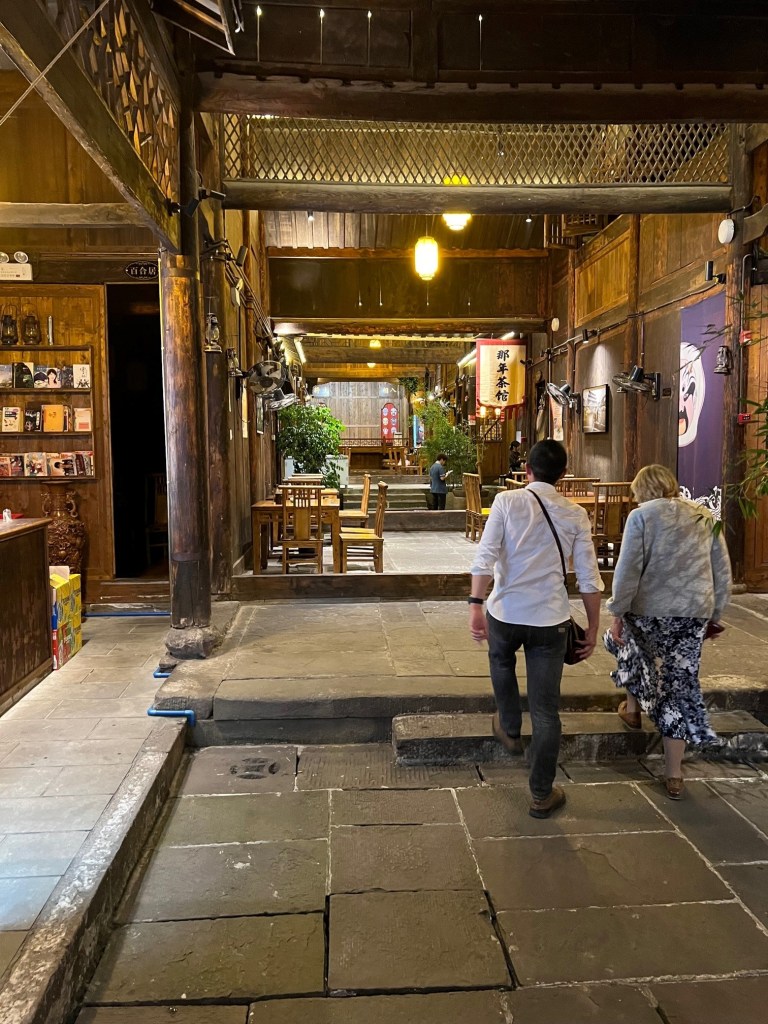
Sometimes though, spiritual life is like walking along that street in China, shown above. We are there by faith, but we don’t understand much of what is going on, and if we are getting any signals we often don’t recognise them or understand what they mean until the moment has passed and they are like another missed call on our cellphone. How often do we lament, “Oh, I knew the Lord was telling me (not) to do that! If only I’d listened!” The signals that we follow the most faithfully are the ones generated by our own bodies and our own minds. We might be spiritual beings, surrounded by spiritual realities, but often we might as well simply be creatures of the flesh for all that we are responding to the spiritual dimension.

Our Guide

What we need of course in an alien environment is a guide, and Jesus has given us just that: a guide to walk with who will make sense of the spiritual world that we have become citizens of. I mean the Comforter of course, the Holy Spirit. But He is a gentleman: He won’t translate for us unless we ask Him. And as well as being a gentleman, He is love, so He won’t guide us in His purposes unless our purposes are committed to His. I have a feeling that God is dealing with many of us as individuals to set us free from our self-centred agendas and align our hearts with His own, so we can be prepared for whatever He is about to do on the Earth. We need to be walking with our Guide.

Solid Food

Because I think the Lord wants to lead us into far greater revelation that we have been accustomed to – the “greater things” He spoke of – and He is saying to many of us that the season of spiritual milk is over. We’re  no longer babes, and we need solid food. We have had plenty of lessons in how to operate in the gifts of the Holy Spirit and we have seen something of the reality of the power of God, but these have mainly been school days and now it’s time to grow up. Classes will always continue for those who need them, but the solid food of living in this world as citizens of the kingdom of God is the same food that Jesus spoke of to His disciples, which is to do the will of the One who sent us. As He sent out the 12 and the 70, He sends the Church out today. To graduate from the classroom requires faith and sacrifice, but it is when we are in touch with the reality of love that we can expect the truth of love to guide us in spiritual realms, and the Power of Love to quicken our lives and flow into the lives of others. We will start to read the signs all around us as we walk: “Reach out here. Touch there. Speak these words. Bring my healing to this sick person. Intercede for this city.  Cast out this demon…”

“Mercy and truth met together.
Righteousness and peace have kissed.
Truth shall spring out of the Earth,
And righteousness shall look down from heaven.

Yes, the Lord will give what is good;
And our land will yield its increase.
Righteousness will go before Him
And shall make His footsteps our pathway.”

(Psalm 85, 10–13).

The Economy of Heaven

The banking system is falling through thin ice

We are currently hearing a lot about the collapse of the Silicon Valley Bank and its potential effect on the world economy: another sheet of the thin ice of debt upon which our financial systems are built has cracked, and it won’t be the last. I’m about to go away for a few days and was glancing through my book “Two Seconds to Midnight” this morning (thinking ‘Should I read through this again and make sure I am practising what I preach??’) and landed on this passage in the section on God’s Provision. The wider context in the book is our priestly calling, but I am sharing it here as a signpost to all of us, in these times of financial shaking, of the certainties of God’s economy.

Ho! Everyone who thirsts,
Come to the waters;
And you who have no money,
Come, buy and eat.
Yes, come, buy wine and milk
Without money and without price.
Why do you spend money for what is not bread,
And your wages for what does not satisfy?
Listen carefully to Me, and eat what is good,
And let your soul delight itself in abundance.”
(Isaiah 55:1-2)

So we find our provision in the presence of God, and we receive His abundance when we take our priestly calling seriously and allow the Holy Spirit to do His work of holiness within us. Indeed, unless we do “come to the waters” I don’t believe we can fully appreciate what it means to “buy and eat” without money. Before the Holy Spirit was sent, the twelve had given up everything to follow Jesus and spent every day in His company, yet they certainly had not grasped that He was Jehovah Jireh and that they could trust Him entirely for their needs. We see this clearly in Mark 8:14-21:

“Now the disciples had forgotten to take bread, and they did not have more than one loaf with them in the boat. Then He charged them, saying, ‘Take heed, beware of the leaven of the Pharisees and the leaven of Herod.’ And they reasoned among themselves, saying, ‘It is because we have no bread.’ But Jesus, being aware of it, said to them, ‘Why do you reason because you have no bread? Do you not yet perceive nor understand? Is your heart still hardened? Having eyes, do you not see? And having ears, do you not hear? And do you not remember? When I broke the five loaves for the five thousand, how many baskets full of fragments did you take up?’ They said to Him, ‘Twelve.’ ‘Also, when I broke the seven for the four thousand, how many large baskets full of fragments did you take up?’ And they said, ‘Seven.’ So He said to them, ‘How is it you do not understand?’”

We are not given any discussion of what they hadn’t understood, because the account moves straight onto the healing of a blind man. But we can read the context clearly enough. Jesus wanted to feed the spirits of His disciples, but they were too worried about their stomachs to receive what He was saying. Yet they had just witnessed Him miraculously providing a good couple of tons of bread (enough for 9,000 men, plus women and children), maybe more, for the needy crowds, with enough left over to feed the disciples for weeks. “Don’t you get it?” He was saying. “You’re sitting in the boat with Jehovah Jireh and you’re worried about food? Why do you think I told you back on the Mount of Olives not to worry about what to eat, or what to wear? You should know by now that I’ve got all that under control, so you can pay attention to the important stuff! ‘Listen carefully to Me, and eat what is good, and let your soul delight itself in abundance.’”

The Baskets Full

There is yet another layer to this story that concerns God’s supply for us. Take either of these two miracles: the sequence is exactly the same. Someone gives a tiny amount to the Lord; He multiplies it and involves His disciples in the miraculous distribution of the food, then there is an abundance left over for the disciples to enjoy. The first priority for the disciples was to give out what God had provided, and after the distribution they received their baskets full. In the world’s economy we receive first – income, wages, salary, etc. – then we give out of whatever spare is left in the baskets at the end. If we’re feeling generous there might be as much as half a loaf left out of our original five. In the economy of heaven there is a different dynamic: first we give what God tells us to give (if He is telling us, of course), then what is left in the basket afterwards is ours. But there is an additional element in the heavenly model: the loaves and fishes have passed through the hands of the Saviour, so what had been earth’s ration becomes heaven’s abundance. God wants us to give out of heaven’s abundance so He can multiply our portion accordingly: “Give, and it will be given to you: good measure, pressed down, shaken together, and running over will be put into your bosom. For with the same measure that you use, it will be measured back to you” (Luke 6:38).

God’s provision is in His presence

The important lesson for us is that God’s provision is in His very presence. What He wants from us is our hearts: a willingness to trust Him with what is ours, and to place it in His hands. We catch a glimpse, literally, of God’s perspective on our economy when we see Jesus sitting outside the Temple watching people putting their gifts into the treasury. We know the story: the poor widow, whose two mites represented all she had, had put in far more than the wealthy who gave leftovers from their abundance. We don’t see that widow again, but we can be sure that God gave back to her in the same measure that she had given to the Temple. Wealth and poverty have traded places. Our God is a creator, and loves to create, and we can so easily forget that when we look at our bank statements. But if our hearts are rich towards Him, we will see Him create in our material circumstances and fill our baskets, whereas if our hearts are bound by our bank accounts we remain in poverty, and will only ever see the loaves and fishes that we can provide for ourselves.

(From “Two Seconds to Midnight,” pp 130-133. MD Publishing 2021)