Category Archives: Walking in the Spirit

God gives the Spirit without limit. Jesus gave the Holy Spirit to the church to equip us to be His witnesses and carry on the work that He started by that same power. To deny that the power and gifts of the Holy Spirit are available to the believer today, or to say, as some do, that God does not speak supernaturally to His people today, is effectively taking Christ out of Christianity.

Bread from Heaven: 3

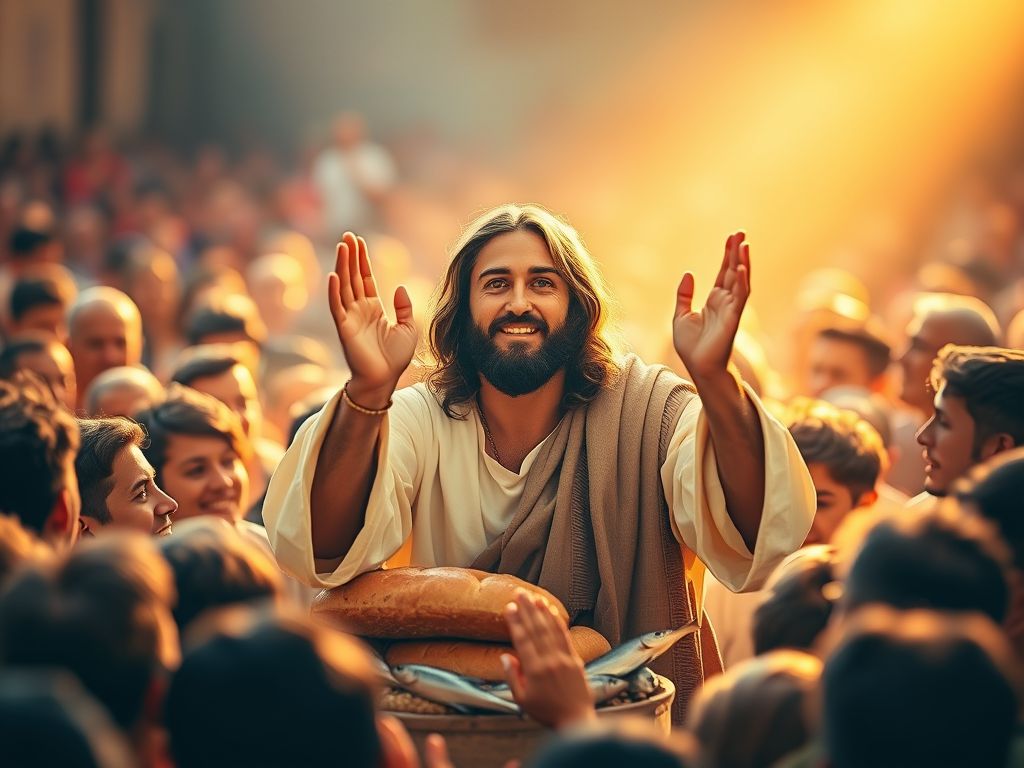
And Jesus took the loaves, and when He had given thanks He distributed them to the disciples, and the disciples to those sitting down; and likewise of the fish, as much as they wanted. (John 6:11)

He knew what He would do
In our attempts to bring up our children to say “please,” the parents among us might well have said at times: “And what’s the magic word?” However in the Kingdom it’s not please, it’s thank you. Jesus didn’t ask the Father to multiply the loaves and fishes; he thanked Him for them. This miracle, along with its “twin“ where the 4000 are fed in the accounts of Matthew and Mark, is one of only three occasions in the New Testament where Jesus gives thanks to the Father. The Greek word used for giving thanks is eucharisteo, and Jesus uses it when He feeds the multitude, when He thanks His Father for always hearing His prayers at the raising of Lazarus, and at the last supper, when He gave thanks for the bread and wine.

Eucharisteo: We use the same Greek word ourselves when we remember the cross at the Eucharist, and for me, this is the key to understanding much of the significance of this miracle. Andrew looked at the loaves and fishes with eyes of flesh and asked: “What is this among so many?”, but Jesus looked with the eyes of the spirit and saw the riches in glory that would meet the need of the multitude above all that the disciples could ask or imagine. He could see the limitless creative powers of heaven, and He knew that “all that the father has is mine,” (John 16:15) so it is no surprise that John’s account of the miracle tells us that “He himself knew what He would do.” (John 6:6)

In everything give thanks
In his letter to the Philippians, Paul exhorts us to “be anxious for nothing, but in everything, by prayer and supplication, with thanksgiving, make your requests known to God.“ (Philippians 4:6) We know that Jesus had direct access to the Father’s provision because of who He was, and there are no barriers to our faith in that regard. But it is much harder to believe that we have the same access to that provision, because we know who we are as well. We can, and do, believe that Christ dwells in our hearts through faith, that in Him we are seated in heavenly places, and that all things are possible through Him; but we also know that we have only experienced the boy’s family picnic when faced with a multitude, and not the feast.

When Jesus gave thanks at the feeding of the 5000, I don’t think He was thanking His Father for the loaves and fishes in His hand, but for the provision that was in heaven. Demonstrating what He told His disciples in Mark 11:24, He believed He had received it, gave thanks for it, and it was done for Him. His Father passed the food to Jesus, and He passed it to the disciples to give out.

God wants us to give thanks in everything. Whether we are faced with abundance or lack, and whether or not we are petitioning heaven for something, we are to be thankful at all times. Paul expresses this sentiment in his letter to the Romans:

“… He who eats, eats to the Lord, for he gives God thanks; and He who does not eat, to the Lord he does not eat, and gives God thanks. For none of us lives to himself, and none of us die himself. So if we live, we live to the Lord; and if we die, we die to the Lord. Therefore, whether we live or die, we are the Lord’s.” (Romans 14:6–8).

Our Inheritance
As I have mentioned, the only occasion outside of feeding the multitudes and giving thanks for the bread and the wine at the last supper, was when Jesus thanked the Father for hearing Him at the raising of Lazarus. His Eucharist there was more about His relationship with the Father than what He was about to do. Our constant thanksgiving to God is not for what we do or don’t eat – or do, or receive -, but it’s for a relationship with Him which we can indeed be thankful for in all things. We can be thankful to Jesus every moment of the day for the fact that we are His, and what we have is His. But more than that, amazingly, what He has is also ours:

“And if you are Christ’s, then you are Abraham‘s seed, and heirs according to the promise.”(Galatians 3:19)

“And because you are sons God has sent forth the spirit of His son into your hearts, crying out, “Abba, Father!“ Therefore you are no longer a slave but a son, and if a son than an heir of God through Christ.” (Galatians 4:6–7)

We are heirs of God through Christ. We have an inheritance to be forever thankful for. Just as everything that the Father has belongs to Jesus, everything that Jesus has is ours in Him. Of course this does not mean that my neighbour’s house, or wife, or goods belong to me because they are His: the key phrase is “in Him.” “In Jesus name” is not just a phrase that turns a request into a prayer, but it’s the declaration that what we are asking for in prayer is something that we are requesting on His behalf because He has told us that He wants us to have it, whether it’s to accomplish His Kingdom purposes through us or for us. Whatever we are doing, we have an inheritance to be thankful for, and which is at our disposal all the time we are walking alongside Him. What is His is ours. If I am sitting at the dinner table with my wife and I ask her to pass the salt, she is not going to question my action: the salt on the table is a shared possession. Of course she is going to let me have it.

Paul makes this clear in his first letter to the Corinthians:

“Therefore let no one boast in men. For all things are yours. Whether Paul or Apollos or Cephas, or the world, or life, or death, or things present, or things to come – all are yours. And you are Christ’s, and Christ is God’s.” (1 Corinthians 3:21-23)

Just as Jesus is the transition from earth to heaven for our spirits, He is also the transition for us from heaven to earth for our inheritance. So whatever the loaves and fishes or the starving crowd may represent, what do we have available to meet the need? Jesus can make our lack into His abundance if we remember to thank Him for our inheritance. Pass the salt, please, Lord. Thank You.

Being disciples; making disciples.

We all know that Jesus calls us to “go and make disciples of all nations.“ Some of us obey the call geographically and go to other nations to make disciples; some of us find “the nations” in our own neighbourhood or workplace; some of us ignore the call altogether and leave it to the evangelist. But even if we don’t live in a mixed race neighbourhood and everybody at work was born in the same country as we were, our home country is still a nation, and we still have to “go” to it, and the purpose of “going” is to make disciples. So assuming we have “gone” with a willingness to share the gospel, how do we go about the business of discipleship?

“Follow me as I follow Christ,“ said Paul to the Corinthians. (1 Corinthians 11:1)  We can’t really expect to make committed disciples if our own discipleship is flabby and inconsistent. I don’t think it’s enough just to lead people through discipleship courses: the Holy Spirit has to be at work in and through the people leading the courses if the spirits of new believers are going to be impacted and their minds renewed. If we want new believers to grow to maturity and find their place in the Kingdom of God, we need to launch their walk with the power that they will eventually need to carry on without us and be discipling others themselves. The alternative is a church that is bloated with members but lacking in love and power – what Smith Wigglesworth called “leafy trees” that bear no fruit.

“Freely you have received, freely give,” said the Lord when he sent out the twelve. (Matthew 10:8) when we “go” to make disciples, we can only give what we have received ourselves.

In all your ways acknowledge Him
I found a key verse for discipleship in an unexpected place: proverbs 3:5. We all know it: “Trust in the Lord with all your heart and lean not upon your own understanding. In all your ways acknowledge him, and he will direct your paths” The first part of this verse tells us clearly where to place our trust, and it tends to be the one that is quoted the most often. But it’s the second part that caught my attention. The word translated – rather weakly, I feel – as “acknowledge,“ is yada. In Hebrew this is the word used for “knowing” in life-giving intimacy, as when Adam “knew” Eve. What the second part of Proverbs 3:5 says to me is that God will “direct our paths” when we take every step in intimate relationship with him. Following this, the word yasar, translated here as “direct“ our paths is the same word used in Isaiah 40:3 for “make straight” a highway in the desert.

The voice of one crying in the wilderness:
“Prepare the way of the LORD;
Make straight in the desert 
A highway for our God.”

When God is with us – not just notionally, but experientially – at every step, he won’t just be “directing” our paths in the sense of telling us where to go, but he will be ‘making them straight’ before us, clearing the ground and removing obstacles so that we can move forward with Him even though it may feel as if we are lost in the desert.

Zachariah 8:23 says this:

 “Thus says the Lord of hosts: In those days ten men from every language of the nations shall grasp the sleeve of a Jewish man, saying “let us go with you, for we have heard that the Lord is with you.”

It is when the men (and the women) of the nations know that the Lord is with us that they will want to “go with us.” Surely this is a picture of how we are to make disciples. As we walk closely with the Holy Spirit and He directs our paths, so we can direct the paths of others; not by weekly meetings following a discipleship course, but by walking alongside new believers who have joined themselves to us because they can see God at work in our lives. But there’s a health warning here, too, especially for people (like myself) who cherish their own space: when revival comes and we have ten people grasping our sleeves, we won’t have a lot of time for ourselves. Are we ready? Am I?

The Passion of Agape: Love and Fire in Revival

“Oh God of burning, cleansing flame,
Send the fire!
Your blood-bought gift today we claim,
Send the fire today!”

(William Booth)

Before Jesus saved me back in 1984, I was a New Ager. An old friend who knew me then – in fact he was one of the people who were praying for us at the time – has just sent me the following email: “Thought this might grab you.  Two New Agers moved to Stroud because they thought that’s where they’d find the answers.  Eventually, they turned up at John Street Baptist Church saying, “The New Age hasn’t worked.  What have you got to offer?” They became Christians and brought lots of friends along so that the New Age enquirers started to outnumber the members…”

God is clearly starting to move. People are hungry. But unless we are hungry for God ourselves we cannot expect to share our bread with others. The following is an extract from Wheat in The Winepress: I wrote this passage in 2017, but I’ve been feeling for the last couple of days that it’s appropriate to release it again now.

Our element
The zeal of the Lord of Hosts, the fire of the Holy Spirit which Jesus sends onto the world, and the perfect love, the agape, that casts out fear are all bound together: zeal expresses agape, agape sends zeal. Together they express the passion of the heart of God that yearns for the restoration of His Kingdom and the marriage of the Lamb. This is the Love that Jesus tells us to abide in. Like water to fish, as I’ve already said, the “sea of pure divine love” that they experienced at Azuza Street is actually the element in which we are called to live. It is no coincidence that the greatest miracles happened there when the fire was visibly present.

It is often said that in the developed, “free” world we don’t see the miracles of healing that seem to be much more the norm in third world countries and the persecuted Church. I, for one – and I think I speak for many here – have always explained this by saying “we think we don’t need faith: we have medicine!”   But as we know, Paul tells us that what counts – the only thing that counts – is “faith working through love” (Gal 5:6). Even if I have the faith that moves mountains, without love I am nothing (1 Cor 13:2). I don’t think it’s the faith that sets these churches apart, so much as the love through which it is working. They “love each other fervently, with a pure heart.” They need each other, are committed to each other, and are contemporary expressions of the Church of Acts 4. They are one as the Father and the Son are one. Their unity commands the blessing. Because they are obedient to the command to “love one another” they receive what they ask from the Father. They are swimming in that sea of perfect Love; they are abiding in Christ, immersed in the river of Ezekiel 47; they are in their element. Am I? Are you? Or are we fish out of water, flapping about on the deck, gasping for Life in the Spirit, knowing that there should be more but somehow unable to reach for it? 

The longing of the Bride and the Groom
Wherever it is that we see the fire burning today, or if we look into history and see where it has been, we find the same initial spark: Christians who are hungry for more of God. Not just a little bit more – “If I clear the cluttered desk of my life – actually no, just my church meeting as long as You don’t stay too long – a bit, I can fit a bit more of you on this corner, God” – but really MORE; the more that will take us from our dimension into His. “Lord, I’m sweeping everything off my desk. Will You come and fill it? Nothing else will do!”

The cry of the heart, a two-word prayer, that went out from Toronto in 1994 and still goes out today was “More, Lord!” Another two-word prayer that I remember singing as a worship song in a UK Catch the Fire meeting in 1995 was “Yes, Lord!”. If we want More, first we really need to be hungry: it’s “the effective fervent prayer of a righteous man (that) avails much” (James 5:16); and second: God wants our total Yes.

The story of Gideon shows us how we can respond when God’s fire begins to take hold. If we want to see in the Word how the fire starts we need to look elsewhere: not to a New Testament treatise on the Holy Spirit, or to an Old Testament prophesy of Holy outpouring, but to the love poem on the longing of the bride and the groom for one another. As the unfolding of the intimacy between the Shulamite and The Beloved draws to a close, the bride says, in words that encapsulate the essence of the zeal of the Lord:

 “Set me as a seal upon your heart,
As a seal upon your arm;
For love is as strong as death,
Jealousy as cruel as the grave; 
Its flames are flames of fire,

A most vehement flame” (Song, 8:6)

The jealous, passionate love of the Father and the Son, burning in the fire of the Holy Spirit: for the bride of the Bible, nothing else will do. Before the Beloved comes to her, He asks for one thing:

“You who dwell in the gardens,
The companions listen for your voice –
Let me hear it!”
(Song 8: 13)

And the bride responds, to end the poem:
“Make haste, my beloved,
And be like a gazelle
Or a young stag
On the mountains of spices.”
(Song 8: 14)

Not even Jesus could tell us when He is going to return, but we know two things. One is a collection of signs of the end of the age that He gives us in Matthew 24 – signs which many would say are being fulfilled in our day. The other thing that we know is that He will come in response to hearing our voice. “Let me hear you call me!” says Jesus, the Beloved. ‘Let me hear you say the words “Make Haste, my Beloved!” I want you to be hungry for Me!’ At the very end of the Bible we hear the echo of the Shulamite’s response: “And the Spirit and the Bride say, ‘Come!’” And we hear the Beloved say: “Let him who hears say, “Come!” And let him who thirsts come. Whoever desires, let him take the water of life freely.” (Rev 22:17)

It’s not just the Bride who calls out; it’s the Spirit and the Bride. Just as Jesus completed the work that the Father gave Him to do at the cross, the Holy Spirit will one day complete the work that He has been given to do on the earth: the preparation of the Bride for the marriage of the Lamb, and the handing over of the kingdoms of the world to the kingdom of our God and His Christ. And as individuals and churches, we are ready when we hear Him ask us to call out to Him. We are ready when we acknowledge that we are thirsty. We are ready when we desire to freely take the water of life. According to the Song of Songs, this will be when we say “More Lord, Yes Lord, nothing but the most vehement flame will satisfy!” 

The Fullness of God
One final thing we can be sure of is this: when holy fire does bring revival to our street, it won’t be anything like what we expect. However in the parable of the ten virgins (Matt 25: 1-13) Jesus does make it clear what we have to do: we need to be ready for Him with our lamps trimmed and full of oil. This isn’t just about trimming wicks: it’s about the whole lamp. The Strong’s definition of the Greek word for “trimmed”, kosmeō (from which comes our word “cosmetic”) means to arrange, decorate, adorn, or put in order. In the book of Revelation the seven lampstands represent the seven churches that the risen Lord is walking among (Rev 1:20). Jesus wants our churches to be brimming with the oil of the Holy Spirit, and beautified with all the fruit of lives laid down, hungry for Him.

The last words of Christ’s prayer in the Garden of Gethsemane were this: “I have declared to them Your name, and will declare it, that the love with which you loved Me may be in them, and I in them” (John 17:26). The Greek word onoma, name, means more than just the epithet by which a person is called – it refers to everything associated with the name, including character, rank, and all attributes. Jesus is saying that He has revealed the fullness of the Father to His disciples: as He said, “If you’ve seen me, you’ve seen the Father.” And He says He will reveal the fullness of the Father in the future: “I will declare it.” How? By the Holy Spirit, whom He will send to bring the same revelation that the twelve had when they were with Him. Why? So that His agape may be in us. The agape of God being poured out into our hearts by the Holy Spirit who is given to us is the fulfilment of John 17:26. Jesus tells us that it is by our love that the world will know we are His disciples. I don’t think that this is about the world looking at us and just seeing how much we love each other, or even looking at our humanitarian efforts and seeing how much we love the world. It means that when we truly walk in His agape WE WILL DO THE WORKS THAT HE DID, and revival will follow. This was Heidi Baker’s experience in Mozambique, and surely this is true discipleship.

Paul prayed (Eph 3 14-21) that we would be filled with all of God – the “fullness” of God, meaning that no aspect of the Divine nature (see 2 Peter 3-4) would be missing from our lives. This fullness comes from yielding our vain understanding to the truth that the Agape of Christ goes beyond anything we can humanly grasp; that it surpasses or goes beyond anything that we can call knowledge. Paul begins by praying that, with all the riches of His Glory at His disposal, God would give us the supernatural ability, the dynamis power, to enable the faith to rise in our hearts that Christ will make His home there as He promises (John 14:23). Paul uses the word katoikeō, meaning to dwell, inhabit, be always present. This prayer, for them and for us, is that the indwelling Christ would become a present, manifest reality in our lives so that agape can become the foundation for all we are and all we do; that Jesus would hold our gaze with that most vehement flame, reaching out through us with supernatural gifts to the people we are with, lifting our hearts into heavenly glory as we worship, and opening the storehouses of Heaven to all our needs as we bring His fire to the earth.

We are rooted and grounded in agape when the manifest presence of God is a reality in our lives and we walk in intimacy with Him, and this can only happen when we fully die to ourselves and yield our hearts to the mighty power of the Holy Spirit. Without dynamis there is no Gideon’s army and there is no agape; and without agape there will always be wheat in the winepress.

A picture has been with me as I have been thinking about this over the last few days, and it’s that of a bonfire that has burnt down from its original intensity and where the burning sticks have been scattered on the ground, charred black in places, still glowing red in places with a few small flames licking around them. I believe this is a picture both of the Church – where the sticks are individual congregations – and of churches, where the sticks are individual believers. For centuries the devil has been poking and scattering, isolating people, isolating congregations, always working to destroy unity and weaken the Church. I believe that God is gathering those burning pieces of wood together. He is leaning over them, His heart bursting with love, the marriage of the Lamb bright in His vision, blowing, blowing, blowing. As He rearranges those embers and burning brands new relationships will be formed and old structures broken. To be an army of Gideons in these last days we need to let Him gather us where the flames are and let His agape fill our lives: then we can set our world on fire.

(Adapted from “Wheat in the Winepress,” MD Publishing 2018)

Walking worthy of our calling


“I, therefore, the prisoner of the Lord, beseech you to walk worthy of the calling with which you were called, with all lowliness and gentleness, with longsuffering, bearing with one another in love, endeavouring to keep the unity of the Spirit in the bond of peace.”
(Ephesians 4:1)

I beseech you therefore, brethren, by the mercies of God, that you present your bodies a living sacrifice, holy, acceptable to God, which is your reasonable service.” (Romans 12:1)

I’ve been reading Romans 12 alongside Ephesians 4 recently, and I was struck by the similarities in both Paul’s messages. They both begin with the same entreaty: “ I therefore beseech you.” Paul beseeches the Romans to “present your bodies a living sacrifice, holy, acceptable to God, which is your reasonable service,” and goes on to encourage them “not to think of himself more highly than the ought to think but to think soberly…“ In essence this is very similar to “walking… with all lowliness and gentleness, with longsuffering, bearing with one another in love.” To the Romans he explains that this is necessary because “God has dealt to each one measure of faith,“ whereas to the Ephesians he writes “to each one of us grace was given according to the measure of Christ’s gift.“ The Romans are taught that “we, being many, are one body in Christ, and individually members of one another,“ whereas the Ephesians are encouraged to “keep the unity of the spirit in the bond of peace. There is one body and one spirit, just as you were called in one hope of your calling…“ (3 to 4). In both letters Paul considers how different grace gifts perform different functions. For the Romans Paul focusses on the functions (sometimes called “motivational gifts”) themselves, whereas to the Ephesians he looks at the different types of people performing them – the “(fivefold) ministry gifts.” However both passages essentially have the same message:

“Don’t think of yourself as special: the identity and purpose that you have has been given to you as a gift by the grace of God and is yours by Faith. Your life isn’t about you. It’s about the point you play in the Kingdom of God, which is the rule and reign of Christ through his body on earth. It has meaning and value when it is used for the benefit of others out of a motivation of love for the Lord and love for others. If you can put your flesh and your self-importance on the altar and get hold of the glory and majesty of the Kingdom we are being called into, and concentrate on using what it is that God has given you to do to equip and build up others, not in your own strength but in His mighty power that can move mountains with mustard seeds, the whole body of Christ will grow in love and maturity and God will be glorified.“

The Hope of our Calling
In the light of this, what is “the hope of our calling,” and the ”calling with which we are called?” Paul says “I press on towards the goal for the prize of the upward call of God in Christ Jesus.” (Philippians 3:14) Our call is from Heaven. It’s a prize. Bible teacher Andrew Wommack says: “When you see a therefore, you’ve got to find what it’s there for!” Romans 12 begins: “I beseech you therefore, brethren, by the mercies of God, that you present your bodies a living sacrifice, holy, acceptable to God, which is your reasonable service.” What’s the therefore there for? Read the last verse of the previous chapter, which is all about the unsearchable wisdom of God in His plan for “all Israel,” Jew and Gentile, to be saved. The last verse reads: “For of Him and through Him and to Him are all things, to whom be glory forever. Amen.” When we offer our lives to Jesus as a living sacrifice because we realise there’s nothing else we can reasonably do in the light of all that He is, we are pressing on for that goal.

In Philippians 3:12 Paul also talks about pressing on, “to lay hold of that for which Christ has laid hold of me.“ Jesus got hold of our spirits on the cross and has taken them to heaven with Him, and now he’s calling us to live lives that will manifest on earth the amazing truth of who we have become. We are called to leave our own bodies behind and humbly join ourselves to the spiritual body of Christ. That is the calling which we are to walk worthy of. A hand isn’t a hand for its own sake; it’s only a hand in as much as it serves the body. My call isn’t my ministry: it’s the coming perfection of the body of Christ – “a perfect man, to the measure of the stature of the fullness of Christ;” (Eph 4:13) – that it serves.

Measuring Mustard Seeds
Paul introduces his passage to the Romans on gifts with the explanation “God has given to each of us a measure of faith,” (Romans 12:3) whereas the introduction to the parallel passage in Ephesians four is “but to each of us grace was given according to the measure of Christ gift.”  This leads me to the final point of this teaching. If indeed these two texts are expressing the same truths in the way that I suggest they are, then the “measure of faith” corresponds to “the grace that has given according to the measure of Christ gift.” The point is this: what measure does God use? I have always understood these passages as saying that God gives each one of us a particular measure of faith to correspond with the gift in which we are operating, and every translation I have seen seem to imply the same thing – ie that God deals, or assigns, different measures to different people. However Jesus Himself says “God does not give the Spirit by measure.” (John 3:34) Christ’s gift to us is the power that raised Him from the dead (Romans 8:11), and “the power to do exceedingly abundantly above all that we could ask or think.” (Eph 3:20) If we only need a “mustard seed” grain of the faith that comes from God to move a mountain, is God really going to measure our mustard seeds depending on the size of the mountains He want us to move? I think not. God didn’t give me more, or less, grace than He gave you: we both received His grace according to the measure of Christ’s gift, which is actually beyond measure. As we know from 2 Cor 12:12, when we are weak, we are strong. It’s when we operate in our weakness but in His measure of grace that God is glorified. Peter puts it like this: “If anyone ministers, let him minister as with the ability that God supplies, that in all things God may be glorified through Jesus Christ.

The Perfect Man
Paul gives us this vision of the Body of Christ in Ephesians 4:16 “from whom (ie Christ, the Head) the whole body, joined and knit together by what every joint supplies, according to the effectual working by which every part does its share, causes growth of the body for the edifying of itself in love.”

The phrase ”effectual working” is the Greek “energeia”, which is only used in the New Testament for superhuman power. “Share” is metron, the same word as the measure (metron) of Christ’s gift. We are called to participate in God’s plan by devoting ourselves to laying hold of His superhuman power to fulfil our assignments. We aren’t going to access His energeia unless our walk is aligned with His will, and to align with His will we have to lay down our own. There is no such thing as compromise in the service of the King: our sinful nature is such that we can’t walk  “with all lowliness and gentleness, with longsuffering, bearing with one another in love,” unless we’ve left our flesh on the altar and stepped away as the new creations that we are in the Spirit. I believe that it’s only when we succeed in this that Ephesians 4:16 is fulfilled in our lives.

The “perfect man” that the body of Christ is being called into is the mature bride of Christ filled with a love that matches His own. To play our part in that high calling our lives must display a love and desire for unity that is worthy of the goal we are pressing on to attain.

Those who wait on the Lord shall renew their strength

Have you not known?
Have you not heard?
The everlasting God, the LORD,
The Creator of the ends of the earth,
Neither faints nor is weary.
His understanding is unsearchable
.

He gives power to the weak,
And to those who have no might He increases strength.

Even the youths shall faint and be weary,
And the young men shall utterly fall,

But those who wait on the LORD
Shall renew their strength;
They shall mount up with wings like eagles,
They shall run and not be weary,
They shall walk and not faint.

(Isaiah 40: 28-31)

I have always seen “waiting on the Lord” in the context of extended time frames: waiting for the Holy Spirit to show up in a worship service; waiting for an answer to prayer; waiting days or weeks for a word from God before making a decision. In addition, I have never thought deeply about running and not growing weary, or walking and not growing faint, although in my advancing years I certainly look longingly at those verses and hope they will apply to my physical state. Mounting on wings like eagles has been a  metaphor for growth, increase, victory, in fact any undefined superior state that can be attained under God’s blessing: the verse has never had a very practical application for me, just a rather undefined sense of promise that I can’t say I have often known to materialise outside of some worship services where “rising up” to a higher level of worship in the Spirit has been the goal. I have never applied the scripture to short term, immediate contexts.

Until today. When I was a child, my mother used to say to me “Bobby, you’re always rushing.“ (A word to the wise: if you know me, please do not call me Bobby!) It’s a character trait I’ve battled with (or maybe so much not battled as be driven by…) all my life. I’m a “fast adopter“ when it comes to decision-making; I tend to try to do things quickly so I can finish them rather than aim for thoroughness ; I seem to miss significant details on the few occasions when I’m trying to think things through, and – probably most importantly – I tend to say the first thing that comes into my head in conversation without really checking if it’s coming from a positive or a negative place. This is at age 74, after more than 40 years of being a Christian, when I really should know better. Not much about me seems to have slowed down except my body.

But this morning I saw these verses differently. It was in an all too familiar context, where I had gone into something without giving it sufficient forethought, when I realised that “waiting on the Lord“ can also mean waiting for as short a time as a few seconds for my flesh to die and “the wisdom from above” to rule my thinking before responding to words or circumstances. And then I saw the rest of the scripture. Mounting on Eagles wings takes me into the heavenly places where my new man is seated in Christ, where I can draw on all I have been given in the Spirit. When I do this, I renew my strength in the Lord. I can “walk worthy of my calling” (Eph 4:1) and “not grow weary of doing good.“ (Galatians 6:9). I can “run with perseverance to race marked out for us,“ not growing faint, but “fixing my eyes on Jesus the author and finisher of my faith.“ (Hebrews 12:1–2)

When we “mount up with wings like eagles” we take our place in the Spirit, in the Lord who “neither faints nor is weary.” We don’t grow faint or weary because He doesn’t, and we are in Him. Out of His unsearchable understanding comes the wisdom we need, “the wisdom from above,” which is “ first pure, then peaceable, gentle, willing to yield, full of mercy and good fruits, without partiality and without hypocrisy. (James 3:17). In our weakness we are strong. (2 Cor 12:10)

Verse 30 says this:
Even the youths shall faint and be weary,
And the young men shall utterly fall…

I have always seen this verse as a dramatic contrast with the favourable consequences of waiting on the lord in the rather woolly sense that I have always understood it, but now I understand it more as a contrast between walking ( or running) after the flesh, which always leads to failure, and walking in the Spirit. “Waiting on the Lord” becomes taking the time to step  into the Spirit  – or as Graham Cooke calls it, to “step back into the Lord” – to receive all that there is for our situation from where we are seated in Christ in heavenly places. Yes, we need to wait for Him in our meetings if we want to see the power of God move and His Presence fall. Yes, we need to wait in faith for Him to answer our prayers. But, and just as importantly, we need to wait for Him in the dynamic of our daily walk with God if we want to walk after the Spirit and not after the flesh.

In the light of this, the urgency of psalm 27:14 takes on a new meaning:

“Wait on the LORD;
Be of good courage,
And He shall strengthen your heart;
Wait, I say, on the LORD!”

Let’s do it. It appears to be a recommended route to victory in Christ.

Understanding the Sabbath: Peace in Christ

“He Himself is our peace.” (Eph 2:14)

“For this reason the Jews persecuted Jesus, and sought to kill Him, because He had done these things on the Sabbath.” (John 5:16)

There is a lot more to the Sabbath law than observance of the fourth commandment, which instructed the Jews to “Remember the Sabbath Day, and keep it holy.” Just as Jesus’s “work” on the Sabbath was emblematic to the Jews of His disrespect for the whole of the Old Covenant law, the sabbath itself looks forward to the New Covenant in His blood that sets us free from condemnation under the Law and into the peace of His Sabbath rest.

The Bible tells us: “And on the seventh day God ended His work which He had done, and He rested on the seventh day from all His work which He had done. Then God blessed the seventh day and sanctified it, because in it He rested from all His work which God had created and made.” (Genesis 2:2-3) The new testament adds another layer to the Creation account: the specific involvement of Jesus in the work of creation.

“For by Him all things were created that are in heaven and that are on earth, visible and invisible, whether thrones or dominions or principalities or powers. All things were created through Him and for Him.” (Col 1:16) “All things were made through Him, and without Him nothing was made that was made.” (John 1:3) God rested from his work on the Sabbath, or the seventh day, so the Sabbath was instituted. But it wasn’t only the Father who rested: the Son rested too.

A way of life, not just an observance
God rested when the work of creation was finished. And He rested again when the work of the new creation was finished on the cross. When God blessed the sabbath day and sanctified it under the old covenant, He was looking forward to the time when, in Jesus, His rest would be a way of life, not just an observance. But in the era of the Old Covenant also, God’s rest extended beyond the seventh day. The writer to the Hebrews says:  “To whom did He swear that they would not enter His rest, but to those who did not obey?” (Heb 3:18) For the rebellious Hebrews, who “did not enter because of unbelief,” (Heb. 3:19) entering God’s rest equated to entering the Promised Land, where they would find rest from the toil of slavery.

Just as Canaan represented God’s rest for the Israelites, we enter our rest in Christ when we believe in His promises to us, or as Hebrews 3:14 puts it, “if we hold the beginning of our confidence steadfast to the end.” The Greek word used for God’s rest is “katapausis,” which means “a calming of the winds.” Katapausis Is the spiritual atmosphere of Heaven. Jesus tells us “My peace I give to you; not as the world gives do I give to you” (John 14:7), and when we walk in His peace we walk in the atmosphere of Heaven and find “rest for our souls.” (Matt. 11:29). All the winds are calm, because – as Jesus physically demonstrated – it is He who calms the storm.  As every Christian knows, He famously said, “The Sabbath was made for man, not man for the Sabbath.” (Mark 2:27). God gave us the Sabbath to enshrine in His Law that we need to enter His rest, not that we need to stop working every seven days.

Finished – but still working
Two notions that seem to be at odds with each other are that “God finished His work” on the seventh day, and the words of Jesus to the Pharisees when they confronted Him over healing the man at the pool: “My Father has been working until now, and I have been working.” (John 4:17) What is the difference between the work that the Father and the Son finished on the seventh day, and the work that they were – and still are – continuing to do?

I think the answer lies in the fact that creation was perfected on the seventh day, so all of God’s dealings with Man – Father, Son, and Holy Spirit – from then on were from His place of rest. Whether it was Christ’s miracles of healing and deliverance, God’s victories in the reign of David and many other heroes, or His repeated call to His errant people through His prophets to return to Him, the focus of God’s work has always been to restore His people to their Sabbath state of wholeness and relationship with Him. The lame man was healed on the Sabbath so the he could walk in the wholeness that the Sabbath represents. Just as the first creation was finished on the Sabbath day, so the new creation was perfected when Jesus cried out from the cross “It is finished!” And so the writer to the Hebrews says: “We who have believed into that rest.” (Hebrews 4:3) Through faith in the redeeming blood of Jesus that was shed on the Cross, we become “the righteousness of God in Him,” (2 Cor 5:21) and enter into the perfection of God’s rest.

“True righteousness and holiness.”
This perfect state is the condition of the new man, “which was created according to God, in true righteousness and holiness.”  (Eph 4:24) Peter exhorts us to  “be diligent to be found by Him in peace, without spot and blameless,” (2 Pe 3: 13) while Hebrews 4:9-11 says “There remains therefore a rest for the people of God. For he who has entered His rest has himself also ceased from his works as God did from His. Let us therefore be diligent to enter that rest, lest anyone fall according to the same example of disobedience.” The peace of His sabbath rest is the gift of God’s grace through Jesus, yet two new testament writers exhort us to be diligent to “enter” that gift. So while we cannot earn God’s peace by our religious works, we need to “work” at keeping a short account of sin in our lives (“without spot and blameless”) and “work” at remembering who we are in Christ, what He has purchased for us, and that “The Spirit of God, who raised Jesus from the dead, lives in you.” So rest does not come without some effort (Romans 8:11), but if we are diligent to keep these truths foremost in our thinking we will walk away from the paralysis of religion and into God’s rest.

Only in that place we can really access everything that is our promised inheritance in Christ.

(The topic of “entering into God’s rest” is also explored in “Walking in Newness of Life.”)

The Pool of Bethesda (2): the paralysis of religion

After this there was a feast of the Jews, and Jesus went up to Jerusalem. Now there is in Jerusalem by the Sheep Gate a pool, which is called in Hebrew, Bethesda,  having five porches. In these lay a great multitude of sick people, blind, lame, paralyzed, waiting for the moving of the water. For an angel went down at a certain time into the pool and stirred up the water; then whoever stepped in first, after the stirring of the water, was made well of whatever disease he had. Now a certain man was there who had an infirmity thirty-eight years. When Jesus saw him lying there, and knew that he already had been in that condition a long time, He said to him, “Do you want to be made well?” he sick man answered Him, “Sir, I have no man to put me into the pool when the water is stirred up; but while I am coming, another steps down before me.” Jesus said to him, “Rise, take up your bed and walk.” And immediately the man was made well, took up his bed, and walked. And that day was the Sabbath. (John 5: 2-9)

God’s house of mercy
The healing at the pool took place on the Sabbath. In the sequence of signs as John recorded them, this was the first time that Jesus challenged the religious order by “working” on the designated day of rest, and John records it as the opening skirmish of His battle with the pharisees that ended at Calvary. “For this reason the Jews persecuted Jesus, and sought to kill Him, because He had done these things on the Sabbath.” (John 5:16) “Bethesda” means “house of mercy,” or “flowing water,” and it was by the Sheep Gate. This is not just a place in Jerusalem: it is a picture of the church. The healing at Bethesda was certainly a sign pointing to our need for an encounter with the living Christ, but it also tells us that there are many sheep in God’s house of mercy and flowing water who are immobile on their beds by the pool, and that one of the main types of paralysis is the paralysis of religion.

Paralysed by religion
The dictionary definition of religion refers to worship of a God or gods and the activities surrounding that worship, and in a broader sense to “enthusiastic and repeated engagement” in a particular pursuit. Avid sports fans are often referred to as making a religion of their sport, for example. However, I worship the Christian God, enthusiastically and repeatedly, yet if someone asks me the question “are you religious?“ I say, “No I’m not religious; I have a living faith.“ So in the church many of us now see the term religion as not so much describing our worship of the living God, but the practice of those who, in the words of Paul to Timothy, have “a form of godliness but deny its power.” (2 Timothy 3: 5–7). The question for those of us who say we have a living faith is this: is it possible for us also to be paralysed by religion?

We tend to Pillory the Pharisees today as archetypal examples of everything we want to avoid in our worship of Christ. And so we should: they lived by the law and missed Jesus. There is no need to quote here any of the many things that Jesus said against them: the important point is that we don’t follow their example and find ourselves as paralysed and lifeless as they were. They too were lying by the pool on their bed, the bed of the law, waiting for the waters to be stirred by the Messiah – who was standing right in front of them.

Flowing in the spirit?
The Bible tells us, “Whatever was written in the past was written for our instruction so that we could have hope through endurance and through the encouragement of the scriptures.”  (Romans 15:4) The Holy Spirit hasn’t just made it clear how tragically fruitless the religion of the Pharisees was so that we could feel superior in our relationship with Him: those scriptures are also there for our instruction so that we can take care not to follow any of their practices. How much of this instruction are we actually taking on board? For example – and I know I’m far from being the first person to say this – I was born again In 1984, when the charismatic movement was surging through the established church. We used to think of ourselves as “flowing in the spirit,“ and (I’m ashamed to say) how superior we were to the church down the road whom we saw as ossified in their “hymn– prayer sandwich“ format. I now belong to one of the larger modern evangelical Charismatic/Pentecostal networks. We consider ourselves to be free in the spirit, and to be hosts of the presence of God during our meetings. But before I go to church on a Sunday, I know that we will start with a couple of fairly lively praise songs, the host for the day will do the notices, the children and teenagers will go out to their respective groups, we will continue with worship for about another half an hour, then there will be a preach (we used to call them sermons, but that was  too religious) for about 30 minutes, and then a closing song and an appeal for ministry at the end. We will start at 10:30 and finish around 12:15; gather for refreshments after the meeting, and will be out of the building by about 12:45. We do make room for the gifts of the Spirit during the worship time, so three or four people might bring a word of encouragement, a prophecy or a word of knowledge; maybe a tongue and an interpretation – but how different is this really from the “hymn-prayer sandwich?“ The fillings might be a bit different, but it is no less predictable, and I suspect that we are not very different from many modern evangelical churches.

The Spirit of God does graciously meet with us in the little box that we give him, and we rejoice in the fact that we have been in his presence, even though it may have just been the hint of a reflection of a glimmer. We say, and pray, that we want more of him; we long to see healings and deliverance; yet how much more of ourselves will we give? Would we know more of His presence and His power if we gave him more of our time? Or even if we took the compartments out of the box and, for example, allowed the allocated time for worship to eat into the allocated time for the sermon? Or even – shock horror – not have a sermon (sorry, a preach) at all?


The mountain and the chocolate box
I think we can be very easily satisfied with the experience that we describe as “entering the presence of God.“ When the presence of God came into Solomon’s temple at the time of its dedication, the priests were unable to stand. When the Roman soldiers came to Gethsemane to arrest Jesus, they fell to the ground when He identified himself with the words “I am He.” (John 18:6) In our own church we had a half night of prayer a couple of months ago (we should have them more often…), from 8 pm to 2 am. People came and went as they pleased; not many stayed for the whole six hours. But it wasn’t until about 1:30 that the presence of God really came, so powerfully that most of the few of us who were there had to fall to our knees; and then someone gave a prophetic word that brought a long awaited breakthrough in the life of one of those present. When the presence of God came to Toronto, He changed lives and impacted people like Heidi Baker, (Iris Global) Che Ann (Harvest International Ministries) Bill Johnson (Bethel Church) and Nicky Gumbel (the Alpha Course) whose ministries have brought the Kingdom of God into millions of lives. A hallmark of Toronto Airport Vineyard meetings in the 1990s, as well as of other revivals, was daily meetings that went by the clock in heaven and not the clock in the kitchen. I think we can package the presence of God in a chocolate box when He wants to take us up a mountain. God has a much bigger space to move in than we often allow Him. If the dimensions of our box are so far away from His, it’s because our religion keeps it small and keeps us too easily satisfied.

The dynamic of Life
Jesus said , “For as the Father has life in himself, so he has granted the Son also to have life in himself,” (John 2:26) and that He had come to “give life, and that in abundance.” (John 10:10) I love to go out and take photographs of birds. One of the great difficulties in bird photography is the fact that the subjects rarely keep still. Life is always on the move. When the cells in a body become motionless, that body is dead. When Jesus told the paralytic to pick up his bed and walk on the Sabbath day, He was giving him life: He was asserting the dynamic of Life over the inertia of religion.

So how much are we really free from the constraints of religion that we see in the Pharisees of Jesus‘s day? Anne and I lead one of the small groups in our church (we call them “life groups.“ What do you call yours?) This Summer each life group is  leading an evening midweek meeting for the whole church. Everyone in our life group comes to the school of prophecy that we host at our house, and our vision is to encourage the other groups to pursue the presence of God more actively in their gatherings. I had planned how I felt our meeting should flow, and who should contribute what. Anne was most dismissive. “And where exactly is the Holy Spirit in control of all of this??“ she asked. And she was right. How easy it is to operate in the flesh when we think we are being spiritual. When man controls he brings religion. When the Holy Spirit controls, he brings liberty.

A living, breathing bride
Jesus comes to give life. His words are words of life. Walking is not doing the same things the same way, but doing what He says, when He says it. Life is movement. When He speaks, the life He speaks brings into us movement. We can be walking in the Spirit while we have a meal out with friends because we can be responding to His promptings between mouthfuls in the conversation, and we can be walking in the flesh every Sunday at our Church meetings because we are following our prepared format and not His dynamic instructions. When He returns, He will coming back for a living,  breathing bride that He has perfected and made beautiful in His presence, and He is longing for us to run to meet Him, however our theological lens views that moment. We may not fully understand how we will be caught up in the air (1 Thessalonians 4:17), but one thing we do understand is this: He will not be pleased with a bride who sits in her pew and recites the litany of the wedding service without even looking into His face.

Four rules for walking in the works God has prepared for us.

Ephesians 2:10 says that we are “God’s workmanship, created in Christ Jesus for Works prepared beforehand, we might walk in them.“ God’s word doesn’t say that we should do the works or complete them or carry them out, or any such similar term: he says that we should walk in them. So what does that mean? How do we walk in what God is prepared?

God has given us parameters for walking. We are to walk by faith and not by sight, we are to walk in Love, and we are to walk in the Spirit. There are other specifics too, like walking in newness of life,  walking circumspectly, and more; but these three enough to go on with. If we are to be walking in God‘s works – His works and not our own – we need to pay attention to them.

Rule One: “Walk by faith and not by sight.” ( 2 Cor:7)
To walk in God‘s works, we need to walk by faith. Among all the other things that can be said about what it is to walk by faith, one top level definitive is that it is contrary to walking by sight. We know this because scripture says so. A first requirement for any of God‘s works is that we cannot see everything that we need in order to carry it out, but that we trust God to provide it. If He has prepared the works beforehand, He has also prepared the resources. We cannot see them because we’re walking by faith, but we trust him to provide. We don’t wait to see his provision before we take a step: we start walking beforehand, knowing that He is El Shaddai, and will provide. Rule one stands alongside rule two:

Rule Two: “So likewise you, when you have done all those things which you are commanded, say, ‘We are unprofitable servants. We have done what was our duty to do.’  (Luke 17:10)

When the disciples asked Jesus to increase their faith, he gave them the model of the unprofitable Servant. The walk of faith has to be a walk of obedience: we do what we are told to do, no more, no less. So what has He told us to do? I think  there are two levels of command. There are scriptural commands which are for everyone, and there are specific directives which are unique to each of us. Jesus told us to love God with all our being, and to love our neighbour as ourselves. His “new commandment” was that we love one another. Without love, we are nothing (1 Cor 13:2), and as the whole of 1 Corinthians 13 makes clear, our works are worthless.

I think we find another “level 1” directive in Micah 6:8, where we find these famous words:  “And what does the Lord require of you But to do justly, To love mercy, And to walk humbly with your God?” If we are walking humbly before our God we are more likely to hear the specific directives at level two – whether we are Heidi Baker being told to go to Mozambique, or A N Other being told to give $100 into a specific ministry, or to pray for someone’s healing in the street. If we are looking for power encounters and adventures of faith without paying attention to level one, the chances are that we will be operating out of personal ambition and spiritual pride and not humility and love, and it’s unlikely that the Lord is going to give us any of the John 14:12 “greater things“  to do. But when our hearts are set on obeying the Lord at level one, “you will hear a voice behind you saying this is the way; walk in it” (Isaiah 30:21), and that word will be confirmed in such a way that we will not doubt the instruction. This leads us to rule three:

Rule Three: “A new commandment I give to you, that you love one another; as I have loved you, that you also love one another. By this all will know that you are My disciples, if you have love for one another.  (John 13:34-35)

Rule three is to walk in love. Not only is nothing we do of any value if we don’t walk in love, but Jesus tells us that we will glorify Him if we do – because all will know that we are His disciples. The love Jesus is talking about is His sacrificial “agape” love. Somebody I know well in our church has been given a vision for a project in Liberia, where there is 85% unemployment. This project, when completed, will provide income and employment and bring a little bit of God‘s kingdom to earth. Her dream is to do something that will lift a community out of poverty, and she thinks about it night and day. She said once that she wasn’t sure if it was from the Lord. I said I’m sure it is. Why? Because, apart from other confirmations she has received, she gets absolutely nothing out of it for herself, yet is prepared to invest a significant amount of time and money into the work. It is an expression of agape love with no self interest. Where does God’s Love point us? Because that is where His works will be prepared.

Rule four: “Pray always with all prayer and supplication in the Spirit (Eph 6:18)
Faith and agape  Love are only ours by the Spirit: “The flesh profits nothing.” (John 6:63)  Faith is “the gift of God, not of works, lest anyone should boast,” (Eph 2:9) and God’s love is “poured into our hearts by the Holy Spirit who was given to us.“ (Romans 5:5) Faith and Love are two of the only three things that “remain“ when all else has passed away (1 Corinthians 13:13) Spiritual projects are carried forward by spiritual prayer. Paul asks the Ephesians to be “praying always with all prayer and supplication in the Spirit, being watchful to this end with all perseverance and supplication for all the saintsPaul’s work as a messenger of Christ was sustained by the prayers of the body of Christ. If Paul needed prayer support to walk in the walks prepared for him, then so do we, and we need to be upholding others with our own prayers.

So to fulfil the purposes that we were created for in Christ Jesus, we receive our instructions from the Lord, and we trust Him to provide us with what we need to carry them out. We are 100% motivated by the blessing that we are expecting others to receive from the work, and we ensure that every step is covered and guided by Spirit-led prayer. If we take our steps according to these principles, I think we will see the works that God has prepared starting to take shape in front of us as we walk.

The Diffuser

A poem by Konna Thompson

Father,
You are the diffuser
that I don’t need to switch on
all I need to do
is ask
and receive your aromatherapy

which is not simply a pleasant scent
that merely calms my nervous system
but saturates my soul
your spirit is gentle
yet is a highly concentrated
fragrance of love

please don’t refrain
from pouring your purest oil
on my head
please don’t let my hands
become too soft
please make my feet walk worthy
of the calling I receive

I receive your b r e a t h
of life
I want to inhale your aroma
and for my bloodstream
to be infused by you
every cell carrying your DNA
so that I can leave a scent of Jesus
wherever I go

Anoint me

Walking in Newness of Life

The God  who is Love created man in His image, so we were made in the image of Love. Satan marred that image with sin, so the foundation of God’s design for society was ruined, and love was replaced by the Law. God’s perfection and beauty could be found in His Law (See all of Psalm 119), but for men, even the priesthood and the Levites, the dedicated servants of God, it was impossible for that Godliness to be reflected in their behaviour. As we learn from Romans 7, “The Law is holy, and the commandment holy and just and good … but sin, that it might appear sin, was producing death in me through what is good.” (Romans 7:12) Instead of living in the freedom and safety of Love – the fulfilment of the Law – human beings outside of Christ are now only free and safe to the extent that sinful behaviour is held in check by law. The law is like the sign that says “don’t step on the grass:” Since by its nature sin always looks for ways to bypass the law and step on the grass, law is always multiplying to keep pace with sin.

Recently I saw a village primary school with a tree in the grounds. It was the beginning of the school day. Children were climbing the tree and swinging on the branches. There was no visible supervision, although various parents were around, dropping their children off. It was a happy, joyful scene. I thought: “Goodness, this is wonderful. Children climbing the tree, doing what God designed them to do, with no health and safety police wagging their fingers? I must take a photo!” Then a second thought came hard on its heels. “No, you can’t take a picture. The safeguarding police say No.”

In the world, the law of sin and death proliferates, both in fact driven by fear: fear of death (in this case, health and safety) and fear of sin (safeguarding.) But in the Kingdom of God there is a different order, because peace has come to Earth:

“For He himself is our Peace, who has made both one, having broken down the middle wall of separation, having abolished in his flesh the enmity, that is the law of Commandments contained in ordinances, so as to create in himself one new man from the two, thus making peace, and that he might reconcile them both to himself in one body through the cross, thereby putting to death the enmity.”  (Ephesians 2:14–16).

On one level, Paul is writing in this scripture about the enmity between “those who are near and those who are afar off,“ (Eph 2:17) that is the Jews and the Gentiles. The Jews are “near“ because they were chosen by God to manifest Him to the world through their obedience to his law; the Gentiles are “far off“ because they are lost in carnality and enslaved to the world’s thinking. But there is a deeper level, another war, a level of reality in the spirit that is represented by the two people groups. The enmity between Jew and Gentile represents the war between flesh and spirit that Paul refers to in the epistles to the Galatians and the Romans:

“The flesh lusts against the spirit and the spirit against the flesh, and these are contrary to one another, so that you do not do the things that you wish.“ (Galatians 5:17) 

When Paul writes to the Romans he says: “I delight in the law of God according to the inward man.” (Romans 7:22), and in verse 23 he calls it “the law of my mind:” “But,” he says, “I see another law in my members, warring against the law of my mind, and bringing me into captivity to the law of sin which is in my members.” (Romans 7:23) The “war” between the law of God and the law of sin that Paul describes here is the same as the battle between flesh and Spirit that he writes about to the Galatians. His terminology has evolved (His epistle to the Galatians was the first one written) but the conflict is the same – whether it’s called flesh against Spirit; the law of sin against the law of God, Gentile against Jew.

We (or at least I) tend to polarise our thinking, with the result that our drive is to be “more spiritual” at the expense of the flesh which, as we know, has to die. But the key is not to strive to crucify the flesh, but to recognise that Jesus Himself is our peace because, as Ephesians 2:14 makes clear, “He has broken down the middle wall of separation.” He has put to death the enmity by creating in himself “one new man from the two.” When we step back into Jesus, the Word made flesh, we step into the peace that He has created, where the flesh is no longer captive to sin but merges with the spirit in one new creation, and we are no longer striving against the law of God, but seeking to fulfil it in faith and love.

I was in the Spirit one day; it was sunny outside, and the thought came to me: “I fancy going birdwatching this morning, instead of sitting here having a quiet time.” I said: “Lord, I fancy going birding now. What should I do” He said, “Do what you like.” So I thought about that, and decided that what I liked doing just then, rather than going out looking for birds to photograph, was sitting with Jesus and studying is word with Him. So that’s what I did, and in the few minutes that followed received a revelation that I will share in another post. And I learnt an important truth: whatever we do when we walk in newness of live is going to be in His will.

Paul first explores the idea of the wall of separation in the letter to the Galatians, when he says “In Christ Jesus neither circumcision nor uncircumcision avail anything, but a new creation.” (Gal 6:15). We often say/hear/read statements like this; “I keep putting my flesh on the altar, but it keeps climbing off again!” I wonder if this is because we haven’t grasped the reality of who we are as new creations in Christ, where flesh and Spirit have become one in Him? In His Kingdom, religion and carnality are both equally irrelevant, as they play no part in the new creation. If we overlay Galatians 6: 15 with Galatians 5:6, which is “in Christ Jesus neither circumcision nor uncircumcision avail anything, but faith working through love,” we find an equation that states “a new creation is faith working through love.”

If this is true, and scripture confirms it is – because “without faith it is impossible to please God,” and “unless one is born again, he cannot see the kingdom of God,” – our actions must always be not only carried out in a spirit of love, but in a place of faith, if we are to be walking “in newness of life”, living as new creations. Does this mean our actions “avail nothing” in the Kingdom of God unless we are in some way walking on the water and trusting God for the miraculous? I don’t think so. Since “faith comes from hearing,” I think we are walking in faith whenever we hear God directing our steps and do – or don’t do – whatever it is He says. We are in faith whenever we allow Him to guide us with His eye (Psalm 32:8). Our faith is in the person of Jesus: not just because the righteousness of God that is ours by faith is going to clothe us in white and give us a place at the wedding banquet, but because in Him, clothed in Him, we live our lives as new creations in a world that is passing away, “in the midst of a crooked and perverse generation.” (Phil 2:15) And when, by faith, we are in Christ, then our deeds will be directed by love, because God is Love.

One of the leaders at a recent Alpha that we ran at our church bought a little toy bus for a child who loved busses, and left it on the table at the Alpha meeting. A young man on the course noticed the bus, and asked about it. “There’s a kid I often see at work who has got a thing about busses. I saw this and bought it for him.” The young man was so touched that someone would go out of their way to buy a toy bus for a child that he had no real relationship with, just because “the kid loves busses,” that he realised in that moment that the love of Jesus was actually a reality that directed people’s lives, and gave his life to Christ. Buying the bus didn’t require miraculous provision; it just required responding to a prompting from the Lord and doing a small act of kindness. Faith working through love, at the heart of the new creation, availing much for the Kingdom of God.

The scriptures give us many analogies for living out our lives as new creations, as children of the Kingdom and not of the world. Paul likes the image of putting on clothes: “clothe yourselves with the Lord Jesus Christ, and do not think about how to gratify the desires of the flesh.” (Romans 13:14), or “put on the new man which was created according to God, in true righteousness and holiness.” (Eph 4:24) We “put on the armour of God,” and we “put on” Christ’s own character (Col 3:12-17). But to put on clothes we need to go to the wardrobe, and this wardrobe only exists in one place, and that is heaven. We may call it spiritual realms, or heavenly places, or, as both Jesus and Paul do, just “above;” but it’s the place where Christ is seated. “Seek the things that are above, where Christ is, seated at the right hand of God. Set your minds on things above, not on earthly things.” (Col 3:1-2) And just like the atmosphere of places on earth are unmistakeable and tell us clearly where we are – be it beach, forest, desert, mountain or city – heaven too has its own atmosphere. It’s the atmosphere of rest.

Rest (katapausis) is a state of the environment. When the Father finished the work of creation He rested. “Rest“ refers to the state of Tranquility, literally a “calming of the winds.” It is the atmosphere of heaven, the atmosphere of the Spirit. God instituted the Sabbath day for men to keep holy, so that His creation could share something of the atmosphere of rest in which He dwells. Peace (eirēnē), however, is a state of the soul. It’s an experience. Jesus gives us His peace. He’s the prince of peace, He made peace when He broke the wall of division between Jew and Gentile, and all they represent, at the cross. Peace is what we experience when we are at rest, when the winds have stopped.

The Prince of Peace is also Lord of the Sabbath. Jesus is lord of our circumstances and Lord of our souls. The writer to the Hebrews exhorts us to “diligently enter into that rest,” (Hebrews 4:11), and affirms that “we who have believed“ have done so (Hebrews 4:3); while Peter, quoting the psalmist, exhorts us to “seek peace and pursue it.” The peace that Jesus gives us, “not as the world gives,“ is our experience of the spiritual atmosphere of heaven.

And here’s the thing: we cannot put on Christ unless we go to the wardrobe, the place of God’s rest, and if we’re not experiencing peace we haven’t entered it, and so we’re in the wrong place. We will either be operating out of our carnality or out of the religion that tries to control it (and religion has many spiritual disguises), but we won’t be where the wall of division has been broken down. To “seek peace and pursue it” is more than just trying to calm down, and more even than trying to seek the face of Jesus: it is to ensure that we are walking in newness of life, because nothing else avails anything for the Kingdom of God.