Category Archives: Walking in the Spirit

God gives the Spirit without limit. Jesus gave the Holy Spirit to the church to equip us to be His witnesses and carry on the work that He started by that same power. To deny that the power and gifts of the Holy Spirit are available to the believer today, or to say, as some do, that God does not speak supernaturally to His people today, is effectively taking Christ out of Christianity.

Love Never Fails (Mirror, mirror, on the wall)

In the last five minutes, I have been frustrated with my internet connection because it has failed yet again, and I have been annoyed by a text arriving on my phone and requiring my attention just as I sat down to write this piece. Of course there is no-one in my study with me to witness these little mini- explosions…

Although that isn’t true, is it? Actually the One through whom the Universe was made is here too. He knows every thought in my head, and every ripple of emotion that ruffles the surface of my heart. He gave his life up in agony so that I might live through him, delivered of the negatives embedded in my flesh and bearing fruit that glorifies Him, and that demonstrates to the principalities and powers of darkness the consummate victory of the cross and the eternal wisdom of God’s Great Plan. Yet in the space of five minutes, instead of spiritually “possessing my soul” by bearing the fruit of patience (“In your patience possess your souls” – Luke 21:19) I have yet again delivered it to to sin and death by yielding to my flesh.

As if to reinforce the point, Anne has just come upstairs with the landline phone in her hands: a friend from church wants a chat to arrange a cup of tea together. This time I smile. I smile because I am writing about love: the love that never fails. How far I am from that love! But as Paul famously writes, I can thank God for Jesus, who delivers me from “this body of death” (Romans 7:25). I may not have offended anybody mortal, but I offended Him.

The Light of Love

Love never fails. One day the sun will dim and the light of the stars will fade, but God’s love endures forever. As part of creation, even the sun and the stars are “subject to decay,” as Paul writes in Romans 8:20. But when The Perfect is come, the New Jerusalem will be coming with it, with “no need of the sun or of the moon to shine in it, for the glory  of God illuminates it. The Lamb is its light.” (Rev 21:23). The love of God is not like the light of the sun: it cannot decay. It cannot be dimmed. It’s not the created light that God separated from darkness (Gen 1:4); it’s the light that created the darkness and shines in it, which the darkness cannot put it out. “This is the message which we have heard from Him and declare to you, that God is light and in Him is no darkness at all,” writes John (1 John 1:5). Uncreated eternal light is the light of love; it’s God Himself.

I’m not writing this because I think you don’t know it, because I’m sure you do: what I’m trying to put into words is the sense that the love that God pours into our hearts by the Holy Spirit is totally outside and beyond anything in the Universe that could diminish even a single spark of its light and power within us. Not just the abstract idea, but something of the experiential knowledge that it is the power of Life itself, it is the power that raised Jesus from the dead, it is the power that created the universe, and it is the power by which we were born again to eternal life and by which our spirits were resurrected with Christ to be seated with Him in heavenly places. Can anything separate us from this love? (Romans 8: 31-39)

“No!” we say, because we know that this is the truth of the Word. Yet how much of our lives are actually spent in the experience of this truth? When I lost my patience with the internet, then again with the person who dared to send me a text while I was writing, was I living in its glory? The new creation walks by faith and not by sight; after the Spirit and not after the flesh, bathed in the light of this love. It wasn’t the new creation Bob that lost his patience; it was the old one that is supposed to be passing away. Although nothing can separate us from the love of God that is ours in Christ Jesus, we can lose contact with it oh, so easily. And the more we live outside of this contact, the less we see it working through us and wonderfully touching other people. ”You are restricted by your own affections,” as Paul writes (2 Cor 6:12).

Treasure in Earthen Vessels

Yet  “It is the God who commanded light to shine out of darkness, who has shone in our hearts to give the light of the knowledge of the glory of God in the face of Jesus Christ.” What is shining in our hearts is brighter than the sun, and it is not subject to decay. We have this amazing treasure in the earthen vessels of our lives (2 Cor 4:7). But what do we see when we look in the mirror: the treasure, or the earthen vessel? Paul says “We all, with unveiled face, beholding as in a mirror the glory of the Lord, are being transformed into the same image from glory to glory, just as by the Spirit of the Lord.” (2 Cor 3:18) Can we really see the glory of the Lord’s blazing love in our own eyes when we study our reflection?

Paul had already written about reflections in the earlier letter to his church at Corinth: “Now we see in a mirror, dimly, but then face to face. Now I know in part, but then I shall know just as I also am known,” (1 Cor 13:12) Perfection hasn’t come yet, but it’s on its way. And as we allow the Holy Spirit freedom to work in our hearts, we keep moving closer to its glory. We can catch a glimpse of it even now, burning undimmable in the depths of our unveiled hearts – for “when one turns to the Lord, the veil is taken away” (2 Cor 3:16) – and He changes us from glory to glory as we become more like Him.

Before I formed you in the womb

The wonder of all this is, that the light of Christ within us is already part of who we are as the spiritual beings who have been raised and seated with Him in heavenly places. In that place that is outside the realms of time, we are already glorified: “For whom He foreknew, He also predestined to be conformed to the image of His Son, that He might be the firstborn among many brethren. Moreover whom He predestined, these He also called; whom He called, these He also justified; and whom He justified, these He also glorified.” (Rom 8: 29-30) Our heavenly body already exists: “we know that if our earthly house, this tent, is destroyed, we have a building from God, a house not made with hands, eternal in the heavens” (2 Cor 5:1) Paul doesn’t say that “we will have” an eternal heavenly body (“building”); he says we have already got it. Since it’s eternal, it actually existed before time. God said to Jeremiah: “Before I formed you in the womb I knew you; Before you were born I sanctified you; I ordained you a prophet to the nations.” (Jer 1:4) When “this corruptible has put on incorruption, and this mortal has put on immortality,” (1 Cor 15:4) we will finally be stepping into the eternal self that has been waiting all our lives to receive us.

Is this what we see when we look in the mirror? Because it’s what the love of God planned for us before He created time itself. Before He called creation into being and subjected it to decay, our glorified selves were already raised with Christ, and the works that we would do on Earth as we move in contact with the fire of that love were already prepared. (Eph 2:10) To walk by faith is to step through eternity, in the blazing light of perfect love by which we are being transformed from glory to glory.

If you want patience – and love, and joy, and the rest of the fruit of the Spirit – take a step of faith now and look at yourself as you really are. I am an amateur photographer, and I long for images that are ‘pin-sharp.’ What you will see will not be pin-sharp yet, but the more you long for it, the clearer it will become. Meanwhile it is no less real, and the light that you see it by is “the light of the knowledge of the glory of the Lord in the face of Christ.” (2 Cor 4:6) Look, there He is, burning with unfailing love: Christ in you, the hope of glory.

He Will direct Your Paths

If we have been following Jesus for any length of time we will know Proverbs 3: 5-6, probably by heart – and if we don’t, it’s one to learn! “Trust in the Lord with all your heart, And lean not on your own understanding; In all your ways acknowledge Him, And He shall direct your paths.” The word translated as “acknowledge” actually means much more that just a nodding reference – it means to know intimately. What this scripture actually tells us is to know the presence of God in all that we do. Here’s a story of how God delights to surprise us at times with the truth of these words.

I am fascinated by wild birds, and my main leisure interest is to spend time watching and photographing them – as those who know me will testify. Sometimes God speaks to me through them as well – see “Dabbling Ducks and Goosanders,” for example. Yesterday was Sunday. My morning routine is to start the day with about an hour reading the word, praying and listening to the Holy Spirit – in other words, having a “quiet time.” But yesterday I woke at about 6.30, saw the sun shining outside, and thought: ”I’m going birding this morning!” I felt a release to go; I didn’t feel that I “should” be having my quiet time or even checking in with the Lord in case He had anything for me to bring to the church meeting. So I made a cup of coffee, and I did in fact read a few verses while I was drinking it, including 1 Cor 8:6 “yet for us there is one God, the Father, of whom are all things, and we for Him; and one Lord Jesus Christ, through whom are all things, and through whom we live.” That’s nice, I thought: I’m going birding through Jesus.

So at around 7.00 am I set off for Norton Bog, one of my favourite birding spots, about 25 mins drive away. I was listening to some worship on the way, and one of the songs referenced Acts 17:28 “In whom we live and move and have our being.” Hello, I thought – there could be a bit of a theme coming through here… Then as I was thinking about where to go in the location I was heading for, I felt the Lord say, quite clearly, “I’ve got something for you this morning.”

I parked the car and set off down the path I had selected, with my camera and binoculars slung round my neck. It’s a wooded area, and I quite often see jays around there, but I’ve never managed to take a decent picture of one – they always fly off into the trees before I can get them in focus. “I wonder what He’s got for me?” I thought.  I had it in my mind that I might see some warblers who should have arrived on our shores to breed by now, but I just mentioned to the Lord that If I could get a decent shot of a jay I would go home happy.

There are various trails at Norton bog – woods, heathland, and waterside. In opting for the woods, I wasn’t going to go on the waterside trail as well – it was in the totally opposite direction; but as I was walking I changed my mind, and when I came to a fork in the path I took the one that would double back to the lake. On the way I saw a small bird at the top of a tree whose call I didn’t recognise. My big zoom lens did a good job and I looked at the images on the screen of my camera. A marsh tit! Not a common little bird, and in serious decline, like many others. I’ve been wanting to see one this year. Was this what God had for me? I looked carefully again at all the pictures, and then I saw a tell-tale splash of white on the back of its neck. This wasn’t a marsh tit at all, but a coal tit: much more common. A nice picture of a sweet little bird, but nothing special; not what I felt God had for me. I carried on towards the lake.

I wasn’t far along the lakeside path when I saw it: a splash of white rump flitting among some trees fifty-odd yards away that said “Jay.” As usual though, before I had got it in shot, the bird had flown onto another branch. I backtracked a few paces to get a better picture, clear of some of the woodland obstructions that were in my line of sight, and then the jay did what jays, in my experience at least, never do: it flew onto a fence post in the open and just sat there, posing for me. And not only did I get a beautiful picture of a perching jay, but when it did fly off I already had it in focus, and I got another beautiful picture, this time of a flying jay. This definitely was the treat that God had prepared for me. What a loving Father.

However this isn’t just a testimony of the goodness of God, although it certainly is one, and shows just how much God loves to bless His kids with little treats: there are a few lessons we can draw from it, not least the one that I have already mentioned.

Don’t stop at the coal tit.
God has great things planned for us. There are promises in His Word, and there are promises given to the church and to you as an individual where He has said, in so many words, “I’ve got something for you.” There are many prophesies current at the moment in which the Holy Spirit is talking about a great revival to come. One I saw recently said: “Don’t try and surf the ripple: wait for the wave to come,” the message being that if you surf the small wave you will finish up on the beach and won’t be ready to ride the big wave that follows it. Let’s not be content with one or two people getting saved and joining the church, the occasional healing or other testimony of the grace of God. While we must not “despise the day of small things,” our Father has great things in store, and He wants us to press in to them.

Be open to a change of direction
I had planned just to stay in the woods, but I turned back to go to the lake because I felt a little nudge from the Holy Spirit telling me to do so. I knew He had “got something for me,” so my spiritual antennae were up and open to His guidance. But the fact is that He has always “got something for us:” sometimes He will prompt us to follow an unexpected course that we hadn’t planned for. There will be “a voice behind us saying “this is the way, walk in it” (Isaiah 30:21), but our ears need to hear the whisper of the Spirit behind the clamour of our flesh, and when we hear the voice we need to do what it says.

There is… one Lord Jesus Christ, through whom are all things.
As one for whom the morning “quiet time” is as regular and as certain a start to my day as the breakfast that follows it, I am the last person to diminish its importance. But let’s not put God in a box – or an armchair. He does not need us to be sitting with our Bibles open and worship music on to be getting our attention: what He needs is for our hearts to be open to His love. Routine is the friend of religion, not of faith. He wants us to sit with our Bibles open because we are hungry for His word, not because it’s what we do at 7.30 every morning. He wants us to be with Him where He is (John 17:24), and it may not be in our 7.30 a.m. armchair. In Him we live and move and have our being, and all things are through Him. When we are truly walking in the Spirit our quiet time will last all day long, and we will walk into all the things that He has got for us.

What has God got for you?

Purpose, provision, our Promised land and Holiness. Extracts from Two Seconds to Midnight

Our purpose
To be yoked to Jesus is to be yoked to His purpose. John tells us that the purpose for which the Son of God was made manifest was to “destroy the works of the devil” (1 John 3:8). Our purpose is to bear fruit. Think of the parable of the sower: the seeds sown in and through our lives can’t bear fruit if the devil snatches them away, if they have no spiritual nourishment in which to put down roots, or if they are choked by worldly distractions and worries. The “good ground” is where these works of the devil are being or have been destroyed: this is where we bear fruit and where we find our promised rest. Because rest follows work: we enter into the Lord’s rest when we stand in the victory wrought through the work of the cross. Whatever we are seeking to accomplish in the kingdom of God must be a work of the Spirit: unless we truly believe that Christ has already accomplished at the cross the work we are walking in, we will achieve nothing. If it is not a work of faith, it is a work of the flesh and will simply burn in the fire of testing. The rest that is born out of walking in the purpose that God has birthed in us is the rest that is found in the place of victory on the other side of the cross.

Our Promised Land
Our promised land – the “exceedingly great and precious promises that have been given to us” – is this: to be “partakers of the divine nature”. If we allow ourselves to be invaded by the Spirit of God, we not only find ourselves starting to really know Him – to know His heart, His character, His desires for us, and above all His voice – we start becoming like Him. We will do what He did, and we will do the “greater things” promised in John 14:12. We will start to feel His compassion, so it won’t even occur to us to want to feed ourselves before feeding the 5,000. We will speak out of His love instead of our self-interest. Our promised land isn’t our city, the mega-church we want to build, a worldwide ministry, or 10,000 views on our YouTube channel; it’s to be partakers of the divine nature. The prerequisite to entry is that we have “escaped the corruption that is in the world through lust”. All that leaven has to go. Only Jesus can make this happen, because “if the Sonmakes you free, you shall be free indeed” (John 8:36) and He will do it by the power of the Holy Spirit, because “the Lord is the Spirit; and where the Spirit of the Lord is, there is liberty (2 Cor 3:17). Peter needed Pentecost to be yoked to Jesus. And if it was necessary for Peter, it is necessary for us.

Holiness
If you are married, it is very likely that you and your spouse became man and wife because you loved one another. If your marriage is successful, one of the reasons is probably the fact that you were attracted to the qualities you saw in your spouse. You loved – and hopefully still love! – your spouse because of who they are, and because you love the qualities and the attributes that characterise them. We worship God, and tell Him we love Him. It’s reasonable to say that God’s standout attribute is His holiness. So do we love holiness?

If we put a poster on the wall saying “Be holy, for I am holy,” our response to it at any given time would be a good litmus test of whether we are walking in the flesh or in the Spirit. The flesh is corrupt so it will always want to avoid even the thought of holiness, so in the flesh we would most likely just want to take it off the wall and put a photo frame there instead. If we want to run from the poster there is no point praying about anything, because we won’t be praying in the Spirit – unless of course we are praying about not wanting to run from the poster. However, in the Spirit we will see those words and be drawn to Jesus, and coming from our heart will be a cry that He will continue to work in our lives to remove anything that stops the light of His holiness shining in our lives. That would be a good time to pray.

God’s Provision
The important lesson for us is that God’s provision is in His very presence. What He wants from us is our hearts: a willingness to trust Him with what is ours, and to place it in His hands. We catch a glimpse, literally, of God’s perspective on our economy when we see Jesus sitting outside the Temple watching people putting their gifts into the treasury. We know the story: the poor widow, whose two mites represented all she had, had put in far more than the wealthy who gave leftovers from their abundance. We don’t see that widow again, but we can be sure that God gave back to her in the same measure that she had given to the Temple. Wealth and poverty have traded places. Our God is a creator, and loves to create, and we can so easily forget that when we look at our bank statements. But if our hearts are rich towards Him, we will see Him create in our material circumstances and fill our baskets, whereas if our hearts are bound by our bank accounts we remain in poverty, and will only ever see the loaves and fishes that we can provide for ourselves.

Make Right Angles (Prophesy)

MAKE RIGHT ANGLES

“Mercy and truth have met together, righteousness and peace have kissed.” (Ps 85:10)

I saw a parallelogram, leaning over so it was nearly flat. Two corners had very obtuse angles, and the opposite two had very acute angles. I felt the Lord say this:

“My house is leaning over. It is leaning over because the corners are weak. The corners are where Word and Spirit join. In some places the rigor of My word is lacking, and although those places are open to My Spirit, they are also open to that which is not of My Spirit, and so they are weakened. Other places at the opposite corners have no openness to My Spirit, so they are narrow and sharp and do not display my glory or release my power.”

The right angle is neither obtuse nor acute, but is made at the cross, “Where mercy and truth have met together, righteousness and peace have kissed.” (Ps 85:10)

See me upright on the cross with my arms outstretched to you. This is the right angle. Now stand on all I have said, stretch your arms out to one another, and be open to all that I can do. Stand straight, be open. Make right angles. With these I build My Church.”

“The Priests Stood in their Places” (Teaching)

This teaching follows on from “the cygnet and the eggshell.” You also may want to read 2 Chron 35 vs 1-19.

If the command has gone out for us, the priests of God, to “stand in our places” ready to minister at the altar, what does this mean for us? We serve the Lord, and we serve those who are in the Temple. Here are a couple of thoughts on the second of those two: our ministry to others.

Remain in peace

2 Peter 3:14 exhorts us to “be diligent to be found by Him in peace,” and in 1 Pe 3:11 the apostle quotes Psalm 34:14 – “Depart from evil and do good; Seek peace and pursue it.” Impetuous Peter was probably one of the last of the 12 that we associate with a peaceful demeanour, but in his position as one of the leaders of the new church of His Lord he is emphatic about the need to minister out of a place of peace. When we stand at the altar of Calvary and look on the perfect sacrifice that tore open the veil of separation between God and man, when we hear the words “it is finished,” we can be assured of His presence and His power touching whatever we do. That place of peace is the place of faith. The children of Israel did not enter the “rest of God” because of their unbelief (Heb 3:19). If our souls are not at rest we too are in unbelief, and since “Whatever is not of faith is sin” (Rom 14:23), anything we do or say when we are away from the peace of God is likely to be corrupted by sin. Isaiah 26: 3 says “Thou wilt keep him in perfect peace whose mind is stayed on thee.” The way to peace is to keep our minds centred on Jesus; to stay in touch with the altar. If we move away from the altar we lose our peace; if we have lost our peace it’s because we have moved away from the altar.

Remain in the Spirit

For most of us this doesn’t mean we cut ourselves off from the people that God has put us with to spend all our time in prayer, worship, and studying the Bible, although there can be seasons when this is exactly what we do, and for some it is the calling on their lives. But whatever our commitments and our calling, we are citizens of Heaven, and our spirits are seated with Christ in Heavenly places. To stay in the Spirit is to remember who we are and where we are from, and to be aware that whatever we are doing, whoever we are with, that is the reality of our condition. Like Jacob’s ladder, our spirits connect Heaven and Earth. If we pray “Thy Kingdom come” we need to remember that this can happen through us at any time, in any situation. “Pray without ceasing” (1 Thess 5:17) means to keep Jesus on the line – like a permanent phone call – all the time. We won’t be speaking to Him all the time, and nor will He be speaking to us all the time, but He is there, on the line. And if we know He is there, it means we can expect the supernatural to break into our lives and the lives of the people around us at any moment.

Be providers

Then Josiah gave the lay people lambs and young goats from the flock, all for Passover offerings for all who were present, to the number of thirty thousand, as well as three thousand cattle; these were from the king’s possessions. And his leaders gave willingly to the people, to the priests, and to the Levites. Hilkiah, Zechariah, and Jehiel, rulers of the house of God, gave to the priests for the Passover offerings two thousand six hundred from the flock, and three hundred cattle.” (2 Chron 35:7-8)

When Josiah instituted his great Passover after he had restored Temple worship in Jerusalem, people flocked to the feast from all over Judah and from the remnant of Israel who had remained after the exile of the Northern Kingdom. The people came to the Temple, but they came empty-handed. Following the lead of the King himself, the leaders provided generously and willingly for those who had nothing, so that all could join in the feast. In the Passover that is to come, when the only safe place in the world is under the blood of the Lamb, many will flock, empty-handed, into the church. We serve at the altar of Jehovah Jireh, and our King has already set us His example of giving as well as giving us some very clear principals in His teachings. When we give to meet the needs of others, the Lord will provide or us.

Be pray-ers

I’ve already mentioned the need to “keep Jesus on the line” as an understanding of how we can “pray without ceasing.” The more we can do this, the more our daily life merges with our prayer life. But in this context, let us remember to keep interceding for the needs of others. The most important thing to remember is that prayer in the flesh is as unproductive as anything else we do in the flesh. We are told to ”pray in the Spirit,” and we are told that the Holy Spirit help us to pray because we don’t know how to pray ourselves. If we pray as God leads, we are engaging with Him in what He is doing. If we pray where our emotions – or someone else’s emotions – lead, we can expect to be disappointed. James 5:15 tells us that “The prayer of faith will save the sick person, and the Lord will restore him to health; if he has committed sins, he will be forgiven.” (ASV) We also know that “faith comes by hearing, and hearing by the Word of God.” (Rom 10:17) So before we pray, we need to be hearing from God, by the Holy Spirit, who to pray for and how to pray. There is a chasm of difference between human sympathy and God’s compassion, and it’s His compassion that brings Heaven to Earth, not our sympathy. We need to know from Jesus what, and who, is on His heart for us to pray for. But If we have Him on the line, He will prompt us.

“Then afterward they prepared portions for themselves and for the priests, because the priests, the sons of Aaron, were busy in offering burnt offerings and fat until night; therefore the Levites prepared portions for themselves and for the priests, the sons of Aaron… There had been no Passover kept in Israel like that since the days of Samuel the prophet; and none of the kings of Israel had kept such a Passover as Josiah kept, with the priests and the Levites, all Judah and Israel who were present, and the inhabitants of Jerusalem.” (2 Chron 35: 14, 18)

We need to get ready, because we are going to be busy.

Buckle up the Belt of Truth

When God spoke through his prophets to his old covenant people he repeated the same message many times and in many different ways: “Return to me or face the consequences!”

The same God speaks through his prophets today. He continues to say the same thing to different people in different ways. His heart of love for His people has not changed: He continues to say “Return to me!“  And the call hasn’t changed: He said to the first Adam “where are you?“ and today, although the context may be different, He still says to us, the brothers and sisters of the second Adam: “Where are you?“

He still is longing to walk with us in the garden of His promises, and many in His church are still nowhere to be seen. He has a plan and a purpose, and He will see that plan and  purpose fulfilled: His desire is that walk with him, close to him, yoked to him, so He can best fulfil that plan in all our lives.

The message that He is giving to many of his prophets today is clear: the vision is “written on tablets so that he may run who reads it!” (Hab 2:2) There is a great shaking coming on the world; and there will be much upheaval; but in and through this we will find safety under the shadow of his wings; we will be a light in the darkness as we walk in his light, and as His light arises on us so many will come out of the darkness to seek Him. There have been pictures of earthquakes, of storms, of avalanches; there have been words of the lion roaring, of light shining, of a strong tower standing, but the message is fundamentally Isaiah 60: 2-3, and ultimately the deepest symbolism of the Book of Revelation:

For behold, the darkness shall cover the earth,
And deep darkness the people;
But the LORD will arise over you,
The Gentiles shall come to your light,
And kings to the brightness of your rising.
And His glory will be seen upon you.

Nevertheless there is a new emphasis now, a new note that hasn’t been heard before. In summary, what I feel the Spirit is saying to the Church is this:

“Buckle up for a bumpy ride, because this really is about to happen soon. Buckle up the belt of Truth, because this is what will keep you safe. But pay attention, because it will be the new thing I am doing, and not the old thing that you have been doing. Listen to me and learn from me and you will tread the high places of the Earth in my presence. But if you refuse to listen you will seek me but you will not find me; you will see my light shining over the mountains but you will continue to stumble through the undergrowth of the valley that I want to lead you out of; and your heart will be in danger of growing bitter and critical towards those who are experiencing my glory.”

Our response.

Prophesy requires a response. When Agabus prophesied a famine, “ the disciples, each according to his ability, determined to send relief to the brethren dwelling in Judea” (See Acts 11: 28-30) So how do we do to prepare for what is coming? Here are a few suggestions.

Intimacy with the Holy Spirit.
Jesus tells us that His sheep hear His voice – but it’s only through the Holy Spirit that He speaks, whether this is directly into our hearts or via the Bible, so unless we are familiar with that voice we will not recognise it when it comes, and we will miss His directions. This doesn’t just mean spending a fixed period of time every day praying and reading the Bible; it means staying close to Him all day so that we can hear his whisper as we walk, that “voice behind us, saying this is the way, walk in it.” (Isaiah 30:21)

Openness to change.
God is doing “a new thing.” This doesn’t mean that it’s not in the Bible, because it is. It will either be prophesy that is now coming to fulfilment, or aspects of new testament church life and ministry that God is only now restoring to the church. We need to make sure that our openness to what God is doing today is is only shaped by what He did when He first established the church 2,000 years ago. and just not by what we, our fathers, or our Bible teachers saw God doing yesterday.

Practical love
Are we free and generous in our giving? As the financial systems of the world become more shaky, the best place to invest our money is in the Bank of Heaven, where “moth and rust do not corrupt, and thieves do not break in and steal.” (Matt 6:19) As we shovel out, God shovels in – and His shovel is bigger than ours.

Holiness
Friendship with the world is enmity with God (James 4:4). Jesus is coming for a bride without spot or blemish. God judged idolatry and compromise among His Old Covenant people and He has not changed today. We all need to ask the Holy Spirit if we have any idols ourselves, and what we need to do for our “houses” to be an acceptable dwelling place for Him. We must recognise that Peter meant what he said when he wrote “Just as He who called you is holy, so be holy in all you do, for it is written: ‘Be holy, because I am holy.’”

None of these – or other principals of discipleship – are new ideas. I think that the “new thing” that God is doing today is to allow unprecedented erosion of the sandy foundations that the world’s civilisation is built upon, so that what is build on the Rock of Jesus Christ is the safe haven that can be seen by all, more clearly than ever before. His call to us today is to make sure we are in it and are not wandering around outside.

Pursuing Love (Teaching)

Pursue love, and desire spiritual gifts, but especially that you may prophesy.” (1 Cor 14:1)


We all know the above scripture: it’s wheeled out often enough as a proof text for the prophetic and for the gifts of the Holy Spirit. And we all know the context: it follows Paul’s famous treatise on Love, and is sandwiched in the middle of the New Testament training manual on exercising the gifts of the Spirit. Both the “command” words are emphatic in their meaning. To pursue is to chase after someone until you have caught up with them, not just jog behind then a t a distance; and to desire has a connotation of a zealous, earnest longing and reaching for something, not just a wishy-washy want, an “it would be nice if…”

Chase after love, reach for spiritual gifts, especially prophesy. How do we respond to this verse in the context of church? And is one of these two injunctions more important in God’s sight than the other? I think the following story can give us some insights:

And behold, there came a man named Jairus, and he was a ruler of the synagogue. And he fell down at Jesus’ feet and begged Him to come to his house, for he had an only daughter about twelve years of age, and she was dying. But as He went, the multitudes thronged Him. Now a woman, having a flow of blood for twelve years, who had spent all her livelihood on physicians and could not be healed by any, came from behind and touched the border of His garment. And immediately her flow of blood stopped. And Jesus said, “Who touched Me?” When all denied it, Peter and those with him said, “Master, the multitudes throng and press You, and You say, ‘Who touched Me?’ ” But Jesus said, “Somebody touched Me, for I perceived power going out from Me.” Now when the woman saw that she was not hidden, she came trembling; and falling down before Him, she declared to Him in the presence of all the people the reason she had touched Him and how she was healed immediately. And He said to her, “Daughter, be of good cheer; your faith has made you well. Go in peace.” (Luke 8: 41-48)

There are many points in this story that we can ponder on, but one thing that stands out for me is this: Jesus stopped for the woman who touched him. I can imagine myself in that situation. It would probably go something like this: ‘I’ve just got a call to pray for the daughter one of the city’s leaders; and not only that, but she is dying! So not only am I being called on by a VIP, but this is serious stuff, and it’s urgent. Out of my way everyone! I can’t stop! I’m on an important mission…” And so on. How many snares for the flesh there are in that scenario. And even if had “perceived power going out of me,” I would probably just have thought “Great! Someone ese has got healed too. That’s cool. Now how much further to Jairus’s house?”

How different is the way of the Spirit. “Who touched me?” The disciples just wanted to get to Jairus’s house and thought Jesus was being ridiculous, but they hadn’t understood the meaning of “touched.” They saw just the clamouring of the flesh, but the touch that Jesus felt went beyond the flesh and reached His Spirit. So He put the “important” mission on pause while He stopped to give the woman her life back. Not only did she receive her physical healing, but He affirmed her identity (“Daughter”), He encouraged her heart (be of good cheer), He built her faith, He ministered wholeness beyond her symptoms, and He gave her peace. He did not just impart a gift of healing; He loved her.

Again, when the 5,000 were fed, it was because Jesus allowed their need into His agenda. He had just heard of the death of john the Baptist and was in a “remote place” with His disciples, where the context suggests He had planned to spend some time processing and no doubt praying over what had just happened. But the crowds followed Him, and he had compassion on them (Matt 14: 13-21). On this occasion the gift of the Holy Spirit was the working of miracles, and He empowered the disciples to minister it. But again the vehicle, as it was throughout His ministry, was love.

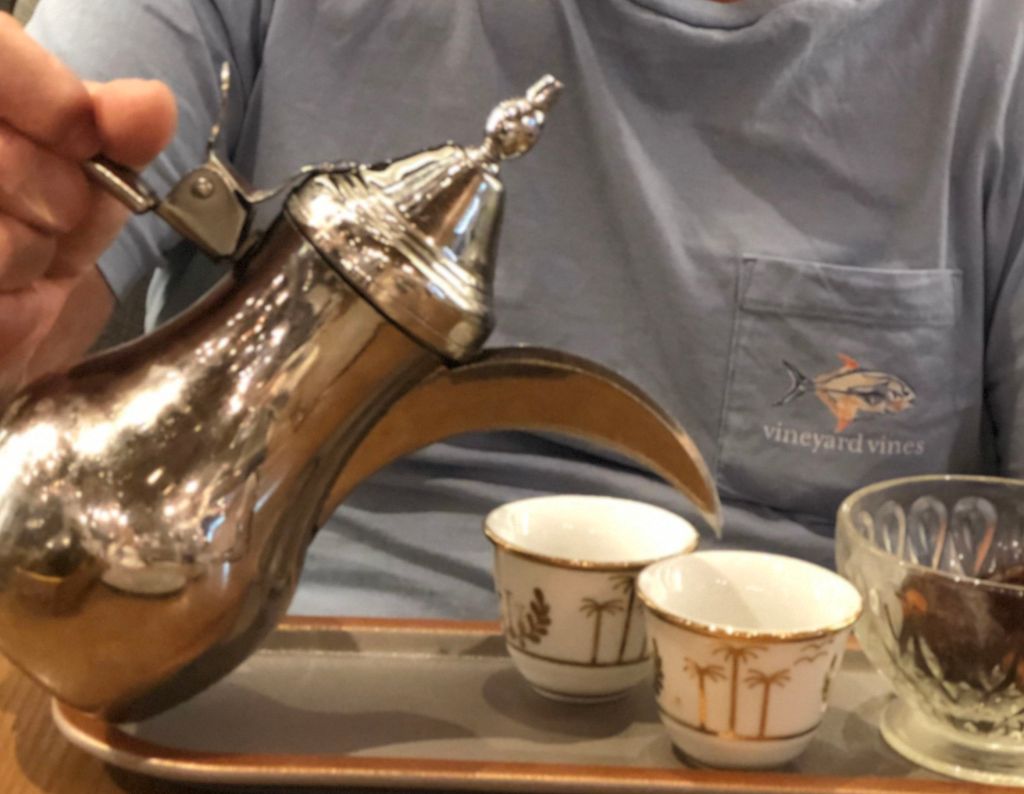
I see gifting like an Arabian coffee pot with a long curved spout, full of coffee. This is our gifting. We stay full of the Spirit, and we keep the coffee on the heat – close to Jesus. It’s full of everything in 1 Corinthians 12 and 14. But the “most excellent way” that Paul shows is in chapter 13 is how we pour the coffee: we pour it carefully, in love, into the cups that come our way. We do not pour unless God tells us to, and He shows us which cups to pour into. Sometimes, as with the 5,000, there may be more cups than we have coffee in the pot, but if God has told us to pour, we pour. And He will keep filling the pot as we do. However it happens. we direct our gifting in Love. Because if we don’t, it goes all over people’s laps…This “most excellent way” is actually the ONLY way: without it, as 1 Cor 13 emphasises, we are nothing.

Jesus Himself makes it clear that it is possible to have gifting without love:

“Not everyone who says to Me, ‘Lord, Lord,’ shall enter the kingdom of heaven, but he who does the will of My Father in heaven. Many will say to Me in that day, ‘Lord, Lord, have we not prophesied in Your name, cast out demons in Your name, and done many wonders in Your name? “And then I will declare to them, ‘I never knew you; depart from Me, you who practice lawlessness!’” (Matt 7: 21-23)

To do the will of the Father and to keep the law of Christ is to love. To minister without it is to practice lawlessness: it’s that simple. So to come back to the original question: can we say that love is more important than gifting? The answer, I think, is that we can’t. Not because of the relative values of each, but simply because we can’t weigh them against each other. I think the assumption for first century Christians was that everyone could expect to move in supernatural giftings. I don’t think anyone at Ephesus, or Sardis, or even lukewarm Laodicea would have thought of saying “I don’t operate in any gifts of the Holy Spirit, but I’m full of love!” In His letters to the seven churches in Revelation, Jesus didn’t tell any of them to work on their prophesy and healing ministries: He told them to return to their first love; not to tolerate compromise, and to persevere to the end, even unto death.

I think most churches today are probably a long way from the level of faith of first century believers.  In the last century – since Azuza Street – the Lord has been leading His people to contend for that faith again. And now, since Covid, the world has changed:  one of the consequences of lockdown has been a proliferation of digital meetings, and along with that trend an increase in both the awareness and the availability of training courses for ministry, especially in the realm of the prophetic, to help believers satisfy their biblical desire for spiritual gifts. Even though we can’t meet as churches, the Holy Spirit is making sure that the resources are available for the five-fold ministries to “equip the saints for the work of ministry.” But in this digitised, Covidised world, where we can no longer say “Who touched me?” it is even more essential that we “pursue love.”


Proverbs 25:16 says:
“Have you found honey?
Eat only as much as you need,
Lest you be filled with it and vomi
t.”

If we pour, God will fill. But if we make the filling, rather than the pouring our priority – the pot rather than the cups, the spiritual gifts rather than the way of love – we run the risk of swelling in self-importance rather than growing in faith, and we will “vomit” instead of pouring. We don’t pursue the gifts; we pursue love, desiring the gifts. And as we concentrate on the cups and let them interrupt our agendas, God will give us what He wants to pour into them.

The secret place (Prophetic exhortation)

Many of us know and refer to Psalm 91 as a promise of protection. Verse one says: “He who dwells in the secret place of the Most High shall abide under the shadow of the Almighty.This verse sets the tone for the many promises of protection that follow in the rest of the psalm. The Lord is calling His church under His wing, because He loves us and wants to protect us from what is coming. I believe He says:

“Do not dream that life is going to get easier, because outside of my protection it is going to get more difficult. But under my wing is peace, blessing, and security. The problems won’t go away, but under my wing are solutions; hidden, surprising solutions.  Under my wing you will learn to hear my voice, and if you hear my voice you will know what to do when difficulties arise; but to hear my voice you must be close and you cannot be close unless you seek my presence. So draw near to me and spend time with me. My sheep hear my voice, and my voice is the one that will guide you. Learn my voice.  Learn to tell it from other voices that push and drive, because I lead and draw gently; I call and whisper, I do not shout. Take my yoke upon you and learn from me: I am gentle and humble of heart. I will not scare you, but I will bring you peace.”

The Bread of the Presence

Come into my presence


I believe that the Lord is calling His people into His presence, and to renewed holiness. He would say this at this time:

“As the world shudders under the changes that are coming upon it, come and sit with me in the beauty of holiness. Come and eat the bread of my presence. I have prepared a table for you where all clamour is silenced and my light breaks through the shadows. As you sit with me and eat the bread of my presence I will give you seeds to sow, for my seeds are in the bread. They are the words of life that only I can give you, so come into my presence and sit with me, find peace with me and let me feed you. You desire to sow my word, so let me sow in you first; then when you speak my word you will take with you the peace that I will give. Freely receive, then freely give. As it was with the first apostles, so it will be with you, and it will be known that you have been with me.”

The Coming Harvest

“Behold, the days are coming,” says the LORD,
“When the ploughman shall overtake the reaper,
And the treader of grapes him who sows seed;
The mountains shall drip with sweet wine,
And all the hills shall flow with it.” (Amos 9:13)

The New Testament gives us a clear picture of what is meant spiritually by sowing and reaping. The word of God is sown through teaching and preaching, and the harvest is reaped when those hearts where they were sown accept Christ. Much of the ministry of the Church hinges on the activities of sowing and reaping, of teaching and evangelism.

But God is preparing us for another, and greater harvest. Although sowing and reaping will carry on, the work of preparing for the coming harvest will overtake the work of the current one. The apostolic and the prophetic will run ahead of the teacher and the evangelist, ploughing the land and treading the grapes. Ploughing the land and treading the grapes have this in common: they break through the surface layers and break up structures. The plough breaks up the soil; treading breaks down the grapes. I believe the Lord wants to break up our well-trodden paths and move below the skins of our relationships. Even as the devil seeks to use lockdown to keep us apart, the Lord will work in our lives to bring us together and move us towards true Unity of the Spirit.

I believe the Lord would say: “Why is the soil hard? Because you have walked in the same places for so long that the soil is trampled down; the seeds of the Word do not take root and the birds of the air devour them. So I am sending out the ploughman to break up the ground again, so my seeds can take root and grow.

And why is the wine not flowing? Because you hold and treasure your clusters of grapes instead of letting the juice flow from them, and you are content with superficial relationships in which people remain separate and isolated within their own protective skins, instead of truly giving themselves to one another. So I am sending out those who will tread on the traditions, the forms and the routines that you hold onto, and they will break them down so that the life of My Spirit can be released in your worship. And I will move in your relationships and break through those defensive skins that keep you apart; and as I am in the Father and the Father is in me, you, too, will become perfect in one, and the world will see your love and will know that you are my disciples. The world does not want your well-trodden paths, but it will seek out the life that it sees growing when the plough has broken them up. The world does not see your clusters, but it will see your love when the grapes are trodden and the wine is flowing.”

Before the harvest comes the plough, and before the new wine comes the treading. When this time comes many will feel they have nowhere to stand and nothing to hold onto; but the Lord says “Stand on my Word, and hold onto Me. Do not resist the breaking, and receive those who appear to tread on things that you would preserve, because when the work of preparation is done those who sow will again see fruit; ten, twenty and a hundredfold; and those who reap will not have barns big enough for the harvest.”