Tag Archives: by faith

Bread from Heaven: 3

And Jesus took the loaves, and when He had given thanks He distributed them to the disciples, and the disciples to those sitting down; and likewise of the fish, as much as they wanted. (John 6:11)
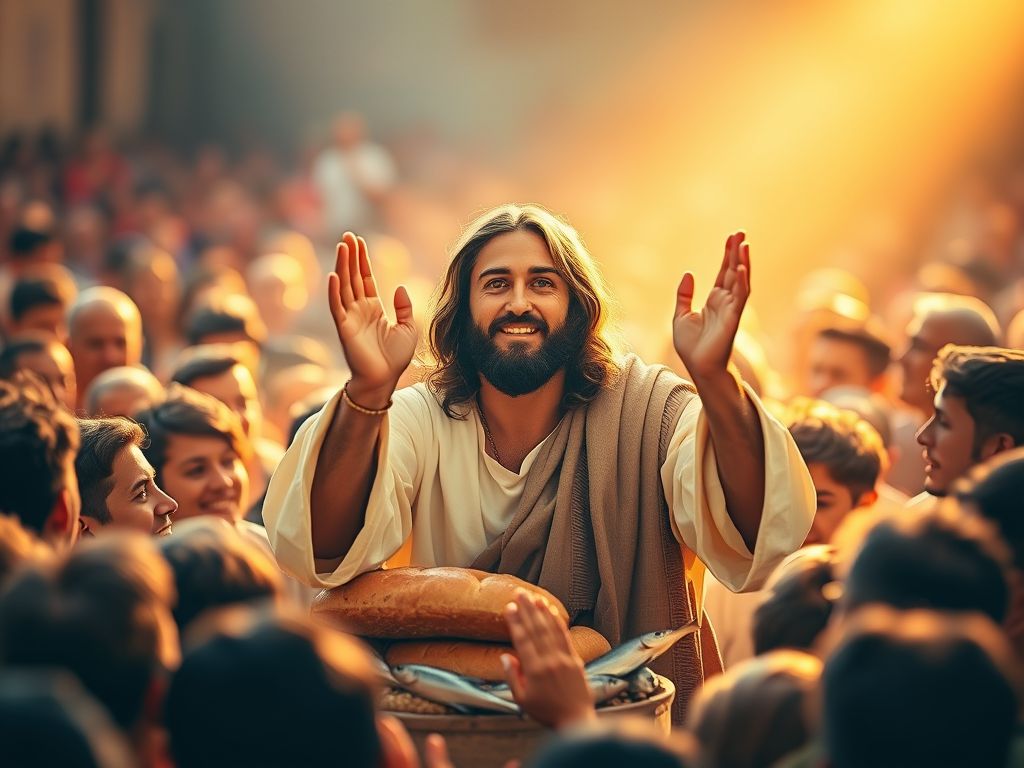
He knew what He would do
In our attempts to bring up our children to say “please,” the parents among us might well have said at times: “And what’s the magic word?” However in the Kingdom it’s not please, it’s thank you. Jesus didn’t ask the Father to multiply the loaves and fishes; he thanked Him for them. This miracle, along with its “twin“ where the 4000 are fed in the accounts of Matthew and Mark, is one of only three occasions in the New Testament where Jesus gives thanks to the Father. The Greek word used for giving thanks is eucharisteo, and Jesus uses it when He feeds the multitude, when He thanks His Father for always hearing His prayers at the raising of Lazarus, and at the last supper, when He gave thanks for the bread and wine.

Eucharisteo: We use the same Greek word ourselves when we remember the cross at the Eucharist, and for me, this is the key to understanding much of the significance of this miracle. Andrew looked at the loaves and fishes with eyes of flesh and asked: “What is this among so many?”, but Jesus looked with the eyes of the spirit and saw the riches in glory that would meet the need of the multitude above all that the disciples could ask or imagine. He could see the limitless creative powers of heaven, and He knew that “all that the father has is mine,” (John 16:15) so it is no surprise that John’s account of the miracle tells us that “He himself knew what He would do.” (John 6:6)

In everything give thanks
In his letter to the Philippians, Paul exhorts us to “be anxious for nothing, but in everything, by prayer and supplication, with thanksgiving, make your requests known to God.“ (Philippians 4:6) We know that Jesus had direct access to the Father’s provision because of who He was, and there are no barriers to our faith in that regard. But it is much harder to believe that we have the same access to that provision, because we know who we are as well. We can, and do, believe that Christ dwells in our hearts through faith, that in Him we are seated in heavenly places, and that all things are possible through Him; but we also know that we have only experienced the boy’s family picnic when faced with a multitude, and not the feast.

When Jesus gave thanks at the feeding of the 5000, I don’t think He was thanking His Father for the loaves and fishes in His hand, but for the provision that was in heaven. Demonstrating what He told His disciples in Mark 11:24, He believed He had received it, gave thanks for it, and it was done for Him. His Father passed the food to Jesus, and He passed it to the disciples to give out.

God wants us to give thanks in everything. Whether we are faced with abundance or lack, and whether or not we are petitioning heaven for something, we are to be thankful at all times. Paul expresses this sentiment in his letter to the Romans:

“… He who eats, eats to the Lord, for he gives God thanks; and He who does not eat, to the Lord he does not eat, and gives God thanks. For none of us lives to himself, and none of us die himself. So if we live, we live to the Lord; and if we die, we die to the Lord. Therefore, whether we live or die, we are the Lord’s.” (Romans 14:6–8).

Our Inheritance
As I have mentioned, the only occasion outside of feeding the multitudes and giving thanks for the bread and the wine at the last supper, was when Jesus thanked the Father for hearing Him at the raising of Lazarus. His Eucharist there was more about His relationship with the Father than what He was about to do. Our constant thanksgiving to God is not for what we do or don’t eat – or do, or receive -, but it’s for a relationship with Him which we can indeed be thankful for in all things. We can be thankful to Jesus every moment of the day for the fact that we are His, and what we have is His. But more than that, amazingly, what He has is also ours:

“And if you are Christ’s, then you are Abraham‘s seed, and heirs according to the promise.”(Galatians 3:19)

“And because you are sons God has sent forth the spirit of His son into your hearts, crying out, “Abba, Father!“ Therefore you are no longer a slave but a son, and if a son than an heir of God through Christ.” (Galatians 4:6–7)

We are heirs of God through Christ. We have an inheritance to be forever thankful for. Just as everything that the Father has belongs to Jesus, everything that Jesus has is ours in Him. Of course this does not mean that my neighbour’s house, or wife, or goods belong to me because they are His: the key phrase is “in Him.” “In Jesus name” is not just a phrase that turns a request into a prayer, but it’s the declaration that what we are asking for in prayer is something that we are requesting on His behalf because He has told us that He wants us to have it, whether it’s to accomplish His Kingdom purposes through us or for us. Whatever we are doing, we have an inheritance to be thankful for, and which is at our disposal all the time we are walking alongside Him. What is His is ours. If I am sitting at the dinner table with my wife and I ask her to pass the salt, she is not going to question my action: the salt on the table is a shared possession. Of course she is going to let me have it.

Paul makes this clear in his first letter to the Corinthians:

“Therefore let no one boast in men. For all things are yours. Whether Paul or Apollos or Cephas, or the world, or life, or death, or things present, or things to come – all are yours. And you are Christ’s, and Christ is God’s.” (1 Corinthians 3:21-23)

Just as Jesus is the transition from earth to heaven for our spirits, He is also the transition for us from heaven to earth for our inheritance. So whatever the loaves and fishes or the starving crowd may represent, what do we have available to meet the need? Jesus can make our lack into His abundance if we remember to thank Him for our inheritance. Pass the salt, please, Lord. Thank You.

Bread from Heaven

After these things Jesus went over the Sea of Galilee, which is the Sea of Tiberias. Then a great multitude followed Him, because they saw His signs which He performed on those who were diseased. And Jesus went up on the mountain, and there He sat with His disciples. Now the Passover, a feast of the Jews, was near. Then Jesus lifted up His eyes, and seeing a great multitude coming toward Him, He said to Philip, “Where shall we buy bread, that these may eat?” But this He said to test him, for He Himself knew what He would do. (John 6: 1-6)

Jesus lifted up His eyes
When Jesus saw the crowds coming towards them and asked Philip “Where shall we buy bread, these might eat?” (John 6:5), He knew not only the eternal words that the Holy Spirit had spoken through Isaiah hundreds of years previously, but He also know what He was going to say to the Jews the following day, and, more significantly, what He wanted His church to learn from it from that time until His return.

John introduces the narrative by presenting Jesus on a mountain with His disciples. This must be every believer’s favourite place: a mountaintop experience with the Lord, in the company of a few close friends. When we are in that place, we want it to go on for ever. Eventually it will, but John also tells us that “a great multitude followed Him, because they saw His signs which He performed on those who were diseased.” (John 6:2) If we are spending time with Jesus on Earth, the crowds are never going to be far behind.

It’s all about the harvest
When He met the Samaritan woman, Jesus said to His disciples: “Behold, I say to you, lift up your eyes and look at the fields, for they are already white for harvest!” (John 4:36). Now John echoes this exhortation in his account of the fourth sign, reminding us that it is not just about the significance of the Lord’s supernatural power to multiply bread, or even about His compassion for the hungry: it’s all about the harvest. Jesus lifted up his eyes. So one challenge to us as we consider this sign is this: how much time do we spend with our eyes on the ground instead of lifting them up to the harvest?

If you are the same as me, you probably equate ‘lifting your eyes’ with Psalm 121 – lifting our eyes to the hills, and seeing that our help comes the Lord “who made heaven and earth.” Although Jesus clearly does get help from heaven here- a lot of help – He is not looking away from His circumstances and comforting Himself, as we do, with eyes of faith: He is looking at the circumstances with eyes of love so that He can comfort the people He can see. If I was on a mountain and saw a hungry crowd below me, I would either want to go further up the mountain, or round to the other side, and down. Quickly. But He is not thinking about how the circumstances affect Him; He is only thinking of how He can affect the circumstances. This is a standout Kairos moment of His ministry, and He knew what He would do.

Facing the hungry crowd
As for us, there are times when we are on that mountain and there is a “hungry crowd” coming towards us. It might only be one person, but we know what it will mean: they will make demands. Certainly our time and energy, quite probably our money and/or resources, possibly our emotions, but one thing we know is true: they are hungry, and we’ve only got a few loaves and fishes. But the other thing that is true is that we are there with Jesus. We know that He only did what the Father told Him to do and didn’t always minister to everyone He met, and it might be that the He tells us not to get involved and to get down off the mountain. But assuming He doesn’t, how do we face the “hungry crowd” with the crumbs that we have to offer?

“He said to Philip, “Where shall we buy bread, that these may eat?” But this He said to test him, for He Himself knew what He would do.”

I don’t think that He was testing Philip on his knowledge of Isaiah 55. Jesus wanted to know if Philip was starting to see with the eyes of the Spirit, or if he was still limited to the material world. At this stage, it looks like his score was zero (which is encouraging for us, as the same Philip completely by-passed all the confines of the material world in the power of the Holy Spirit when he preached the gospel to the Ethiopian Eunuch!). I think Jesus is regularly testing our faith. Since He said “Will the Son of Man find faith on earth when He comes?” (Luke 18:8), it makes sense that He will be putting us in situations where He can see where we are on the faith-o-meter. He wants all our readings to increase.

There was much grass in that place.
God knows what our faith is ready for, and He also knows whether or not this is a Kairos moment for us, where He has got everything lined up for us to operate in the power of the Spirit. Wisdom says “ponder the path of your feet.” (Prov 4:26) The hungry crowd is approaching. Where has the “path of our feet” led us? Are we on a rocky slope, or is there “much grass?” People will be filled if they are in a place where they can be sufficiently at peace to receive from the Lord. If they are struggling just to keep on their feet and stay upright, it is less likely that we are going to reach into their situation, and that God hasn’t planned for us to try: if that moment hasn’t yet arrived we are just going to be emptied ourselves, and no-one is going to get any bread.

Verse 10 tells us that “There was much grass in that place.” For the miracle to take place the crowd needed somewhere to sit down and rest so that they could receive and partake of what Jesus was going to give them. Jesus hadn’t yet drawn on His heavenly resources, but the natural setting was in place – indeed it had been developing ever since that grassy plateau on the mountain had been created through Him and for Him (Colossians 1:16) at the beginning of time. Part of the convergence of that moment was that the hungry crowd should be there with Jesus just where there was provision for them to stop and sit down: not on a rocky slope or a narrow path, but on a flat area where “there was much grass.” If God can provide that visible abundance in the earthly realm just at the right time, how much more are heavenly resources available?

The Kingdom of Abundance
Paul writes to the Ephesians: “Now to Him who is able to do exceedingly abundantly above all that we ask or think, according to the power that works in us, to Him be glory in the church by Christ Jesus to all generations, forever and ever. Amen. (Eph 3:20) Jesus is Lord over a kingdom of abundance. “God does not give the Spirit by measure,” (John 3:34) because there is no limitation in the Kingdom of God. The writer to the Hebrews tells us that the earthly tabernacle and its rituals were a “copy and a shadow of heavenly things.” (Heb 8:5). There are clues in Scripture that this applies to the rest of the earthly creation as well, and that the temporal is a shadow of the eternal. The earthly Jesus is the Son of Man who goes to the cross, and we get a glimpse of the heavenly Jesus when He appears on the Mount of Transfiguraton. We have the Jerusalem of Israel, and the “New Jerusalem coming down out of heaven;” (Revelation 21:2) and we have John’s revelation that “it does not yet appear what we shall be.” (1 John 3:2).

The disciples could only see five loaves and two fishes, but Jesus could see the bread of heaven. When we pray for the Kingdom of God to come “on earth as it is in heaven,” we are praying for limitless heaven to come to limited earth. So when we lift our eyes and sense that Jesus is showing us a need that He wants to meet, and we know that there is “much grass in that place,” we can look with the eyes of faith and see that the single packed lunch which is the most our brains can grasp will convert to 5,000 by the power that works within us. At least.

Four rules for walking in the works God has prepared for us.

Ephesians 2:10 says that we are “God’s workmanship, created in Christ Jesus for Works prepared beforehand, we might walk in them.“ God’s word doesn’t say that we should do the works or complete them or carry them out, or any such similar term: he says that we should walk in them. So what does that mean? How do we walk in what God is prepared?

God has given us parameters for walking. We are to walk by faith and not by sight, we are to walk in Love, and we are to walk in the Spirit. There are other specifics too, like walking in newness of life,  walking circumspectly, and more; but these three enough to go on with. If we are to be walking in God‘s works – His works and not our own – we need to pay attention to them.

Rule One: “Walk by faith and not by sight.” ( 2 Cor:7)
To walk in God‘s works, we need to walk by faith. Among all the other things that can be said about what it is to walk by faith, one top level definitive is that it is contrary to walking by sight. We know this because scripture says so. A first requirement for any of God‘s works is that we cannot see everything that we need in order to carry it out, but that we trust God to provide it. If He has prepared the works beforehand, He has also prepared the resources. We cannot see them because we’re walking by faith, but we trust him to provide. We don’t wait to see his provision before we take a step: we start walking beforehand, knowing that He is El Shaddai, and will provide. Rule one stands alongside rule two:

Rule Two: “So likewise you, when you have done all those things which you are commanded, say, ‘We are unprofitable servants. We have done what was our duty to do.’  (Luke 17:10)

When the disciples asked Jesus to increase their faith, he gave them the model of the unprofitable Servant. The walk of faith has to be a walk of obedience: we do what we are told to do, no more, no less. So what has He told us to do? I think  there are two levels of command. There are scriptural commands which are for everyone, and there are specific directives which are unique to each of us. Jesus told us to love God with all our being, and to love our neighbour as ourselves. His “new commandment” was that we love one another. Without love, we are nothing (1 Cor 13:2), and as the whole of 1 Corinthians 13 makes clear, our works are worthless.

I think we find another “level 1” directive in Micah 6:8, where we find these famous words:  “And what does the Lord require of you But to do justly, To love mercy, And to walk humbly with your God?” If we are walking humbly before our God we are more likely to hear the specific directives at level two – whether we are Heidi Baker being told to go to Mozambique, or A N Other being told to give $100 into a specific ministry, or to pray for someone’s healing in the street. If we are looking for power encounters and adventures of faith without paying attention to level one, the chances are that we will be operating out of personal ambition and spiritual pride and not humility and love, and it’s unlikely that the Lord is going to give us any of the John 14:12 “greater things“  to do. But when our hearts are set on obeying the Lord at level one, “you will hear a voice behind you saying this is the way; walk in it” (Isaiah 30:21), and that word will be confirmed in such a way that we will not doubt the instruction. This leads us to rule three:

Rule Three: “A new commandment I give to you, that you love one another; as I have loved you, that you also love one another. By this all will know that you are My disciples, if you have love for one another.  (John 13:34-35)

Rule three is to walk in love. Not only is nothing we do of any value if we don’t walk in love, but Jesus tells us that we will glorify Him if we do – because all will know that we are His disciples. The love Jesus is talking about is His sacrificial “agape” love. Somebody I know well in our church has been given a vision for a project in Liberia, where there is 85% unemployment. This project, when completed, will provide income and employment and bring a little bit of God‘s kingdom to earth. Her dream is to do something that will lift a community out of poverty, and she thinks about it night and day. She said once that she wasn’t sure if it was from the Lord. I said I’m sure it is. Why? Because, apart from other confirmations she has received, she gets absolutely nothing out of it for herself, yet is prepared to invest a significant amount of time and money into the work. It is an expression of agape love with no self interest. Where does God’s Love point us? Because that is where His works will be prepared.

Rule four: “Pray always with all prayer and supplication in the Spirit (Eph 6:18)
Faith and agape  Love are only ours by the Spirit: “The flesh profits nothing.” (John 6:63)  Faith is “the gift of God, not of works, lest anyone should boast,” (Eph 2:9) and God’s love is “poured into our hearts by the Holy Spirit who was given to us.“ (Romans 5:5) Faith and Love are two of the only three things that “remain“ when all else has passed away (1 Corinthians 13:13) Spiritual projects are carried forward by spiritual prayer. Paul asks the Ephesians to be “praying always with all prayer and supplication in the Spirit, being watchful to this end with all perseverance and supplication for all the saintsPaul’s work as a messenger of Christ was sustained by the prayers of the body of Christ. If Paul needed prayer support to walk in the walks prepared for him, then so do we, and we need to be upholding others with our own prayers.

So to fulfil the purposes that we were created for in Christ Jesus, we receive our instructions from the Lord, and we trust Him to provide us with what we need to carry them out. We are 100% motivated by the blessing that we are expecting others to receive from the work, and we ensure that every step is covered and guided by Spirit-led prayer. If we take our steps according to these principles, I think we will see the works that God has prepared starting to take shape in front of us as we walk.

The God of David’s deliverance.

One of David’s great psalms of faith is Psalm 18, which he wrote, according to 2 Sam 22: 1, “on the day that the Lord delivered him from his enemies and Saul.” Many of the truths expressed both in Psalm 18 and in the book of Psalms as a whole – not to mention the rest of the Bible – are encapsulated in the section from verses 28-34. I wrote last week about the walk of faith. If we can allow the Holy Spirit to write the following promises on our hearts, as He did for David, I believe our walk will be strengthened. Here is the whole passage, followed by a few thoughts on each verse.

For You will light my lamp;
The LORD my God will enlighten my darkness.

For by You I can run against a troop,
By my God I can leap over a wall.

As for God, His way is perfect;
The word of the LORD is proven;
He is a shield to all who trust in Him.

For who is God, except the LORD?
And who is a rock, except our God?

It is God who arms me with strength,
And makes my way perfect.

He makes my feet like the feet of deer,
And sets me on my high places. (Psalm 18: 28-34)

He teaches my hands to make war,
So that my arms can bend a bow of bronze.

(Psalm 18: 28-34)

For You will light my lamp;
The LORD my God will enlighten my darkness
.

This is a promise. Sometimes we find darkness has descended on us like a cloud. It seems like the Lord is enthroned in another universe – if He even exists at all – and all we have is the experience of our flesh and our immediate circumstances. But the Lord promises that He will light our lamp. The light shines in the darkness, and the darkness has not overcome it. If we can keep this word in our hearts, believe it, speak it out, and ask the Lord to manifest its reality, it will strike the match that lights the lamp.

In addition, He promises to give us direction when we are lost or confused. His word is a lamp unto our feet and a light unto our path: he will show us not only where to put our feet next, but – although sometimes we have to wait for this – He will shine a light on the direction of our path ahead.

And finally, this is a promise of revelation. We can, and do, read the word diligently; we can quote promises of healing and provision, or whatever else we need, but our lamp can remain unlit. If the Word of God is the  sword of the Spirit, we need the Spirit to wield it; it’s not enough to quote it mechanically. And if it is a lamp unto our feet we need the Spirit to light it: a memory verse that is not breathed into us by the One who wrote it is not likely to guide our feet anywhere. We need the Word, and we need the Spirit. This applies as much to our personal devotions as it does to our church services.

For by You I can run against a troop,
By my God I can leap over a wall

Jeremiah 12:5 says “If you have run with the footmen, and they have wearied you, Then how can you contend with horses?”  As deep darkness spreads across the nations (Isaiah 60:2) we will need to be moving in the opposite direction to the troop of the world. Temptation, persecution, hardship, financial pressure are all “horses” that we could face. But God promises that He will be with us in our trials, and if we do not allow ourselves to be swept along by “the troop” but trust in His faithfulness and the power of His Spirit, we will see the glory of the Lord appear over us as He promises in Isaiah 60:2.

We can apply the second part of this verse to many metaphorical “walls,” but one wall that the enemy is always trying to fortify is that of division within the body of Christ. Jesus wants us united so that the blessing can be commanded (Psalm 133); Satan will do all he can to prevent this from happening. The flesh will always seek to protect its own interests, so it is only by the Spirit, in the love of Christ, that we can be one with our brothers and sisters in Christ and attain to “the unity of the Spirit in the bond of peace.” (Eph 4:3)

As for God, His way is perfect;
The word of the LORD is proven;
He is a shield to all who trust in Him.

God says: “I will instruct you and teach you in the way you should go; I will guide you with my eye.“ (Psalm 32:8) As I have written elsewhere, if someone is going to guide us with their eye we need to be looking at them in order to see what they are looking at. In general terms His way will always be the way of Love, and because love fulfils the whole of the law it will always be perfect, but in the specific context of our own daily need for direction, His way will always be our perfect option when we follow his guidance. Man’s wisdom at best is relative and incomplete, whereas God’s word contains no impurities: the Hebrew word translated as “proven” has the connotation of smolten metal that has had all the dross removed. So His proven word can always be relied upon to give us perfect direction: our part is to trust Him. It is not the words themselves that are our shield, like some sort of spell or mantra; it is the God who speaks them. When we look to Him and trust Him to be our shield, it is not so difficult to follow in the direction that He gives us.

For who is God, except the LORD?
And who is a rock, except our God?

There is one God, Father, Son and Holy Spirit, world without end. Salvation, deliverance, Life itself, an only be found in Him. Is God the rock on which we build our lives, or is it our career, our family, our wealth, our status, our marriage, our ministry? This verse needs very little comment, except the concluding words of the first epistle of John: “Little children, keep yourselves from idols.” (1 John 5:21) An idol is anything that takes the place of God in our hearts. Only He can have the place of lordship.

It is God who arms me with strength,
And makes my way perfect.

The word translated here as “arms” actually means “clothes,” or “girds,” as in being girded with armour. The verse actually speaks of the strength provided by the armour of God. Another meaning of the word translated here as “perfect” is “complete.” When we have put on the Ephesians 6 armour of God we are complete in Christ. Putting on the armour is the same as putting on Christ.  Psalm 93:1 says, “The Lord is clothed, He has girded Himself with strength.”  The armour that He is wearing is the strength that He arms us with. “Putting on the armour” isn’t a ritual to go through in our morning devotions: what we need to do regularly is to check that we have never taken any of it off. When we are “armed with” faith, salvation, righteousness, truth, and peace, wielding the Word of God, our way is perfect and we stand clothed in Christ. If any of them are missing we are less than complete.

He makes my feet like the feet of deer,
And sets me on my high places.

Have you ever seen a deer slip on a mountain path? Exactly: they don’t.  Ephesians 2: 6 tells us that we are seated with Christ in heavenly places; and Zechariah 3:9 tells us that, in Christ, we will  have “places to walk among those who stand here” (in the courts of Heaven). We are called to walk after the Spirit and not after the flesh (Romans 8:4), and to walk after the Spirit is to walk in the high places where God has set us. He wants us to be sure-footed, not taking a couple of spiritual steps then falling into carnality. He gives us those deer’s feet, and He lifts us to our high places: the truth of these words only manifest in our lives when we are yielded to His Spirit. And it is “my high places” where He sets me; not someone else’s. Each of us has a place of authority, the place of our call, where His anointing will flow. If you don’t know yet what your “high places” are, ask the Lord to show you.

He teaches my hands to make war,
So that my arms can bend a bow of bronze.

Finally, we are called to battle, whether we want to recognise it or not. A bow of bronze would have been a formidable weapon in David’s time, but you couldn’t use one effectively without training. And this isn’t all theory and interesting ideas: after we had studied this passage in School of Prophesy recently, Anne and I went for a walk on Cannock Chase (an area of wooded heathland near our home). While we were there we saw a small group of people – four or five – join hands round a tree and appear to pray, but they looked, and felt in our spirits, shifty and dark. If they were praying, they were not praying to Jesus. When they had gone, we went to the tree to investigate, and found a couple of memorials there to people who, presumably, had died. We prayed, for light to come into the darkness there, and for curses to be broken. God was teaching our hands to make war.

He will lead us into victory, and His glory will rise over His church as the times get darker; but we will need to fight for it.

The Big Reshuffle

Prophesy from Andrew Baker for 2025

There is coming a big reshuffle, a time, a season, in fact a year, to put things in place for this new season. There will be a very big, noisy rattling, like going over rapids, a time such has not seen been seen before. There will be an upheaval of nations all over the world. There will be a repositioning and a realigning in the practical, financial and even the spiritual area, affecting your position and call, and all aspects, in fact, of ministry. There will be a recalibration, a shifting, so that God’s people, and many others in the secular world, are ready for 2026 onwards.

2025 is the year of holding tight to God as He moves things about. Huge changes are coming; new things and developments appearing; fresh ways of looking at things and new ways to accomplish them.

His people will be required to have a deeper walk of faith, walking right in the centre of corruption at many levels, yet holding the light of the Lord to show the way. God will position His people, and those secular people whom He will use, to bring light, hope, provision and direction during an upheaval that’s coming next in the world and in the church.

Do not panic, be calm. Get the lifeboats ready and practise your drills. This is a different year, 2025, not the same as any other you have experienced. Lay down the thinking that says that things can only be done the way they have always been done. Be free and flexible to operate in new ways, methods and plans. He can see ahead, now He wants you to understand the reality and get ready now! Change is here. You have not been this way before.

God’s ministers will loose, release and relinquish many things and people, even projects. You will collect many new ones but also there will be many challenges but also answers from heaven that you have not seen before, in your lifetime.

It’s a time to step up to the plate and do things you felt unable to do before. Get yourself ready in mind and in faith. Great is your God in the midst of you. He will enable you, bless you, anoint you, fill you and give you all you need in every way. His people will become the head and not the tail. Eventually, His leaders will help people into safety, like an ark, from drowning.

This is the season, enter it with joy and faith. There will be new adventures, and 100% commitment and submission will be required of God’s children and servants. Now the miracles, rescues, upbuilding of new, of good things, and the falling of old things. This is your day coming now. 2025 is your Esther season, Esther chapter 4 verse 14. This is your time, your moment, your season, your era. Don’t miss this! Rise up and be the ones who would take hold of the season with great courage. Be like Jesus, who for the joy set before Him in eternity, endured the cross as well as brought changes to the world. It is not a time to think of self, but to expand the kingdom of God. Be God’s people of this final season! Be those who will give, release, loose, relinquish, and yet pick up, run with and enjoy it, gathering, on the way forwards, an abundance of all that is needed and many new believers, too. It’s time to disciple the new and the younger; teaching with your experience, showing them how to walk in faith and in power. It’s time to see the last revival and the resources to do the job.

This is a time of fire and faith, not fear. It is a time for victory, not running from the enemy, for believing, rising up and seeing the kingdom increase in depth, height, wisdom, numbers, and, in particular, commitment to Jesus.

There will be an upheaval of nations, world finances, climate issues, lawlessness, power struggles and all that goes with this. You have authority and peace in Me. Take up your positions, allow the preparations to take place step by step, during the coming year, as you hear and obey. These changes and directions are not just to carry you through future issues coming on the earth and in the church, but are to give you the foreknowledge, the ability and the enabling to help so many more. The Lord is saying that we must now take time aside and meditate on these things.

From Faith to Faith

“So Jesus came again to Cana of Galilee where He had made the water wine. And there was a certain nobleman whose son was sick at Capernaum. When he heard that Jesus had come out of Judea into Galilee, he went to Him and implored Him to come down and heal his son, for he was at the point of death. Then Jesus said to him, “Unless you people see signs and wonders, you will by no means believe.” The nobleman said to Him, “Sir, come down before my child dies!” Jesus said to him, “Go your way; your son lives.” So the man believed the word that Jesus spoke to him, and he went his way. And as he was now going down, his servants met him and told him, saying, “Your son lives!” Then he inquired of them the hour when he got better. And they said to him, “Yesterday at the seventh hour the fever left him.” So the father knew that it was at the same hour in which Jesus said to him, “Your son lives.” And he himself believed, and his whole household. This again is the second sign Jesus did when He had come out of Judea into Galilee.”

Signs and wonders: we all want to see them. Why was Jesus so disparaging about the miraculous here, particularly since he says later that “the works which the Father has given Me to finish—the very works that I do—bear witness of Me, that the Father has sent Me.” (John 5:36)? The importance of this second sign is that Jesus is looking for faith – “the evidence of things hoped for” (Heb 11:1) – that will draw people to the Father who sent Him, not just followers seeking the supernatural for their own benefits. To believe on the basis of a miracle that is seen is evidence-based, not faith-based, and does not generate the Hebrews 11:1 faith that reaches into the unseen. But faith that “believed the word that Jesus spoke” will continue to believe the words that Jesus speaks, and opens the door to eternal life: “He who hears My word and believes in Him who sent Me has everlasting life, and shall not come into judgment, but has passed from death into life.” (John 5:24)

When Jesus withstood the first temptation, he said, quoting Deuteronomy 8:3, “It is written, Man shall not live by bread alone, but by every word that comes from the mouth of God.” (Matt. 4:4) A few verses on in the discourse to the Pharisees quoted above, Jesus states: “I can of Myself do nothing. As I hear, I judge; and My judgment is righteous, because I do not seek My own will but the will of the Father who sent Me.” Although the word translated here as “judge” – krino –  is most commonly used in English with reference to judicial processes, the meaning of the Greek is much broader and relates primarily to mental judgement: having an opinion or making choices and decisions in any context, not just that of human behaviour. Jesus is basically saying, ”Whatever the situation, I do what the Father tells me; I don’t just do what I like. What the Father says is what I do. I live by every word that comes from His mouth.”

Paul writes: “For in it (“it” refers to the gospel) the righteousness of God is revealed from faith to faith; as it is written, “The just shall live by faith.” (Romans 1:17) Jesus says explicitly here that the righteousness of His decisions comes from the fact that He always does what the Father says, and by implication His human flesh has no say in anything. When we believe in Jesus and are born again His righteousness becomes ours, but to reveal His righteousness on a daily basis we have to live by His words, “from faith to faith.”  If we want to witness to Christ, His righteousness must be revealed in us. There is only one way to achieve this: just as Jesus said to his disciples after the meeting with the Samaritan woman, (John 4) our food must be to do the will of the one who sent Him.

The Waters are Rising (2)

I believe that the recent floods in Valencia, Spain, are prophetic of what the Lord will be sending onto the world. I believe He’s saying this:

“My flood waters are rising. They will be coming down from my mountain, pouring across the Earth, and sweeping systems and structures before them. They will sweep away religion like a straw house. They will be flowing around the hills and the mountain sides, through the valleys and through the towns, so do not try and climb the mountains that face you, or walk over the hills. Do not seek me in the solitude of the valley or the throng of the people. Yes, I am there, and you will find me while you have to be there, but do not go there to seek me. For it is time to wait and to listen for the rushing waters. When they come they may look dangerous and alarming, but trust me to let them carry you to new places. The waters will lift you and they will carry you. You will not sink, but if you try to swim you will only splash fruitlessly and swallow water, and you will not propel yourself anywhere; for the river is too powerful for you. It will take you to where I intend to put you, and not to where you have decided to go. You will see the flotsam of the world being carried along with you, but do not hang onto it. I will carry you like I carried the ark in the days of Noah, and you will come to rest on a high mountain where you will know My presence and my provision. It is this mountain that will be your place of safety in the flood. And when the waters have subsided, you will go down into the debris and the ruin that has been left, and you will bring my salvation to the world.”

About six months ago I sensed that The Lord also gave me a word on rising waters. At the time I was on a birdwatching visit to a place where the high tide floods a saltmarsh. I sensed then that the flood was coming over the low marshy places, but that “that a time will come and is coming shortly when the flood will speed up.” I think we are now in that time of increased momentum. Time is short: we need to let the waters take us to safety – even if it seems to be the most dangerous thing to do.

(Footnote: Spain is a stronghold for religion and religious spirits, so the floods also demonstrate what will happen to religion when the waters rise.)

Pure Joy

A few weeks ago a visiting speaker came to our church. Before she started speaking, she said that the Holy Spirit had highlighted a certain gentleman in the second row, three seats along … It was me. She brought a very encouraging word, with enough detail about myself (she had never seen me before) to confirm its accuracy, but the thrust of it was that ‘a door would be opening to me that would draw me closer to Him.’

Don’t we love it when someone brings an encouraging prophesy, underlined by another gift of the Spirit, the word of Knowledge, that speaks into our spiritual life and affirms us in our walk with God? I did not know what door she was referring to, but open doors often speak of opportunities. More time with Him and therefore less time at work? Ministry opportunities? I didn’t know and didn’t try and guess, but I certainly left church feeling good and played the recording of her word to me a few times over.

A couple of weeks after that we were praying for each other at School of Prophesy. One of the guys said that he could see our business going down a waterfall. There would be churning in the pool at the bottom; we would come out afterwards, but the watercourse would be different. That too was accurate: two days later our expected sales for this time of year plummeted, and there is definitely churning going on as I write. I have had to hold on  to the Lord as the water takes us on its course.

Then a few days ago the penny dropped: this was that. The open door that would draw me closer to Jesus is the waterfall that is rocking our business. When God speaks to us of blessing – and to be drawn closer to Him has to be a promise of blessing, because “at His right hand are pleasures for evermore” (Psalm 16:11) – our flesh tends to interpret that, in some way, in terms of advancement and comfort. (Well, mine does anyway…) But God has a different angle:

Consider it pure joy, my brothers and sisters, whenever you face trials of many kinds,  because you know that the testing of your faith produces perseverance.” (James 1: 2-4)

When the Holy Spirit spoke to me of that door that was going to open, did it ever occur to me that it was going to be an opportunity for my faith to be tested in order to produce perseverance? I think not. Did I imagine a trial, or a mountain top experience? Certainly the latter.  But God’s ways are not our ways. How different are the values of His Kingdom to those things our soulish minds hold dear. We value our comfort and advancement, our security and the approval of our peers; God values that we “act justly, … love faithfulness, and … walk humbly with your God.” (Micah 6:8) The Narrow Way has a totally different trajectory to the way of the world. God’s priority for us is that we walk with Him, and that we “Seek first the Kingdom of God.” And it is only by faith that we can take any steps with Him at all, so if trials are the best way to strengthen our faith and bring us into that place of blessing which is increased closeness to Him, there is a good chance that trials are what we are going to get.

My business is a tiny little pool: the world itself is going through a state of churning, and none of us know what the watercourse will look like when it comes out the other side. But one thing is true: we all need to let Jesus draw us closer to Him, because there is no other place that is more secure. One of the worship songs that came out of the charismatic movements starts “This is my desire, to worship you…” We love to lift our hearts and voices, and probably our hands, and tell the Lord how much we want to come close to Him. The Son shares our desire, and expresses it to the Father just before going to the cross: “Father, I desire that they also whom You gave Me may be with Me where I am, that they may behold My glory which You have given Me; for You loved Me before the foundation of the world.” (John17:24) We lift our voices to draw near to God; Jesus lifted His body onto the cross to have us close to Him. His Spirit in us will always be working towards that goal, because that is His desire. This was the joy set before Him.

Probably the best-known “resurrection psalm” is Psalm 16, where, by the Spirit,  Jesus expresses that joy through the words of David:

I have set the LORD always before me;
Because He is at my right hand I shall not be moved.

Therefore my heart is glad, and my glory rejoices;
My flesh also will rest in hope.

For You will not leave my soul in Sheol,
Nor will You allow Your Holy One to see corruption.

You will show me the path of life;
In Your presence is fullness of joy;
At Your right hand are pleasures forevermore
.
(Psalm 16: 8-11)

Jesus faced the greatest trial of all for the joy of seeing our faith bring us into the glory of unity with Him and the Father for ever. So when we are facing trials, let’s remember to “consider it pure joy” as Jesus did: our faith is being tested, to enable us to persevere in the things that really matter.

The Multitudes Are Coming

“After these things Jesus went over the Sea of Galilee, which is the Sea of Tiberias. Then a great multitude followed Him, because they saw His signs which He performed on those who were diseased. And Jesus went up on the mountain, and there He sat with His disciples.” (John 6: 1-3)

When Jesus saw the multitude coming, what did He do? He went up the mountain and sat there with His disciples. If there is one theme that has common to what the Holy Spirit is saying to the churches through His prophets today, it is that the multitudes are coming. There will be a revival such as the world has never seen before. Smith Wigglesworth prophesied it in 1947; Rick Joyner had seen it when he published The Harvest in 1997; Jarrod Cooper saw it in 1996 and wrote about it in Days of Wonder. Many less well-known prophets all around the world have had visions and words about this coming revival.

The multitudes are coming. Are we ready? As Smith Wigglesworth wrote (his prophesy is published in many places online), the prophesied glory will be nothing like the world has known. The glory of God has flickered briefly throughout the ages, but the new wine has always burst the old wineskin. In the past there was still hope in the world systems. There have always been signs of decay, but the grass was green, the water flowed, economies grew, and families looked forward: the future held promise. But today is different. The environment that seemed strong enough to bear the weight of its increasing population is now as fragile as wet paper, the debt-ridden international economy has about the strength of a cobweb, the most powerful nation in the world is governed by a senile old man, and moral confusion is so rife not even the basic polarities of gender are no longer a certainty in a child’s world. The multitude are coming, because promise has gone from the world.

Where do we go? Do we shore up our Church systems to prepare ourselves (or maybe, in some cases, to hide…)? Do we run to meet them in missionary fervour? Do we build great platforms from which we can address the crowds? No. We go up the mountain and we sit down with Jesus. We wait in His presence, and while we are waiting, we renew our strength and learn what it is to rise up on Eagles wings, because when the multitudes arrive He will give us our instructions, and one thing that we can be certain of is this: whatever He tells us to do it will not be what we expect, and it will be nothing that can be bought from the world, any more than the disciples could have bought enough bread from the local villages. Nobody will minister to the crowds from a platform built by human hands.

Jesus is bringing a revelation of His glory to the Church. He is God, through whom the worlds were made; whereas “all the glory of man is as the flowers of the grass,” (Ps 103:15) and even the nations are “like a drop in a bucket, and are reckoned as dust on the scales.” (Isaiah 40:15) God will provide for the multitudes out of His glory, in the presence of which our greatest achievements are less than dust. All we can bring to Jesus is our faith and our thankful love, and our desire for His presence above all things.  He told the disciples to make the people sit down, even though they had still had nothing in their hands to give them, and they obeyed in faith.  Then He gave thanks for the loaves and fishes, and handed them to His disciples to feed the crowd.

Up on the mountain, Jesus is fashioning a new wineskin that will not burst. The multitude will be fed by the insignificant in the hands of the glorious, distributed by the obedient.

Word and Spirit: Faith-filled discipleship

Dead and buried
John’s gospel comes in to land on Christ’s personal call to Peter, to you and to me: “Do you love me? Follow me.” In this final conversation that we are party to, Jesus revealed to Peter that his life on Earth would not end well; that he would follow Him all the way to the cross. And the same is true for us: we can’t follow Jesus, unless we die with him. Fortunately, for most of us that death has already been accomplished, and we are indeed not only dead, but  dead and buried: “having been buried with him in baptism, in which you were also raised with him through your faith in the working of God, who raised him from the dead.”(Colossians 2:12) In fact Colossians 3: 3  goes on to tell us “For you have died, and your life is hidden with Christ in God,” and Paul continues: “when Christ, who is our life appears, you also will appear with him in glory.“

At the same time Jesus declared that he came to give us “life in abundance,” (John 10:10), and Romans 8:11 tells us: “But if the Spirit of Him who raised Jesus from the dead dwells in you, He who raised Christ from the dead will also give life to your mortal bodies through His Spirit who dwells in you.” So I died when I gave my life to Christ; my life is hidden with Him until He appears, yet this “hidden” life is still available to me in this mortal existence – indeed to “put on the new man” (Eph 4:24) is a fundamental principle of new testament Christianity. How can I “put on” this new life that I have been raise to with Christ, this resurrection life, if it is “hidden with Christ in God” and won’t appear until Jesus returns in glory? It would seem that there is something of a theological circle to square here.

His word carries His life
I think one key is in an earlier statement from Jesus in the gospel of John: “It is the Spirit who gives life; the flesh profits nothing. The words that I speak to you are spirit, and they are life (John 6:63) Our life is in the words He speaks to us. The very substance of God’s word is spirit and life. Whether it’s the written logos, quickened to us by the Holy Spirit as we read it, a prophetic word spoken over us, a rhema word spoken directly into our hearts, or whatever other medium God chooses to avail Himself of to speak to us, His word carries His life. Jesus circles back to this theme in the great image of the Vine, in John 15, where He makes it clear that one of the conditions of our fruitfulness is that His words abide in us:

If you abide in Me, and My words abide in you, you will ask what you desire, and it shall be done for you. By this My Father is glorified, that you bear much fruit; so you will be My disciples.” (verses 7-8)

It is the words He speaks to us that are the vehicle of His abundant Life, and from His abundant life flows our fruitfulness, while the branches of the vine that don’t carry His word are “cast out and withered.” But there is another layer to this: talking of us and the Israelites, the writer to the Hebrews says: “For unto us was the gospel preached, as well as unto them: but the word preached did not profit them, not being mixed with faith in them that heard it.” (Heb 4:2)  If we are going to “profit” from the words that we hear so that the Spirit and Life that is their substance becomes part of our lives, they need to be “mixed with faith.” We can believe that all of God’s promises are true; we can believe the entire “logos” word of the Bible; we can receive and agree with a prophetic “rhema” word over our lives; but unless we act on what we believe to be true we are still standing with the Israelites of old on the “start” square of the Kingdom game board. We need to throw the dice and move. If there is no action to take, we prepare ourselves to take action, so when God says “Go now” we aren’t saying “Hang on a minute – I need to pack my bags…”

The word mixed with faith
Scripture is most emphatic about the need to “mix the word with faith.” The writer to the Hebrews actually calls it “an evil heart of unbelief” if we don’t do so:

“Beware, brethren, lest there be in any of you an evil heart of unbelief in departing from the living God; but exhort one another daily, while it is called “Today,” lest any of you be hardened through the deceitfulness of sin. “

Believing, in NT usage, is not about intellectual assent; it is about active trust. And to “mix the word with faith” doesn’t just refer to “stepping out in faith” for ministry, or giving, or other faith-filled acts: we also have to trust the word of God if we are going to “put on the new man” and put off the old “members“ of sin that dwell on the Earth. We have to trust the word of the Spirit to bring forth the fruit of the Spirit. This means letting go of our old way doing things, our old mindsets, our old way of reacting to people and situations. They have to be dead and buried, and this takes active faith on a daily basis, because  “the deceitfulness of sin” will always rise up to try and protect the flesh. If we trust Jesus with our lives and remember to call on Him when trouble is on us, His peace will rule in our hearts and He will show us the way forward. If we try to protect ourselves with our emotions, then fear and anxiety will always have the upper hand. The flesh profits nothing.

Chalk on a blackboard
As we know, God speaks with a “still, small voice.” It is like chalk on a blackboard that rubs off easily. Whether He is saying “Be patient,” “Give that person £100,” or “Go and talk to that woman at the bus stop,” we need to act “today,” while the white writing is still there, because if we don’t the words will soon fade and only the black will remain; and instead of following the Living God we will “depart from Him” and our hearts become increasingly desensitised because we are not seeing Him work in our lives. It is sometimes said that faith is like a muscle: if we don’t exercise it, it will waste away; but the more we exercise it, the stronger it gets. Jesus revealed this principle when He said to His disciples:

It has been given to you to know the mysteries of the kingdom of heaven, but to them it has not been given. For whoever has, to him more will be given, and he will have abundance; but whoever does not have, even what he has will be taken away from him.” (Matt 13:12)

Paul writes: “Let the word of Christ dwell in you richly.” (Col 3:16).  Richly is also translated as abundantly. Did you notice the word “abundance” again in the above scripture? If we want to really know abundant life and be fruitful disciples we need to act on what we have been given. It is of course Paul who squares the circle.  “I have been crucified with Christ; it is no longer I who live, but Christ lives in me; and the life which I now live in the flesh I live by faith in the Son of God, who loved me and gave Himself for me.” (Gal 2:20)  The abundant life that we walk in when we respond in faith to the word of God isn’t actually our life at all, but it is Christ in us.

We have died, and our lives are hidden with Christ in God, but whenever we act in faith on the words that He gives us this life comes back to us from Heaven, we take another step in the supernatural, and Jesus is revealed.  Surely this is to die for?