Tag Archives: Holy Spirit power

Poured out at Pentecost and poured out today: the essential fuel for the victorious Christian life.

Seeing Jesus

“A little while longer and the world will see me no more, but you will see me. Because I live you will live also. In that day you will know that I am in my Father and you in Me and I and you. He who has my commandments and keeps them it is he who loves Me, and he who loves Me will be loved by my Father, and I will love him and manifest Myself to him.” (John 14:19)

Everyone wants to see Jesus. Whether we are believers or unbelievers, we are drawn to the presence of the Son of God. Here, Jesus promises His disciples – that’s us – that we definitely will see Him, even though this privilege isn’t granted to the world. I do know a few people, and know of others, who have had visions of Christ, but I haven’t, and I think it’s true that my experience (or, in this case, lack of it) is common to most of the Church. So why is that? How do we square this circle?

Just to repeat the last sentence of the above verse, Jesus says “He who has my commandments and keeps them it is he who loves Me, and he who loves Me will be loved by my Father, and I will love him and manifest Myself to him.” He had just said, a few minutes earlier (verse 15) “If you love Me, keep My commandments,” so He is really emphasising the point here: loving Him is not singing worship songs; it’s doing what He says. He goes on to add “And I will pray the Father, and He will give you another Helper, that He may abide with you forever— “the Spirit of truth, whom the world cannot receive, because it neither sees Him nor knows Him; but you know Him, for He dwells with you and will be in you. I will not leave you orphans; I will come to you,” (vs 16-18) then He continues with the verses I quoted above.

I have separated the verses like this to emphasise the context in which the promise to see Jesus is set, which has basically got two aspects. One is obedience: He says He will love us and manifest Himself to us (so that we see Him) when we love Him by “keeping His commandments;” and the other is the timing of this experience – “on that day” – which is the coming of the Holy Spirit. For the men He was talking to at the time this would be Pentecost, but for every believer who turns to Jesus in repentance and faith “that day” is the day when the Holy Spirit comes to dwell in us and brings the Father and the Son with Him, the day when we “know that I am in the Father and you in me and I in you.”

Jesus returns to this point when Judas (not Iscariot) asks him (verse 22): “How is it that you will manifest yourself to us, not to the world?” and He replies: “If anyone loves me, he will keep my word, and my Father will love him, and We will come to him and make our home with him.” But when I read this it seems that there has been an elephant creeping into the room, which suddenly trumpets very loudly. The elephant is this: it seems from these words that the presence of the indwelling Holy Spirit, and indeed the very love of the Father, depends on whether or not we love Jesus by “keeping His word.” This seems to fly in the face of everything we understand about the grace of God, and puts us back under law. Or does it? He says His yoke is easy and His burden is light – this can’t be the yoke of the law.

Jesus says specifically that we are to keep HIS commandments. We can all repeat one of them, the “New commandment” that He has given us to love one another. Jesus gives us plenty of teaching, which is the “word” (logos) He refers to elsewhere in this passage , but I think He only gives us one other commandment (Greek: entole) He commands us to believe in Him. At the beginning of this chapter, He says “You believe in God, believe also in Me.” The easy yoke that the Son lays upon us is to love one another and to believe in Him. This is the essence of Christian discipleship, which Paul captures in Galatians 5:6  “For in Christ Jesus neither circumcision nor uncircumcision avails anything, but faith working through love.” The conditions for the Father and the Son to move in by the Spirit and make their home in us are that we love one another and believe in Jesus.

In the same breath as the promise that we will see Him, Jesus makes another astounding statement: “Because I live you will live also.” When He comes to live in us, we aren’t just alive for a while; we have life itself, life without death, flowing through our veins. Each new creation, filled with the Spirit of God, is a vessel of eternal life in a dying world. In His prayer to the Father, Jesus says “This is eternal life, that they may know you, the only true God, and Jesus Christ whom you have sent.” (John 17:3) To love one another and to believe in the Son of God is to know eternal life, and if we aren’t loving and believing (faith working through love) we aren’t really alive.

He said “If anyone walks in the day, he does not stumble, because he sees the light of this world. But if one walks in the night, he stumbles, because the light is not in him.” (John 11:9-10) We can see by the Light of the World when the light is dwelling in us. To see Jesus can’t just mean to actually see His form, because that is granted to such a small number of people that it would make nonsense of the Cross. I don’t think it can mean seeing Him in Heaven, because this passage is all about knowing Him on Earth. Paul prays “the eyes of your understanding  being enlightened; that you may know what is the hope of His calling, what are the riches of the glory of His inheritance in the saints and what is the exceeding greatness of His power toward us who believe, according to the working of His mighty power which He worked in Christ when He raised Him from the dead and seated Him at His right hand in the heavenly places,” (Eph 1: 18-20) Giving light to (enlightening) the eyes of our understanding is, I think, part of the picture, in that the Holy Spirit can enable us to see the wonder of all that He has done for us. But most of all I think we will “see Jesus” when we visibly see the “greatness of his power” manifesting in the works that the Father will do when we walk in the obedience that He has spelled out, and pray in His name for the Father to do those things that He shows us.

If we love Him we will do what He says: not because of a joyless obligation to obedience, but because in our love for Jesus we will be actively seeking His will; we will be wanting to please and delight Him just as we would want to please and delight any loved one. More than that, we will want to simply spend time in His presence without asking anything of Him, simply because He is who He is. But what sort of love is it if we disregard even his most fundamental commandment, which is that we love one another? How can we say we love Him if we don’t trust Him? How can we expect the Father and the Son to come an make their home where there is criticism and division? What sort of intimacy would there be with a loved one if we only met once or twice a week, with a group of other people, and then just for half an hour or so every morning? If we love someone we want to meet with them, walk with them and talk with them, and involve them in our lives as much as possible. And so it is with Jesus: if we love Him, not only do we find out what He wants and do what He says, but we spend time with Him for no other reason than, quite simply, because we want to. Our delight is to “Be still and know that I am God.”

I think it’s in the light of this love that we start to see Jesus. And when we see by His light (John 11:9-10 above) we will, just as Jesus did, be able to see what the Father is doing (John 5:20): if the Father was “always working” when Jesus walked in Galilee (John 5:17), He is still working when He is walking in His body today. Jesus promised that we would do “greater works” than He did in those days because he was “going to the Father,” and as He tells us “My Father is Greater than I” (John 14:28) We can do greater works than Jesus because the Father who is greater than Jesus is dwelling in us by His Spirit. When we love and trust Jesus enough, the Father will show us what He is doing, we will ask in the name of Jesus for those works to be done, the Holy Spirit will carry them out, and we will see the revival that we have all been waiting for.

A Royal Priesthood: 1) The Hill of the Lord

“Who may ascend into the hill of the Lord?
Or who may stand in His holy place?

I am currently re- reading my own book, Two Seconds to Midnight – not out of vanity, but because I felt God gave me that message and I want to be sure I am practising what I have preached. I have just finished the Chapter on our calling as a royal priesthood, and since it follows on well from the picture of the Narrow Way I am posting it here. It’s in two parts: this is the longer section.

Fire from the Lord

I think that one of the most shocking stories in the Bible is in Leviticus 10, when “fire went out from the Lord” and consumed Aaron’s two sons Nadab and Abihu because they offered the wrong type of fire to burn incense on His altar. Later, Moses told his dumbstruck brother that this was what the Lord meant when He said He would have the people recognise His holiness. Any reading of the Law pertaining to the priestly ministry in Leviticus yields a recurring theme, which can be summarised something like this: “I am the Lord who brought you out of Egypt to be My own possession among all the nations on earth. You must be Holy because I am holy. If you obey My laws and don’t defile yourselves or My sanctuary, My presence among you will make you Holy. You must distinguish between the sacred and the profane and keep yourselves holy, because I am the Lord, the Holy One who is in your midst.”

Be holy, because I am holy

We don’t have to drill far down into the detail before we agree that the flesh cannot adhere to the external requirements of holiness that the Law demands; that the Day of Atonement and the release of the scapegoat is no substitute for the blood of the Lamb, and therefore we cannot know God’s presence in our midst without Jesus. But I think that we would be wise to remember our calling as disciples of Jesus, which is to be “a royal priesthood, a holy nation” (1 Peter 2:9), “kings and priests unto God” (Revelation 1:6 KJV). We have a high calling, and the church will be recognised in these last days as a people “set apart unto God” among those of us who rise up to it. Although Jesus has fulfilled all the Law pertaining to Temple sacrifice on our behalf, God’s requirement of holiness hasn’t changed. God said to the Israelites, “Be holy, because I am holy” (see Leviticus 19:1-2), and Jesus repeated it under the New Covenant. The worldwide Pentecost that arose out of Azusa Street was rooted in the Holiness movement. Under the Law, nothing and nobody unclean could come near the Holy Place, but whoever and whatever was acceptable to God was made holy through contact with the altar and the sacred objects around it (Exodus 23 – 31). The priestly garments also had the power to transmit holiness (see Ezekiel 44:19).

Cut Flowers

So we come to the question: why was the Holy Spirit sent – whether at the first Pentecost, or any subsequent move of God, be it the Moravians, Azusa Street, the Hebrides Revival, or Toronto 1994? Yes, He comes to equip the church so that we receive the promised “power from on high” (Luke 24:49), without which we can accomplish nothing lasting. But the Holy Spirit also comes to make us holy, and to enable us to walk in holiness. Power from on high is not just power to work miracles in the world; it is power to walk in the holiness of the Spirit. To follow after a move of God without understanding that He requires His Temple to be a holy place is like cutting flowers off from their roots and placing them in a vase of water to be admired. They will last a few days, but they will surely die. While they remain rooted, they will produce seeds and multiply.

The Promise of Blessing

Our primary calling as priests is to serve the Lord in His holy Temple; and as kings it is to exercise His authority in whatever domain He has given us. There is an overlap here with the theme of provision: Just as the Aaronic priests received their portion from the offerings made by the people at the altar, so we too can expect God to provide for us as we minister to Him. But for our ministry to be acceptable, the requirement for holiness is no different from what it was in the days of the Tabernacle, for “I am the Lord, I do not change” (Malachi 3:6). Because we now live under grace we no longer die if we ignore the rules, and we can still be certain of our heavenly inheritance whatever mess we make of our earthly ministry. But Psalm 24:3-5 says:

“Who may ascend into the hill of the Lord?
Or who may stand in His holy place?
He who has clean hands and a pure heart,
Who has not lifted up his soul to an idol,
Nor sworn deceitfully.
He shall receive blessing from the Lord,
And righteousness from the God of his salvation.”

God’s word wraps up a promise of material blessing (bread and fish*) in the assurance that our heavenly Father will always “give the Holy Spirit to those who ask Him” (Luke 11:13). We cannot clean our own hands or purify our own hearts: the blood of Jesus is the only cleansing agent that will wash away our sin, and only the Holy Spirit can lift us into this holy place. He longs to bless us, and He wants to see us walk in His provision because we are His children. Therefore He will always give us the Holy Spirit when we ask, so that, transformed by His holiness, we can ascend the hill of the Lord, we can stand in His holy place, and we can receive the blessing of our portion as priests.

(*This refers back to the previous chapter in the book)

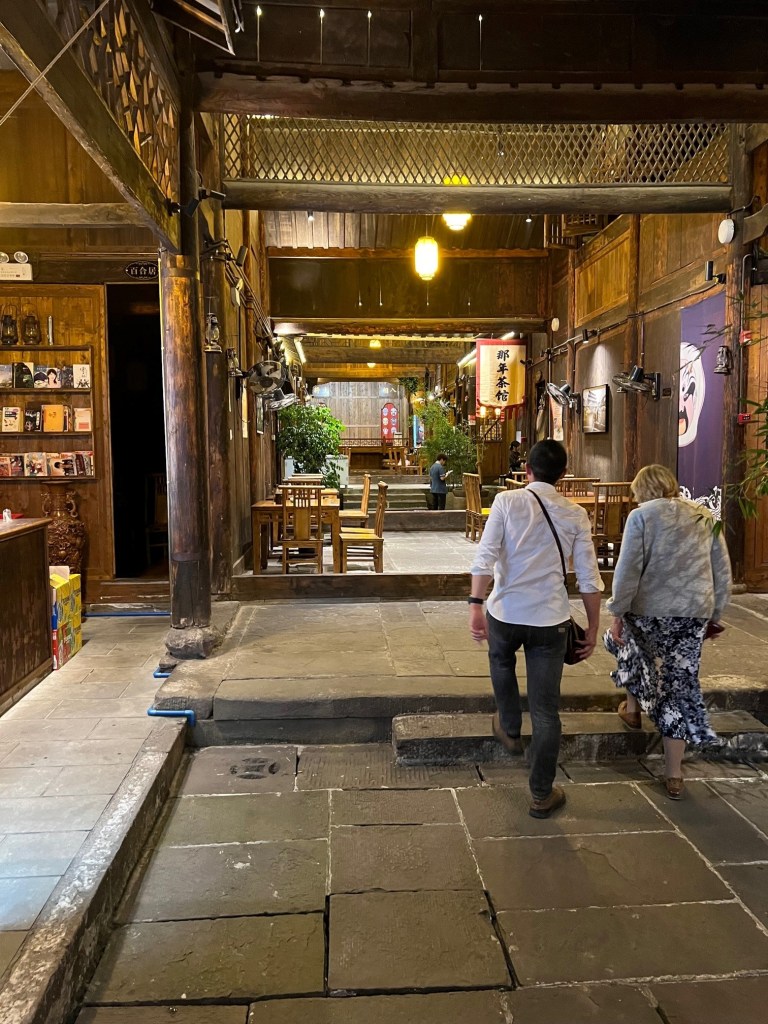
Pictures from China: 2) Sojourners and Pilgrims

As we often remind ourselves, we are no longer of this world if we are born again of the Spirit of God; we are merely in it. We are sojourners and pilgrims (1 Peter 2:11), looking for that heavenly city which is to come as we walk after the spirit and not after the flesh. At least, that is how it’s supposed to be. What is true is that our spirits have been born again into the spiritual dimensions, but our flesh still lives in the world that it was created for – or indeed that was created for it. Our challenge as Christians is to respond to the messages that come to us in the Spirit, and not override them with the signals from the world and the flesh.

Another missed call

Sometimes though, spiritual life is like walking along that street in China, shown above. We are there by faith, but we don’t understand much of what is going on, and if we are getting any signals we often don’t recognise them or understand what they mean until the moment has passed and they are like another missed call on our cellphone. How often do we lament, “Oh, I knew the Lord was telling me (not) to do that! If only I’d listened!” The signals that we follow the most faithfully are the ones generated by our own bodies and our own minds. We might be spiritual beings, surrounded by spiritual realities, but often we might as well simply be creatures of the flesh for all that we are responding to the spiritual dimension.

Our Guide

What we need of course in an alien environment is a guide, and Jesus has given us just that: a guide to walk with who will make sense of the spiritual world that we have become citizens of. I mean the Comforter of course, the Holy Spirit. But He is a gentleman: He won’t translate for us unless we ask Him. And as well as being a gentleman, He is love, so He won’t guide us in His purposes unless our purposes are committed to His. I have a feeling that God is dealing with many of us as individuals to set us free from our self-centred agendas and align our hearts with His own, so we can be prepared for whatever He is about to do on the Earth. We need to be walking with our Guide.

Solid Food

Because I think the Lord wants to lead us into far greater revelation that we have been accustomed to – the “greater things” He spoke of – and He is saying to many of us that the season of spiritual milk is over. We’re  no longer babes, and we need solid food. We have had plenty of lessons in how to operate in the gifts of the Holy Spirit and we have seen something of the reality of the power of God, but these have mainly been school days and now it’s time to grow up. Classes will always continue for those who need them, but the solid food of living in this world as citizens of the kingdom of God is the same food that Jesus spoke of to His disciples, which is to do the will of the One who sent us. As He sent out the 12 and the 70, He sends the Church out today. To graduate from the classroom requires faith and sacrifice, but it is when we are in touch with the reality of love that we can expect the truth of love to guide us in spiritual realms, and the Power of Love to quicken our lives and flow into the lives of others. We will start to read the signs all around us as we walk: “Reach out here. Touch there. Speak these words. Bring my healing to this sick person. Intercede for this city.  Cast out this demon…”

“Mercy and truth met together.
Righteousness and peace have kissed.
Truth shall spring out of the Earth,
And righteousness shall look down from heaven.

Yes, the Lord will give what is good;
And our land will yield its increase.
Righteousness will go before Him
And shall make His footsteps our pathway.”

(Psalm 85, 10–13).

The Pillars of Evangelism

The fields are white unto harvest

In his second letter to Timothy, Paul wrote: “But you be watchful in all things, endure afflictions, do the work of an evangelist, fulfil your ministry.” (2 Tim 4:5) If we stopped anyone in the street, Christian or atheist,  (OK anyone over 40 who has lived in an English-speaking country), and asked them to name an evangelist and say what they did, we would almost certainly hear the name of Billy Graham and be told that they stood up in public places and preached about Jesus/ God/ the Bible. I think this image of “the evangelist” is still prevalent in the church today, and that “evangelism” is a special activity carried out at special events by a few gifted people, often in full-time ministry and “living by faith; and that the rest of us can only expect to occasionally “witness” or “share our faith” now and then, “sowing seeds” that we do not necessarily expect to see coming to fruition. But I don’t think this is the truth. In fact I think that it is an enfeebling dilution of the legacy that Jesus left to the Church, and doesn’t really help anyone to fulfil their ministry.  If we combine the “Great Commission” verses in Matthew and Mark into one paragraph, we get the following:

And Jesus came and spoke to them, saying, “All authority has been given to Me in heaven and on earth. Go therefore into all the world and preach the gospel to every creature, and make disciples of all the nations, baptizing them in the name of the Father and of the Son and of the Holy Spirit. He who believes and is baptized will be saved; but he who does not believe will be condemned.  And these signs will follow those who believe: In My name they will cast out demons; they will speak with new tongues;  they will take up serpents; and if they drink anything deadly, it will by no means hurt them; they will lay hands on the sick, and they will recover. Teach them to observe all things that I have commanded you; and lo, I am with you always, even to the end of the age.” And they went out and preached everywhere, the Lord working with them and confirming the word through the accompanying signs.” (Matt 28:18-30 combined with Mark 16: 15-20)

Just as the church has specialist prophets but “All can prophesy,” (1 Cor 14:31) and has specialist pastors and teachers  but we are all called to love one another and to “teach and admonish one another in all wisdom;” (Col 3:16) we are all called, as Timothy was, to do the work of an evangelist and preach the gospel, even though the church also has specialist evangelists. (See Ephesians 4. It’s not the subject of this article, but leadership in every church should comprise all these specialist ministries. I’m just saying… ) So here are eight principals, eight “pillars of evangelism,” that we can take from Christ’s command. To do the work of an evangelist properly I think we need to take all of them seriously.

  1. All the world
    We Go into all the world. Our workplace as disciples of Jesus is primarily the world. We don’t expect the world to come to the church; we take the church into the world.
  2. Every creature
    We preach to every creature – old, young, rich and poor. God is no respecter of persons. In the parable of the wedding feast Jesus said: Therefore go into the highways, and as many as you find, invite to the wedding.’ So those servants went out into the highways and gathered together all whom they found, both bad and good. And the wedding hall was filled with guests.” Our commission is to make sure that the hall is filled with guests: whatever they are wearing, rags or riches, is all replaced by the wedding garment.
  3. Saved… condemned
     We preach the full gospel: salvation and condemnation. To preach is to proclaim, with authority, something that has been done, in the manner of a herald. (From the Strong’s definition.)  We are heralds of what Christ has done for us and its consequences, both for those who believe and those who don’t believe.
  4. Baptizing them
    We baptize converts in water and we baptize in the Holy Spirit by the laying on of hands. “Therefore leaving the principles of the doctrine of Christ, let us go on unto perfection; not laying again the foundation of repentance from dead works, and of faith toward God,  of the doctrine of baptisms, and of laying on of hands, and of resurrection of the dead, and of eternal judgment. (Heb 6: 1-2) The Ephesian church was birthed through baptism and the laying on of hands: “When they heard this, they were baptized in the name of the Lord Jesus. And when Paul had laid hands on them, the Holy Spirit came upon them, and they spoke with tongues and prophesied.” (Acts 19: 5-6) Being filled with the Holy Spirit has experiential results. If we do not ourselves have the faith and the personal experience to pray for someone to be filled with the Holy Spirit and to experience some consequences of that infilling, we need to leave that ministry to someone who does. In the case of the Ephesians, it was Paul. Otherwise we are offering a hungry person cornflakes and just giving them an empty packet.
  5. I am with you always
    We go, therefore, knowing the presence of God, who with us always, because we are in Christ, baptized into Him, into His death and His resurrection (Romans 6:3). We operate “in the name of Jesus” because we have been baptized into His identity. A Christian is a “little Christ,” not a partial Christ.
  6. All authority
     We go in His authority: When Jesus sent out the seventy, He said “Behold, I give you the authority to trample on serpents and scorpions, and over all the power of the enemy, and nothing shall by any means hurt you.” (Luke 10:19) This was before Pentecost. Whether or not it is in the realm of our current experience, we are now in the day of the Greater Things; we are raised together with Him and seated with Him in Heavenly places. We have more authority now than the seventy, not less.
  7. These signs will follow
     Knowing what it means to be sent in His name, we go in the full expectation of signs and wonders following the preaching of the gospel. Paul writes: “I am not ashamed of the gospel, for it is the power of God unto salvation to everyone who believes.” (Romans 1:16) To preach the gospel is to proclaim Christ’s authority over all of heaven and earth, over all the works of the enemy including sickness and demonisation. If we have no expectation of His authority being manifested when we preach “the power of God unto salvation,” we are like people who get into their company car and don’t start the engine. Not only are we going nowhere, but we are not honouring the One who paid with His life for us to have the car in which we have been told to “Go.”
  8. Teach them
     Finally, as “fishers of men,” we keep those whom we have caught. Jesus said “Those whom You gave Me, I have kept. And none of them is lost, except the child of perdition.” (John 17:12) God will give us as many as we can keep, therefore we make sure that we teach them all the things that Jesus has commanded us, so that they in turn can go and make disciples.

Jesus said that it’s the harvest field that needs workers, not the seedbed. It’s time the Church took seriously the work of the evangelist, and started reaping. In Matthew 9: 36-38, we read this:

“But when He saw the multitudes, He was moved with compassion for them, because they were weary and scattered, like sheep having no shepherd. Then He said to His disciples, “The harvest truly is plentiful, but the labourers are few. Therefore pray the Lord of the harvest to send out labourers into His harvest.”

The Greek word that he uses for pray, deomai, means to petition, bag, beseech. It implies a felt need, a longing. We “go” because Jesus tells us to. And yes, the reluctant brother (Matt 21: 28-32) was commended for his obedience. But if we really want to enter into the joy of the reaper (John 4:36) and experience the harvest firsthand, we need to feel the Lord’s compassion for the lost in our own hearts, we need to be aching ourselves for the lack of harvesters, and we need to be beseeching the Lord of the harvest for co-workers who will join us in the task.

In that spirit, Go, therefore!

The School of Love

I won’t repeat what I wrote a few days ago: we do not know the day or the hour, but there are abundant signs – in the world, and for those who look upward, in the heavens also – that the return of the King really is at hand. Our mandate is to go into all the world and preach the gospel, preparing the way for that time. Our priority must be to reach the lost. Our light must increase as the darkness deepens. It will do, because Isaiah 60 1-11 says it will: the question that each of us have to face is whether we want to be part of that brilliance or not. To do so we need to grow in three areas: faith, power, and love.

Faith: for ourselves
We will need to grow in faith –we will need it as individuals, to depend increasingly on Jehovah Jireh as the provision of the world fails. If, as Revelation 13:17 says will happen, we are forced to choose between trading in the system of the world and its banking and being true to our King and His Kingdom, we will need to walk day by day in the expectation and experience of God’s supernatural provision. I wrote a couple of years ago about the time at the beginning of lockdown when everyone was panic-buying toilet rolls and there were none in the shops:  God told us not to join the panic but to rely on Him, and when we were down to our last one a delivery van full of them pulled up next to my wife at the local petrol station. God delights to show His little flock that they need not fear. (Luke 12:32) But this is just one example of God’s faithfulness and practical care out of three years of living by our bank cards and not by faith. How prepared are we for this to be a way of life?

The Bible verses abound, beginning a small selection with Hebrews 10:38 : “The just shall live by faith.” Paul reminds us that “We walk by faith and not by sight.” (2 Cor 5:7) “The prayer of faith will heal the sick,” declares James. (James 5:15). Hebrews again: “Without faith it is impossible to please Him, for he who comes to God must believe that He is, and that He is a rewarder of those who diligently seek Him,” (Heb 11:6) and to finish, Paul’s pithy statement to the Romans: “Whatever is not of faith is sin.” However we choose to look at our walk with God in these last days, there is one truth that is paramount: every step we take has to be a step of faith.

Power: for the world
Faith is not just for our daily bread of course: we will need it to grow in power, the second area of need. The world will need to see us move in the power of the Holy Spirit if the multitudes who are in the valley of decision are to see the word of the gospel confirmed in signs and wonders and come to faith. Romans 1:16 tells us that the gospel  “is the power of God unto salvation to everyone who believes…” As I wrote in Rainbows and Chickens,” those who believe that God moves in signs and wonders today need to preach the gospel to see the power of God at work; and those who regularly preach the gospel need to have an expectation of God to confirm that word with signs and wonders. Word and Spirit must work together. Hebrews 4:2 is a key verse:

For indeed the gospel was preached to us as well as to them; but the word which they heard did not profit them,  not being mixed with faith in those who heard it.”

So here is the equation: Faith + the gospel = power to save. Paul wrote this to the Galatians: “For all of you who were baptized into Christ have clothed yourselves with Christ.” (Gal 3:17) This is not theoretical language; this is truth. To be baptized in the Holy Spirit is to be immersed, soaked, in the Spirit of Christ. Being “in Christ” isn’t just theology; it’s the reality of being soaked in Him.  And if we are soaked, we can expect people to get wet when we touch them – wet with the miraculous life of Christ. Jesus told us that the way to increase our faith is to understand that we are just “unprofitable servants; we have only done what we were told to do.” (Luke 17:10.) So if we couple the faith of simple obedience with believing the reality of who we really are – who God says we are – in Christ, we can expect to leave a trail of the soaking wet Life of Christ behind us whenever we “go” and preach the gospel. And when those signs and wonders happen, faith rises in many hearts and mixes with the word that was preached, and souls are born again into eternal life.

Love: for the Church
And finally we will need to grow in love – the church will need it, because it’s the unity that commands the blessing and it’s by our love that the world will know that we are disciples of Christ. Faith and love are the two poles of the magnet that powers the dynamo of Kingdom growth. We have all read 1 Corinthians 13 (I am speaking to Christians here: if you aren’t one yet, now is your time), and we know that even faith that moves mountains is nothing without love. To the Galatians Paul says: “For in Christ Jesus neither circumcision nor uncircumcision avails anything, but faith working through love.” (Gal 5:6) Without love we are nothing, and our faith and our gifting are to no avail. I don’t think Jesus commanded us to love one another just so that we could be a sort of spiritual shop window for His glory (although we are that: see Ephesians 3:10): the teaching of Jesus on Love puts His command to the church in a far more radical context:

You have heard that it was said, ‘Love your neighbour and hate your enemy.’ But I tell you, love your enemies and pray for those who persecute you, that you may be children of your Father in heaven. He causes his sun to rise on the evil and the good, and sends rain on the righteous and the unrighteous.  If you love those who love you, what reward will you get? Are not even the tax collectors doing that?  And if you greet only your own people, what are you doing more than others? Do not even pagans do that? (Matt 5: 43-46 NIV)

School of Love
I think the Church is our school of love: if we cannot learn to love one another in the church, what hope does the world have to receive what Christ has for them? As Peter writes: “For it is time for judgment to begin with God’s household; and if it begins with us, what will the outcome be for those who do not obey the gospel of God?” (1 Pe 4:7) We cannot  grow in faith and power unless we grow in love as well. Revival is messy and demanding. Converts need to become disciples. Just like the 5,000, the poor who have had the gospel preached to them need to be fed. The lonely and isolated need befriending. We will need to have compassion on the hungry crowd, not send them home – or to someone else’s church. So we need faith and power to see revival happen, but we need love to live with the results.

Jesus wants to come back for a loving bride that is on the same page as Him. I’m not sure if I’m ready for Him yet. What about you?

Lazarus: the grave and the glory.

“Do not conform to the pattern of this world, but be transformed by the renewing of your mind. Then you will be able to test and approve what God’s will is- his good, pleasing and perfect will.” (Romans 12:2)

The following material is from a message I preached in Liberia, so it’s more a collection of bible verses arranged under headings, mostly from John 11: 1-44, than a lot of my own thoughts. Which has to be good, really…

The purpose of Jesus’s ministry was to see  the Kingdom of Heaven established on earth through the church, and the account of the raising of Lazarus from the dead is a picture of exactly that: the Kingdom coming on earth; life overcoming death. In it we see two ways of thinking : the earthly way, represented by Martha and Mary, the disciples, and the Jews; and the Kingdom way of Jesus. We’re going to consider these two, remembering that the Word tells us that if we want to see the “good, pleasing and perfect will” of God, we need to be renewed in the spirit of our minds…

“Do not conform to the pattern of this world, but be transformed by the renewing of your mind. Then you will be able to test and approve what God’s will is- his good, pleasing and perfect will.” (Romans 12:2)

Some aspects of earthly, or carnal thinking.

1) Earthly thinking wants to hold on to circumstances as they are

Verse 21: “ Lord, if You had been here, my brother would not have died.” (Martha)
Verse 32:  Lord, if You had been here, my brother would not have died.” (Mary)
Verse 37 “And some of them said, “Could not this Man, who opened the eyes of the blind, also have kept this man from dying?” (Some of the jews)

2) Earthly thinking sees the problem

Jesus said, “Take away the stone.” Martha, the sister of him who was dead, said to Him, “Lord, by this time there is a stench, for he has been dead four days. (Vs 39)

“Rabbi, lately, lately the Jews have sought to stone you, and are you going there again? (Vs 8)

3) Earthly thinking cannot believe the word of God

“I am glad for your sakes that I was not there, that you may believe. Nevertheless let us go to him.” Then Thomas, who is called the Twin, said to his fellow disciples, “Let us also go, that we may die with Him.” (vs 15-16)

4) Earthly thinking knows the doctrine, but it’s all head-knowledge

Jesus said to her, “Your brother will rise again.” Martha said to Him, “I know that he will rise again in the resurrection at the last day.” (v 24)

Jesus said to her, “I am the resurrection and the life. He who believes in Me, though he may die, he shall live. And whoever lives and believes in Me shall never die. Do you believe this?” She said to Him, “Yes, Lord, I believe that You are the Christ, the Son of God, who is to come into the world.” (v 25-27)

Martha knows about Him, but hasn’t grasped that the resurrection itself and eternal life itself are standing in front of her.

5) Earthly thinking depends on someone else

“If only you had been there…”
If only xxx was still here…
If only the leaders would sort this out…
If only an evangelist would come to our town…

Some aspects of Kingdom thinking

  1. When earthly thinking sees the problem, Kingdom thinking sees the glory of God:

“Therefore the sisters sent to Him, saying, “Lord, behold, he whom You love is sick.” When Jesus heard that, He said, “This sickness is not unto death, but for the glory of God, that the Son of God may be glorified through it.” (vs 3-4)

2) Kingdom Thinking walks in a different dimension; the dimension of the Spirit:

 “Are there not twelve hours in the day? If anyone walks in the day, he does not stumble, because he sees the light of this world. (v9)

“But the natural man does not receive the things of the Spirit of God, for they are foolishness to him; nor can he know them, because they are spiritually discerned.” (1 Cor 2:14)

3) Kingdom Thinking knows Gods protection
Again, “Are there not 12 hours in the day …” (v. 9 – in response to the threat of being stoned)

4) Kingdom Thinking knows that Father has heard our prayer:
 “Father, I thank You that You have heard Me. And I know that You always hear Me…” (vs 41-42)

5) Kingdom Thinking operates out of faith
“Did I not say to you that if you would believe you would see the glory of God?” (v 40)

How do we change our thinking and renew our minds?

1) Know “The resurrection and the Life” personally.
that I may know Him and the power of His resurrection” (Phil 3:10)

This is the most important point of all. It’s one thing to know about Jesus; it’s something else entirely to know Him personally and have a relationship with Him as one of His disciples. So the first question is this: Do you know Jesus yourself? Have you been born again of the Spirit of God? As Jesus put it Himself: “Truly, truly, I say to you, except anyone be born from above, he is not able to see the kingdom of God.”” (John 3:3)

2) Know who He is in you
“But if the Spirit of Him who raised Jesus from the dead dwells in you, He who raised Christ from the dead will also give life to your mortal bodies through His Spirit who dwells in you.” (Rom 8:11)

Christ in you, the hope of glory” (col 1:27)

Bible hope is the expectation that something will happen; certainty, not wishful thinking. One of the most telling examples of New Testament “hope” is in Romans 8 20-21: “For the creation was subjected to frustration, not by its own choice, but by the will of the one who subjected it, in hope that  the creation itself will be liberated from its bondage to decay and brought into the freedom and glory of the children of God.” God didn’t have His fingers crossed when He brought death into the world: He knew for certain that His plan for redemption would be fulfilled.

Jesus was certain that God’s glory would be manifested at the tomb of Lazarus. ““This sickness is not unto death, but for the glory of God.” Through Christ in us we have this certainty of coming glory, and through faith we can make this a reality in our present lives.

3) Hear what He says in the Spirit

Know that “my sheep hear my voice.” Not just my leaders, not just my prophets, not just the man who is preaching, but my sheep. All of them. Learn how to recognise His voice and believe what He says, because faith comes from hearing. Jesus knew what was coming because His Father had told Him.

4) Instead of wanting to hold on to what you’ve had, look forward to what God is going to bring.

“Didn’t I tell you that you see the glory of God?”

This is not meant to be an exhaustive list of what we need to do in order to renew our minds and move towards resurrection life, but it illustrates an important principal of discipleship: we can either stare at life’s tombstones, or we can be like Jesus and look for the glory. The decision is ours.


Of His fullness we have received…

“Of His fullness we have all received, and grace for grace. For the law was given through Moses, but grace and truth came through Jesus Christ.” (John 1: 16-17)

Any Christian who believes that the gifts and power of the Holy Spirit are available and operational in the Church today will know of, and quite possibly tell others of, the need to be filled with the Holy Spirit, as Scripture exhorts us in Ephesians 5:18. But as I’ve become more aware lately of what it is to be standing under the waterfall of God’s Grace, (see the last article, Mountains and Waterfalls) I’ve been considering what it actually means to be filled with the Spirit.

If all the fullness of God dwells in Jesus (Colossians 1:19), and Christ, the Hope of glory, is in us (Col 1:27), then how much of Christ dwells in us? Do we believe that it is a fragment? A cell? Maybe just a fragment of a cell? Or do we dare to believe that our loving Heavenly Father will answer Paul’s prayer for every Christian of every age, that we would be “filled with all the fulness of God?”

We are called to love one another; to have grace in our dealings. Jesus made in clear in the Sermon on the Mount that Kingdom relationships are characterised by the fact that what we give does not depend on what we receive: “If you love those who love you, what reward will you get? Are not even the tax collectors doing that?” (Matt 5:46) On the contrary, if we “love your enemies, bless those who curse you, do good to those who hate you, and pray for those who spitefully use you and persecute you,” we have the astounding promise that “You shall be perfect, just as your Father in heaven is perfect.” (Verse 47) We won’t just be good, because we have obeyed the rules, but we’ll be like God – because actually, as far as the rules of the world are concerned, we have broken them.

So a basic principle in the Manifesto of the Kingdom is that what we give to men does not depend on what we receive from them. We don’t love according to the tit-for-tat rules of the world, any more than we are to depend for what we need on the get-what-you-pay-for provision of the world. When Jesus preached repentance unto God, it was more than an exhortation to stop behaving badly: it was a call to throw out man’s rulebook and embrace God’s – whose book consists basically of two sentences: love God, and love one another. If we seek this Kingdom, everything else will be given to us.

“Of His fullness we have all received, and grace for grace.” Just as we have received out of the fullness of God in Christ, so it is only out of our fullness that others can receive grace from us – the grace that rises above the tit for tat of the world, that enables us to overcome negative reactions to damaging words and quench fiery arrows with living water. The Grace that enables us to be perfect, just like our Father in Heaven.” The purpose of being full of the Holy Spirit is not so much to have access to supernatural gifts, but to have access to supernatural love, supernatural gentleness and supernatural generosity. If our Saviour had not been filled with all the fullness of God, Satan would have shown Him a good carnal reason to disobey His Father; but He could say that Satan “has nothing in me” because He was completely full of God.

So two questions. The first is this: how full of the Holy Spirit are we?  Because if we are really full, like Stephen was, we don’t run away when the stones start to fall, but we “see the heavens opened, and the Son of man standing on the right hand of God.” (Acts 7:55)  It’s often said that we leak, which is why Paul’s exhortation is the present continuous tense – “Be being filled.” But I don’t think it’s true that we leak, and every now and then have to go back to the fountain (often at Church) for a top-up. We can’t fill the flesh with the Spirit. I think we are more like completely broken bottles, and  the only way for Scripture’s present continuous tense to operate in our lives is to stay under that waterfall, standing permanently in the Grace of God, morning, noon and night; work, rest and play. And at church as well. What a blessing we could be at church by just staying soaked all week. And if we can do this, out of our fullness others will receive, grace for grace. At church, in the home, and in the workplace.

And here is the second question: what is our expectation of the “fullness of God” in our lives? I was in a zoom gathering last night, and the word that Father spoke to us by His Spirit was that He wants to bring a new level of creativity to His people: that the atmosphere of Heaven is the Beauty of Holiness, and that He wants us to release that beauty into the world in all that we do – our work, or pastimes, our creative projects, our relationships of course – and that He would bring us new gifts, new resources, new skills, new levels of faith, in fact all that we need out of the infinite unseen storehouses of Heaven to start bringing this about. It was a beautiful, encouraging Word, and I do not do it justice with my single-sentence paraphrase. And it would be so easy for it to remain on the shelf, along with the library of other beautiful encouraging words that I have heard over nearly 40 years in the faith. Except for one thing. If you know me or follow my site, you will know that I am a “birder”: I love watching and photographing birds. I was sitting in the sunshine in my garden this afternoon, enjoying a cup of tea, when I heard a birdsong in the tree that I did not immediately recognise. I managed to get a picture, and I identified it as a female linnet. The linnet is a little finch with a sweet song, which the Victorians used to keep in cages as songbirds.  Linnets are not particularly rare, but I do not recall ever seeing one in my garden before – and we have lived here since 1998. It was something unexpected, beautiful, and new.

This was the linnet: not just a little brown bird, but something beautiful, unexpected and new.

I believe that little bird was a sign from the Lord of all Creation to remind me, and you, that He has so much more for us than we could ever ask or imagine, and that even now, as the world seems to be rushing to pull down its tents, He wants us to stretch forth the cords of ours and enlarge our vision of who He is and what it means to be filled with all of His fullness. If we do this He will fill whatever we give Him with more of who He is so that when the needy come to us they can be filled in turn from our fullness, grace for grace. Whatever your garden is, and whatever those linnets might be for you, watch out for them, because the Holy Spirit is releasing them from their cage.

“Lord, teach us to pray…”

“If you then, being evil, know how to give good gifts to your children, how much more will your heavenly Father give the Holy Spirit to those who ask Him!” (Luke 11: 1-13)

When the disciples asked Jesus to teach them how to pray, he gave them – and us – the Lord’s prayer. We tend to think – or at least I always have – that the Lord’s prayer is His answer to their request. But the teaching doesn’t end there. In Luke 11, the first four verses are the prayer itself, the next four are the illustration of the value of persistence in prayer, and the next five are the illustration of the Father’s generosity towards all who “ask seek and knock.” We have 13 verses of teaching, not just four: what to pray, how to pray, and how we can expect the Father to answer.


It’s been said before, but what strikes me about the illustration of the persistent friend is that he isn’t asking for bread for himself, but for the traveller who has come to his house. Jesus isn’t teaching us about how to pray for ourselves, but how to pray for others. Actually what He does teach us about praying for ourselves is quite short: basically He says our Father has got what we need before we even ask Him! (Matt 6:8)  If we walk in daily relationship with our Father Jesus says that He will feed and clothe us without the need for our shopping list. It’s  when we have nothing in our larder for those who come to out “house” that prayer is a requirement.


The model that the apostle Peter gives us for evangelism is to always be ready with an answer for those who ask us about our faith (1 Peter 3:15.  I wrote about it last week). I think we can read the reference to our “house” as being more than the bricks and mortar that we live in (if we are fortunate enough), but our whole area of influence and the network of our relationships. In a sense, whoever we are with is in our “house,” and the Lord wants us to feed them with His bread. We don’t feed them with our bread; we feed them with His bread. We have nothing in our personal larders they can feed anybody else’s spirit: we have to go to the Lord for His provision. And it seems that sometimes we have to pester Him before He provides. Why? I wouldn’t like to say that I know, but it might be that He wants us to show a bit more love for and commitment to the needy person then one quick request. It may be our persistence is a hallmark of our love and also, maybe, a measure of our faith. But whatever the reason, Jesus teaches us to ask until we have received what we are asking for.

And this leads on to the final section of the teaching. Having shown that we need to be persistent when we “ask, seek, and knock” (the Greek tense means “ask and keep on asking), the Lord’s teaching goes on to tell us how faithful the Father is to answer. The persistent friend kept on asking for bread to give to his visitor. Jesus said that if we, as “evil” mortals, know how to give “good gifts” to our children, our good Father can surely be counted on to give “good gifts” to us, His children. In the next verse, the idea of the Father giving the Holy Spirit to those who ask (v 13) seems to come out slightly of left field in the context of the passage, but if we think of asking the Father to give us “bread” for others it follows on very clearly.

“Bread” is an accepted image for Words of Life. Our “daily bread” is the spiritual sustenance we receive through God’s word as well as the sustenance we need for our bodies. When we need Words of Life to give to someone, there is only one person we can turn to, because only Jesus has them (John 6:68). The only way we can receive those words of life are by the Spirit.  It is not unintentional that the writer of the Book of Acts quotes Jesus as making a connection between the Father giving the Holy Spirit and earthly fathers giving “good gifts” to their children. If an “evil” earthly father can give “good gifts” to his children, how much more will our Heavenly Father give “good gifts” when He gives the Spirit to those who ask (persistently)? And those good gifts, I would say, are precisely what the context suggests they are: they are the gifts of the Holy Spirit. We get “bread” for our friends by asking our Father for gifts of the Holy Spirit.

If Jesus’ passion is to build His church, and our commission is to get the job done in His name, especially by having an answer for everyone who asks us about our faith, we have in Luke 11 1-13 a classic three-point sermon on how to go about it:

1: We walk in God’s ways. If we live out of the Lord’s prayer from our hearts we will be doing that, and our light will be seen by others. (vs. 1-4)

2: They will come to our “house” out of the darkness because they will see that light and they will need to be fed. (vs. 5-8)

3: We can’t feed them ourselves, but we know someone who can give us the best bread of all – the gifts of the Holy Spirit. (vs. 9-13) To adapt Zechariah 4:6, it’s not by might, nor by power, nor by any human “bread” that we can share the gospel, but by my Spirit, says the Lord. All we have to do, whenever someone sees our light and comes to our “house,” is to ask. Persistently.

The Path of the Just

The path of just is like the shining sun,
That shines ever brighter unto the perfect day.“ (
Prov 4:18)

I started my prayer time this morning, half thinking and a half praying the usual daily thoughts, along the lines of “Lord, what are my priorities today? What should I be doing?” And then it was “And is there anything I should be writing about?” The last question was quite unusual, because I tend to write when I feel I’ve got something to say: I don’t usually ask the Lord first if he’s got something for me. (Maybe I should…) When I sat back in my chair the morning sun came out from behind a cloud and streamed through the window, so dazzling that it was difficult to open my bible and read it. But when I did it opened at Proverbs 4 verse 18:
“The path of just is like the shining sun,
That shines ever brighter unto the perfect day.“ (Prov 4:18)

It seemed fairly clear that His answer to my question about writing was “Yes, and this is it!” So this is what I’ve got…

Until the day that the lord chooses to intervene with the mechanisms of the universe, the Sun is never going to stop rising. It will always bring life, and it will always bring light . God does not want our path to be intermittent and jerky. Smith Wigglesworth said that once we are called to the Spirit we can’t return to the flesh. “God has given to us in the spirit, and behold, we are spiritual children today, and we must know that we have to be spiritual all the time. God forbid that we should ever be like the Galatian church, after we been in the spirit, we could come in the flesh. You are allowed to go into the spirit but you are never allowed to come in the flesh after you have been in the spirit.“ (Message given at Glad Tidings Tabernacle and Bible training school, San Francisco, August 22, 1922*)

So it is with the path of just: like the Sun, it is set on a course that is governed by immutable spiritual laws that are laid down in heaven and condensed for us in the command to love. The Hebrew word translated as “just” (tsaddiyq) means both just or righteous in government and in deed, and also righteous as justified and vindicated by God. It is because we have been justified by the blood of Jesus we are the righteousness of God in Christ, and this applies to every saint. It is only the Just who can walk after the spirit. The purpose of our walk, the path of the just, is to shine like the sun, and we do that when we consecrate ourselves to sharing God’s life and His love. When we walk after the spirit every step we take is like the footsteps of good King Wenceslas in the Christmas Song: they are warm with the love and the life of Jesus.

Many of us pray to see that sun shining in revival, but how much do we really want to pay the price of being part of the fire? In “Compelled by Love,” Heidi Baker tells of how – to the consternation of the authorities – she went into a camp set aside for people with highly contagious cholera, hugged the sick and dying, and brought the healing and Life of Jesus to the whole camp. Jesus isn’t going to give us black marks when we slip into carnality, but I do believe he is sad when we do, because he knows that not only we are missing His best, but also that He is missing our best. He must long for us to partner with the Holy Spirit like the apostles of old, the Wigglesworths of yesterday, and the Bakers of today.

Anne (my wife) had a visitation from God a few years ago that lasted three days. She says she knows exactly when He started to withdraw: it was when she reached out for a kit-kat (a chocolate biscuit that breaks into “fingers”) after He had said “don’t eat that now,” said to God “Why not? It’s harmless,” and ate it anyway. God has nothing against chocolate biscuits and He isn’t about micro-managing our appetites, but on that occasion He had a reason for wanting Anne to say no to her desire, harmless though it seemed. Because the presence of the Holy Spirit wasn’t so strong on her from that moment, the next time she was tempted to move out of the Spirit it was more difficult to resist, and so it continued until the sense of His manifest presence had gone.

We can scratch our heads over what it means to grieve the Holy Spirit, but I think it begins with this: the Lord wants us to be so in tune with His Spirit that we can dismiss those promptings of carnality that make our vessels so leaky, and He is grieved when we aren’t. When we spiral down the path to sin and death (James 1:15), His grief must increase, and David expresses acute awareness of this in Psalm 51, but I think this is the lesson of Anne’s story. Instead of being full of the Holy Spirit like Stephen and Barnabas in the Book of Acts, we judder along with our tanks on reserve, leaking because they are pierced through by chocolate biscuit fingers.  If more of us came to church full, instead of needing to be filled, we would be more likely to see the power of God moving among those who stagger in empty.

So we press on toward the goal of the upward call of God in Christ Jesus – although actually how much pressing do we really do?  A small group of us were praying to know the manifest presence of God in our midst, for the Daystar to consume our lives with His presence. A sister prayed with wonderful honesty: “Lord, we long for revival, or we think we do anyway…” I think she nailed it: do we really want revival, or do we just want to warm our hands on the fire?  Jesus tells us clearly that we should count the cost of following Him, whether he was talking specifically about carrying the cross, or teaching through the illustrations of assessing the cost of building a tower or the strength of an opposing army. If we want the Presence, I think we do need to press. When that shining sun is on its trajectory in the spirit, pouring God’s life and love into others, it cannot come down to Earth for a night out or a bit of r and r. It stays on course as it heads for the perfect day. The Son of Man had no place to rest His head.

The Mighty One, God the LORD,
Has spoken and called the earth
From the rising of the sun to its going down.

Out of Zion, the perfection of beauty,
God will shine forth.”
(Ps 50: 1-2)

God will do what He says. He will shine forth out of Zion. Zion will be found wherever that sun is shining. Are we just going to dream of the perfect day, or are we going to commit ourselves to staying on the path towards it? If we feel that we need a prayer of renewed consecration, we can do no better than the one the merciful Holy Spirit gave to David all those years ago:

Create in me a clean heart, O God,
And renew a steadfast spirit within me.
Do not cast me away from Your presence,
And do not take Your Holy Spirit from me.
Restore to me the joy of Your salvation,
And uphold me by Your generous Spirit.
Then I will teach transgressors Your ways,
And sinners shall be converted to You.
“(Psalm 51: 10-13)

“In royal robes I don’t deserve.
I live to serve
Your Majesty”
(Jarrod Cooper, from the Album “Days of Wonder.”)

*The Smith Wigglesworth quotation is published in “Smith Wigglesworth, the complete collection of his life teachings,” compiled by Roberts Liardon.

Extracts from Two Seconds to Midnight

How to be ready for God’s next move

“Two Seconds to Midnight” combines personal testimony, teaching, Bible commentary and prophetic themes in an exploration of Matthew 11:29-30: “Take My yoke upon you and learn from Me, for I am gentle and lowly in heart, and you will find rest for your souls. For My yoke is easy and My burden is light.”  The premise of the book is based on a prophetic revelation that there is very little time left before we reach the time marked on God’s calendar for something momentous to  occur, and we need to stay yoked to Jesus in order to be ready for it. Who knows (only the Father!) – it may even be the return of Christ. The following short extracts, starting with the introduction, are intended to give something of the flavour and the diversity of the book.


Introduction: Midnight

“On the eve of my birthday, my watch stopped at three seconds to midnight. The next morning I was writing this interesting fact in my diary, thinking about what it meant. Could it be a sign that there were just a few seconds left on God’s clock before Jesus returns? Or could it have been the Lord saying that there are just a few seconds left before the beginning of the new season we have been hearing so much about?

“I glanced up from my diary to the watch that was on the table before me, and suddenly, as I looked on, the second hand began to move again. It moved exactly three seconds and stopped with the hour, minute, and second hands all in line at midnight. Suffice it to say that the hairs on the back of my neck and on my arms literally stood on end!”

(Andrew Baker, Heavenly Visions: A Portfolio of Prophetic Revelations series 2 book 5, Ark Resources)

As Andrew Baker wrote, what happens at “midnight” was not made clear. What is abundantly clear, however, is that there is not long left until it happens and, whatever it is going to be, it is very, very important on God’s agenda. When a child is out with a parent with a deadline to meet – a train to catch, for example – we can expect to see the same parenting strategy employed again and again: “Hold my hand!” And as the child holds the parent’s hand, she knows that she isn’t going to get lost or left behind. She knows she’s safe; she knows she’s loved. And the parent who loves that child and who has a plan for them both also knows two things: she is safe, and the plan is on track.

We have a deadline, a train to catch. Jesus is calling out to us to focus; to stay close to Him. He doesn’t just ask us in Scripture to hold His hand: He asks us to do something that is more solid and safer still. He says to us “Take My yoke upon you . . .” If we remain yoked to Jesus we will not lose our way: we will be where He wants us to be, when He wants us to be there.

Andrew Baker recorded that experience in 2016; since then I believe the clock has ticked again, and with the advent of COVID the world has changed and midnight has been brought closer. Of course none of us knows how long the next two seconds will last, as “with the Lord one day is as a thousand years, and a thousand years as one day” (2 Peter 3:8); but this book is an exploration of what it means to be yoked to Jesus so we can serve Him best in what little time remains on His heavenly clock before midnight chimes.


Which yoke?

Evening came. I had my file ready for taking notes. I had produced a school play earlier that year, which I had written around a published series of songs that told the story of Noah’s Ark. (My heart, even then, was always drawn to the divine.) One of the characters was God, and the ring binder we had used in the play for His book was the file I was using for my notes. She went into a trance. If I hadn’t so totally bought into what was happening I would have run a mile: her face became Chinese. Muscles that she didn’t possess changed her features and slanted her eyes as the thing that was controlling her moulded her face like putty. And then we saw Akhenaten: he was a hunchback, and she grew a hump before our eyes. He also had a deformity that twisted his mouth: her mouth twisted, her face elongated, and I was sitting in front of the pharaoh that had been dead for nearly 4,000 years. I asked him questions for my book, and wrote down what he said. But what remains with me, and the reason I am telling this tale, is the first thing that was said by “Lao Tzu”. In a thin, reedy voice, it said, “We are very pleased. We see that you have found the golden book!” The cover of the file, God’s book from my play, was sprayed all over with gold paint.

The spirit realm isn’t “up there”, it is all around us. A testimony for all of us who seek to walk with Jesus is the experience of how God can control situations, lining up our personal universes so that we step into situations, or read a relevant Bible passage, in His perfect timing so that we know that our lives are aligned with His will. But what my experience in Glastonbury shows is that it isn’t just the Lord who can move us around to fulfil His plan for our lives. The devils aren’t just randomly prowling around looking for opportunities to do us harm: they too have plans – nasty, evil plans – and will proactively seek to draw us along the path that they have laid out for us. For Anne and me it was to be drawn deeper into the occult. Decisions that we thought we were making of our own free will were actually the result of demonic manipulation designed to bring us into greater bondage. The only real difference between us and the spiritist couple was that they were probably told to go to Glastonbury by their “spirit guides”, whereas we thought we were choosing our path.


Not a Tame Lion…

In Numbers 3 – 4 we read of the specific tasks allotted to the Levites. Unless our Bible study resources take us to the books of the Law, we (or is it just me?) tend to pass over these sections of Scripture in favour of the sweeping narratives of Samuel and Kings, the beauty and the raw emotion of the Psalms, the wonders of the prophets and of course the grace-filled New Testament. But if we want to encounter the holiness of our God we will find Him above the place of atonement in the tabernacle of Moses. We too easily humanise our heavenly Father. Yes, He is Abba. Yes, He welcomes us into His arms. Yes, He sings a song of love over us. But His accessibility by the blood of Jesus and His presence among us does not dilute the awesomeness of His majesty. As C.S. Lewis famously said in the Chronicles of Narnia, He is not a tame lion. While we inhabit our tents of flesh we cannot see Him as He is (1 John 3:2), but this does not diminish who He is among us. Because grace had not been given (one could say that Moses was the exception) the Levites only had a detailed set of regulations to keep them safe from destruction as they carried out their duties. The power that emanates from His being and permeated through all the sacred objects is like the electricity coursing through overhead power cables: touch it and you die. Such was – such is – the power that if any of the Kohathites, whose job was to transport the ark on their shoulders, even looked at a part of the load that was not their designated area, they would be destroyed. When God was allocating the tasks He gave specific instruction to Moses regarding the Kohathites “that they may live and not die when they approach the most holy things” (Numbers 4:19).

The pure perfection of creative love that made and powers the universe is not cuddly daddy. This is the power that raised Jesus from the dead. This is the cable that is coiled inside our spirits. Because we have the insulation of the blood of Jesus we can grasp the power line, but because we can grasp it without being destroyed does not diminish it at all; it just gives us an understanding of the power of the blood of Christ.


The lesson of gentleness

Gentleness brings peace. At the beginning of this section we looked at James 3:17, which tells us that “the wisdom that is from above is first pure, then peaceable, gentle, willing to yield, full of mercy and good fruits, without partiality and without hypocrisy.” Verse 18 goes on to say that “the fruit of righteousness is sown in peace by those who make peace”. If we want to see the kingdom of God established in and through our lives we need to sow “the fruit of righteousness”. Whatever emotional turmoil may be in your heart as a consequence of words spoken or deeds done by someone close to you, it is possible to make a decision to be gentle in response. You lose nothing by doing so: it is only the powers of darkness that lose their hold. As I said with reference to Jesus, this does not diminish your authority but, on the contrary, it creates emotional space for peace to reign, the wisdom from above to descend, and ultimately for a harvest of righteousness to be reaped.

At the time of writing, Anne and I have been married for 39 years, and we have been Christians for most of that time. But if I were able to go back in time and make just one change to my character, I think it would be that I exchange my orge for gentleness. I was cooking something on the hob last night. Anne came into the kitchen and said, “Turn the ring down! You always have it too high, and it just burns! You need to have it on a gentle heat.” I think I have always liked to say things emphatically and to be dominant and, as I delude myself, in control. My flame tends to be high, but instead of transforming what it touches, it too easily burns. We need to trust God to do the work of transformation, and keep our own flame on a gentle heat. When we see red, we need to see a red light. So if you are someone whose relationships are marred by emotional tidal waves, don’t wait until you are over 60 to learn the lesson of gentleness. And wherever we are in our journey, Jesus asks us to learn it from Him. He specified it because it is important, and we need to learn it now (if we haven’t already, of course) because there are only two seconds to midnight.


Daily Bread

George Muller lived with his arms wrapped tightly around God’s pipeline. He was a man yoked to Jesus. God’s abundant provision is there for us, as it was for Muller, but I believe that we are to give in faith ourselves if we are to fully appreciate what it is to ask, and receive in faith.

There are only two seconds left. Jesus warns us (Matthew 24:38-39): “For as in the days before the flood, they were eating and drinking, marrying and giving in marriage, until the day that Noah entered the ark, and did not know until the flood came and took them all away, so also will the coming of the Son of Man be.” Before that time comes, He tells us that we would see various signs that many would say are strongly evident now. We are on ice that is getting thinner by the day – not just in the Arctic, but in a financial system based on debt and greed, and flashpoints increasing in the geopolitical sphere. If – or rather when – the ice breaks and society falls through into the dark water’s chaos, we will need increasingly to rely on the Lord for our daily bread. The hole in the wall will be empty. There will need to be Josephs who will feed their brothers, and who will also demonstrate the goodness of Jehovah Jireh when world systems fail. Jesus said, “Nevertheless, when the Son of Man comes, will He really find faith on the earth?” (Luke 18:8). Let us make sure that He does.

Another sign of the last days is given to us in Revelation 13:18: “The number of the beast.” Whatever the deeper meaning and identity of 666 may be, we don’t need an online Bible teacher to help us understand the simple facts laid out for us in Revelation 13: that anyone who doesn’t have that number on their right hand or their forehead will not be able to buy or sell, and risks death. At the time of writing, thousands of people in Sweden are inserting a tiny microchip, the size of a grain of rice, into their hands so their biometric details can be scanned by various digital readers. It is being used to pay for train travel, to gain access to clubs and car parks, and it is said to be ready for use to take payments in shops and restaurants. Sweden is on the cusp of becoming the first cashless society in the world. The technology, known as RFID, is the same as that used in other contactless payment systems, so all of us who use contactless payments are only a skin-deep layer away from it ourselves.

The COVID crisis has brought cashless transactions closer still, and I don’t think it takes a great leap of the imagination to connect these developments in with the arrival of a completely state-controlled system of buying and selling under the beast. It will be hailed as a great boon to society, eliminating financial fraud as well as the contagion risks of handling cash. If that scenario is only two seconds away, we need to learn, urgently, how to stay yoked to Jesus in order to receive, and give, provision, because we do not know when we really will have to depend on God for our daily bread.


Blue tassels in our garments

Just like my game with Shelley is now an intrinsic and permanent part of how we behave with each other, and a source of fun that never diminishes, God wants the fabric of His word to so run through our lives that its living, active power is continually expressed through who we are and what we do. The Lord said to Moses:

“Speak to the children of Israel: Tell them to make tassels on the corners of their garments throughout their generations, and to put a blue thread in the tassels of the corners. And you shall have the tassel, that you may look upon it and remember all the commandments of the Lord and do them, and that you may not follow the harlotry to which your own heart and your own eyes are inclined, and that you may remember and do all My commandments, and be holy for your God. ‘I am the Lord your God, who brought you out of the land of Egypt, to be your God: I am the Lord your God.’” (Numbers 15:38-41

The quality, the commitment, the fruitfulness of our discipleship depends on the centrality of the word of God in our lives. Our faithful response to God’s word is a measure of the extent to which we have taken His yoke upon us.

 A lot of the wisdom in the book of Proverbs is sound advice that anyone will benefit from following, and expresses ideas that are not unique to the Judeo-Christian tradition. Many of the moral teachings of Jesus resonate with adherents to other major faiths. But what God wants for us is not just for His words to give us a pattern to follow and principles to abide by; He wants us to be channels for the creative power of His word to be released in the world, releasing light into the darkness and building the kingdom of heaven. This means that we live in faith that the power of God’s word to bring His rule and reign into our lives is greater than the power of the circumstances around us. To apply the wise teachings of the Bible to our lives is the best way of navigating our circumstances, but to believe in and release the power of God’s word is the way to overcome them. This is why John 15:7 is so important, where Jesus says, “If you abide in Me, and My words abide in you, you will ask what you desire, and it shall be done for you.” To move in power, contrary to the prevailing currents of the world, contrary to “the harlotry to which [our] own heart and [our] own eyes are inclined” (Numbers 15:39) we need to know Scripture, not just have a passing acquaintance with it.

In The Silver Chair, the sixth of C.S. Lewis’s Chronicles of Narnia, Aslan (Jesus) sends Jill Pole and Eustace Scrubb on a mission to liberate the prince of Narnia from an evil spell. He gives them four signs, which they are to repeat daily and never forget, and to follow whatever the circumstances. However, as the children come under the spell of the evil witch themselves, lured by a lying temptation of rest and comfort among some giants who would actually have killed and eaten them, the signs fade from significance. They neglected the discipline of keeping them uppermost in their minds, at a level where they actually would “direct their paths”; consequently their quest was more difficult and dangerous than it needed to have been. All the Narnia stories are rich in spiritual significance. We too are on a mission to bring freedom to the captives, and we too have to hold onto the “signs” that God has given us, irrespective of appearances and in the face of temptation. We cannot accomplish God’s mission without God’s word. We need to have those blue threads in the tassels of our garments.

Possessing our Souls

Jesus tells us, “By your patience possess your souls” (Luke 21:19) when we face end-time betrayal and hatred. Patience is translated elsewhere as “longsuffering” and “perseverance”. The writer to the Hebrews says, “And we desire that each one of you show the same diligence to the full assurance of hope until the end, that you do not become sluggish, but imitate those who through faith and patience inherit the promises” (Hebrews 6:11-12). To be patient we need to be still, because we know that when we are still we know that He is God (Psalm 46:10). We need to know how to wait on the Lord, because that is how we renew our strength. Patience is a crucial attribute of the Spirit-filled life, because patience says to us, “Stop! Don’t rush to react. What is God saying here?” We believe God’s promises in our hearts, but without patience we do not stop to reach out for them.

Peter writes (2 Peter 1:4) that we partake of the divine nature through His “great and precious promises”. When we are in a time of trial and the wolves come howling round our houses, we can run to protect our flesh, which is when they will come running after us and pounce; or we can stop, and “in our patience possessing our souls”, we can reach in faith with renewed minds into the truth of the divine nature which is our promised inheritance.


Pressing on…

“Trying to be good” is a burden, because no matter how hard we try, we are going to fail. And when we fail at being good, where do we go to escape the guilt? If we know Jesus personally, then the chances are we will run to the cross, we will receive forgiveness, and then we’ll start trying to be good again until the next time we fail. But how do we “press toward the goal for the prize of the upward call of God in Christ Jesus” (Philippians 3:14)? If we keep having to go back to the beginning? Paul has already given us the answer in the previous two verses:

Not that I have already attained, or am already perfected; but I press on, that I may lay hold of that for which Christ Jesus has also laid hold of me. Brethren, I do not count myself to have apprehended; but one thing I do, forgetting those things which are behind and reaching forward to those things which are ahead.” (Philippians 3:12-13)

We don’t slide down the snake and go back to the start: it’s not snakes and ladders. There aren’t any snakes on this board, because the snake has been defeated! Yes we fall, yes we need forgiveness again, but we continue to reach forward “to those things which are ahead”. In the Spirit we already partake of the “divine nature”, so if we sin there is only ever one reason: we have walked in the flesh and not in the Spirit. Jesus said of the scribes and Pharisees that they “bind heavy burdens, hard to bear, and lay them on men’s shoulders” (Matthew 23:4). Religion today writes the report that says, “Could do better. Must try harder.” What does Jesus say to us? “Take My yoke upon you. My burden isn’t the heavy burden of religion: My burden is light.” The difference is this: modern religion, whether you are a tongue-speaking Pentecostal or an incense-burning Catholic, is trying to be like Jesus and to do what He would do. Walking in the Spirit, yoked to Jesus, is asking Him what He would do then doing what He says. His yoke is relationship. By simply doing what He says we are reaching ahead into the divine nature which is our inheritance.


The Biggest Wave

“Take heed, watch and pray; for you do not know when the time is. It is like a man going to a far country, who left his house and gave authority to his servants, AND TO EACH HIS WORK, and commanded the doorkeeper to watch. Watch therefore, for you do not know when the master of the house is coming – in the evening, at midnight, at the crowing of the rooster, or in the morning – lest, coming suddenly, he find you sleeping. And what I say to you, I say to all: Watch!” (Mark 13:33-37, my capitals)

Scripture encourages us to discern the times when Jesus castigates the Pharisees for not doing so (Luke 12:56). We need to understand the season we are in, and this book is a response to the impression that the times we are in are basically the End Times. I think the “midnight” of Andrew Baker’s vision and the title of this book might be the return of the Lord, but since this is not a detail that the Father will reveal we cannot make that assumption. I see us as surfboarders out in the sea, where the waves seem to get bigger and more frequent with every passing year. I imagine God saying something like, “You are not going to have an easy ride. There is no longer going to be a calm sea; a swell is building up that is not going to die away, and the waves are only going to increase and get bigger. But the biggest wave of all shall be the wave of My Spirit as it sweeps across the face of the earth . . .”

The biggest wave will be the wave of God’s Spirit as it sweeps across the face of the earth. Whatever the waves are that crash into the foundations of society, I believe God’s wave will be bigger. I believe this wave will be unlike anything we have known in two thousand years: it will come crashing into the church and will completely uproot some of those big “leafy trees” so that they will be completely washed away, while the fruitful ones will multiply exponentially to take the gospel to the ends of the earth. We ride the wave, or we are engulfed by it. To ride this wave we need to be focused on our purpose, or our quest for it – “to each his work” – and not be found sleeping. Our debt-based economic system cannot withstand shocks forever. But whether they come in the form of virus outbreaks, oil-price collapse, water shortage, plastic pollution, war in the Middle East or elsewhere, global warming, cyberterrorism, or something else as unexpected as coronavirus was in 2019, God knows all of it, and He has given us authority and responsibilities in His house. “Joseph” ministries, responsible for providing for the household when the world system crumbles, how full are your granaries? Are they even built yet? You’ve only got two seconds left . . .


The Blind Beggar

“So Jesus stood still and commanded him to be brought to Him. And when he had come near, He asked him, saying, ‘What do you want Me to do for you?’ He said, ‘Lord, that I may receive my sight.’ Then Jesus said to him, ‘Receive your sight; your faith has made you well.’ And immediately he received his sight, and followed Him, glorifying God. And all the people, when they saw it, gave praise to God.” (Luke 18:40-43)

Of all the healings that we read of in the gospels, the blind beggar is the only one who is specifically referred to as following Jesus after his healing. What this tells me is that we cannot be yoked to Jesus unless we ask the Holy Spirit to open our eyes. And when He does, not only will we be glorifying God, but those around us will be giving Him praise as well.

Our promised land – the “exceedingly great and precious promises that have been given to us” – is this: to be “partakers of the divine nature”. If we allow ourselves to be invaded by the Spirit of God, we not only find ourselves starting to really know Him – to know His heart, His character, His desires for us, and above all His voice – we start becoming like Him. We will do what He did, and we will do the “greater things” promised in John 14:12. We will start to feel His compassion, so it won’t even occur to us to want to feed ourselves before feeding the 5,000. We will speak out of His love instead of our self-interest. Our promised land isn’t our city, the mega-church we want to build, a worldwide ministry, or 10,000 views on our YouTube channel; it’s to be partakers of the divine nature. The prerequisite to entry is that we have “escaped the corruption that is in the world through lust”. All that leaven has to go. Only Jesus can make this happen, because “if the Son makes you free, you shall be free indeed” (John 8:36) and He will do it by the power of the Holy Spirit, because “the Lord is the Spirit; and where the Spirit of the Lord is, there is liberty (2 Cor 3:17). Peter needed Pentecost to be yoked to Jesus. And if it was necessary for Peter, it is necessary for us.

If we are going to face the coming Jerichos we need the presence of the Holy Spirit to be so real in our meetings that bystanders see fire coming out of our buildings and call the emergency services. It happened at Azusa Street; it happened much more recently (21st-century recently) at a glory conference in Washington DC; and I am sure that there are other occasions that I haven’t heard of. It needs to keep happening. The church needs to be baptised with the Holy Spirit and fire, just as John the Baptist prophesied. And if we take His yoke, really take His yoke having had our eyes opened to all that He is and all that we are in Him, we will start to see that happen. The walls of Jericho falling down? Easy.