All posts by Bob Hext

I am an author and bible teacher, and lead the prophetic ministry at Wildwood Church (A New Frontiers church) in Stafford, UK. I founded Crossbow Education Ltd, an educational supplies company for supporting people with dyslexia, in 1993, and retired as CEO on March 28th 2025. I married Anne in 1980: we have three children and 7 grandchildren. As a disciple of Jesus, my motivation is to see the Kingdom of God advance in every walk of life: workplace and business as well as marriage, family and church, and I write to fulfil Ephesians 4:12 - "for the equipping of the saints for the work of ministry, for the edifying of the body of Christ." Because the work of ministry is for all of us, all of the time. I don't spend all my time doing "spiritual" stuff though: I like to spend time with friends, to travel, and - my main hobby - to watch and photograph birds.

Four rules for walking in the works God has prepared for us.

Ephesians 2:10 says that we are “God’s workmanship, created in Christ Jesus for Works prepared beforehand, we might walk in them.“ God’s word doesn’t say that we should do the works or complete them or carry them out, or any such similar term: he says that we should walk in them. So what does that mean? How do we walk in what God is prepared?

God has given us parameters for walking. We are to walk by faith and not by sight, we are to walk in Love, and we are to walk in the Spirit. There are other specifics too, like walking in newness of life,  walking circumspectly, and more; but these three enough to go on with. If we are to be walking in God‘s works – His works and not our own – we need to pay attention to them.

Rule One: “Walk by faith and not by sight.” ( 2 Cor:7)
To walk in God‘s works, we need to walk by faith. Among all the other things that can be said about what it is to walk by faith, one top level definitive is that it is contrary to walking by sight. We know this because scripture says so. A first requirement for any of God‘s works is that we cannot see everything that we need in order to carry it out, but that we trust God to provide it. If He has prepared the works beforehand, He has also prepared the resources. We cannot see them because we’re walking by faith, but we trust him to provide. We don’t wait to see his provision before we take a step: we start walking beforehand, knowing that He is El Shaddai, and will provide. Rule one stands alongside rule two:

Rule Two: “So likewise you, when you have done all those things which you are commanded, say, ‘We are unprofitable servants. We have done what was our duty to do.’  (Luke 17:10)

When the disciples asked Jesus to increase their faith, he gave them the model of the unprofitable Servant. The walk of faith has to be a walk of obedience: we do what we are told to do, no more, no less. So what has He told us to do? I think  there are two levels of command. There are scriptural commands which are for everyone, and there are specific directives which are unique to each of us. Jesus told us to love God with all our being, and to love our neighbour as ourselves. His “new commandment” was that we love one another. Without love, we are nothing (1 Cor 13:2), and as the whole of 1 Corinthians 13 makes clear, our works are worthless.

I think we find another “level 1” directive in Micah 6:8, where we find these famous words:  “And what does the Lord require of you But to do justly, To love mercy, And to walk humbly with your God?” If we are walking humbly before our God we are more likely to hear the specific directives at level two – whether we are Heidi Baker being told to go to Mozambique, or A N Other being told to give $100 into a specific ministry, or to pray for someone’s healing in the street. If we are looking for power encounters and adventures of faith without paying attention to level one, the chances are that we will be operating out of personal ambition and spiritual pride and not humility and love, and it’s unlikely that the Lord is going to give us any of the John 14:12 “greater things“  to do. But when our hearts are set on obeying the Lord at level one, “you will hear a voice behind you saying this is the way; walk in it” (Isaiah 30:21), and that word will be confirmed in such a way that we will not doubt the instruction. This leads us to rule three:

Rule Three: “A new commandment I give to you, that you love one another; as I have loved you, that you also love one another. By this all will know that you are My disciples, if you have love for one another.  (John 13:34-35)

Rule three is to walk in love. Not only is nothing we do of any value if we don’t walk in love, but Jesus tells us that we will glorify Him if we do – because all will know that we are His disciples. The love Jesus is talking about is His sacrificial “agape” love. Somebody I know well in our church has been given a vision for a project in Liberia, where there is 85% unemployment. This project, when completed, will provide income and employment and bring a little bit of God‘s kingdom to earth. Her dream is to do something that will lift a community out of poverty, and she thinks about it night and day. She said once that she wasn’t sure if it was from the Lord. I said I’m sure it is. Why? Because, apart from other confirmations she has received, she gets absolutely nothing out of it for herself, yet is prepared to invest a significant amount of time and money into the work. It is an expression of agape love with no self interest. Where does God’s Love point us? Because that is where His works will be prepared.

Rule four: “Pray always with all prayer and supplication in the Spirit (Eph 6:18)
Faith and agape  Love are only ours by the Spirit: “The flesh profits nothing.” (John 6:63)  Faith is “the gift of God, not of works, lest anyone should boast,” (Eph 2:9) and God’s love is “poured into our hearts by the Holy Spirit who was given to us.“ (Romans 5:5) Faith and Love are two of the only three things that “remain“ when all else has passed away (1 Corinthians 13:13) Spiritual projects are carried forward by spiritual prayer. Paul asks the Ephesians to be “praying always with all prayer and supplication in the Spirit, being watchful to this end with all perseverance and supplication for all the saintsPaul’s work as a messenger of Christ was sustained by the prayers of the body of Christ. If Paul needed prayer support to walk in the walks prepared for him, then so do we, and we need to be upholding others with our own prayers.

So to fulfil the purposes that we were created for in Christ Jesus, we receive our instructions from the Lord, and we trust Him to provide us with what we need to carry them out. We are 100% motivated by the blessing that we are expecting others to receive from the work, and we ensure that every step is covered and guided by Spirit-led prayer. If we take our steps according to these principles, I think we will see the works that God has prepared starting to take shape in front of us as we walk.

Vigilance in the Face of Spiritual Threats

Your enemy is prowling … Photo by Michael Parsons.

A matter of life and death
This picture is of an oyster catcher chasing away a crow. Crows predate the eggs and chicks of birds, so for the oyster catcher this skirmish is serious: it’s a matter of life and death. Ground nesting birds like oyster catchers are particularly vulnerable to predation: I read an account recently of a goshawk taking the nearly full grown chick of another oyster catcher at one of my local sites. On that occasion the parent bird didn’t manage to chase away the predator. In the natural world the battle between predator and prey is always a matter of life and death: there is no in between layer. How different it is for us. We have so many layers of protection, whether it is our insurance policies, our security cameras, our fancy doorbells that tell us who’s outside, health, police and emergency services – the list goes on. Rarely is a potential threat immediately threatening. Or is it?


The Unseen World
While on holiday recently, I went snorkelling. Above the water, nothing of the undersea world was visible. However the hotel had made snorkelling equipment freely available to residents, and as soon as I put on my mask and flippers I saw a different reality: the reef below me was alive with a myriad of darting fish and other colourful creatures, waving weeds, canyons, mountains, sand, stones, and seashells. The small fishes were flashing away because they were constantly wary of potential threats. In some of the crevices lurked sea urchins of different sizes; their poisonous spines waiting for an unsuspecting touch from any passing creature, or indeed from my flailing hands. When I took off the snorkelling equipment and went back to my sun lounger, I was struck not only by the natural beauty that I had just witnessed, but also of the reality of an unseen world below the water’s surface that is both beautiful and dangerous, and how we live much of the time on the surface of life, completely blind to the present reality and imminent dangers of the unseen world of the spiritual dimension.


The Prowling Predator
 Yet, like the oystercatcher, we have a predator. As Peter writes, “your enemy, the devil, prowls around like a roaring lion seeking whom he made devour.“ (1 Peter 5:8) Paul writes  that we “wrestle… with the spiritual hosts of wickedness in heavenly places.” (Eph 6:12) Jesus tells us that “The thief does not come except to steal, and to kill, and to destroy.” (John 10:10) Because of the prowling predator, Peter warns us to “be sober, be vigilant.“ In other words, we are to keep our heads clear and our eyes open, because we don’t know where the next attack is coming from. The word Peter uses here for being vigilant is gregoreo, and it is particularly significant for Peter. It was He who was sleeping, along with James and John, in the garden of Gethsemane when they were there with Jesus just before his betrayal. Jesus said to him: “What, could you not gregoreo with me just for one hour? Gregoreo and pray, less you enter into temptation. The spirit indeed is willing, but the flesh is weak.“ (Matthew 26: 40–41). We all know how the flesh failed Peter when Jesus was on trial, so his exhortation to vigilance was written with feeling. But by the time Peter was writing his letters, he also knew that God has made spiritual mask and flippers – the gifts of the Holy Spirit – freely available to the church to help us keep our eyes open underwater.

For want of a nail…
What we need to remember is that the devil plays the long game. There is a proverb, often attributed to Benjamin Franklin, that goes: “For want of a nail the shoe was lost, for want of a shoe the horse was lost, for want of a horse that rider was lost for want of a rider the battle was lost, for want of a battle the kingdom was lost, and all for the want of a horseshoe nail.” As a rule, the spiritual hosts of wickedness are not waiting round the corner with an axe to take us out at one fell swoop: they are more likely to tempt our flesh into negligence of a horseshoe nail so that we fall all by ourselves while they are busy tempting others. How often we say, “Oh that won’t matter…“ And then we find out further down the road that it really did matter, a lot.  The little thought that we were ignoring was actually the Holy Spirit showing us where the enemy had loosened a nail.


Ultimately, we know that the kingdom is the Lord’s, and that no amount of lost nails will compromise the final outcome of the victory that He has already won on the cross. But if we will keep our eyes open to the unseen spiritual realm we can avoid the lurking sea urchins that would take us out of the battle, temporarily or permanently, even though the final outcome will not be affected.

Understanding the Armour of God: Spiritual Readiness

(An extract from “Wheat in the Winepress”)

(I said in my last article “To put on God‘s armour is to put on Christ.” This extract from the book shows in more detail how this statement is backed up by scripture.)

We cannot know “the day or the hour” of the culmination of God’s purposes on earth and the return of Christ, but we do know that we must be ready, with our lamps filled and trimmed, as the parable of the ten virgins illustrates. Some observers would say that many end-time prophecies are being or already have been fulfilled, and that the time when the Church is really thrust into end-time battle stations is nearly upon us. In our cosseted Western lives our condition is almost dreamlike: with bank loans and credit cards, who needs faith for God’s supply?  With drugstores and doctors, who needs miracles of healing? We have Google and AI: who needs words of wisdom? We see TV documentaries: who needs to see the spirit realm? Ask those who were Christians in China in the 1980s. Ask the Christians in North Korea. Ask the brothers in Africa, where sorcerers call down lightning on Christian meetings. Ask those who have seen friends and family beheaded by Islamic State jihadists. Banks can fail, medicines can run out, and electricity can be cut off. We must wake up to the reality of the spiritual battle around us: we need to be standing in the purposes of God.

The Breastplate of Righteousness
And He has provided His righteousness: it is perfect and complete; we cannot add to it with our talents, our knowledge or our religion. Psalm 85:13 tells us: “Righteousness will go before Him, and shall make His footsteps our pathway.” We cannot walk in His footsteps unless we are wearing His breastplate. If we go into battle without it, we will be mown down. If we think we’ve got it right, we haven’t: we’re embellishing  the  God-given  garment  of  righteousness and making it unwearable. We are beginning in the Spirit, and then trying to make ourselves perfect in the flesh. (Galatians 3:2)

I cannot speak for others, but I know that I have always tended to personalise the rest of the armour of God when reading Ephesians 6. I have listened to, or read, teaching that paints a picture of Paul in his prison cell, looking at a Roman soldier on guard duty and likening the various aspects of our Christian walk with the armour he can see. We imagine Paul pondering on how the knowledge of our salvation is like a helmet that keeps our thinking on a godly track. We think of our faith extinguishing fiery darts of doubt and fear. We buckle our belt, keeping all our garments in place as we declare the truths of the word of God. Our faith, our helmet, our belt and so on – not so much the armour of God, but the armour of godliness.

But Paul’s pen is not the only one that the Holy Spirit used to tell us about His armour. Hundreds of years before Paul was writing to the Ephesians, Isaiah wrote prophetically of Jesus:

“He saw that there was no man,
And wondered that there was no intercessor;
Therefore His own arm brought salvation for Him;
And His own righteousness, it sustained Him,
For He put on righteousness as a breastplate,
And a helmet of salvation on His head.” (Isa. 59:16-17)

The helmet of salvation
We have already explored how we cannot wear our own righteousness, or do anything to add to what the Lord has provided; and we have seen that it is the Spirit, not us, who wields the sword of God’s word. It is clear from these verses that the helmet, too, belongs to the Lord Jesus. We do not wear “our” helmet of salvation: we wear His. Is this not a different level? The strength and the very existence of the helmet we wear does not depend on the level of our certainty, our detailed knowledge of the Scriptures or our understanding of theology. It is not just a symbol that came to Paul to illustrate the condition of our renewed mind: the helmet of salvation is what Jesus wore when God’s “own arm brought salvation for Him”. It’s His helmet that He has given to us. As we face the enemy, the protection over our thought-life is the same as Jesus was wearing when He won the victory at Calvary. He removes it from His head and offers it to us, saying, “Here you are. This is for you.” It isn’t going to fail.

The shield of faith
God’s righteousness is our breastplate. The Holy Spirit wields His sword, the word of God. We wear the Lord’s helmet on our heads. The faith, our shield, is also not our own. The Greek used for Jesus’s words in Mark 11:22, “Have faith in God”, is better rendered as “Have the faith of God”. Ephesians 2:8 tells us: “For by grace you have been saved through faith, and that not of yourselves; it is the gift of God.” The faith that led us to salvation comes from God. We do not create faith in our minds: all faith is God given. We learn in Romans 12:3 that “God has dealt to each one a measure of faith”. When Jesus tells us to “have faith in God” He is telling us that God is giving us a measure of His faith – the faith that called the universe into being at the speaking of His creative word; “the evidence of things not seen” (Heb. 11:1). This shield of faith, which extinguishes the fiery darts of doubt (“Did God say . . . ?) and fear, tells us that God’s word is truth and life. Like the helmet of salvation, the shield of faith is fashioned entirely by God: it is made of the very fabric of God’s creative power (the faith of God), and it is provided for us as a gift. We cannot go into battle without it.

The belt of truth
The item that “girds up our loins”, ready for action, is one thing that our post-modern world says does not exist: absolute truth. Paul writes to Timothy: “Now the Spirit expressly says that in latter times some will depart from the faith, giving heed to deceiving spirits and doctrines of demons .” (1 Tim. 4:1). In his second letter, Paul returns repeatedly to the topic of sound doctrine, encouraging Timothy to remain faithful to the truths that he has learnt, to continue walking in them, and to commit them to other trustworthy men who can pass them on (2 Tim 1:13, 2:2, 3:14). He tells the Galatians: “But even if we, or an angel from heaven, preach any other gospel to you than what we have preached to you, let him be accursed” (Gal. 1:8). This gospel of the grace of God through Jesus Christ is outrageous; it is astonishing; but it is clear and straightforward: God really did so love the world “that He gave His only begotten Son, that whoever believes in Him should not perish but have everlasting life” (John 3:16). We buckle “these truths” round our waists and we run with them in place, shod with the message of reconciliation that God has given us – “the shoes of the gospel of peace” – His peace (John 14:27), not peace as the world gives.

The point is this: all of the items in our armoury are not only God-given; they partake of the actual nature of God. Psalm 93:1 says, “The Lord is clothed, He has girded Himself with strength.” The armour that He is wearing is the armour that we put on. This is the Armour of God.

So like Gideon’s men, we take our provisions. We do not go into battle empty handed, but we take all the divine amour and every spiritual weapon that God has made available. We can ask for spiritual gifts like words of knowledge or gifts of healing, and by faith we can “take them in our hands”, believing that they will manifest when they are needed. We know that the righteousness of God is ours by faith in Christ, and we can go out and love our enemies wearing that righteousness as our breastplate, knowing that we have been freely forgiven and justified, and that nothing can separate us from the love of God which is ours in Christ. We equip ourselves with the word of God, and we allow the Holy Spirit to wield it. We take the helmet and the shield that He has fashioned and provided, clasp the belt of His truth round our waists and prepare ourselves to walk in His peace. Thus clothed in God’s strength, we look down onto the Midianites below us in the valley, and we pick up our trumpets.

(From “Wheat in the Winepress” by Bob Hext, published by MD Publishing)

Redeeming the Time: The Biblical Call to Action

“See you then that you walk circumspectly, not as fools but as wise, redeeming the time, because the days are evil.” (Ephesians 5:15)

The Greek word translated as “circumspectly” is Akribos. It means diligently, accurately, perfectly, not deviating in any way from the set path.  Akribos is how we have to drive a car: “with due care and attention.” It describes doing something in manner that doesn’t ignore some aspects of the situation, checking that everything is in order, that all requirements are met, and nothing is left out. Luke uses Akribos  to describe how he wrote his “orderly account” of Jesus’s life and ministry (Luke 1:3). Paul uses it when he writes to the Thessalonians to remind the them that they know perfectly well (akribos) that “the day of the Lord comes as a thief in the night.” (1Thess 5:2) To walk circumspectly is to pay full attention to every step we take. The scripture tells us it’s how we “redeem the time:” we don’t just skip along n the light; we watch our every step. The question is, what does redeeming the time actually mean?

It’s one of those phrases that I think I have glossed over until now, when I started studying Ephesians. What’s opened it up for me is that word translated here as “time“ is kairos, which is a definite and fixed measure of time, (it could be a moment or a longer period, even an epoch. It is sometimes used today in the term “Kairos moment” to describe a moment of special significance when God‘s kingdom purposes intersect our lives.) Redeeming the time seems to mean bringing God’s purposes into our current situation; in other words seeing God‘s will done on earth as it is in heaven.

The days are evil
The temporal context is also relevant. Paul exhorts us to redeem the time “because the days are evil.” Does he mean the particular days that he is writing in, or does he mean that all days are evil outside of God’s Kingdom rule? I think it must be the latter. The Holy Spirit was addressing the body of Christ through the ages, not just Paul’s contemporaries, therefore the text must mean that all the days are evil. Evil is the default setting until and unless we redeem the time. Microsoft has a default setting called oneDrive where it will save your work unless you choose another folder. You can’t change the setting, but you can override it. I never use oneDrive, so I always choose my own folder. When we redeem the time, we choose to override the default setting and save the kairos into God’s folder and not the devil’s.

In the previous verses, Paul has already shown us that we “find out what is acceptable to the Lord“ when we walk as Children of light (see my previous article, “Walking as Children of Light: Discovering God’s Will”), but he’s reminding us here that we also need to watch our steps as we walk. It is when we are diligent in our walk as Children of light that we redeem the time, and that in doing so we walk in wisdom because we have an understanding of God‘s will. The instruction “walk circumspectly, not as fools but as wise“  suggests that we are not being wise when we are not walking circumspectly. If we are not diligent in how we walk, we are actually being fools.

Paul continues his letter to the Ephesians by giving specific examples of applying this godly wisdom to how we conduct ourselves  in the world and in our relationships, and then he returns to the theme to close the letter. I think we tend to separate the famous passage on the armour of God from the rest of the text, but I don’t think this is what Paul intended. “The days are evil” (Eph 5:16) because they are ruled by the powers of evil whenever God‘s kingdom rule is not established. Evil is the fallen world’s default setting. We put on the armour of God in order to “withstand in the evil day.” When is the evil day? It’s today, tomorrow, the next day, and every day that the time is not redeemed.

Putting on Christ
Putting on the armour of God is the same as putting on Christ: He is our armour. To put on God‘s armour is to put on Christ, and to put on Christ is to put on the new man. (Again, see “Walking as Children of Light: Discovering God’s Will.”) The analogy is a practical step-by-step illustration of how to be diligent when we do so. We must put on all the armour, and we must wear it all the time. The picture tells us exactly what we are wearing and why. Unless we are circumspect and make sure we are wearing it all, the new man is incomplete and won’t walk very far before the enemy has tripped him up. But when we wear it, we are walking as Children of light and are in full understanding of God’s will, redeeming the time because the powers of darkness flee before the light.

The conclusion of Paul’s letter to the Ephesians is not an additional section dealing with spiritual warfare for those who have the mettle to take it on, but is a summary of what has gone before. It’s worth repeating his introduction to the armour here:

Finally, my brethren, be strong in the Lord and in the power of His might. Put on the whole armour of God, that you may be able to stand against the wiles of the devil. For we do not wrestle against flesh and blood, but against principalities, against powers, against the rulers of the darkness of this age,  against spiritual hosts of wickedness in the heavenly places. Therefore take up the whole armour of God, that you may be able to withstand in the evil day, and having done all, to stand.” (Eph 10-13)

The days are evil because the prince of this world has been given dominion by fallen man, and his wiles are carried out by the “the rulers of the darkness of this age,” and the “spiritual hosts of wickedness in the heavenly placeswho administer his evil rule. (Eph 6:12) Our calling as the army of God is to seize back that dominion and to place it under the feet of our heavenly Captain, or, has He himself said, to take the kingdom by force. (Matt 11:12) This is what it means to redeem the time. Every day is an evil day unless we redeem the time by walking circumspectly, which means paying careful attention to our Captain, seeing that we are fully equipped as Children of light to carry out His commands, and being careful to watch our every step as we advance through the battlefield.

Walking as Children of Light: Discovering God’s Will

Walk as Children of light, finding out what is acceptable to the Lord.” (Ephesians 5:10)

I spent my working life in the world of education and dyslexia, and went to countless conferences where the title revolved round the notion of “putting theory into practice.“ Whether it is learning how to drive and doing our theory test first, or learning how to teach children with learning difficulties, our model is that: first we learn the principles, then we have an examination to get our qualification, then we apply them.

Not so the biblical model of Christian discipleship. We don’t need to get a qualification, because Jesus got it for us at the cross:  we start with the practice straight away, and as we go, we discover the enduring reality of the principles that God has given us.

Paul wrote letters to 6 different churches. They all had specific issues that he wanted to cover, but behind his instruction there was only one body of truth, and one passion for all of the churches (2 Cor 11:28), which was that they grow to maturity in Christ. So sometimes we find him saying the same thing to different churches but using different words. Our English translations of his words can sometimes obscure the meaning rather than clarify it. For example, Ephesians 5:10 in the translation I use (NKJV) says that we “find out” what is acceptable to the Lord by walking as Children of light, whereas in his letter to the Romans he tells him that they will “prove” God’s will if they renew their minds. The word translated as both “find out” and “prove” is Dokimazo, which means to test, to prove, to examine, to scrutinise to see if something is genuine. Here are both passages:

 “For you were once darkness, but now you are light in the Lord. Walk as children of light (for the fruit of the Spirit  is in all goodness, righteousness, and truth)  finding out what is acceptable to the Lord. (Ephesians 5: 8-10)

“And do not be conformed to this world, but be transformed by the renewing of your mind, that you may prove what is that good and acceptable and perfect will of God.” (Romans 12:2)

Because of how we tend to read the Bible, we will probably approach these scriptures independently and come to different conclusions about what they mean. But actually, they mean the same thing. We Dokimazo the Will of God by walking as Children of light, and we Dokimazo the good and perfect Will of God by renewing our minds,. How do we renew our minds? Not by studying for the qualification, but by walking as children of light, step by step.

Paul instructs the Ephesians as well as the Romans on the theme of renewing the mind, in chapter 4 21-24:

“…  the truth is in Jesus: that you put off, concerning your former conduct, the old man which grows corrupt according to the deceitful lusts, and be renewed in the spirit of your mind, and that you put on the new man which was created according to God, in true righteousness and holiness.

He explains here that we are “renewed in the spirit of our minds“ when we put on the new man, which he also tells us was “created according to God in all true righteousness and holiness.” The new man seeks the Kingdom and not the self, and so thinks differently. The use of the word “spirit” here refers to the motivating power; what drives our thinking. He expresses the idea in Romans 8:5: “Those who live according to the flesh set their minds on the things of the flesh, but those who live according to the Spirit set their minds on the things of the Spirit.” Being renewed in the spirit of our minds is what we do whenever we fix our eyes on Jesus. When we walk as children of light and find out what is acceptable to the Lord, we can’t produce anything except the fruit of the Spirit, which Paul says is in “all goodness, righteousness, and truth.” If we are children of light we are born of the light, what is in us is light, we walk in the light, what we emanate is light, and also that light can bring revelation, because “whatever makes manifest is light.” (Eph 5:13) Light, as the parenthesis in verse 9 explains, is “all goodness, righteousness and truth.” These are the elements of our new nature, which as we have already seen was “created according to God, in true righteousness and holiness.” (Eph 4:24) Light is what comes out of us; it’s the fruit that we bear. We are all familiar with the different attributes of the fruit of the spirit that are listed in detail in Galatians 5:22-23: the verse in Ephesians summarises them well.

Aaron’s Rod
Numbers 17 gives us the story of Aaron’s rod, which budded, blossomed and fruited overnight to confirm Aaron’s appointment as high priest. We are a royal priesthood ourselves (1 Pe 2:9); “Kings and priests unto God” (Rev 1:6), so what applies to Aaron applies to us. So I think that the biblical model for the fruit of the Spirit is actually the supernatural fruiting of Aaron’s rod, rather than the natural development of earthly fruit that matures over time, which is how we tend to see it. If the Spirit is not confined to time, nor is His fruit; and to claim that self-control, for example, is taking its time to develop in my character is like anchoring the work of the Holy Spirit, who makes all things new, to the old man of flesh in the body of sin and death. If I am struggling with self-control it is because I am not seeking the Kingdom of God and I haven’t put on the new man in that situation. The same applies to love, peace, joy and the rest of the Galatians 5 list. To think otherwise seems like natural thinking; a good excuse for bad behaviour.

So we learn from Ephesians 5:9 that we manifest the fruit of the spirit by taking steps as Children of light, and in doing so we discover God‘s will for us. Our new nature is complete from the start: we “put it on“ just like we put on our clothes in the morning. It doesn’t develop gradually, any more than we start the day just wearing one sock and walking around naked until we’re ready to put on another one. Our new nature is “God‘s workmanship, created in Christ Jesus for good works, that we should walk in them.“ (Ephesians 2:10) It is raised with Christ and seated in heavenly places, Aaron’s rod waiting to blossom, ready for us to put on at every moment of the day, every day. Walking in the spirit isn’t just about encountering God in supernatural manifestations and impossible adventures of Faith, although it can be both of those; it is about choosing the new creation’s priestly garments in our daily life and our dealings with other people instead of the old man’s rags of selfishness and sin. Paul sums up the immediacy of this fruitfulness in Ephesians 5:14

“Therefore He says:

“Awake, you who sleep,
Arise from the dead,
And Christ will give you light.”

We will obviously fail, a lot, and mess up our new clothes; but when we do we repent, we receive forgiveness, we get up, and we start walking again. Because of God’s amazing grace, our new creation is as spotless again as it was the day it was born, and we will have been renewing our minds, putting on the new man, walking in the spirit, and bearing the fruit of righteousness at every step. “If we walk in the light as He is in the light, we have fellowship with one another, and the blood of Jesus Christ His Son cleanses us from all sin.” (1 John 1:7)  I don’t think the process of sanctification is about letting this fruit grow in us over time, because according to Ephesians 4:24 it’s all there from the start: I think it’s all about learning to walk for longer in the Light without falling over, as Jesus “sanctifies and cleanses us with the washing of water by the word.”  (Eoh 5:26) And as we walk into those works prepared beforehand we experience the divine appointments, supernatural moments and miraculous provision that we long for.

We often quote Jeremiah 29:11, that tells us that God knows the plans that he has for us. If we want to know what those plans are, we make up our minds to keep walking as children of light, and we will step into them.

The Diffuser

A poem by Konna Thompson

Father,
You are the diffuser
that I don’t need to switch on
all I need to do
is ask
and receive your aromatherapy

which is not simply a pleasant scent
that merely calms my nervous system
but saturates my soul
your spirit is gentle
yet is a highly concentrated
fragrance of love

please don’t refrain
from pouring your purest oil
on my head
please don’t let my hands
become too soft
please make my feet walk worthy
of the calling I receive

I receive your b r e a t h
of life
I want to inhale your aroma
and for my bloodstream
to be infused by you
every cell carrying your DNA
so that I can leave a scent of Jesus
wherever I go

Anoint me

The Call of the Dove

“Your gentleness has made me great.“ (Psalm 18:35)

The aspiration to greatness is probably hidden somewhere (and at times not so hidden) in every unredeemed heart, whereas personal greatness is no longer an attribute that a Christian disciple would want to appear in his spiritual CV. However, seated as we are in Christ with the unlimited power of His Spirit in our hearts, we are all have that greatness, however weak and foolish our actions in the flesh may be. His gentleness has made us great. But if I am great because of His gentleness, it is also true that I am only great in His gentleness, because gentleness is in His very character, as He describes it himself: “take my yoke upon you and learn from me, for I am gentle and humble of heart, my yoke is easy and my burden is light.”  (Matt 11:29) Gentleness is a characteristic of the fruit of the Spirit that Jesus is looking for in the life of every believer.

Ephesians 2:10 tells me that I was “created in Christ of Jesus for Works prepared beforehand , that I may walk in them,” so if I am not walking in His gentleness, I am not walking in Him, and I’m not fulfilling my destiny in the works that He has prepared for me to walk in. And if I am not walking in His works, I must be walking in my own, and therefore I am walking after the flesh and not after the Spirit.

Gentleness is not weakness, it is enabling power. Gentleness does not push; it leads, because it knows where to go. Gentleness does not argue, but speaks the truth in love or does not speak at all. It does not react to situations and people out of fear, but out of knowledge of the truth. There is no uncertainty in gentleness: Jesus knew where he had come from where he was going, and so do we. We have come from above and will be returning there.

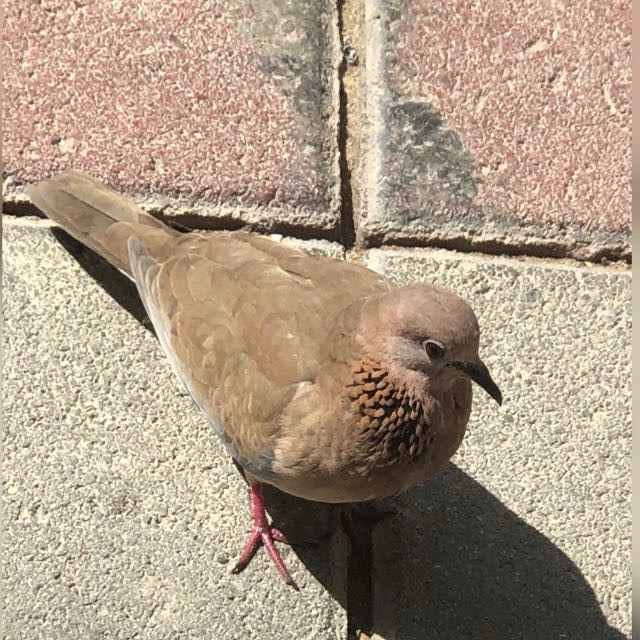
Gentleness is like the wavelets in a sheltered, cove: buoyant and supportive, never overwhelming and never crashing on the beach, yet moving with all the power of the tide.  Those wavelets are seasoned with salt: it’s the salt that is supportive, and so should it be with our speech. (Col 4:6) Gentleness is the dove who baptised Jesus in the power of the Holy Spirit, and characterises the advance of the kingdom of God. Gentleness is the dove who brought the olive branch to Noah, and is a species of bird that can be seen and whose call can be recognised everywhere in the world. 

Whatever may flood our circumstances and our emotions, it is gentleness who brings the promise of landfall in the kingdom of God. It is always at hand. Let us always be ready to hear and respond to the call of the dove.

(A note on the image: I took the picture of the dove in the Middle East. Traditionally we portray the biblical dove as white, but it’s quite likely to have looked more like this one.)

Built Together in Christ

“In whom the whole building, being fitted together, grows into a holy temple in the Lord, in whom you also are being built together for a dwelling place of God in the Spirit.“ (Ephesians 2:21–22).”

To love another person we must let them into our lives. We cannot love on our own agenda: we can only love by embracing the agenda of the other. This is why the gospel consistently requires us to lay down our lives. This is why walking “worthy of calling with which we are called“ (Ephesians 4:2) involves lowliness, gentleness, longsuffering, and bearing with one another in love.” And of course we have the great model for our walk at Calvary, the demonstration of heavenly submission magnificently expounded for us by Paul in Philippians 2 : 6-10.

However we understand or experience it, an essential principle of Christian life is that “the love of God is poured out into our hearts by the Holy Spirit who is given to us.” (Rom 5:5) But what we don’t talk or read about very much is how Christ’s love for us is demonstrated by the very fact that He laid down His life in order to let us in. If He let us into His life, how much do we let each other into ours?

We are being built together in Him in order for him to dwell in us. What an incredible reciprocation. We love Him because He first loved us. And if He is building us together for the honour and privilege of being in Him we also need to love one another first, letting each other into our own lives with no personal agenda or demand. Our flesh cannot achieve this, because the ultimate goal of the flesh is always self preservation. But when His love for us is expressed through us, and as we allow others into our lives as He has allowed us into His, we can truly “walk worthy of calling with which we are called.“

When we have learnt this, much more will follow; because the dwelling place for His Spirit that He is building in us will have grown.

Walking in Newness of Life

The God  who is Love created man in His image, so we were made in the image of Love. Satan marred that image with sin, so the foundation of God’s design for society was ruined, and love was replaced by the Law. God’s perfection and beauty could be found in His Law (See all of Psalm 119), but for men, even the priesthood and the Levites, the dedicated servants of God, it was impossible for that Godliness to be reflected in their behaviour. As we learn from Romans 7, “The Law is holy, and the commandment holy and just and good … but sin, that it might appear sin, was producing death in me through what is good.” (Romans 7:12) Instead of living in the freedom and safety of Love – the fulfilment of the Law – human beings outside of Christ are now only free and safe to the extent that sinful behaviour is held in check by law. The law is like the sign that says “don’t step on the grass:” Since by its nature sin always looks for ways to bypass the law and step on the grass, law is always multiplying to keep pace with sin.

Recently I saw a village primary school with a tree in the grounds. It was the beginning of the school day. Children were climbing the tree and swinging on the branches. There was no visible supervision, although various parents were around, dropping their children off. It was a happy, joyful scene. I thought: “Goodness, this is wonderful. Children climbing the tree, doing what God designed them to do, with no health and safety police wagging their fingers? I must take a photo!” Then a second thought came hard on its heels. “No, you can’t take a picture. The safeguarding police say No.”

In the world, the law of sin and death proliferates, both in fact driven by fear: fear of death (in this case, health and safety) and fear of sin (safeguarding.) But in the Kingdom of God there is a different order, because peace has come to Earth:

“For He himself is our Peace, who has made both one, having broken down the middle wall of separation, having abolished in his flesh the enmity, that is the law of Commandments contained in ordinances, so as to create in himself one new man from the two, thus making peace, and that he might reconcile them both to himself in one body through the cross, thereby putting to death the enmity.”  (Ephesians 2:14–16).

On one level, Paul is writing in this scripture about the enmity between “those who are near and those who are afar off,“ (Eph 2:17) that is the Jews and the Gentiles. The Jews are “near“ because they were chosen by God to manifest Him to the world through their obedience to his law; the Gentiles are “far off“ because they are lost in carnality and enslaved to the world’s thinking. But there is a deeper level, another war, a level of reality in the spirit that is represented by the two people groups. The enmity between Jew and Gentile represents the war between flesh and spirit that Paul refers to in the epistles to the Galatians and the Romans:

“The flesh lusts against the spirit and the spirit against the flesh, and these are contrary to one another, so that you do not do the things that you wish.“ (Galatians 5:17) 

When Paul writes to the Romans he says: “I delight in the law of God according to the inward man.” (Romans 7:22), and in verse 23 he calls it “the law of my mind:” “But,” he says, “I see another law in my members, warring against the law of my mind, and bringing me into captivity to the law of sin which is in my members.” (Romans 7:23) The “war” between the law of God and the law of sin that Paul describes here is the same as the battle between flesh and Spirit that he writes about to the Galatians. His terminology has evolved (His epistle to the Galatians was the first one written) but the conflict is the same – whether it’s called flesh against Spirit; the law of sin against the law of God, Gentile against Jew.

We (or at least I) tend to polarise our thinking, with the result that our drive is to be “more spiritual” at the expense of the flesh which, as we know, has to die. But the key is not to strive to crucify the flesh, but to recognise that Jesus Himself is our peace because, as Ephesians 2:14 makes clear, “He has broken down the middle wall of separation.” He has put to death the enmity by creating in himself “one new man from the two.” When we step back into Jesus, the Word made flesh, we step into the peace that He has created, where the flesh is no longer captive to sin but merges with the spirit in one new creation, and we are no longer striving against the law of God, but seeking to fulfil it in faith and love.

I was in the Spirit one day; it was sunny outside, and the thought came to me: “I fancy going birdwatching this morning, instead of sitting here having a quiet time.” I said: “Lord, I fancy going birding now. What should I do” He said, “Do what you like.” So I thought about that, and decided that what I liked doing just then, rather than going out looking for birds to photograph, was sitting with Jesus and studying is word with Him. So that’s what I did, and in the few minutes that followed received a revelation that I will share in another post. And I learnt an important truth: whatever we do when we walk in newness of live is going to be in His will.

Paul first explores the idea of the wall of separation in the letter to the Galatians, when he says “In Christ Jesus neither circumcision nor uncircumcision avail anything, but a new creation.” (Gal 6:15). We often say/hear/read statements like this; “I keep putting my flesh on the altar, but it keeps climbing off again!” I wonder if this is because we haven’t grasped the reality of who we are as new creations in Christ, where flesh and Spirit have become one in Him? In His Kingdom, religion and carnality are both equally irrelevant, as they play no part in the new creation. If we overlay Galatians 6: 15 with Galatians 5:6, which is “in Christ Jesus neither circumcision nor uncircumcision avail anything, but faith working through love,” we find an equation that states “a new creation is faith working through love.”

If this is true, and scripture confirms it is – because “without faith it is impossible to please God,” and “unless one is born again, he cannot see the kingdom of God,” – our actions must always be not only carried out in a spirit of love, but in a place of faith, if we are to be walking “in newness of life”, living as new creations. Does this mean our actions “avail nothing” in the Kingdom of God unless we are in some way walking on the water and trusting God for the miraculous? I don’t think so. Since “faith comes from hearing,” I think we are walking in faith whenever we hear God directing our steps and do – or don’t do – whatever it is He says. We are in faith whenever we allow Him to guide us with His eye (Psalm 32:8). Our faith is in the person of Jesus: not just because the righteousness of God that is ours by faith is going to clothe us in white and give us a place at the wedding banquet, but because in Him, clothed in Him, we live our lives as new creations in a world that is passing away, “in the midst of a crooked and perverse generation.” (Phil 2:15) And when, by faith, we are in Christ, then our deeds will be directed by love, because God is Love.

One of the leaders at a recent Alpha that we ran at our church bought a little toy bus for a child who loved busses, and left it on the table at the Alpha meeting. A young man on the course noticed the bus, and asked about it. “There’s a kid I often see at work who has got a thing about busses. I saw this and bought it for him.” The young man was so touched that someone would go out of their way to buy a toy bus for a child that he had no real relationship with, just because “the kid loves busses,” that he realised in that moment that the love of Jesus was actually a reality that directed people’s lives, and gave his life to Christ. Buying the bus didn’t require miraculous provision; it just required responding to a prompting from the Lord and doing a small act of kindness. Faith working through love, at the heart of the new creation, availing much for the Kingdom of God.

The scriptures give us many analogies for living out our lives as new creations, as children of the Kingdom and not of the world. Paul likes the image of putting on clothes: “clothe yourselves with the Lord Jesus Christ, and do not think about how to gratify the desires of the flesh.” (Romans 13:14), or “put on the new man which was created according to God, in true righteousness and holiness.” (Eph 4:24) We “put on the armour of God,” and we “put on” Christ’s own character (Col 3:12-17). But to put on clothes we need to go to the wardrobe, and this wardrobe only exists in one place, and that is heaven. We may call it spiritual realms, or heavenly places, or, as both Jesus and Paul do, just “above;” but it’s the place where Christ is seated. “Seek the things that are above, where Christ is, seated at the right hand of God. Set your minds on things above, not on earthly things.” (Col 3:1-2) And just like the atmosphere of places on earth are unmistakeable and tell us clearly where we are – be it beach, forest, desert, mountain or city – heaven too has its own atmosphere. It’s the atmosphere of rest.

Rest (katapausis) is a state of the environment. When the Father finished the work of creation He rested. “Rest“ refers to the state of Tranquility, literally a “calming of the winds.” It is the atmosphere of heaven, the atmosphere of the Spirit. God instituted the Sabbath day for men to keep holy, so that His creation could share something of the atmosphere of rest in which He dwells. Peace (eirēnē), however, is a state of the soul. It’s an experience. Jesus gives us His peace. He’s the prince of peace, He made peace when He broke the wall of division between Jew and Gentile, and all they represent, at the cross. Peace is what we experience when we are at rest, when the winds have stopped.

The Prince of Peace is also Lord of the Sabbath. Jesus is lord of our circumstances and Lord of our souls. The writer to the Hebrews exhorts us to “diligently enter into that rest,” (Hebrews 4:11), and affirms that “we who have believed“ have done so (Hebrews 4:3); while Peter, quoting the psalmist, exhorts us to “seek peace and pursue it.” The peace that Jesus gives us, “not as the world gives,“ is our experience of the spiritual atmosphere of heaven.

And here’s the thing: we cannot put on Christ unless we go to the wardrobe, the place of God’s rest, and if we’re not experiencing peace we haven’t entered it, and so we’re in the wrong place. We will either be operating out of our carnality or out of the religion that tries to control it (and religion has many spiritual disguises), but we won’t be where the wall of division has been broken down. To “seek peace and pursue it” is more than just trying to calm down, and more even than trying to seek the face of Jesus: it is to ensure that we are walking in newness of life, because nothing else avails anything for the Kingdom of God.

Rooted and grounded in love

The great grey shrike on Cannock Chase

“That you, being rooted and grounded in love, may be able to comprehend with all the saints what is the width and length and depth and height— to know the love of Christ which passes knowledge; that you may be filled with all the fullness of God.” (Eph 3: 17-18)

Love is the ground where the word of God takes root.  It’s the foundation where the house is built. It brings stability and strength. Love characterises the “good and noble heart” of Luke 8:15 that keeps the word of the kingdom and bears fruit with patience. The Greek word translated as “Noble” is Agathos. It’s the same word used in Mark 10:18, when Jesus says only God is good. Similarly, the Strong’s definition of Kalos (“good”) relates to every manner of perfection; flawlessness, in a word. A good and noble heart Is one that is flawless and perfect, not one that is corrupted by sin.

By contrast, Jeremiah 17 :9 tells us “the heart of man is deceitful above all things, and desperately wicked. Who can know it?” The Hebrew word “anas,” translated as “desperately wicked,“ has the sense of weakness and frailty associated with an incurable illness. If ever there was a word to describe our sinful nature, this is it. It is definitely not good ground, and never will be. The only “good and noble” heart that Scripture shows us is the heart of God Himself. And the wonderful thing is, that when we are born again of the Father and He has given us a new heart, this is the very “heart of flesh” that we receive. It seems to me that the seed of the word of God can only be sown in the heart of flesh that we receive by the Spirit at the new birth. This is the ground of love with the word takes root and bears fruit.

This is not just theology and spiritual ideas: it works. When we choose to build on the ground of love we experience God‘s blessing. “Give, and it shall be given to you“ does not just refer to money or resources: when we choose to give love to others, God gives back to us, even in the small things. In fact, He often teaches us through the small things so we can apply his teaching to the bigger ones. If you know me, or have read some of my other articles, (eg “Between the Chapel and the Damned”) you will know that I am a bird watcher. A hobbyist bird photographer, to be precise. The picture above is of a distant great grey strike. They are very rare winter visitors to the UK, and there has been one this Winter on Cannock Chase, just a few miles from my house. There are apps that pinpoint the location of these rarities, so people in the birding community know roughly where they are. Yesterday morning I went out to try and find the great grey shrike. I only had a couple of hours, because I needed to meet with Anne by 10.30 so we could be on the same page about what to say at the retirement party that was being given in our honour (we have just retired from our business) at 12.00 o’clock. In other words, I had a relational commitment, a commitment to prioritize love.

I spent about an hour walking around and waiting in the area where the shrike had last been seen, but to no avail. My time was running out, and I was going to check one more likely place, but then I felt quite strongly that the Lord said: “No. It’s time you headed back now.“ On this occasion I did what I was told (on many occasions I don’t!) and started back down the path towards the car park. After a couple of hundred yards I turned the corner, and there was a little group of birders with their  cameras and telescopes all pointing in one direction. Yes: it was the great grey shrike. It was a good distance away, but happily I was able to see it and take some pictures. Five minutes after I arrived it flew off. If I had gone to check that other area before turning back, I would have missed it. God wants to bless us, even in our hobbies.

The word from Jeremiah about the heart of man goes on to say: “I, the Lord, search the heart, I test the mind, even to give every man according to his ways, according to the fruit of his doings.“ (Jer. 17:10) He blessed me by allowing me to see that bird, of which there are at the time of writing only three records currently in the UK. But, and more importantly, it blessed Him that I listened to what He said and did what I was told, and put my love for other people before my personal interests.

The point is this. I know full well that my natural heart, my heart of stone, would have gone to check that other place before heading home. I would have said to myself, “It will only take five minutes, and that won’t make any difference to the circumstances of the rest of the day.” And indeed it wouldn’t have: when I got home events had actually been delayed by half an hour or so, so I would have had plenty of time. But my new heart, my heart of flesh, was open to hear the word to prioritise Love, and because I was able to respond to it I walked into the blessing that God had planned. “Seek ye first the Kingdom of God and His righteousness, and all these things shall be given unto you.”  (Matt 6:33)

Even, in this case, a great grey shrike.